


Waiting for interest rates to drop before you scale your portfolio is often the most expensive mistake an investor can make. While most owners fixate on the monthly payment of a single loan, the most successful players in 2026 view their holdings as a liquid engine for growth. You’ve likely felt the frustration of watching equity sit idle in a property while a prime off-market deal slips through your fingers because a traditional bank is hung up on your DTI or W2 history. It feels like your capital is trapped behind a wall of corporate red tape.
This guide shows you how to execute a strategic cash out refinance investment property move that prioritizes the velocity of capital over a few basis points. We’ll show you how to unlock up to 80% LTV to fund your next project without the friction of personal income verification. You’ll learn how to calculate whether a new deal’s ROI offsets a higher refinance rate and how to leverage DSCR products to keep your momentum high. It’s time to stop acting like a borrower and start acting like a fund manager. By the end of this article, you’ll have a clear roadmap to harvest your equity and deploy it where it works hardest.
Key Takeaways
- Stop letting equity sit idle and start viewing it as a liquid engine for your next acquisition.
- Learn the mechanics of a cash out refinance investment property to unlock up to 80% LTV for your next down payment.
- Bypass restrictive DTI and W2 requirements by using DSCR loans that qualify based on the property’s rental income.
- Shift your focus from individual interest rates to Total Portfolio ROI to ensure your capital move is strategically sound.
- Partner with specialized lenders who prioritize speed and transparency over traditional bank red tape to keep your momentum high.
Strategic Liquidity: Why Investors Use Cash-Out Refinancing in 2026
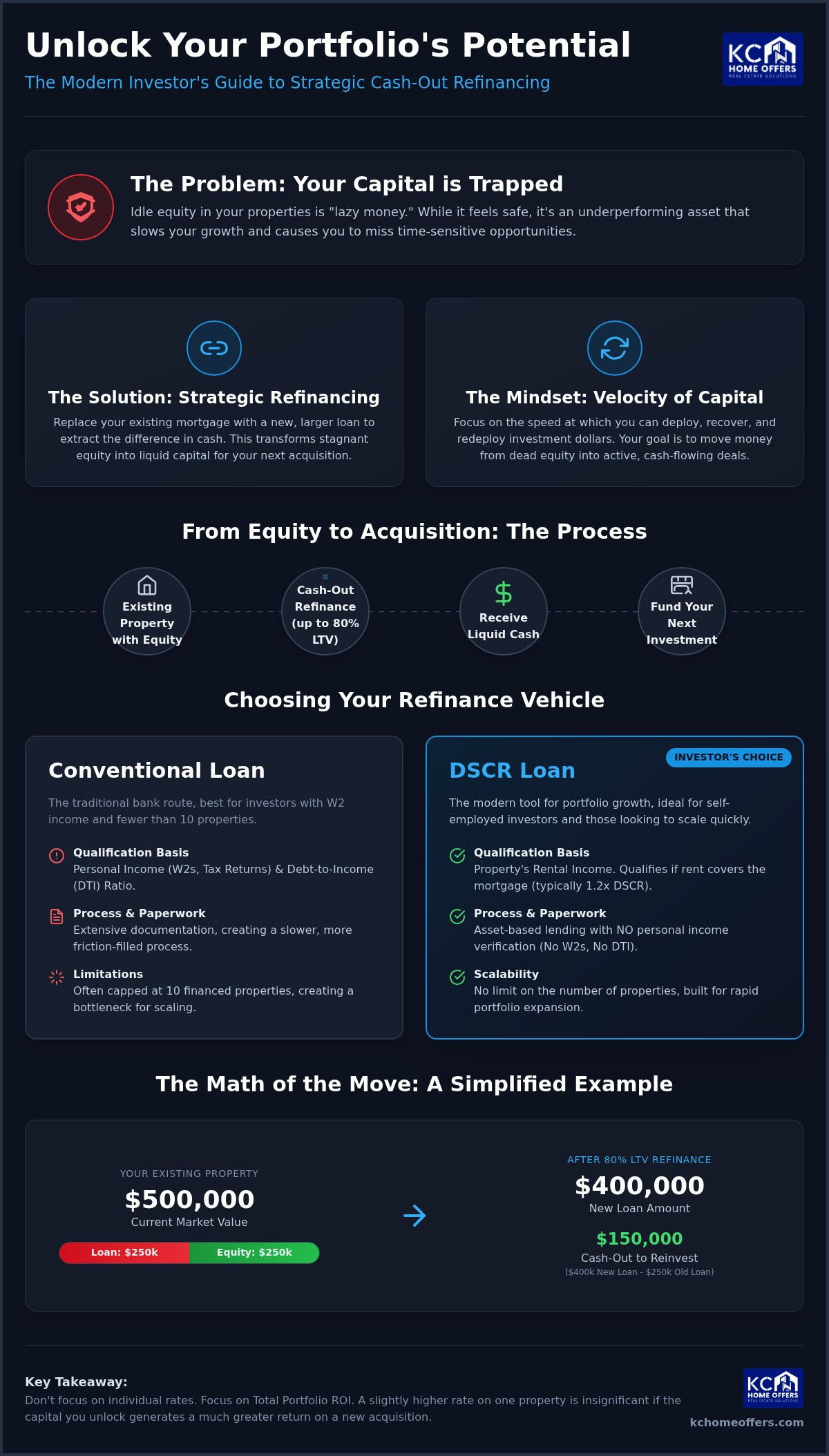
A cash out refinance investment property strategy is no longer just about lowering a monthly payment. In the current market, it’s a tool for strategic harvesting. This process involves replacing your existing mortgage with a new, larger loan and taking the difference in cash. While traditional owners view equity as a safety net, high-growth investors view it as fuel. In 2026, having liquid capital on hand is often more valuable than holding a low interest rate on a single, stagnant asset. If you have $200,000 in equity that isn’t being used, that money is effectively “lazy” and underperforming.
Successful scaling relies on the Velocity of Capital. This is the speed at which you can deploy, recover, and redeploy your investment dollars. By pulling equity out of a stabilized property, you can fund a down payment on a new DSCR loan or a fix-and-flip project. This movement keeps your portfolio in a state of constant expansion. You aren’t just owning real estate; you’re managing a fund where every dollar must earn its keep. The goal is to move money out of dead equity and into active, cash-flowing deals.
The Opportunity Cost of Trapped Equity
Many investors fall into the trap of over-leveraging their safety. If you own 50% of a property, your Return on Equity (ROE) is significantly lower than it would be if you were leveraged at 75% or 80%. ROE measures how hard your actual equity is working for you. When equity sits trapped, it slows your ability to jump on time-sensitive deals. In 2026, off-market opportunities move fast. Waiting for “perfect” rates can cost you a deal with a 20% equity margin, making the small difference in refinance interest rates irrelevant in the grand scheme of your total portfolio ROI.
Cash-Out Refi vs. HELOC for Rental Properties
Choosing between a fixed-rate refinance and a HELOC depends on your risk tolerance and hold period. For most rental properties, a cash-out refinance is the safer play because it locks in a fixed rate. This protects your cash flow from the volatility of variable interest rates that often plague HELOCs. While a HELOC offers flexibility, it can quickly become a liability if rates spike and eat into your monthly net income.
- Predictability: Refinances offer stable, amortizing payments that don’t change with market whims.
- Long-term Strategy: If you plan to hold for five years or more, the fixed debt of a refinance is superior for budgeting.
- Cash Flow Protection: Fixed payments ensure your DSCR remains healthy even if the broader market shifts.
If your exit strategy involves holding the asset for several years, the fixed-rate nature of a refinance is almost always the superior choice for professional portfolio management.
Conventional vs. DSCR: Choosing the Right Refinance Vehicle
The path you choose for your cash out refinance investment property determines how quickly you can pivot to your next deal. While many investors default to their local bank, traditional lending isn’t always built for scale. Traditional banks view you as a consumer, scrutinizing your personal debt to income ratio (DTI) and tax returns. Private investor lenders view you as a business partner, focusing primarily on the performance of the asset. This fundamental difference in philosophy creates two distinct paths for your capital strategy.
Active investors often find that conventional financing becomes a bottleneck once they own more than a handful of properties. Traditional lenders typically hit a hard ceiling at 10 financed properties, and their appetite for risk decreases with each new acquisition. If you’re looking for speed and the ability to close on off-market deals without a mountain of paperwork, asset-based lending offers the flexibility that corporate banking lacks.
The DSCR Advantage for Active Investors
Debt Service Coverage Ratio (DSCR) loans have become the primary engine for portfolio growth in 2026. These loans bypass the need for personal income verification, qualifying the deal based on the property’s ability to cover its own debt. This is why real estate investment loans with no W2 requirements are essential for self-employed investors or those with complex tax structures. In most cases, lenders look for a DSCR of 1.2x to offer the most competitive terms, meaning the property’s gross rent should be 120% of the total mortgage payment. While some programs allow for a 1.0 ratio, hitting that 1.2x mark often unlocks higher LTVs and better interest rates.
Conventional Refinance: Lower Rates, More Red Tape
Conventional loans through Fannie Mae or Freddie Mac often offer lower interest rates, but they come with significant friction. In 2026, these entities have maintained strict reserve requirements, often demanding that investors have 6 to 12 months of principal, interest, taxes, and insurance (PITI) for every property they own. Additionally, the 6-month seasoning rule is a major hurdle. If you’ve recently forced appreciation through a renovation, you’ll likely have to wait half a year before a conventional lender lets you pull cash out based on the new appraised value.
- Documentation: Conventional requires full tax returns; DSCR requires a lease agreement and an appraisal.
- Scaling: Conventional caps out at 10 properties; DSCR has no aggregate limit for most professional lenders.
- Approval Speed: DSCR loans typically close in weeks, while conventional bank approvals can drag into months.
If you’re ready to bypass the bank’s red tape and see what your property’s cash flow can actually do, you can explore specialized DSCR options that prioritize your growth over your tax returns.
The Math of a Move: Is a Cash-Out Refi Strategically Sound?
Deciding to execute a cash out refinance investment property move requires a shift in perspective. Most investors get stuck comparing the interest rate on their current loan to the new rate. This is a narrow view. Instead, you must calculate your Total Portfolio ROI. If you pull $100,000 out of Property A at a higher rate to buy Property B that returns 15% cash-on-cash, your blended return has actually increased. The higher interest expense on the first asset is simply the cost of capital for the second acquisition. By treating a cash out refinance investment property as a strategic capital move rather than a simple loan, you unlock the ability to scale without depleting your personal savings.
Debt yield is a critical metric for 2026 lenders, representing the net operating income divided by the loan amount to measure the property’s ability to pay back the debt regardless of interest rates.
The ‘New Deal’ Offset: Calculating Your Spread
When you harvest equity, you’re looking for a spread between the cost of the capital and the yield of the new asset. If your refinance costs you an extra $400 per month in interest, but the proceeds allow you to acquire off market real estate deals that cash flow $1,200 per month, you’ve created a net gain of $800. You also have to factor in the one-time friction of closing costs, which typically range from 2% to 5% of the new loan amount. Amortize these costs over the life of the investment to see the true impact on your margins and long-term wealth building.
Tax Implications of Cashing Out
One of the most powerful aspects of this strategy is that cash-out proceeds aren’t considered taxable income. You’re simply borrowing against an asset you already own. However, the IRS is specific about how you use that money. To maintain the deductibility of the interest, you must follow “interest tracing” rules. This means you should document that the funds were used specifically for business or investment purposes rather than personal expenses.
As of August 2026, interest expense deduction caps remain a factor for larger portfolios. Always consult with a CPA to ensure your new debt structure aligns with current IRS compliance. By keeping your business and personal accounts strictly separated, you make the audit trail clear and protect your bottom line. Transparency in your accounting is just as vital as transparency in your lending terms.
Qualification Standards for Investment Property Cash-Outs
Qualifying for a cash out refinance investment property depends on a few non-negotiable benchmarks. In 2026, a credit score of 660 is the baseline for most DSCR programs, though hitting 720 or higher often unlocks the most aggressive rates. Loan-to-Value (LTV) ratios typically cap at 75% for single-unit properties, though strong applicants can push to 80% with certain private lenders. If you’re working with 2-4 unit assets, expect a slightly more conservative 70% LTV limit. These caps ensure the property maintains a healthy equity cushion while providing you the liquidity needed to scale.
Seasoning requirements are another critical hurdle. Most lenders require you to own the property for at least 3 to 6 months before you can refinance based on a new appraised value. If you try to pull cash out earlier, you’re usually restricted to a percentage of your original purchase price plus documented renovation costs. This makes timing your exit strategy essential for maximizing your capital harvest. You don’t want to be stuck with a valuation based on what you paid last month when the property is worth significantly more today.
Property Condition and Appraisal Prep
The appraisal is the gatekeeper of your equity. Lenders require a Form 1007 rent schedule to verify that the market rent supports your debt coverage. Minor cosmetic upgrades like fresh paint or updated fixtures can significantly bump your valuation, providing a larger cash-out amount. Conversely, deferred maintenance is a deal-killer. Issues like roof leaks or outdated electrical systems can lead to an immediate loan denial or a “subject to repair” appraisal that freezes your funds until the work is finished.
Documentation Needed for DSCR Refinancing
Efficiency is the hallmark of a professional investor. While you don’t need tax returns for DSCR loans, you do need a clean paper trail for the asset. This includes current lease agreements, a verified rent roll, and property management statements. You should also ensure your insurance coverage meets the lender’s 2026 replacement cost requirements. Organization is key when you’re managing financing for multiple rental properties. Keeping these documents in a dedicated investor binder allows you to move at the speed of the market.
If you’re ready to see how much equity you can unlock from your portfolio, apply for a DSCR cash-out refinance today and get a decision based on your property’s performance rather than your personal income.
Executing the Refi: From Application to New Acquisition
Executing a cash out refinance investment property plan requires a disciplined approach to timing and capital deployment. You’ve already done the math on your spread and prepped your property for the appraiser. Now, you need to move from the planning phase into active execution. The process begins with a clear-eyed valuation of your current holdings; you can’t harvest equity that you haven’t accurately measured. Once you know your position, you must select a lending partner who prioritizes your momentum over bureaucratic checklists. Traditional banks often get bogged down in personal income details, while investor-centric lenders focus on the asset’s performance.
After selecting a lender, you’ll lock in your rate and move into the appraisal phase. This is where your previous maintenance and rent schedule preparation pays off. Once the appraisal is finalized and the loan closes, the funds are yours to deploy. A successful cash out refinance investment property move isn’t truly finished until that capital is safely tucked into its next high-yield destination. Whether you are funding a new acquisition or using the cash as a reserve for a larger project, the goal is to minimize the time your capital sits idle.
Why Speed Matters in 2026 Acquisitions
In the 2026 market, speed is a currency of its own. Having cash in hand from your refinance allows you to waive financing contingencies, making your offer significantly more attractive to sellers. This liquidity is particularly powerful when pursuing fix and flip funding. When you can close in days rather than weeks, you often secure a lower purchase price, effectively baking in profit before you even begin renovations. The psychological advantage of being a cash buyer cannot be overstated; it gives you the leverage to dictate terms and win in competitive multi-offer situations.
Scaling Your Portfolio with KC Home Offers
Scaling your portfolio shouldn’t feel like a second full-time job. At KC Home Offers, we act as your strategic ally, providing transparent terms and fast approvals that traditional institutions simply can’t match. We understand the nuances of real estate investment loans because we’re active participants in the market. You won’t be shuffled through a corporate call center. Instead, you’ll have direct access to experts like Ashley and Aspen, who can help you structure deals that maximize your 2026 growth targets. We’re here to remove the friction from your financing so you can focus on finding your next high-yield project.
Take Command of Your Portfolio’s Growth
Scaling in the 2026 market requires more than just patience; it requires a proactive approach to liquidity. You’ve seen how a cash out refinance investment property can transform “lazy” equity into a high-octane engine for new deals. By prioritizing the velocity of capital and leveraging DSCR products, you bypass the traditional bank hurdles that stop most investors in their tracks. It’s about looking at the total ROI of your portfolio rather than getting stuck on a single loan’s interest rate. When you unlock your equity, you’re not just borrowing; you’re reinvesting in your future momentum.
When you’re ready to move, you need a partner who values speed as much as you do. KC Home Offers provides fast, investor-focused approvals with specialized DSCR and Fix & Flip products designed for the modern market. We offer transparent terms with no hidden bank fees, acting as a strategic ally in your growth. Unlock Your Equity and Scale Your Portfolio with KC Home Offers today. Your next big deal is waiting, and we’re here to help you fund it with the professional oversight you deserve. Let’s get your capital moving.
Frequently Asked Questions
Can I do a cash-out refinance on a rental property with no W2 income?
Yes, you can. By utilizing a DSCR loan, you qualify based on the property’s rental income rather than personal earnings or tax returns. This is a primary tool for self-employed investors looking to execute a cash out refinance investment property. As long as the asset generates sufficient revenue to cover the mortgage, your employment status or W2 history is secondary to the lender’s final decision.
What is the maximum LTV for a cash-out refinance on an investment property in 2026?
In 2026, the standard maximum LTV for a single-unit property is typically 75%. For multi-unit properties with 2 to 4 units, lenders generally cap the ratio at 70%. However, specialized DSCR programs may allow up to 80% for borrowers with high credit scores and strong property performance. These limits are designed to protect the lender’s interest while providing you with significant liquid capital to reinvest in your portfolio.
How long do I have to own an investment property before I can refinance it?
Most lenders require a seasoning period of 3 to 6 months before allowing a cash-out refinance based on the current appraised value. If you attempt to refinance earlier, the loan amount is often restricted to the original purchase price plus documented renovation costs. Waiting the full six months is generally the best path to ensure you can fully harvest the equity created by market appreciation or forced improvements.
Is the interest on a cash-out refinance tax-deductible for investors?
Yes, the interest is generally tax-deductible as a business expense, provided the funds are used for investment or business purposes. The IRS requires strict interest tracing to prove the capital was deployed into another asset or property improvement. You should avoid using these proceeds for personal expenses if you want to maintain the full deduction. Always verify specific 2026 deduction caps with a qualified CPA to stay compliant.
Do I need a minimum credit score for a DSCR cash-out loan?
Most DSCR programs require a minimum credit score of 660 to qualify for a cash out refinance investment property. While some niche lenders might consider lower scores, hitting the 720 mark typically unlocks the most competitive interest rates and higher LTV options. Your credit score serves as a measure of your reliability as a manager, even though the loan itself is primarily secured by the property’s underlying cash flow.
Can I use the cash from a refinance to buy another investment property?
Absolutely. This is the most common use of harvested equity for professional investors. By pulling cash out of a stabilized asset, you can fund the down payment on your next acquisition or finance a fix-and-flip project. This strategy increases your “Velocity of Capital,” allowing you to grow your portfolio much faster than you could by saving personal income for every individual down payment or renovation project.
How much are the typical closing costs for an investment property refinance?
You should budget between 2% and 5% of the new loan amount for closing costs. These fees include the appraisal, title insurance, origination points, and recording fees. For a $300,000 loan, this means your costs will likely fall between $6,000 and $15,000. Many investors choose to roll these costs into the new loan balance to minimize their immediate out-of-pocket expenses when closing the deal and deploying capital.
What happens if my property’s DSCR ratio is below 1.0?
A ratio below 1.0 means the property’s income doesn’t fully cover the debt service. While a standard minimum ratio is 1.0, some 2026 programs allow ratios as low as 0.75 on a case-by-case basis. In these scenarios, you’ll likely face lower LTV limits or higher interest rates. Lenders view these deals as higher risk because the property isn’t self-sustaining, requiring you to demonstrate stronger personal reserves to bridge the gap.
One thought on “Cash Out Refinance Investment Property: The 2026 Investor’s Guide to Scaling”