


What if the size of your W-2 was the least important factor in building a 20-unit portfolio? Most ambitious investors eventually hit a wall where traditional banks stop saying yes. Whether it’s the 10-property limit on conventional loans or a debt-to-income ratio that looks stretched on paper, these hurdles can stall your momentum. You’ve likely felt the frustration of a lengthy approval process that doesn’t account for the actual cash flow your assets generate. This is a common pain point when financing multiple rental properties, but it doesn’t have to be the end of your expansion.
We believe that scaling requires a different playbook than buying your first duplex. This guide provides a clear path for growing your portfolio by moving beyond restrictive personal income verification. You’ll learn how to leverage asset-based lending and fast-moving loan products designed specifically for aggressive growth. We’ll explore the mechanics of DSCR loans and portfolio strategies that allow you to keep acquiring properties long after the big banks have closed their doors. It’s time to stop acting like a consumer and start financing like a professional.
Key Takeaways
- Learn why shifting from personal income verification to asset-based lending is the essential first step for financing multiple rental properties at scale.
- Discover how DSCR loans eliminate the traditional “conventional wall” by focusing on property cash flow rather than your personal debt-to-income ratio.
- Master a streamlined 5-step process to organize your LLC and entity documents, positioning you as a professional borrower for faster approvals.
- Explore how to use Fix & Flip loans as a strategic engine to generate the equity needed for long-term, income-producing assets.
- Understand how to consolidate your portfolio using blanket mortgages to simplify management and unlock trapped equity for further acquisitions.
What is Financing Multiple Rental Properties?
Financing multiple rental properties is the strategic application of diverse loan products to acquire a portfolio of income-producing assets. It goes beyond the basics of real estate investing fundamentals, requiring a shift from consumer-grade debt to professional-grade capital. While your first few deals might rely on personal income and standard bank approvals, scaling requires leverage that compounds wealth without being throttled by your individual tax returns. You aren’t just buying houses; you’re building a business that requires a reliable fuel source.
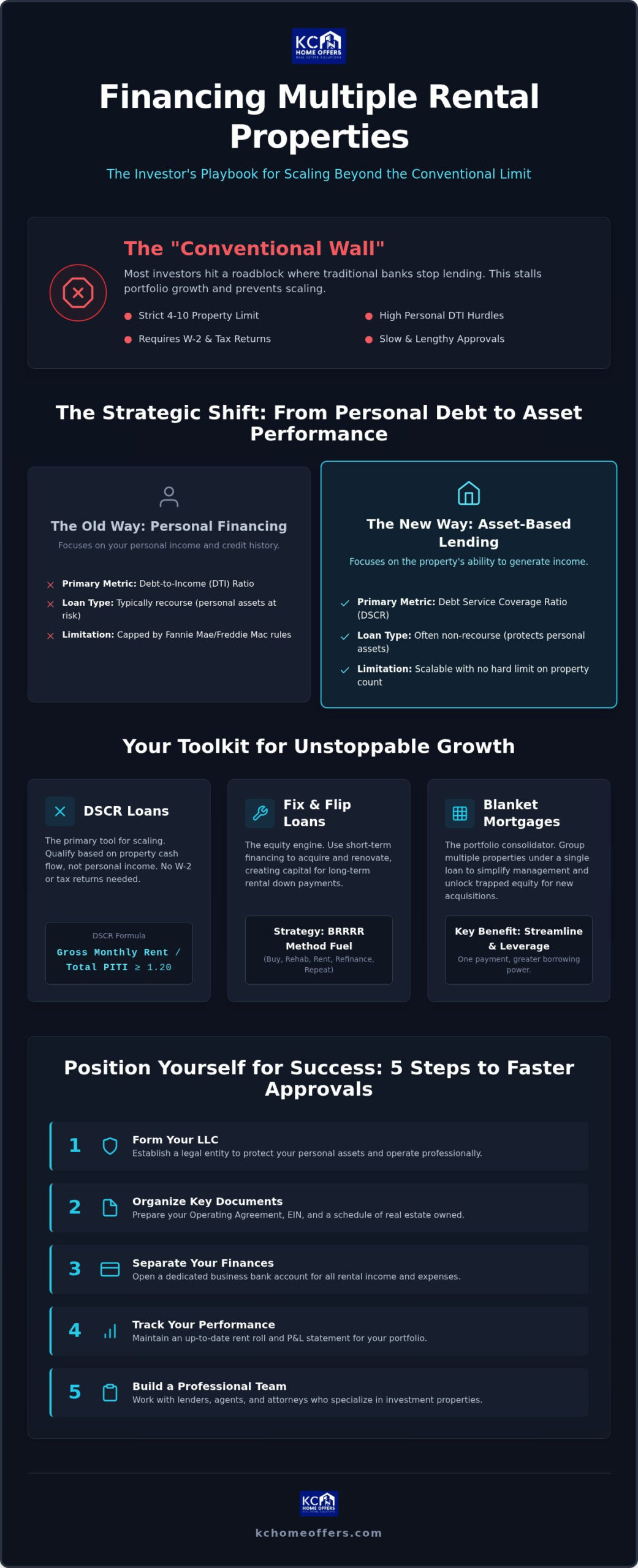
Most investors hit what we call the “Conventional Wall.” This usually happens after your fourth or tenth property when Fannie Mae and Freddie Mac guidelines become too restrictive. At this stage, traditional lenders focus heavily on your debt-to-income (DTI) ratio, viewing every new mortgage as a liability that increases your personal risk. To keep growing, you have to pivot to the Debt Service Coverage Ratio (DSCR). This shift is the secret to financing multiple rental properties successfully because it focuses on the property’s ability to pay for itself rather than your personal paycheck.
The Difference Between Personal and Commercial Financing
Traditional banks view a growing portfolio as a high-risk exposure. They look at your personal credit and existing debt load with skepticism, often ignoring the cash flow your rentals produce. Investment-focused lenders take the opposite approach. They see rental income as a primary strength and an indicator of a healthy, scalable business.
This transition often involves moving from recourse debt to non-recourse options. In a recourse loan, the bank can come after your personal assets if a deal goes south. Non-recourse debt, common in the commercial and investment world, generally limits the lender’s recovery to the property itself. This protects your personal credit and financial standing as your portfolio expands into the double digits.
Why Scaling Requires a New Lending Strategy
Scaling isn’t just about finding deals; it’s about finding the right financial engine. Fannie Mae guidelines are built for homeowners, not professional portfolio builders. Even if you have perfect credit, local banks often have concentration limits. These internal rules prevent them from lending too much to a single borrower or within a specific neighborhood.
Asset-based lending serves as the scaling engine for the modern investor. By focusing on the performance of the asset, you can bypass the limits that stop 90% of investors from reaching their goals. This strategy prioritizes speed and transparency, allowing you to move as fast as the market demands without waiting months for a traditional bank’s committee to review your personal tax returns.
Top Loan Options for Financing Multiple Investment Properties
Breaking through the 10-property limit requires a shift away from standard government-backed products. Most traditional banks stop lending once you hit a certain threshold because they view your growing portfolio as a concentrated risk. To maintain momentum, you need access to specialized products that prioritize the income potential of the real estate over your personal debt-to-income ratio. Choosing the right loan product is the difference between a stalled portfolio and a scalable business. While many beginners look at Creative Rental Property Financing like partnerships or seller financing, professional investors typically rely on a core set of institutional products to drive growth.
DSCR Loans: Scaling Without a W2
The Debt Service Coverage Ratio (DSCR) loan is the primary tool for financing multiple rental properties in 2026. Unlike conventional mortgages that require stacks of tax returns and pay stubs, a DSCR loan qualifies you based on the cash flow of the property itself. The calculation is straightforward: the lender divides the gross monthly rent by the total monthly payment, including principal, interest, taxes, insurance, and any association dues (PITI).
If the ratio is 1.0 or higher, the property “covers” its own debt. Lenders in 2026 typically look for a 1.20 ratio to offer the most competitive terms, though some programs allow for lower ratios if the borrower has significant experience. This product is a game changer for investors who have hit their conventional limit or for those who are self-employed and show lower taxable income. If you are ready to move past personal income caps, you should explore a DSCR loan for rental property to keep your acquisition pipeline moving.
Blanket Loans and Cross-Collateralization
A blanket mortgage allows you to consolidate several properties into a single loan. This is an efficient way to manage a 5+ property portfolio because it reduces the administrative burden of multiple monthly payments and separate escrow accounts. It also allows for cross-collateralization, where the equity in one property can help secure the purchase of another.
The key feature to look for in a blanket loan is the “release clause.” This provision allows you to sell or refinance a single property out of the group without having to pay off the entire blanket loan. This flexibility is vital for portfolio optimization. Professional lenders usually require a 20% to 30% down payment for these products, but the ability to unlock equity across several assets often outweighs the higher entry cost.
Portfolio Loans and Hard Money
Portfolio loans are kept “in-house” by the lender rather than being sold to Fannie Mae. Because the lender sets their own rules, these loans offer more flexibility on credit scores and property types. They are often the best choice for unique properties that don’t fit standard molds. For the “buy” and “rehab” phases, hard money remains a staple. These short-term loans provide the speed needed to win deals in competitive markets. Once the property is renovated and tenanted, you can refinance into long-term debt. If you need a partner who understands this lifecycle, you can view our specialized loan options to find a fit for your next deal.
How to Secure Financing for Your Next Rental: A 5-Step Process
Scaling a portfolio requires a repeatable system that removes the friction of traditional bank approvals. When financing multiple rental properties, you must shift your focus from your personal financial history to the performance of the asset. This transition allows you to move with the speed and efficiency required in the 2026 market. Professional investors don’t wait for a committee to review their tax returns; they command the process by preparing the data lenders actually want to see.
Step 1: Property Analysis and Rent Verification
The success of your loan application depends on the property’s ability to generate income. Lenders rely on the 1007 appraisal form, which provides an official market rent schedule. It’s vital to distinguish between “as-is” rent and “pro-forma” rent. While you might see potential for higher earnings after a renovation, most asset-based lenders qualify the deal based on the current market reality.
Targeting a 1.2x DSCR benchmark is the most effective way to secure favorable interest rates. This means the property’s net operating income should be 20% higher than the mortgage payment. If you’re utilizing real estate investment loans no W2, this ratio becomes the primary driver of your approval. Accurate rent verification ensures your numbers align with the appraiser’s findings, preventing last-minute funding gaps.
Step 2: Building Your Investor Identity
Professional borrowing starts with a clear legal structure. Closing in an LLC is standard practice for investors scaling beyond their first few units. It provides a layer of liability protection and signals to lenders that you are a business operator rather than a consumer. A clean Schedule of Real Estate Owned (SREO) acts as your professional resume. This document should detail every property you own, its current value, mortgage balance, and monthly cash flow.
Asset-based lenders use the SREO to gauge your competence and experience. Along with your entity documents, you’ll need to provide proof of liquidity for the down payment and required reserves. Most professional programs look for 3 to 6 months of cash reserves to cover debt service. Having these documents organized in a digital vault allows you to execute on new opportunities the moment they appear.
Step 3: Execution and Partnership
Once your identity and property data are ready, the final steps involve calculating your estimated DSCR and selecting a strategic ally. You should run your own numbers before the lender does to ensure the deal meets the 1.2x threshold. Finally, partner with a lender who specializes in investment finance. A specialized partner understands the nuances of the rental market and can move from application to closing in a fraction of the time required by a traditional bank. This momentum is what allows you to outpace the competition and grow your holdings without limits.
Common Challenges and How to Overcome Them
Expanding a portfolio brings unique friction points that don’t exist when you own just one or two units. When financing multiple rental properties, you’ll likely encounter high debt-to-income (DTI) ratios and the 10-property cap imposed by traditional lenders. These aren’t dead ends; they’re signals to upgrade your financial toolkit. Switching to DSCR lending solves the DTI issue by focusing on asset performance rather than your personal paycheck. If you lack cash reserves for the next down payment, a cash out refinance investment property strategy on an existing property with high equity can provide the necessary liquidity to keep your momentum.
Slow bank approvals are another common growth killer. Traditional committees can take 45 to 60 days to close a deal, causing you to lose out on competitive properties. Utilizing private money or hard money lenders allows you to close in days rather than months. Once the asset is stabilized and tenanted, you can transition into long-term debt. This speed is essential for investors who value time as much as their capital.
The Truth About Interest Rates and Cash Flow
Many investors stall their growth because they’re waiting for “perfect” interest rates. In August 2026, conventional investment rates are hovering between 7.2% and 7.7%. While asset-based loans might carry a slightly higher rate, the ability to scale infinitely often outweighs the extra interest cost. You should calculate the ROI of the “Opportunity Cost” of waiting. If a deal generates $500 in monthly cash flow, waiting six months for a slightly lower rate costs you $3,000 in lost income. Interest-only options are another powerful tool to maximize monthly cash flow during the early years of an acquisition.
Managing the Risk of Multiple Mortgages
Managing a dozen mortgages requires disciplined risk mitigation. Lenders typically require 3 to 6 months of PITIA (Principal, Interest, Taxes, Insurance, and Association dues) reserves for each property. This cash cushion ensures you can handle vacancies or unexpected repairs without stressing the rest of the portfolio. It’s also wise to ladder your debt maturities. If you have multiple loans with balloon payments or reset dates, ensure they don’t all occur in the same year. This spreads your refinancing risk over a longer period and protects your cash flow.
For short-term capital needs or quick renovations, understanding how do hard money loans work is essential for bridging the gap between purchase and long-term financing. If you’re ready to bypass the traditional hurdles and scale your portfolio today, apply for an investor loan with our team for a fast, transparent approval.
Strategic Growth with Professional Investment Financing
Scaling a portfolio to double digits requires more than just finding good deals; it requires sophisticated financial machinery. Professional financing multiple rental properties is a transition from being a hobbyist to becoming a portfolio manager. In 2026, where institutional investors are aggressively competing for single-family rentals, your ability to close quickly and predictably is your greatest competitive advantage. A long-term partnership with a specialized lender ensures that your capital is always working, allowing you to move from one acquisition to the next without the typical bank-induced delays.
One of the most effective ways to accelerate growth is through the synergy of different loan products. Many successful investors use a Fix & Flip loan to acquire distressed assets and force equity through renovation. Once the property is stabilized, they transition into a long-term DSCR loan. This strategy allows you to “create” the down payment for your next acquisition by capturing the value you built during the rehab phase. It’s a high-momentum approach that turns equity into a scalable engine for wealth creation rather than relying solely on your own cash reserves. Pairing this with a strategic cash out refinance on your investment property can further accelerate your acquisition pipeline by unlocking up to 80% LTV without personal income verification.
Transitioning from One Property to Ten
Moving from a few rentals to a ten-unit portfolio requires a repeatable financing blueprint. At this scale, maintenance costs on older properties can begin to erode your cash flow. This is why many professional investors are turning to new construction financing. Building ground-up allows you to acquire assets with zero deferred maintenance and modern amenities that command higher rents. By integrating new builds into your portfolio, you diversify your risk and lower your long-term operating expenses.
A repeatable blueprint also involves standardizing your entity structures and financial reporting. When your lender knows exactly how you present your SREO and your LLC documents, the approval process moves even faster. Speed and transparency become more valuable than a few basis points on an interest rate because they allow you to secure the best deals before your competition can even get a pre-approval letter. Professional lending is about reliability and the removal of friction. Pairing fast financing with a strong pipeline of off market real estate deals gives you a decisive edge over investors who rely solely on the public MLS.
Why KC Home Offers is the Strategic Ally for Investors
We don’t just provide capital; we provide the momentum needed to scale. KC Home Offers was built by investors who understand the frustration of traditional banking friction. Our focus is on removing the hurdles that stop growth, such as W-2 requirements and personal income caps. We offer tailored loan products like DSCR, Fix & Flip, and New Construction loans that are designed to meet the practical realities of the 2026 market.
Our process is built for transparency and speed. We value your time as much as you do, providing fast approvals that let you stay aggressive in your acquisition strategy. Whether you’re looking to buy your fifth property or your fiftieth, you need a partner who acts as a strategic ally rather than a roadblock. If you’re ready to stop fighting the “Conventional Wall” and start building real wealth, apply for a loan with KC Home Offers today and get your portfolio moving.
Master Your Portfolio Growth Beyond Traditional Limits
Building a significant real estate portfolio requires a mental and operational shift away from consumer-grade banking. You’ve seen how the path to financing multiple rental properties depends on prioritizing asset performance through DSCR loans rather than relying on personal tax returns. By leveraging professional products like Fix & Flip and New Construction loans, you can build equity and scale with a speed that traditional banks simply cannot match. The 2026 market rewards investors who value momentum and transparency over the slow, friction-heavy processes of the past.
At KC Home Offers, we act as your strategic ally by providing fast, transparent approvals without the need for personal income verification. Our expertise in multi-property scaling ensures you have the capital required to outpace institutional competition. Don’t let a 10-property cap or a DTI ratio stall your progress. Scale your portfolio today with KC Home Offers and take control of your financial future. The opportunities in today’s market are yours for the taking when you have the right financial engine behind you.
Frequently Asked Questions
How many rental properties can I finance at once?
Traditional conventional loans have a hard cap of 10 properties. However, when financing multiple rental properties through asset-based financing, there is no technical limit. Professional lenders focus on the cash flow of each individual property rather than your total number of mortgages. This allows you to scale indefinitely by utilizing DSCR or portfolio loan products that treat your real estate holdings as a business enterprise. You can keep buying as long as the numbers work.
Do I need a W2 job to finance multiple rental properties?
No, a W2 job isn’t required for financing multiple rental properties when you utilize asset-based lending. While traditional banks demand pay stubs and tax returns, specialized products like DSCR loans qualify you based on the property’s rental income. This is a massive advantage for self-employed investors or those looking to replace their active income with passive cash flow. Your personal income becomes irrelevant if the asset’s debt service coverage ratio meets the lender’s standards.
What is the minimum down payment for a second or third investment property?
You should expect to put down between 15% and 25% for subsequent investment properties. While some portfolio programs allow for 15% down, most DSCR and commercial lenders in 2026 require a 20% to 25% equity stake to secure the best rates. This higher down payment protects the lender against market volatility and ensures the property maintains a healthy debt service coverage ratio from day one. It also keeps your monthly payments manageable and your equity position strong.
Can I use a single loan to cover multiple rental properties?
Yes, this is known as a blanket mortgage or a portfolio loan. It allows you to cross-collateralize several assets under one deed of trust. This strategy simplifies your monthly management by consolidating multiple payments into one. It also enables you to unlock equity across the entire group to fund new acquisitions. Just ensure the loan includes a release clause so you can sell individual properties without paying off the entire balance. It’s a powerful tool for portfolio optimization.
What credit score is needed for a DSCR loan in 2026?
Most lenders look for a minimum credit score of 640 for DSCR products. However, to access the most competitive interest rates and high LTV options, a score of 740 or higher is typically required. While the property’s cash flow is the primary underwriting factor, your credit score serves as a proxy for your reliability as a borrower. Some specialized programs may go as low as 620 with additional reserves or experience. Maintaining a high score remains a priority for scaling.
How does owning multiple rentals affect my debt-to-income ratio?
In traditional lending, owning several properties often negatively impacts your DTI because banks count the full mortgage payment as a liability but only a fraction of the rent as income. This creates the “conventional wall” that stops many investors. By switching to asset-based lending, the DTI ratio is bypassed entirely. The lender cares about the property’s specific cash flow, meaning your personal debt load won’t stop you from acquiring your next asset. This allows for much faster portfolio expansion.
What are the reserve requirements for financing multiple properties?
Lenders typically require 3 to 6 months of PITIA reserves for every property in your portfolio. These funds must be liquid, such as cash in a bank account or a brokerage account. Having these reserves ensures you can cover vacancies or major repairs without defaulting on your debt service. As your portfolio grows, some lenders may allow you to aggregate these reserves or use a percentage of your total outstanding debt instead. Proper liquidity is the foundation of a safe scaling strategy.
Is it better to use a local bank or a specialized investment lender?
Local banks are great for your first few deals, but they often have low concentration limits that halt your growth. A specialized investment lender is usually the better choice for scaling because they offer products like DSCR and Fix & Flip loans that aren’t available at retail branches. These lenders move faster, understand the nuances of the rental market, and view you as a strategic partner rather than just a consumer. Their efficiency helps you close more deals in less time. Sourcing properties through off market real estate deals further reduces competition and helps you secure better purchase prices that strengthen your DSCR from the start.
One thought on “How to Finance Multiple Rental Properties: The 2026 Investor’s Scaling Guide”