


Why are you letting a tax return from two years ago dictate your ability to buy a profitable property today? For many high-performing investors, the very tax write-offs that protect their wealth are the same ones that kill their borrowing power at a traditional bank. It’s a frustrating paradox where the more successful you become at managing your bottom line, the less a conventional lender wants to work with you. If you’ve been rejected due to rigid DTI ratios or a lack of traditional employment, it’s time to stop trying to fit a square peg into a round hole.
You deserve a financing partner that understands real estate is about cash flow and equity, not just a bi-weekly paycheck. This guide reveals how to secure real estate investment loans no W2 requirements by leveraging property performance and alternative asset verification. We’ll break down the 2026 lending environment, including DSCR options and the latest FinCEN reporting rules, so you can move with speed and confidence. You’ll learn how to decouple your personal income from your investment potential and finally scale your portfolio without the friction of outdated banking standards. It’s time to focus on the deal’s merit rather than your personal tax history.
Key Takeaways
- Learn why traditional debt-to-income ratios often penalize successful investors and how to bypass these limitations using asset-based strategies.
- Master the mechanics of DSCR loans to secure financing based on a property’s cash flow rather than your personal employment history.
- Compare various real estate investment loans no W2 requirements to determine which product aligns with your specific portfolio growth goals.
- Review the 2026 requirements for credit scores and liquid reserves to ensure your application moves through the approval process without friction.
- Discover how a partnership with specialized lenders can provide the speed and transparency needed to close deals in a competitive market.
Why Traditional W-2 Requirements Penalize Successful Real Estate Investors
Traditional banking operates on a playbook designed for the 9-to-5 workforce. These institutions prioritize stability through predictable W-2 income and long-term employment history. For an active investor, this creates a massive hurdle. You might possess a million-dollar portfolio, but if your taxable income appears low due to aggressive growth strategies, a retail bank sees you as a risk. This misalignment is why real estate investment loans no W2 requirements have become the essential tool for scaling in the 2026 market.
The Conflict Between Tax Efficiency and Debt-to-Income
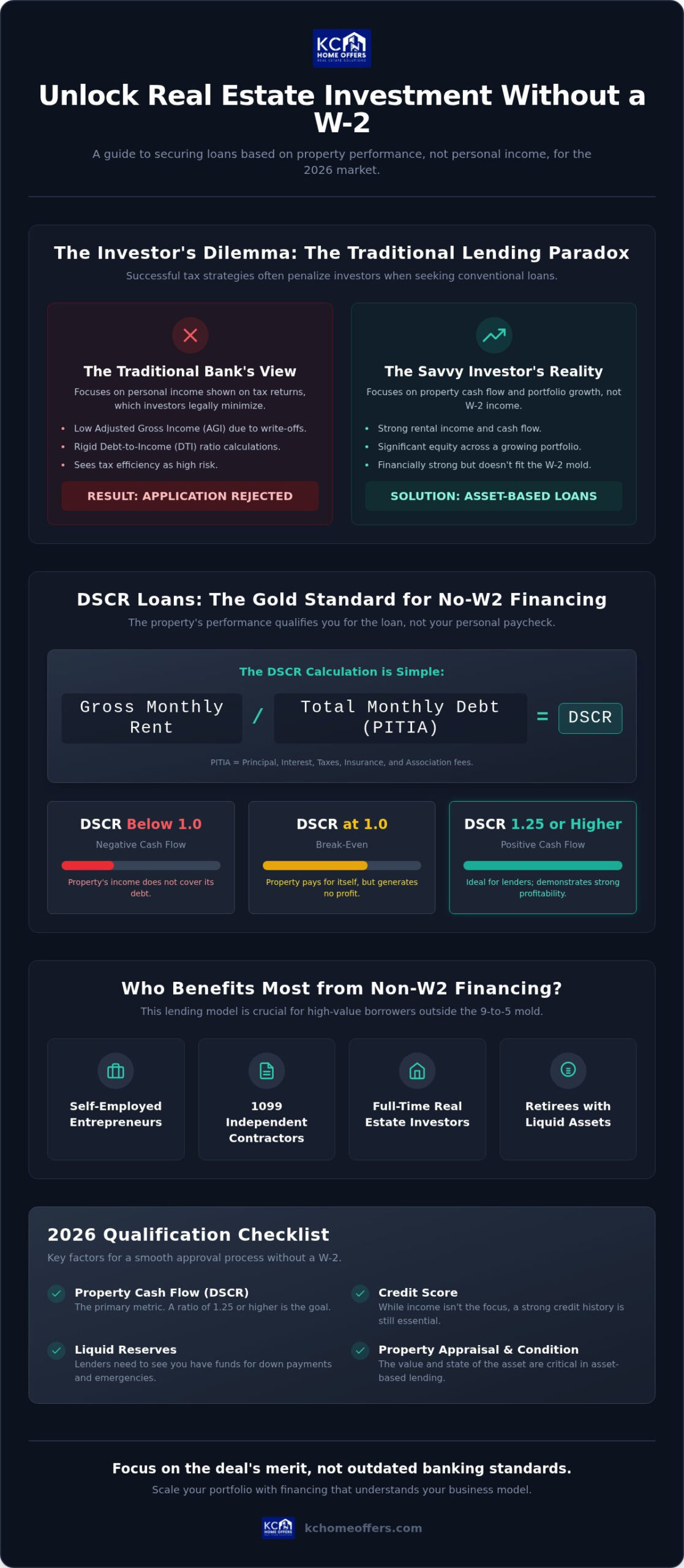
The “Tax Strategy Paradox” is a reality for most professionals. You use depreciation, interest write-offs, and legitimate business expenses to lower your Adjusted Gross Income (AGI). It’s smart business, and it protects your capital. However, traditional lenders use that AGI to calculate your Debt-to-Income (DTI) ratio. If your tax return shows a net loss or minimal profit after deductions, your borrowing power vanishes. These lenders ignore the fact that depreciation is a non-cash expense. They fail to recognize that your Debt-Service Coverage Ratio (DSCR) might actually be very strong. Non-qualified mortgages eliminate this barrier by allowing you to qualify based on the cash flow of the asset rather than the bottom line of your tax return.
Who Benefits Most from Non-W2 Financing?
The shift toward asset-based lending isn’t just about convenience; it’s about survival for specific groups of high-value borrowers who don’t fit the standard mold. The following investors often find that traditional financing is a dead end:
- Self-employed entrepreneurs who reinvest every available dollar back into their companies to spark growth.
- 1099 independent contractors with fluctuating monthly deposits that often scare off conservative bank underwriters.
- Full-time real estate investors who have successfully replaced their “traditional” jobs with rental income and no longer receive a standard paycheck.
- Retirees who possess significant liquid assets and equity but lack the active monthly salary required by conventional standards.
In the 2026 market, the rise of non-Qualified Mortgages (non-QM) reflects a broader understanding that wealth isn’t always reflected on a W-2. By moving the focus from your personal history to the asset’s performance, you unlock the ability to acquire multiple properties simultaneously. This decoupling of personal income from property potential is the only way to build a truly scalable enterprise. Utilizing real estate investment loans no W2 options allows you to act on opportunities as they arise, ensuring your momentum isn’t throttled by a loan officer who doesn’t understand your business model.
DSCR Loans: The Gold Standard for Financing Without Personal Income
DSCR loans represent a fundamental shift in how sophisticated investors approach debt. While traditional lenders obsess over your personal pay stubs, a Debt Service Coverage Ratio lender cares about one thing: the property’s ability to pay for itself. This focus makes them the premier choice for real estate investment loans no W2 requirements. By prioritizing the asset’s performance, you remove the personal income caps that typically throttle portfolio growth. It’s clean, efficient, and built for the speed of the 2026 market.
How the Debt Service Coverage Ratio Works
The calculation for a DSCR loan is straightforward. Lenders take the gross monthly rent and divide it by the PITIA, which stands for principal, interest, taxes, insurance, and any association fees. If the resulting number is 1.0, the property breaks even. Most lenders prefer a ratio between 1.25 and 1.50, meaning the property generates 25% to 50% more income than its debt obligations. For investors with significant equity or high-value assets, some programs even offer “no-ratio” options that waive this requirement entirely. This flexibility is common in Commercial Real Estate Loans and specialized investor products where the deal’s intrinsic value outweighs the borrower’s monthly salary.
Decoupling Personal Credit from Property Performance
In this lending model, the property essentially becomes the primary borrower. The approval process relies heavily on an appraisal that includes a 1007 Rent Schedule. This document provides an independent expert’s estimate of fair market rent for the specific unit. If the market rent supports the mortgage payment, the loan is viable. This process skips the intrusive audits of your personal tax history, leading to significantly faster closing times. Because your personal debt-to-income ratio isn’t part of the equation, you can achieve what we call “infinite scaling.” You aren’t limited by how much you earn at a day job; you’re only limited by how many profitable deals you can find.
Moving away from traditional documentation allows you to act on opportunities that others might miss while they wait for a bank’s underwriting team to verify three years of 1099s. If you want to dive deeper into the mechanics of these products, check out our guide on DSCR loans for rental property. This strategic shift from personal income to asset performance is the most reliable way to build a legacy portfolio without the friction of conventional banking. It’s about letting the numbers on the property speak for themselves, ensuring your momentum stays high as you scale your ventures.
Comparing No-W2 Loan Options: Bank Statements vs. Asset-Based Lending
While DSCR loans prioritize the property’s cash flow, other real estate investment loans no W2 requirements focus on your broader financial liquidity or the immediate equity in a deal. Choosing the right product depends on your specific exit strategy. If you are holding long-term, cash flow is king. If you are renovating for a quick profit, speed and leverage take precedence. Understanding the nuance between these capital sources ensures you don’t overpay for the flexibility you need.
Bank Statement Loans for 1099 and Self-Employed Investors
Bank statement loans are a powerful bridge for business owners who show high revenue but utilize aggressive tax deductions. Instead of looking at your tax returns, lenders analyze 12 to 24 months of deposits to determine your “true” income. This is particularly effective for 1099 contractors and entrepreneurs whose business health is evident in their monthly cash flow rather than their Adjusted Gross Income. Lenders typically apply a standard expense ratio to your gross receipts, often around 50% for business accounts, to arrive at a qualifying income figure. This method provides a much more accurate representation of your ability to service debt compared to traditional conventional investment loans that are tethered to outdated W-2 standards.
Hard Money and Fix-and-Flip Loans for Short-Term Projects
When you are targeting a distressed asset, your W-2 is practically irrelevant. Speed is the primary currency in the “Fix and Flip” or “BRRRR” world. Hard money lenders focus almost entirely on the property’s current value and its After Repair Value (ARV). Utilizing specialized fix and flip funding allows you to secure capital in days rather than months. These asset-based loans often cover a significant portion of both the purchase price and the renovation costs, provided the equity cushion is sufficient. Once the project is stabilized and rented, many investors then transition these short-term notes into long-term DSCR financing to pull their initial capital back out.
Another niche but effective strategy is asset depletion. This allows you to convert liquid reserves, such as large brokerage accounts or cash holdings, into a theoretical “monthly income” stream. Lenders divide your total qualifying assets by a set period, often 36 to 84 months, to create a qualifying income figure for the loan. Across all these products, expect Loan-to-Value (LTV) ratios to vary. Bank statement loans often allow for 80% to 90% LTV, while hard money typically sits between 70% and 80% of the ARV. This variety of real estate investment loans no W2 options ensures that whether you are a high-net-worth retiree or a high-growth flipper, there is a path to funding that respects your operational reality. Investors focused on financing multiple rental properties will find that combining these products strategically is the most effective way to grow beyond the limitations of conventional lending.
Qualifying for Investment Loans Without a W-2: A 2026 Requirements Checklist
Transitioning from a denied W-2 application to a successful asset-based approval requires a shift in how you present your financial health. When you remove the standard paycheck from the equation, lenders look for other indicators of stability and character. In the 2026 lending environment, your credit score and liquid reserves become the primary proxies for risk. Most specialized programs for real estate investment loans no W2 requirements look for a minimum credit score between 620 and 680, with the most competitive terms reserved for those above 720.
Beyond credit, lenders want to see that you can handle unexpected vacancies or repairs. This is measured through liquidity and reserves. You should expect to show three to six months of the property’s housing payment (PITIA) in liquid assets after the down payment is made. Additionally, most no-W2 lenders require you to close the loan under a legal entity, such as an LLC or Corporation. This structure aligns with the business-purpose nature of these loans. Be aware that as of March 1, 2026, the FinCEN reporting rule requires a “Real Estate Report” for non-traditionally financed transfers to legal entities, so ensuring your entity is properly registered and transparent is more important than ever.
Documentation Requirements for Non-QM Borrowers
While you won’t need tax returns or pay stubs, you still need to prove the deal makes sense. Underwriters replace the W-2 with a clean Profit and Loss (P&L) statement if you are self-employed, or simple bank records that show consistent cash flow. For a rental property, the Rent Roll and existing lease agreements are the most critical documents you will provide. If the property is currently vacant, the lender relies on the appraiser’s market rent estimate. In cases where your financial situation is unique, a brief, professional “Letter of Explanation” can often bridge the gap, providing context that a raw spreadsheet cannot.
The Role of Equity and Down Payments
In asset-based lending, equity is the ultimate stabilizer. Because the lender is taking on more risk by not verifying your personal income, they typically require a larger down payment, usually ranging from 20% to 25%. This “skin in the game” protects the lender if the market shifts. If you find a high-potential deal but lack the immediate cash for a full 25% down payment, you might consider a hard money loan to bridge the gap. These short-term, high-leverage options allow you to secure the asset quickly based on its equity, giving you time to stabilize the property before refinancing into a long-term DSCR product. Ready to move past the bank’s “no” and start scaling? Connect with our team at KC Home Offers to review your portfolio strategy today.
Strategic Financing: How KC Home Offers Powers No-W2 Portfolio Growth
Scaling a real estate portfolio requires a partner who understands the friction of traditional finance. At KC Home Offers, we don’t just provide capital; we act as a strategic ally for investors who have outgrown the rigid boxes of conventional banking. We operate with high-level professional standards and a national scope, yet we maintain the accessibility of a dedicated partner. Our approach to real estate investment loans no W2 requirements is built on the belief that your past tax returns shouldn’t limit your future growth. We prioritize the performance of the asset and your vision as an entrepreneur over outdated employment documentation. Pairing the right financing with a consistent pipeline of off market real estate deals is one of the most powerful ways to accelerate your portfolio growth in 2026.
Speed and Transparency in Private Lending
In the fast-moving 2026 market, waiting 45 to 60 days for a big bank to audit your personal life is a deal killer. While traditional lenders are buried in red tape, we focus on the property’s intrinsic value and your track record as an investor. Our internal process is designed for momentum, prioritizing fast approvals that allow you to secure distressed assets or time-sensitive opportunities before the competition. We pride ourselves on being straight shooters. This means you get clear communication regarding terms and fees from the start, with no hidden surprises at the closing table. By removing the friction of personal income verification, we help you close deals in a fraction of the time required by institutional banks.
Customizing Your Loan for Maximum ROI
Generic loan products often lead to mediocre returns. To maximize your ROI, your financing must align with your specific exit strategy. Whether you are seeking new construction financing for a ground-up development or a long-term DSCR loan to stabilize a rental portfolio, we provide the specialized capital you need. We understand that a fix-and-flip project requires different leverage than a buy-and-hold legacy play. Our team works with you to match the right product to your goals, ensuring you aren’t over-leveraged or slowed down by mismatched debt. This specialized focus on real estate investment loans no W2 ensures your capital is working as hard as you are. It’s time to stop fighting with loan officers who don’t understand your business model. You can apply for your no-W2 investment loan with KC Home Offers today and take the next step in scaling your ventures with a partner who values your results as much as you do.
Scale Your Portfolio Without Banking Friction
The transition from traditional banking to asset-based lending is a defining moment for any serious investor. By choosing real estate investment loans no W2 requirements, you effectively remove the artificial ceiling on your growth. You’ve learned that property cash flow and equity are far more important than a bi-weekly paycheck when it comes to building true wealth. Whether you are utilizing DSCR products for long-term stability or fix-and-flip capital for rapid gains, the focus remains on the deal’s merit rather than your personal tax history. Sourcing the right properties is just as critical as securing the right financing, and targeting off market real estate deals gives you a competitive edge by bypassing the crowded public listings where bidding wars erode your margins.
Success in the 2026 market demands speed and a partner who speaks your language. KC Home Offers provides the transparency and investor-focused terms you need to stay ahead of the competition. We specialize in fast approvals for time-sensitive deals, ensuring you never lose a profitable opportunity to banking red tape. Our expertise in DSCR and Fix & Flip financing makes us a strategic ally in your journey toward infinite scaling. It’s time to stop letting outdated DTI ratios hold you back. You can Secure Your Investment Funding with KC Home Offers and start closing your next deal with confidence today.
Frequently Asked Questions
Can I get a mortgage without a W-2 if I am self-employed?
Yes, you can absolutely secure a mortgage without a W-2 by utilizing non-QM lending products. Self-employed investors often choose bank statement loans or DSCR options that prioritize business cash flow and property performance over personal tax returns. These real estate investment loans no W2 requirements allow you to bypass the traditional debt-to-income hurdles that often penalize entrepreneurs who utilize aggressive tax deductions to grow their businesses.
What is the minimum DSCR ratio required for an investment loan?
Most lenders require a minimum DSCR ratio between 1.0 and 1.25 for standard approval. A 1.0 ratio means the property’s gross rental income exactly covers the debt obligations, while a 1.25 ratio indicates a 25% cash flow cushion. Some specialized programs may accept a ratio as low as 0.75 if the borrower has significant liquid reserves or high credit scores. High-equity deals may even qualify for no-ratio programs in certain scenarios.
Do no-W2 investment loans have higher interest rates than conventional loans?
Yes, loans that don’t require traditional income documentation typically carry interest rates that are 0.5% to 2% higher than conventional mortgages. Lenders view the lack of W-2 verification as an increased risk, which is priced into the loan. However, many investors find this a worthwhile trade-off for the speed, higher leverage, and the ability to scale their portfolios without being limited by personal income caps or complex tax returns.
Can I use bank statements instead of tax returns for a rental property loan?
You can use 12 to 24 months of personal or business bank statements to verify your income instead of providing tax returns. Lenders analyze your average monthly deposits to determine your qualifying income, often applying a standard expense ratio to gross receipts. This is a common strategy for 1099 contractors and business owners who show strong revenue but minimal taxable income due to business expenses and depreciation strategies.
How much down payment is required for a no-income verification loan?
A down payment of 20% to 25% is standard for most no-income verification and asset-based loans. Because the lender isn’t verifying your personal salary, they require more “skin in the game” to mitigate potential risk. While some bank statement programs might allow for 10% to 15% down with a high credit score, most DSCR and hard money products stick to the 20% to 25% range to ensure a safe equity cushion.
Can retirees use asset depletion to qualify for investment property loans?
Retirees can utilize asset depletion to qualify for real estate investment loans no W2 requirements by converting liquid assets into a qualifying income stream. Lenders divide your total eligible assets, such as brokerage accounts or cash reserves, by a set number of months to create a monthly income figure. This allows high-net-worth individuals to secure financing based on their accumulated wealth rather than an active monthly paycheck from an employer.
Is a 1099 income considered the same as a W-2 for mortgage purposes?
No, traditional lenders treat 1099 income differently than W-2 income because 1099 earners are considered self-employed. Conventional banks usually require two years of tax returns and will heavily scrutinize your business deductions, which can lower your borrowing power. In contrast, specialized investor loans allow 1099 earners to qualify using bank statements or the property’s own cash flow, providing a much more streamlined path to funding for independent contractors and entrepreneurs.
What property types are eligible for DSCR and no-W2 financing?
Most DSCR and no-W2 programs are designed for residential investment properties, including single-family homes, 2 to 4 unit multi-family properties, and condos. Some specialized lenders also offer these terms for larger multi-family complexes, short-term vacation rentals, and even certain mixed-use buildings. These loans are strictly for business purposes, meaning the property must be intended for investment use rather than as a primary residence for the borrower.
One thought on “Real Estate Investment Loans with No W2 Requirements: The 2026 Investor Guide”