


In a 2026 market where the best inventory disappears in hours, waiting sixty days for a traditional bank to review your tax returns isn’t just a hurdle; it is a deal-killer. You’ve likely felt the frustration of watching a perfect flip or rental opportunity slip away because your capital was tied up in red tape. It’s a common pain for ambitious investors who have the vision but lack the immediate liquidity that big banks refuse to provide without a mountain of W2 paperwork.
We understand that professional real estate investing requires capital that moves as fast as you do. This guide reveals the most effective strategies for using short term real estate loans to bypass traditional banking friction and secure the funding you need. You’ll learn how to leverage asset-based qualification to close deals in under 14 days, regardless of your personal income history.
We’re breaking down the essential 2026 lending landscape, including DSCR options and fix and flip capital tailored for growth. From understanding how the 21st Century ROAD to Housing Act impacts your strategy to optimizing for current SOFR benchmarks, this roundup provides the transparency and momentum you need to scale your portfolio with confidence. It’s time to stop chasing banks and start closing deals.
Key Takeaways
- Learn why the “speed premium” of short term real estate loans is a strategic advantage that allows you to outcompete traditional borrowers in a fast-moving market.
- Discover the specific differences between Hard Money and specialized Fix & Flip financing to ensure your capital matches your project’s renovation needs.
- Understand how to align your loan duration with your exit strategy to protect your profit margins during the selling or refinancing process.
- Master the asset-based qualification method where property potential and investor experience take priority over personal income documentation.
- Identify how a transparent, high-integrity lending partner acts as a strategic ally to help you scale your real estate portfolio without banking red tape.
What Are Short-Term Real Estate Loans and Why Do They Matter?
Short term real estate loans are specialized financial tools with a lifespan typically ranging from 6 to 24 months. They are built for speed and property transition rather than long-term holds. A common point of confusion in the 2026 market is the distinction between a loan’s duration and its purpose. While an investor might use these funds for a short-term rental (STR), the term “short-term” refers to the maturity date of the debt itself. This capital acts as a bridge, allowing you to acquire or renovate a property before transitioning into a long-term DSCR loan or selling the asset for a profit.
The landscape of this financing includes private money lenders, hard money firms, and bridge loan providers. If you’re asking What is a Bridge Loan?, it’s essentially a temporary solution used until permanent financing is secured or the property is sold. Unlike traditional institutions, these players focus on the “speed premium.” You pay a higher interest rate than a standard 30-year mortgage to secure funds in days. In a competitive environment, being able to close a deal while other buyers are still waiting for an appraiser is the difference between a winning bid and a missed opportunity.
The Core Benefits for Real Estate Investors
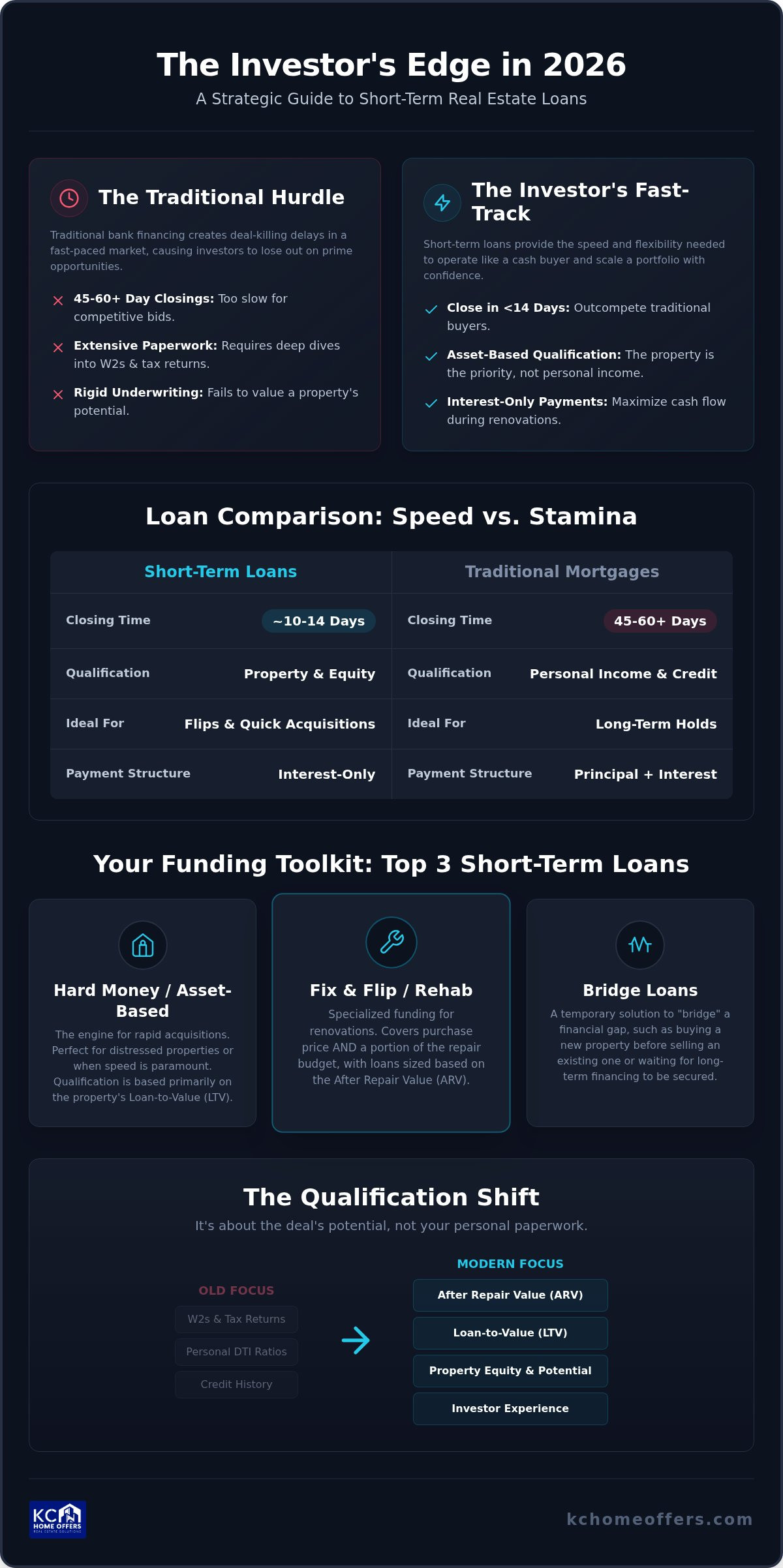
Agility is the primary driver. When you can close in under 14 days, you operate with the power of a cash buyer. Short term real estate loans utilize asset-based underwriting, meaning the lender prioritizes the property’s potential and your experience over your personal tax returns. This removes the friction of the income-to-debt ratios that plague traditional borrowers. It provides the flexibility to structure deals that banks simply won’t touch, such as heavy rehab projects or distressed acquisitions.
Short-Term Loans vs. Traditional Mortgages
The contrast in execution is stark. A traditional mortgage often requires 45 to 60 days of underwriting, deep-dives into W2 history, and strict secondary market guidelines. Short-term financing moves at the speed of the market, often reaching the closing table in just 10 days. Qualification relies on property equity and the viability of the deal rather than personal credit hurdles. Additionally, these loans typically feature interest-only payment structures. This maximizes your monthly cash flow during the renovation phase, ensuring your capital isn’t drained by principal payments before the property is ready for the market.
The 2026 Roundup: Top Types of Short-Term Real Estate Loans
Identifying the right financial vehicle for your specific project is the first step toward a successful exit. Not all short term real estate loans are built the same; some prioritize raw speed for distressed sales, while others provide the capital depth needed for ground-up development. In a high-velocity market, your choice of funding dictates your ability to scale and your ultimate profit margin.
Hard Money and Asset-Based Lending
Hard money remains the engine of the professional investment world. Understanding how hard money loans work is essential for anyone targeting off-market deals or properties that don’t meet traditional habitability standards. These are typically first-position liens where the lender looks at the Loan-to-Value (LTV) ratio to protect the investment. Because asset based loans for real estate focus on the collateral rather than your personal debt-to-income ratio, they allow for rapid portfolio expansion without the friction of personal income verification.
Fix and Flip and Rehab Financing
For projects requiring significant structural or cosmetic updates, specialized fix and flip funding is the industry standard. These loans don’t just cover the purchase price; they often fund a significant portion of the renovation budget through a structured draw schedule. Lenders calculate the loan size based on the After Repair Value (ARV). This ensures you have the liquidity to complete the transformation without stalling mid-project due to capital shortages.
Bridge Loans and the Transition Strategy
Bridge loans serve as temporary financing to cover the gap between an acquisition and a more permanent solution. While they offer immense flexibility, it’s wise to review consumer protection on bridge loans to understand the regulatory landscape and your rights as a professional borrower. A critical gap in many investor strategies is the transition from a short-term acquisition to a long-term hold, often called the BRRRR method. Once the rehab is finished, you’ll typically refinance into a DSCR loan. This allows you to pull your initial capital out while maintaining a cash-flowing asset. If you’re looking for your next high-yield project, reviewing current investor deals can help you find opportunities ready for this exact strategy.
New Construction and Ground-Up Builds
Ground-up builds require a different level of financial oversight. Navigating new construction financing involves managing interest reserves and complex draw schedules as the property moves from raw land to a finished structure. In 2026, the 21st Century ROAD to Housing Act has pushed many institutional players toward new construction, making this a highly competitive sector for private capital. These short term real estate loans ensure your project stays on track from the initial foundation pour to the final inspection.
Comparing Short-Term Loan Strategies: Which Fits Your Deal?
Choosing between different short term real estate loans requires more than just looking at the interest rate. You must align the loan’s duration and terms with your specific exit strategy. If your goal is a quick flip, a 6-month hard money loan with high leverage might be ideal. However, if you’re acquiring a property and need time to stabilize it before selling or refinancing, you might ask What Is a Bridge Loan? to see if it offers the multi-year runway you need. The “speed premium” is worth paying only if the loan’s structure doesn’t choke your profit margins at the finish line.
Execution speed often trumps the cost of capital in a competitive market. A loan that closes in 7 days at 12% is frequently more valuable than one that takes 30 days at 9%, especially when a deal is on the line. Beyond the rate, pay close attention to prepayment penalties. Some lenders require a minimum of 3 to 6 months of interest, even if you sell the property in 45 days. This can significantly impact your ROI. Additionally, understand the difference between recourse and non-recourse debt. Recourse loans allow the lender to pursue your personal assets if the deal fails, while non-recourse loans generally limit their recovery to the property itself.
The BRRRR Method: Bridging to DSCR
For investors focused on long-term wealth, the BRRRR (Buy, Rehab, Rent, Refinance, Repeat) method is the gold standard. You use short term real estate loans for the initial purchase and renovation phases when the property is unbankable. Once the rehab is complete and a tenant is in place, you transition to permanent financing. Choosing a hard money loan vs DSCR loan at the right moment is critical. To scale efficiently, you need a lender who can facilitate a seamless refinance into a 30-year DSCR loan for rental property, allowing you to pull your initial capital back out for the next deal.
Short-Term Rental (STR) Specific Considerations
Financing a short-term rental in 2026 requires a data-driven approach. Lenders now heavily leverage tools like AirDNA to verify projected income and occupancy rates. Unlike long-term leases, STR income is seasonal and volatile, which is why some lenders apply a “haircut” to projected earnings during the qualification process. To secure the best terms, professional property management is often a requirement rather than a luxury. Showing a lender that you have a seasoned team handling the guest experience and dynamic pricing reduces their perceived risk and increases your chances of approval.
How to Qualify for a Short-Term Real Estate Loan in 2026
Qualifying for short term real estate loans requires a fundamental shift in perspective. Traditional banks focus on who you are; private lenders focus on what you’re buying. This asset-centric approach allows for a streamlined process, but it doesn’t mean there are no standards. To secure the best terms in the 2026 market, you need to present a deal that stands on its own merits while demonstrating your ability to execute the project.
The qualification process follows a logical, four-step progression. First, the property evaluation determines the viability of the deal. If the purchase price and renovation budget don’t align with the expected market value, the loan won’t move forward. Second, your experience check influences your interest rates. While we fund first-time flippers, seasoned investors with a portfolio of successful exits often receive more favorable pricing. Third, you’ll need to operate through a legal entity. Most short-term financing is commercial in nature, requiring an LLC or Corporation to hold the title. Finally, liquidity verification ensures you have enough “skin in the game” to cover the down payment and initial carrying costs.
The No-W2 Advantage
One of the most significant benefits for professional investors is the ability to qualify without a traditional salary. Because fast approval investment property loans prioritize property cash flow and equity, they bypass the restrictive debt-to-income (DTI) ratios used by retail banks. You don’t need two years of tax returns or a stack of pay stubs. Instead, you’ll provide a clear project scope, a detailed renovation budget, and proof of funds. This transparency removes the friction that often prevents self-employed investors from scaling their ventures.
Common Pitfalls to Avoid During Application
Even a great deal can fall apart if the numbers aren’t grounded in reality. A frequent mistake is underestimating renovation costs. In a market where material prices can fluctuate, having a 10% to 15% contingency in your “Fix and Flip” budget is essential. Overestimating the After Repair Value (ARV) is another trap. If your exit strategy relies on an unrealistic sale price, you risk getting “stuck” in a high-interest loan with no clear way to refinance or sell. Don’t forget to account for “soft costs” like origination points and closing fees in your ROI calculations. If you’re ready to see how your next deal measures up, you can apply for financing to get a clear, professional assessment of your project’s potential.
Scaling Your Portfolio with KC Home Offers LLC
Success in real estate isn’t just about finding the right property; it’s about having the right capital partner who understands the stakes. In the 2026 market, short term real estate loans are the fuel for growth. KC Home Offers LLC serves as a strategic ally for investors who are tired of the slow, detached nature of traditional banking. We provide the specialized capital needed to move from a single project to a scalable business model. Our approach combines the professional authority of an institutional lender with the accessibility you’d expect from a dedicated partner.
A Partnership Built on Integrity
Our “straight shooter” philosophy means we value transparency as much as you value your time. We don’t hide behind layers of corporate bureaucracy or surprise you with undisclosed fees at the closing table. Instead, we focus on removing friction from the lending process. By prioritizing asset-based underwriting, KC Home Offers LLC ensures your momentum stays high. Whether you are executing a Fix & Flip Loan for a quick turnaround or moving into a DSCR Loan for long-term cash flow, we provide the clarity you need to make informed decisions. We help you scale by offering high-level professional standards with the speed and efficiency required in the national market. This isn’t just about debt; it is about building a sustainable investment engine.
Get Started on Your Next Deal
Submitting your deal for review is a streamlined, efficient process designed for the modern investor. You won’t wait weeks for a committee decision. Our team of experts conducts a thorough but rapid evaluation of your project’s merits. During your first consultation, we’ll discuss your exit strategy, renovation budget, and how our financing can optimize your ROI. We look at the deal’s potential and your track record to build a path forward. We understand that in 2026, the ability to close in under 14 days is a competitive requirement. If you are ready to stop letting opportunities pass you by due to lack of cash, it’s time to work with a lender that prioritizes your results. Secure your short-term real estate loan with KC Home Offers LLC today.
Secure Your Financial Future with Strategic Capital
The transition toward agile financing is no longer a luxury; it is a necessity for anyone looking to compete in the 2026 market. We’ve explored how short term real estate loans provide the liquidity needed to bypass traditional banking hurdles and secure properties in as little as 14 days. By focusing on asset-based underwriting rather than personal income history, you unlock the ability to scale a portfolio with a speed that retail lenders simply can’t match.
KC Home Offers LLC operates as your strategic ally, providing the professional standards of a national firm with the transparency of a “straight shooter.” We don’t just provide debt; we offer a partnership designed to remove friction from your investment journey. From initial acquisition to the final exit, our team is dedicated to your operational efficiency and long-term growth. It’s time to stop letting paperwork dictate your potential.
Apply for Fast, Flexible Short-Term Financing with KC Home Offers LLC today and experience capital that moves at the speed of the market. Your next high-yield deal is waiting.
Frequently Asked Questions
What is the typical interest rate for a short-term real estate loan in 2026?
Typical rates for short term real estate loans in 2026 range from 8.00% to 14.00% depending on the loan type and your experience level. Fix and flip loans often hover between 8.00% and 14.00% while bridge loans can start near 6.6% for institutional projects. These rates reflect the “speed premium” associated with asset-based lending compared to traditional 30-year mortgages. Experienced investors with high credit scores often secure the lower end of this range.
Can I get a short-term real estate loan with bad credit?
Yes, you can qualify for short-term financing with less than perfect credit because the loan is primarily secured by the property’s value. While traditional banks require high scores, many private lenders look for a minimum credit score between 620 and 660. Your track record of successful projects and the deal’s equity often carry more weight than a personal credit report during the underwriting process. This focus on the asset provides a path forward for many investors.
How fast can I realistically close on a hard money or bridge loan?
You can realistically close on a hard money or bridge loan in under 14 days. Unlike traditional bank loans that take 45 to 60 days, asset-based lenders prioritize efficiency to help you win competitive deals. Some experienced investors with pre-approved files can even reach the closing table in as little as 7 to 10 days. This speed is possible because the lender focuses on the property’s value rather than an exhaustive personal financial audit.
Do I need an LLC to apply for a short-term investment property loan?
Most private lenders require you to close your short term real estate loans under a legal entity like an LLC or Corporation. This is because these loans are strictly for business purposes and are not subject to the same consumer protection laws as personal residential mortgages. Operating through an LLC also provides you with liability protection. It creates a professional structure that makes it easier to scale your real estate portfolio over time.
What is the difference between a bridge loan and a fix and flip loan?
A bridge loan is temporary funding used to cover a gap between acquisition and permanent financing while a fix and flip loan specifically includes capital for renovations. Bridge loans are often used for stabilizing a property or “bridging” the time until a sale or refinance occurs. Fix and flip loans utilize a draw schedule to fund construction costs. These draws are based on the property’s after-repair value (ARV) and specific project milestones.
Are there prepayment penalties on short-term real estate loans?
Many short-term loans do not have traditional prepayment penalties, but some include a “minimum interest” clause. For example, a lender might require at least three to six months of interest payments even if you sell the property in 45 days. It’s essential to review your term sheet carefully to understand these carrying costs. Transparency is a core value for reputable lenders, so always ask for a clear breakdown of the interest requirements before signing.
How much of a down payment is required for an asset-based loan?
Asset-based loans typically require a down payment of 10% to 20% of the total project cost. First-time investors might need to bring 20% to 25% to the table to offset the lender’s risk. Seasoned pros with a high volume of successful exits can sometimes secure higher leverage. This “skin in the game” ensures that both the borrower and the lender are aligned on the project’s success and long-term financial health.
Can I use a short-term loan for a primary residence?
No, short-term real estate loans are strictly for investment properties and cannot be used for a primary residence. Federal regulations like the Truth in Lending Act (TILA) create different requirements for owner-occupied housing that most private lenders are not set up to handle. These loans are designed for business-purpose projects where the intent is to renovate and sell or hold the property as a cash-flowing rental asset.