


What if your ability to scale your portfolio had nothing to do with your personal debt-to-income ratio? In the 2026 market, high-performing investors are moving away from the rigid constraints of traditional banking and toward asset based loans real estate strategies that prioritize property cash flow over personal income history. You’ve likely felt the frustration of a lucrative deal slipping away because a bank’s underwriting team spent weeks dissecting your complex tax returns. It’s a common bottleneck that stalls momentum and keeps ambitious portfolios smaller than they should be.
We believe that your financing should move as fast as the market does. This guide will show you exactly how to leverage property value and projected rental income to secure capital without the friction of conventional financing. We’ll break down the 2026 landscape for DSCR and fix-and-flip loans, explain the 1.25x debt service coverage benchmarks, and provide a clear roadmap for closing deals while your competitors are still waiting on a loan officer’s callback. It’s time to stop letting personal income limits dictate your professional growth and start focusing on the math of the asset itself.
Key Takeaways
- Learn why the property’s cash flow and market value are the primary drivers for approval rather than your personal debt-to-income ratio.
- Understand how asset based loans real estate utilize “As-Is” and “As-Completed” appraisals to maximize your leverage in the 2026 market.
- Identify the critical differences between short-term fix-and-flip financing and long-term DSCR hold strategies to choose the right tool for your deal.
- Discover the 2026 qualification checklist, including credit score benchmarks and liquidity requirements, to ensure your next application is funding-ready.
- See how partnering with a strategic lender allows you to close deals faster and scale your portfolio without the friction of traditional bank red tape.
What is an Asset-Based Real Estate Loan?
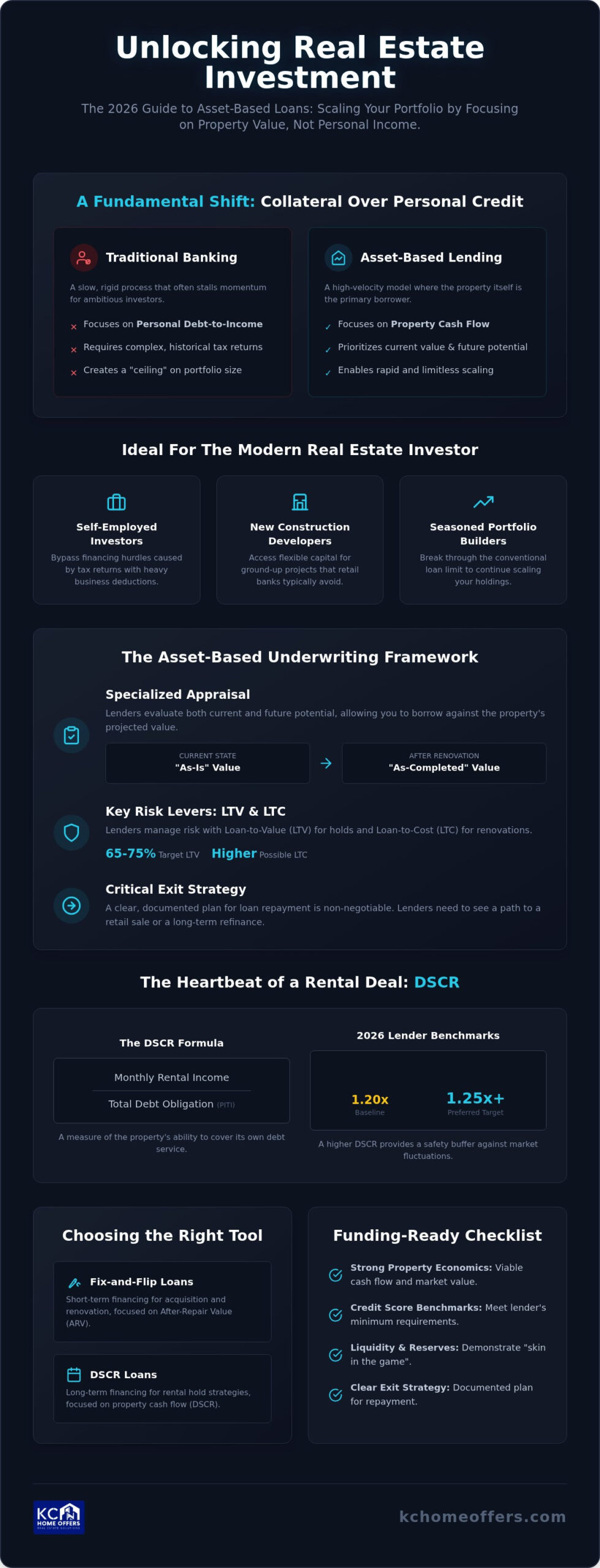
In the high-velocity world of property investment, the property itself is the primary borrower. An asset-based loan is a specialized financing structure where the collateral, rather than the borrower’s personal income, serves as the foundation for the credit decision. While traditional banks spend months dissecting your personal tax returns and salary history, asset based loans real estate strategies prioritize the property’s current value and its future income potential. This shift in perspective allows investors to bypass the slow, rigid underwriting processes that often kill profitable deals.
At its core, this lending model focuses on the math of the deal. Investors utilize these loans for fix-and-flip projects, rental acquisitions, and ground-up builds. If you are exploring how do hard money loans work, it’s helpful to view them as the short-term, high-speed entry point into the broader world of asset-based lending. For a foundational perspective on these structures, What is an Asset-Based Real Estate Loan? explains how collateral-focused financing operates across different sectors, though in real estate, the property’s equity is the ultimate security.
The Core Philosophy: Collateral Over Credit
Asset-based lenders care deeply about the After-Repair Value (ARV) and the property’s ability to generate revenue. They don’t ignore your credit entirely, but it isn’t the deal-breaker it would be at a conventional bank. Instead of fixating on your debt-to-income ratio, they look for “skin in the game” through your down payment and available liquidity. This approach differs significantly from the “conventional box” of 30-year fixed mortgages. Traditional mortgages are designed for stability and personal residence; asset-based loans are designed for momentum and profit. By focusing on the asset’s quality, lenders can offer faster approvals and more flexible draw schedules for renovations.
Who Benefits Most from Asset-Based Financing?
Self-employed investors are the primary beneficiaries of this model. When your tax returns show heavy deductions that lower your taxable income, traditional lenders see a risk; we see a savvy business owner. Developers seeking new construction financing also find these loans essential, as ground-up projects require a level of flexibility that retail banks rarely provide. Additionally, seasoned portfolio builders often hit a “ceiling” after securing ten conventional loans. Asset-based financing removes that ceiling, allowing you to scale your asset based loans real estate portfolio based on the strength of each new acquisition rather than your personal borrowing limits.
How Asset-Based Underwriting Works in 2026
Underwriting for asset based loans real estate differs sharply from the general business lending you might find at a large commercial bank. While those institutions focus on accounts receivable or intellectual property, real estate asset-based lenders look exclusively at the dirt and the structure. The process begins with a specialized appraisal. For fix-and-flip or new construction projects, lenders look at both the “As-Is” value and the “As-Completed” value. This dual-layered assessment allows you to borrow against the future potential of the property, not just its current dilapidated state.
In the 2026 market, Loan-to-Value (LTV) and Loan-to-Cost (LTC) ratios are the primary levers of risk management. Most institutional lenders now target a 65% to 75% LTV for long-term holds, while LTC ratios for renovations might go higher to cover a portion of the construction costs. Beyond the numbers, your exit strategy is the most critical part of the application. Lenders need a clear, documented path for how the loan will be repaid, whether through a retail sale or a transition into long-term financing. Stabilized value refers to the projected market value of a rental property once it reaches a typical occupancy level and generates a consistent, sustainable income stream.
Evaluating Property Cash Flow
For rental acquisitions, the Debt Service Coverage Ratio (DSCR) is the heartbeat of the deal. Lenders calculate this by dividing the monthly rental income by the total debt obligation, including principal, interest, taxes, and insurance. While a 1.2x ratio is often cited as the baseline, most 2026 lenders prefer a 1.25x DSCR to provide a safety buffer against market fluctuations. We often look at the 1007 Rent Schedule in an appraisal to determine market rents, which can sometimes be more favorable than existing lease agreements if a property is currently under-rented. If you’re ready to see how your property’s cash flow stacks up, you can explore our investor-focused lending options to get a clear picture of your borrowing power.
The Role of Experience in Underwriting
Your “real estate resume” significantly impacts your loan terms. In asset-based lending, a proven track record of successful flips or managed rentals acts as a form of secondary collateral. Seasoned investors with five or more completed projects in the last three years often secure lower interest rates and higher LTV caps. Conversely, first-time investors may face more conservative LTV limits, often capped at 65%, to offset the lack of experience. To prove your expertise, be prepared to provide HUD-1 settlement statements or closing disclosures from your previous deals, as these are the gold standard for verifying your investment history.
Asset-Based Loans vs. Hard Money vs. DSCR
Understanding the nuances of asset based loans real estate requires looking past the jargon to the actual function of the capital. While many investors use these terms interchangeably, they represent different tools in your financial kit. Asset-based lending is the broad umbrella that covers any loan secured by property equity rather than personal income. Within that category, hard money and DSCR loans serve very different purposes. Choosing the wrong one can lead to stalled projects or squeezed margins, so it’s vital to match the debt to your specific exit strategy. For a side-by-side breakdown of these options, our guide on hard money loan vs DSCR loan details which financing wins in the current market.
In 2026, the cost of capital is a strategic trade-off. Asset-based rates are naturally higher than conventional bank rates, but they offer a level of speed and flexibility that traditional institutions can’t match. You’re paying for the ability to close a deal in ten days while your competitors are still waiting for a bank’s underwriting department to review their 1040s. This speed of execution is often the difference between securing a high-margin deal and losing it to a cash buyer. When you view interest as a line-item expense rather than a personal burden, the math of asset-based lending becomes much clearer.
Hard Money: The Tactical Sprint
Hard money is the go-to solution for fix and flip funding. These are short-term bridge loans, typically lasting 6 to 18 months, designed to get you through the acquisition and renovation phases. The structure is almost always interest-only, which keeps your monthly carry costs low while you focus on the rehab. Lenders prioritize the property’s potential and the speed of the transaction. If a property is in disrepair and won’t qualify for a standard mortgage, hard money provides the bridge to turn that “as-is” liability into a high-value asset. For a comprehensive overview of all your rapid-capital options, our guide to short term real estate loans covers the full spectrum of bridge financing strategies available in the 2026 market.
DSCR Loans: The Strategic Marathon
Once a property is renovated and tenanted, it’s time to transition to a DSCR loan for rental property. This is the strategic marathon of your investment lifecycle. Unlike the short-term sprint of hard money, DSCR loans offer 30-year terms and are designed for long-term portfolio stability. The transition from a bridge loan to a permanent DSCR hold is a critical move for scaling. By refinancing out of high-interest bridge debt and into a stabilized DSCR loan, you lock in long-term cash flow and can often pull out your initial capital to fund the next acquisition.
Qualifying for an Asset-Based Real Estate Loan
While the property’s performance is the primary driver for approval, you still need to meet specific baseline requirements to secure funding. In the 2026 market, asset based loans real estate lenders look for a combination of property viability and borrower readiness. You don’t need a massive W2 salary, but you do need to prove you’re a capable partner. This starts with the “Liquidity Test.” Lenders typically want to see three to six months of principal, interest, taxes, and insurance (PITI) in reserve. This ensures you can carry the property during a vacancy or a renovation delay without the deal collapsing.
Your credit score still carries weight, even if it isn’t the main event. For most asset-based products, a 620 score is the minimum entry point, while a score of 680 or higher usually unlocks the most competitive interest rates. Property types also matter. Most lenders focus on single-family homes, 2-4 unit properties, and multi-family buildings. Mixed-use properties are often eligible, but they may come with more conservative LTV caps due to the increased complexity of the commercial component.
Required Documentation for Fast Approval
To move at the speed of the market, you need your “loan file” ready before you even find the deal. Speed is your greatest advantage, and having these documents organized prevents delays during the appraisal process. You’ll need a signed purchase contract and a line-itemized rehab budget if you’re doing a flip or a value-add rental. Because these loans are almost always made to business entities, you’ll need your LLC Operating Agreement and EIN ready. Finally, have two months of bank statements available to verify your “cash to close” and your required reserves.
Common Pitfalls to Avoid
The most frequent mistake is overestimating the After-Repair Value (ARV). Professional lenders use conservative appraisals; if your math relies on a “best-case scenario” price, the deal may fail during underwriting. You should also investigate zoning or environmental issues early. A property that looks like a great rental but is zoned for a use that prevents your strategy will be a hard “no” for any reputable lender. Finally, check for prepayment penalties. If you plan to flip a property in four months but your loan has a six-month interest minimum, that’s a cost that can eat your profit. If you’re ready to bypass the red tape and get a clear answer on your next deal, view our investor loan requirements to start the process today.
Scaling Your Portfolio with KC Home Offers
Scaling a real estate business requires more than just capital; it requires a lender that understands the friction points of the 2026 market. At KC Home Offers LLC, we position ourselves as a strategic ally for investors who’ve outgrown the limitations of retail banking. Our approach to asset based loans real estate is built on transparency and speed. We don’t hide behind layers of corporate bureaucracy or surprise you with last-minute fee changes. We’re straight shooters who value your time as much as you do, providing the momentum needed to win in competitive markets.
The Partnership Approach to Lending
Our team brings a blend of localized expertise and a national lending scope to every transaction. This combination allows us to vet your next deal with the eyes of an experienced investor, not just a credit analyst. When you bring a property to us, we look at the math to see if it supports your growth goals. Whether you’re working on your first fix-and-flip or managing a portfolio of fifty rentals, we help you transition from doing one-off deals to running a scalable investment business. We’re here to ensure the financing side of your business is a well-oiled machine.
We offer a full suite of products tailored to the lifecycle of your assets. This includes everything from fast approval investment property loans for quick acquisitions to long-term DSCR and new construction financing. By having all these tools under one roof, you can move seamlessly from a bridge loan into a permanent hold without the stress of finding a new lending partner every time your strategy shifts. This continuity is vital for maintaining a healthy cash flow across a growing portfolio.
Ready to Execute Your Next Deal?
The “Asset-First” advantage is clear: you scale based on the quality of your deals, not the size of your paycheck. In a market where inventory moves fast, your ability to close in as little as 7 to 10 days is a powerful competitive edge. It’s time to stop letting traditional debt-to-income ratios block your acquisitions and start leveraging the equity you’ve built. We prioritize efficiency because we know that in real estate, time is quite literally money.
Review your property numbers today and reach out for a clear, transparent quote. We’re ready to help you execute your next deal with the speed and professional oversight your portfolio deserves. Stop waiting on a bank’s permission and start building your legacy with a partner that moves at your pace.
Master Your Financial Future in 2026
The 2026 real estate landscape rewards speed and clarity. We’ve explored how shifting your focus from personal income to property value allows for a more scalable, professional investment strategy. By utilizing asset based loans real estate investors can bypass the traditional debt-to-income hurdles that stall growth. Whether you’re executing a tactical sprint with a fix-and-flip project or building a long-term rental marathon, the right capital structure is your most valuable asset.
KC Home Offers provides the specialized financing you need to stay ahead. We offer fast approvals with no W2 required and maintain a diverse range of products for Fix & Flip, DSCR, and New Construction projects. Our expert underwriting always values the property’s potential over the paperwork. Don’t let rigid bank requirements limit your vision. Secure your next deal with a transparent asset-based loan from KC Home Offers today. Your next acquisition is waiting; let’s get it funded.
Frequently Asked Questions
What is the main difference between an asset-based loan and a traditional mortgage?
An asset-based loan prioritizes the property’s value and income potential over the borrower’s personal income or debt-to-income ratio. Traditional mortgages require extensive W2 verification and tax returns to prove you can personally pay the debt. In contrast, asset based loans real estate lenders look at the property’s equity and projected rental income as the primary source of repayment. This shift allows investors to scale without hitting personal borrowing limits.
Do I need a high credit score for an asset-based real estate loan?
You don’t need a perfect credit score, but it still influences your interest rate and loan-to-value (LTV) limits. Most lenders require a minimum score of 620 to qualify for investment products. If your score is 680 or higher, you’ll typically unlock lower rates and higher leverage. While the property is the star of the show, your credit history acts as a secondary indicator of your reliability as a strategic partner.
What types of properties qualify for asset-based financing?
Asset-based financing is designed for non-owner-occupied investment properties. This includes single-family rentals, 2-4 unit small multi-family buildings, and larger apartment complexes. Mixed-use properties can also qualify if the residential component is significant. Because these loans are for business purposes, they cannot be used for your primary residence or any property where you intend to live personally.
How fast can an asset-based loan be funded?
These loans can be funded in as little as 7 to 10 business days. Traditional bank financing often takes 30 to 45 days because of the heavy focus on personal income verification. Asset-based lenders move faster by focusing on the property’s appraisal and title work. This speed of execution is a critical tool for investors who need to close quickly to beat out competing cash offers.
Can I get an asset-based loan if I don’t have a W2 job?
Yes, you can secure funding without a W2 job or traditional salary history. Asset-based lending is ideal for self-employed investors, full-time developers, and those with complex tax returns. Since the lender evaluates the property’s cash flow rather than your personal paycheck, your employment status is secondary to the deal’s math. This makes asset based loans real estate the go-to choice for professional portfolio builders.
Are interest rates higher for asset-based loans?
Interest rates for asset-based products are generally higher than those for traditional residential mortgages. You’re paying a premium for speed, flexibility, and the ability to borrow without personal income verification. While the cost of capital is higher, the trade-off is the ability to secure deals that a bank would reject. Most investors view this interest as a business expense that enables higher overall portfolio growth.
What happens if the property doesn’t appraise for the expected value?
If a property appraises lower than expected, the lender will adjust the loan amount based on the agreed-upon LTV ratio. For example, if you were approved for 75% LTV but the appraisal comes in low, the total loan amount will decrease. You’ll then need to decide whether to bring more cash to the closing table or negotiate a lower purchase price with the seller to keep the deal’s math intact.
Is an appraisal always required for an asset-based loan?
A professional appraisal is almost always required to verify the property’s market value and rental potential. Lenders need a third-party valuation to confirm the current value or future value before they can commit capital. While some bridge lenders might offer desktop valuations in rare cases, a full appraisal with a rent schedule is the industry standard for ensuring the investment is secure for both parties.