


The construction landscape is experiencing significant shifts, with the number of active builders fluctuating dramatically in recent years, creating substantial opportunities for ambitious investors ready to capitalize on new inventory. While regulatory shifts like the 2026 Energy Code Update have sidelined the casual developer, the real barrier often isn’t the code; it’s the capital. You likely know that traditional banks move at a glacial pace and often fail to understand the urgency of a ground-up project. Finding reliable construction loan lenders means looking for partners who value speed and transparency over red tape.
Securing a residential construction loan doesn’t have to be a bureaucratic nightmare that drains your liquidity. This guide provides a clear roadmap to mastering the 2026 lending landscape, from navigating the new ERI targets to choosing between one-time and two-time closing structures. We’ll break down how to manage draw schedules without halting your crew and how to leverage private capital to scale your portfolio faster. You will learn exactly how to manage the build process without running out of cash, ensuring your project moves from blueprint to bottom-line profit with total efficiency.
Key Takeaways
- Partnering with specialized construction loan lenders Kansas City investors trust allows you to secure interest-only financing that preserves cash flow during the critical building phase.
- Evaluate the financial trade-offs between one-close and two-close loan products to determine which structure best supports your long-term portfolio goals.
- Streamline your approval process by establishing a clear track record and preparing detailed spec sheets that demonstrate project viability to private lenders.
- Master the construction draw schedule and milestone-based inspections to keep your crew funded and avoid costly project delays.
- Learn to recycle your capital efficiently by transitioning from ground-up financing into long-term DSCR or fix-and-flip strategies once the build is stabilized.
What is a Residential Construction Loan for Investors?
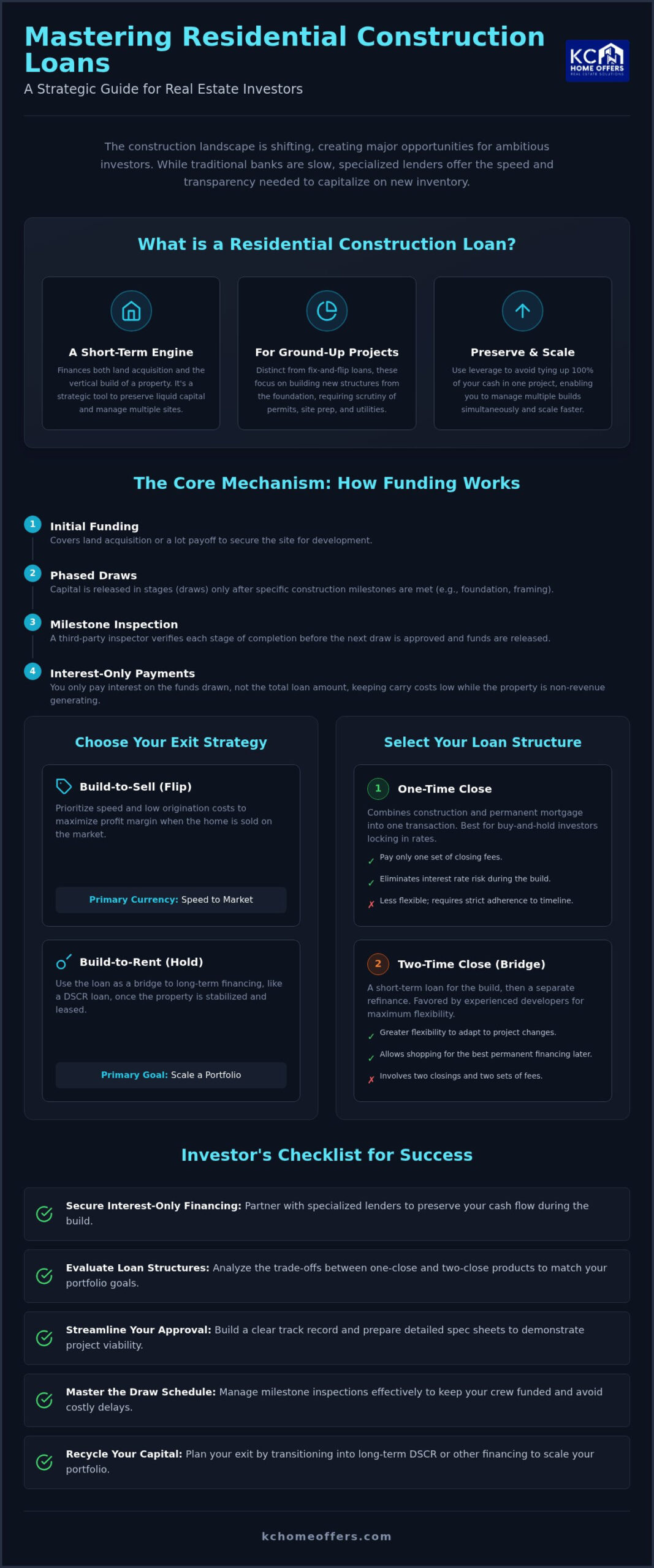
A residential construction loan is a short-term financing engine designed to cover both the acquisition of raw land and the vertical build of a residential property. Unlike a traditional mortgage, which assumes a finished asset, this product is built for the “not yet.” For professional developers, it’s a strategic tool used to preserve liquid capital. Instead of tying up 100% of your cash in a single lot, you use leverage to manage multiple sites simultaneously. Most construction loan lenders Kansas City offers focus on ground-up projects where the structure is being built from the foundation up. This is distinct from heavy rehab or fix-and-flip projects, where you’re working within an existing footprint. Ground-up loans require a higher level of scrutiny regarding permits, site prep, and utility hookups.
The Core Mechanism: How Construction Funding Works
Funding moves in phases. You typically start with land acquisition or a lot payoff and then transition into the vertical build phase. These loans operate through a draw schedule; capital is released only after specific milestones, like the foundation or dry-in, are verified by an inspector. The interest-only period is the phase where investors only pay for the capital currently deployed. This mechanism ensures your monthly carry costs remain manageable while the property is still under construction and not yet generating revenue. It allows you to keep your cash reserves ready for the next deal rather than sinking them into interest on money you haven’t even used yet.
Investment Models: Build-to-Sell vs. Build-to-Rent
Your exit strategy dictates your financing structure. If you’re a build-to-sell developer, you prioritize speed and low origination costs to maximize your margin when the home hits the market. Speed is the primary currency here. For the “hold” investor, the construction loan is a bridge to long-term stability. Once the certificate of occupancy is issued and the property is leased, you can transition into a DSCR loan for rental property. This allows you to recycle your capital by refinancing out of the construction debt and into a 30-year fixed rate based on the property’s rental income. It’s a powerful way to scale a portfolio of brand-new, low-maintenance rental units.
Key Terminology: LTC vs. LTV
Construction loan lenders Kansas City rely heavily on Loan-to-Cost (LTC). This metric measures the loan amount against the actual hard and soft costs of the project, including labor, materials, and permits. While Loan-to-Value (LTV) is still calculated based on the After-Repair Value (ARV), LTC is the primary guardrail for risk during the build. If you already own the land, that equity can often be used as your down payment; this significantly reduces the cash you need to bring to the closing table. Understanding these ratios helps you determine exactly how much liquidity you need to keep on hand for cost overruns or unexpected site issues throughout the project lifecycle.
Choosing the Right Construction Loan Structure
Selecting a loan structure is a tactical decision that dictates your project’s liquidity and long-term debt profile. While consumer lenders often push simplicity, professional investors prioritize leverage and the ability to pivot. Most construction loan lenders Kansas City professionals work with will offer two distinct paths: a unified single-closing process or a multi-phase approach that utilizes bridge debt. Your choice depends entirely on whether you intend to flip the finished asset or hold it as a stabilized rental.
One-Time Close (Construction-to-Perm)
This structure combines the construction financing and the permanent 30-year mortgage into one transaction. You close once, pay one set of fees, and often lock in your long-term rate before the first shovel hits the dirt. It’s an excellent choice for buy-and-hold investors who want to eliminate interest rate risk during the build. However, this stability comes with rigidity. Lenders usually require a vetted general contractor and strict adherence to the initial timeline, leaving little room for the operational shifts that often characterize high-stakes development. If your project faces delays, the transition to the permanent phase can become a bottleneck.
Two-Time Close and Bridge Loan Options
Experienced developers frequently avoid the rigidity of one-time closes in favor of bridge loan real estate structures. This two-phase approach uses a short-term loan for the build, followed by a separate refinance into permanent debt once the property is stabilized. The primary advantage is flexibility. If the market shifts or your costs change, you aren’t locked into a pre-set mortgage. You can adjust your exit strategy mid-build based on current market demand.
This structure also enables capital recycling. Once the home is finished, the increased value (ARV) allows you to refinance out of the construction debt and potentially pull out your original equity to fund your next acquisition. It’s the preferred method for scaling a portfolio quickly. While you’ll face two sets of closing costs, the ability to access your capital faster usually outweighs the upfront fees. If you’re looking for a partner who understands this need for momentum, exploring investor-centric funding is a smart next step.
Don’t overlook the “soft” costs of multi-phase financing. Beyond origination points, you must account for inspection fees at every draw, title update charges, and potential extension fees if supply chain issues push your completion date. Transparent construction loan lenders Kansas City builders trust will outline these costs upfront so your pro forma remains accurate from site prep to sale. Managing these details early prevents the common trap of running out of capital during the final 10% of the build.
Qualification Requirements for Residential Construction Loans
Qualifying for a construction loan is fundamentally different than applying for a standard mortgage. While a traditional lender looks primarily at your debt-to-income ratio, construction loan lenders Kansas City investors partner with prioritize the project’s viability and your execution team’s track record. They need to know that the project will be finished on time and within budget. This requires a shift from personal financial vetting to a comprehensive project audit. You aren’t just a borrower; you’re a project manager in their eyes.
- Track Record: You must demonstrate previous successful builds or partner with a vetted General Contractor (GC).
- Detailed Spec Sheet: Lenders require a line-item budget that accounts for everything from site prep to final finishes.
- Land Equity: Having the land already titled in your name or under a firm contract is essential for securing the loan.
- Liquidity: You need enough cash for the down payment and the “interest reserves” to carry the loan during the build.
- Permit Readiness: Most professional lenders won’t close until the project is “shovel-ready” with all municipal approvals in place.
The Importance of the General Contractor (GC)
Lenders vet your builder as thoroughly as they vet you. They will require proof of insurance, active licensing, and a list of previous build references to ensure the project doesn’t stall. Many investors ask if they can act as their own GC to save on overhead. For most construction loan lenders Kansas City has to offer, the “owner-builder” model is a red flag unless you have a documented history of professional development. Without that experience, a lender sees a high risk of cost overruns and mismanagement, which can jeopardize their collateral.
Financial Readiness: Liquid Reserves and Down Payments
Expect to bring 20-30% of the project costs as a down payment. Beyond the initial capital, lenders often require “interest reserves” to be held in escrow; this ensures the interest-only payments are covered even if the project experiences a temporary cash flow gap. Liquid reserves act as a safety net for unexpected material cost increases. This secondary layer of liquidity proves to the lender that a 10% spike in lumber or concrete prices won’t derail the entire build. By demonstrating this level of financial preparedness, you position yourself as a low-risk partner ready to scale.
Managing the Build: Draws, Inspections, and Timelines
Managing a ground-up development requires a transition from “investor” to “project manager.” The build phase is where most timelines fail. It’s rarely because of the weather. Usually, it’s because of capital bottlenecks. High-performing construction loan lenders Kansas City builders trust use a structured draw system to mitigate risk. This keeps the project moving while protecting the lender’s collateral and your equity.
Navigating the Draw Schedule
You must master the construction loan draw schedule to keep your momentum. Funding is released in stages. These stages typically follow milestones like foundation completion, framing, rough-ins, and final finishes. Lenders use a “percentage of completion” method for funding. If your framing is halfway done, you receive half of that specific budget line. Prompt payments to your General Contractor are vital. Subcontractors who go unpaid can file mechanic’s liens. These liens can freeze your entire loan and stop work on-site immediately.
The Inspection Process and Quality Control
A third-party inspector verifies all work before any capital is released. Expect a rigorous site visit every time you request a draw. Transparent construction loan lenders Kansas City developers partner with require these inspections to protect the asset’s value. If an inspector finds that the plumbing rough-in doesn’t match the spec sheet, the draw stays locked. You must handle corrections quickly to avoid stalling your crew. Maintaining a meticulous paper trail is non-negotiable. You need invoices, photos, and lien waivers for every dollar spent. This transparency ensures that the quality of the build meets the lender’s standards and your project stays on track.
In 2026, material volatility remains a constant factor for developers. A 10% contingency fund is a requirement for survival, not just a suggestion. Clear communication between you, your GC, and the lender is the primary driver of project speed. When everyone is aligned on the schedule, inspections happen faster. Draws clear sooner. If you are ready to start your next project with a lender that moves at your speed, apply for construction financing today. This proactive approach prevents the common friction that slows down most residential builds.
Scaling Your Portfolio with New Construction Financing
Scaling isn’t just about doing more work; it’s about making your capital work harder. For high-velocity investors, a single build is a proof of concept. The real goal is to create a repeatable cycle where equity from one completed project feeds the acquisition of the next. While many construction loan lenders Kansas City offers focus on the individual transaction, a strategic partner looks at your total pipeline. By utilizing specialized ground-up funding, you create significant equity through the vertical build process. This equity becomes the engine for your expansion, allowing you to move from one lot to a multi-site development strategy.
Once the property is stabilized, you have two primary paths to choose from. You can sell immediately, transitioning your profit into fix and flip funding for your next acquisition, or you can refinance. Refinancing allows you to “recycle” your initial liquidity. By moving from a short-term construction loan into a long-term rental product, you pull your original cash out while keeping a cash-flowing asset in your portfolio. This is the ultimate evolution of the BRRRR method, applied to new construction.
The Exit Strategy: Refinance or Sell?
Analyzing the 2026 market is crucial for timing your exit. If inventory remains low and buyer demand is high, a retail sale might offer the highest immediate ROI. However, if rental demand stays aggressive, holding the asset as a brand-new, low-maintenance rental provides long-term stability. The permanent loan appraisal phase is the most critical moment in this transition. You must ensure the appraiser understands the value of new construction upgrades and energy-efficient systems. A strong appraisal ensures you maximize the cash-out amount, giving you the fuel needed for your next land acquisition.
Why Partnership Matters in Construction Lending
Speed and transparency are the only things that matter when you’re scaling a development business. You don’t need a corporate bureaucrat; you need “straight shooters” who understand the local market dynamics and the urgency of a build site. Working with Ashley and Aspen at KC Home Offers LLC provides that direct line of communication. They operate with the same sense of momentum that you do. When you have a lender that understands the “straight shooter” approach, you spend less time explaining your deals and more time closing them. High-integrity facilitation means fewer surprises and more predictable growth for your business. Ready to break ground? Contact KC Home Offers LLC today for a customized construction loan quote.
Build Your 2026 Portfolio with Strategic Capital
Succeeding in the 2026 real estate market requires more than just finding the right lot; it demands a sophisticated approach to capital. By mastering the draw schedule and selecting the right financing structure, you can move from a single build to a high-velocity development cycle. You’ve seen how recycling equity into new acquisitions is the fastest path to growth. However, this momentum is only possible when you work with construction loan lenders Kansas City developers trust to keep pace with their ambitions.
Efficiency is the foundation of every successful project. At KC Home Offers LLC, we provide the transparency and fast approvals seasoned developers need to stay ahead. Our team offers direct access to decision-makers and specializes in investor-focused products, including DSCR and Fix & Flip loans. Don’t let bureaucratic delays stall your next site. We’re committed to removing friction from your funding process so you can focus on building instead of chasing paperwork.
Scale your portfolio with KC Home Offers LLC construction financing and take the first step toward your next ground-up success today.
Frequently Asked Questions
How much of a down payment is required for a residential construction loan?
Most construction loan lenders Kansas City investors work with require a down payment between 20% and 30% of the total project cost. This ensures the developer has significant skin in the game. While traditional mortgages might offer lower entry points for homeowners, investor-focused products prioritize project liquidity. Having this capital ready proves your financial stability and protects the lender’s interest during the high-risk vertical build phase.
Can I use the land I already own as a down payment for a construction loan?
You can typically use the equity in land you already own to satisfy the down payment requirement. Lenders will appraise the lot and credit the current value toward your contribution. If you own the land free and clear, this can significantly reduce the amount of cash you need to bring to the closing table. It’s a powerful way to leverage existing assets to fund a new vertical build.
What happens if my construction project takes longer than the loan term?
If your project exceeds the initial term, you’ll likely need to request a loan extension from your lender. Most private lenders offer six-month or twelve-month terms with the option to extend for an additional fee. It’s vital to communicate delays early. Transparency helps you avoid default and ensures the lender remains a strategic ally. Extensions usually involve paying extra points or a higher interest rate until the property is finished.
Is it harder to get a construction loan for an investment property than a primary residence?
It isn’t necessarily harder, but the qualification criteria are different for investors. While a primary residence loan focuses on your personal income, an investment construction loan focuses on the project’s After-Repair Value (ARV) and your track record. Construction loan lenders Kansas City professionals trust want to see a viable exit strategy and a vetted builder. If the numbers on the pro forma make sense, the approval process is often faster than traditional banking.
What is an interest reserve in a construction loan?
An interest reserve is a dedicated portion of the loan amount set aside in escrow to cover monthly interest payments during the build. Since the property isn’t generating income yet, this reserve ensures the lender is paid without you needing to make out-of-pocket payments. It’s a tool that preserves your cash flow. Once the reserve is exhausted, you’ll be responsible for the interest payments until the loan is refinanced or paid off.
Can I be my own general contractor on a residential construction loan?
Most lenders require you to hire a licensed and insured general contractor with a documented track record. Acting as your own GC, often called an “owner-builder” model, is generally restricted to professionals who develop properties as their primary business. Lenders view inexperienced owner-builders as a high risk for cost overruns and code violations. If you don’t have a history of successful builds, partnering with a vetted pro is the fastest path to funding.
How do construction loan draws work?
Construction loan draws are milestone-based releases of capital that occur after specific stages of work are completed. You’ll submit a draw request, and a third-party inspector will visit the site to verify the progress. Once the work is confirmed, the lender releases the funds to pay your contractors and suppliers. This system ensures that money is only spent on verified improvements, protecting both your equity and the lender’s collateral throughout the process.
What is the difference between a construction loan and a bridge loan?
A construction loan is specifically designed for the ground-up building process, featuring a draw schedule and interest-only payments. In contrast, a bridge loan is a short-term financing solution used to bridge the gap between a purchase and a permanent exit, often for existing structures. While both are short-term, construction loans require much more oversight. Investors often use a bridge loan to acquire land before transitioning into a full construction product for the build.