


The most profitable real estate deals in 2026 aren’t won by the highest bidder; they’re won by the investor who can close before a traditional bank even opens the file. You’ve likely felt the frustration of watching a prime property slip away because institutional lenders took forty-five days to review your W2s while a cash buyer moved in a week. It’s a common bottleneck that keeps your portfolio stagnant and your capital locked in transition.
We agree that waiting on rigid underwriting is a recipe for missed opportunities, especially as new FinCEN reporting rules and stricter Fannie Mae guidelines complicate the path to closing. This guide will show you how to master bridge loan real estate mechanics to bypass these hurdles, securing funding based on asset value rather than personal income history. You’ll learn how to close deals in under 14 days, bridge liquidity gaps, and leverage the 21st Century ROAD to Housing Act to scale your holdings. We’ll break down current rate structures and professional exit strategies so you can move with the confidence of a cash buyer and the precision of a seasoned pro.
Key Takeaways
- Understand how a bridge loan real estate strategy allows you to close deals in under 14 days by focusing on asset value rather than rigid personal income checks.
- Learn the critical differences between bridge loans, hard money, and conventional financing to choose the most cost-effective capital for your specific project.
- Master the art of calculating ARV and LTV requirements to ensure your property qualifies for maximum leverage and minimal out-of-pocket costs.
- Identify the true cost of short-term funding, including origination points and closing fees, to protect your profit margins and ROI.
- Discover professional exit strategies, such as transitioning into a long-term DSCR loan, to ensure a seamless and profitable project lifecycle.
What is a Bridge Loan in Real Estate and How Does it Work?
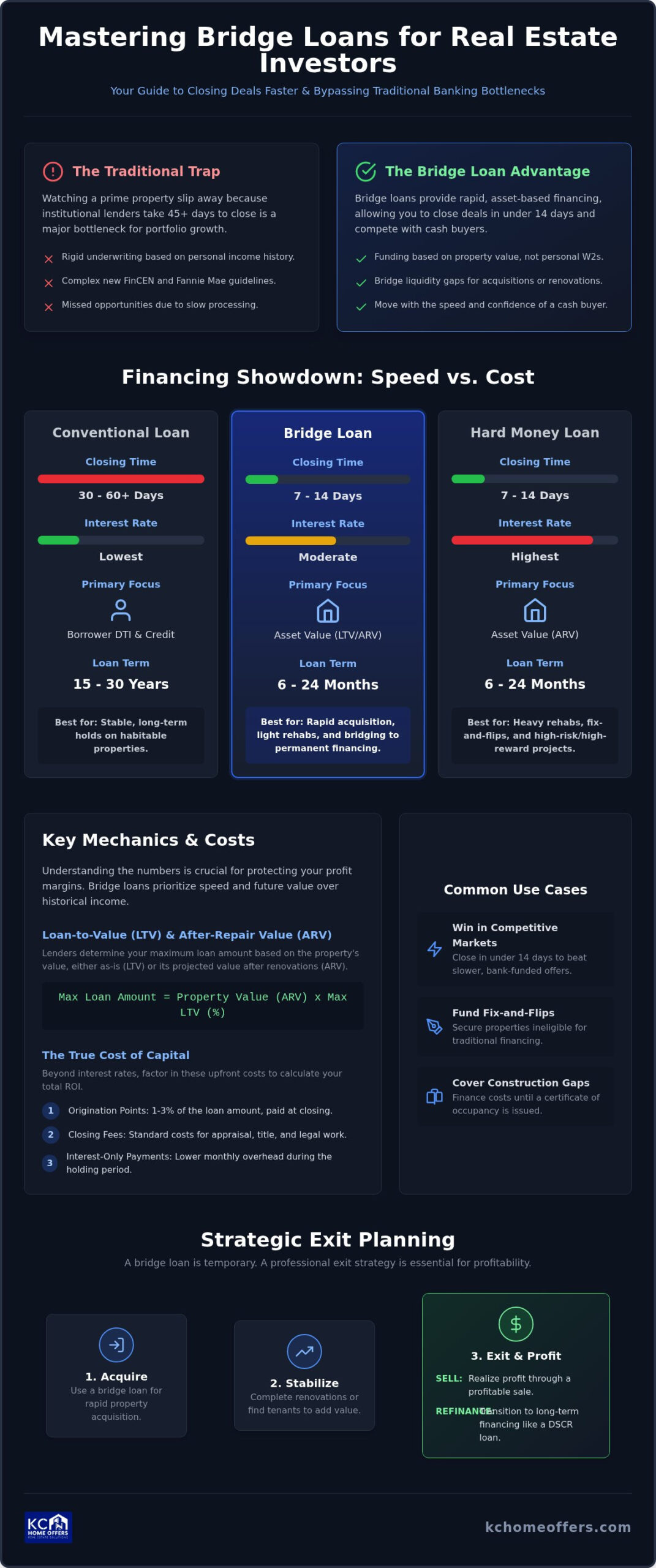
A bridge loan is a temporary lien that prioritizes speed and property equity over borrower credit scores. In the fast-moving 2026 market, this asset-based financing serves as a vital tool to “bridge” the gap between an immediate capital requirement and a long-term financial exit. When investors ask, What is a bridge loan?, they’re typically looking for a way to move faster than the 45-day window required by traditional banks. These loans usually feature short terms ranging from 6 to 24 months, allowing you to secure a property, stabilize it, and either sell or refinance without the weight of a 30-year commitment.
The core value of bridge loan real estate lies in its flexibility. Unlike conventional mortgages that scrutinize every line of your tax returns, bridge lenders focus primarily on the collateral and the project’s viability. This shift in perspective allows for approvals based on the property’s current value and its future potential. It’s a strategic move for those who need to act decisively on a fix and flip project where the opportunity won’t wait for a slow loan committee.
Common Scenarios for Real Estate Bridge Loans
Investors often deploy a bridge loan real estate strategy when timing is the most critical factor in a deal’s success. In highly competitive markets, a 14-day close can be the difference between winning a contract and losing it to a cash buyer. You might also use this funding for distressed properties that don’t meet habitable standards, making them ineligible for traditional financing. Additionally, many developers utilize these funds as a stopgap during new construction financing, covering costs until a permanent certificate of occupancy is issued and long-term debt can be secured.
The Mechanics of Interest-Only Payments
One of the most attractive features of this financing is the interest-only payment structure. By only paying the interest portion of the debt each month, you keep your operational overhead significantly lower during the holding period. This is essential for maintaining healthy cash flow while capital is tied up in renovations or active construction phases.
The loan concludes with a balloon payment, where the full principal amount becomes due at the end of the term. This structure works because the investor’s goal isn’t to pay down the debt over decades. Instead, the focus is on a swift exit, either through a profitable sale or by transitioning into a permanent loan once the property is stabilized. It’s a high-momentum strategy designed for growth and operational efficiency.
Bridge Loan vs. Hard Money vs. Conventional Financing
Choosing the right capital source is about matching the speed of the money to the speed of the deal. Conventional financing is designed for stability, focusing heavily on your personal debt-to-income (DTI) ratio and tax history. In contrast, bridge loan real estate financing flips the script, prioritizing the loan-to-value (LTV) ratio of the asset itself. If you want to understand How Bridge Loans Work in a comparative context, think of them as the middle ground between the rigid structure of a bank and the raw speed of private capital.
The most glaring difference is the timeline. A conventional mortgage typically requires 30 to 60 days to clear underwriting, which is an eternity in a competitive market. Bridge and hard money lenders can often fund a deal in 7 to 14 days. While the interest rates for short-term funding are higher than a 30-year fixed mortgage, the cost is a tactical expense. Paying a higher rate for six months is often offset by the equity gained from securing a property that a traditional buyer couldn’t touch. It’s about the profit at the end, not just the interest paid during the hold.
When to Use a Bridge Loan Instead of Hard Money
While hard money is technically a subset of bridge lending, it’s usually reserved for “heavy” rehabs or structural projects that carry higher risk. Bridge loans often feel more institutional and are ideal for “light” renovations or simply covering a liquidity gap. Lenders might require more documentation for a bridge loan than a “no-doc” hard money loan, but you’ll often be rewarded with slightly better terms and a more professional servicing experience. If your project is a straightforward buy-and-hold transition, a bridge product is usually the cleaner choice.
Transitioning to Long-Term Debt
Smart investors don’t view these loans as a destination; they’re a vehicle. This is the foundation of the “BRRRR” method: Buy, Rehab, Rent, Refinance, Repeat. You use the bridge loan to acquire and stabilize the property, then move into a permanent DSCR loan once the asset is producing income. This transition allows you to pull your initial capital back out and move to the next deal. Many successful partners start by looking for flexible investor funding that can support this high-velocity growth strategy without the friction of traditional bank approvals.
Key Requirements for Securing Bridge Loan Real Estate
Securing a bridge loan real estate facility requires a different mindset than applying for a traditional home mortgage. Lenders don’t care about your salary as much as they care about the deal’s math. Most bridge lenders look for a Loan-to-Value (LTV) ratio between 70% and 80%, meaning you’ll need to bring a 20-30% down payment or have equivalent equity in the property. This “skin in the game” protects the lender while ensuring you’re motivated to complete the project efficiently.
Beyond equity, the After Repair Value (ARV) is the North Star for underwriting. Lenders evaluate what the property will be worth once the renovation is finished. If you have a track record of successful flips in the last two years, you’ll often find more competitive rates and higher leverage. Experience reduces risk, and in this market, reduced risk translates to better terms. You also can’t get a bridge loan without a clear exit strategy. Lenders want to know exactly how they’ll be paid back, whether through a sale or a refinance. Understanding the Pros and Cons of Bridge Loans helps you articulate this plan, as you’ll need to account for the higher interest costs against your projected profit.
Financial Documentation for Investors
Forget the stack of W2s and pay stubs. Instead, prepare a detailed “Scope of Work” that outlines every nail and board involved in the project. If the deal involves renovations, you’ll need a clear construction loan draw schedule to manage how funds are released as milestones are met. It’s also standard practice to close in the name of an LLC. Most bridge lenders strictly fund legal entities rather than individuals to maintain the commercial nature of the loan and streamline the closing process.
Property Appraisal and Valuation
Appraisals for bridge loans move fast, often taking days instead of weeks. The appraiser looks at the “as-is” value to determine current collateral and the “as-completed” value to justify the total loan amount. Bridge lenders prioritize the asset’s liquidation value over the borrower’s personal income. This focus ensures that the property itself can cover the debt regardless of your personal financial fluctuations. It’s a pragmatic approach that values the deal’s strength over your credit history.
Calculating the Real Cost: Fees, Points, and ROI
Transparency in the capital stack is what separates professional investors from amateurs. When you evaluate bridge loan real estate, the interest rate is only one variable in the total cost of capital. You must account for origination points, which typically range from 1% to 3% of the loan amount. These points are an upfront expense that covers the lender’s risk and underwriting costs. Standard closing costs, including title insurance, escrow fees, and legal documentation, also require immediate liquidity at the closing table.
Construction and renovation timelines are rarely perfect. Most bridge facilities offer extension options, usually for an additional point or a flat fee, providing a safety net if your project hits unexpected delays. The ultimate goal isn’t to find the cheapest debt; it’s to secure the most profitable deal. If the speed of a bridge loan allows you to capture a property with a significant equity margin that a traditional bank would decline, the interest expense is simply a tactical cost of doing business.
Hidden Costs to Watch For
Watch out for prepayment penalties that can bite into your ROI if you exit the deal too quickly. Some lenders require a minimum of three to six months of interest, even if you sell the property in sixty days. You should also budget for inspection fees. Every time you submit a draw request for renovation funds, an inspector will likely visit the site to verify progress; these fees are often passed to the borrower. Finally, be aware of default interest. If your loan term ends before you’ve secured permanent financing or a sale, the interest rate can jump dramatically, sometimes by 5% or more, until the principal is repaid.
Leveraging Bridge Loans to Increase Cash-on-Cash Return
Leverage is the engine of portfolio growth. By using a bridge loan to cover 80% of the acquisition and rehab costs, you can control multiple properties with the same capital that would only buy one house in cash. This strategy significantly increases your cash-on-cash return because your personal funds are spread across several high-yield assets simultaneously. It’s about optimizing your capital stack to ensure every dollar is working as hard as possible. If you’re ready to accelerate your portfolio, getting a fast quote on bridge financing is the most efficient way to start the process.
Strategic Exit Planning: How to Pay Off Your Bridge Loan
An exit strategy isn’t just a requirement for the lender; it’s your roadmap to profit. Without a clear path to retire the debt, a bridge loan real estate deal quickly becomes a liability rather than an asset. Most successful investors focus on three primary exit paths: the refinance, the sale, or the cash-out. The “Refinance Exit” is the standard choice for those building a rental portfolio. Once the property is stabilized and producing income, you transition into a 30-year DSCR loan. This allows you to pay off the short-term debt and lock in a permanent rate based on the property’s cash flow.
For fix and flip projects, the “Sale Exit” is the most direct route. You complete the renovations and sell the property to an owner-occupant or another investor. The proceeds from the sale retire the bridge principal, leaving you with the remaining profit. A less common but effective strategy is the “Cash-Out Exit,” where you use liquidity from other assets in your portfolio to retire the debt. This is useful for investors with high equity in other holdings who want to own the new property free and clear.
Timeline management is the most critical factor in a successful exit. You should start your refinance application or list the property for sale at least 90 days before the bridge loan expires. This buffer accounts for appraisal delays, title issues, or market fluctuations that could push you past your maturity date and trigger default interest rates.
Preparing for the Refinance
To ensure a smooth transition to permanent debt, the property must meet “habitable” standards required by long-term lenders. This means functioning kitchens, bathrooms, and HVAC systems must be in place before you apply for a refinance. Keep meticulous renovation receipts and a clear log of all improvements. These documents prove the value-add to the next appraiser, justifying a higher valuation. Also, guard your credit score during the bridge period. Avoid taking on new personal debt or opening new lines of credit that could complicate your final loan approval.
Partnering with KC Home Offers LLC for Seamless Growth
At KC Home Offers LLC, we operate as strategic allies rather than just a source of capital. We provide the speed of a bridge loan with the transparency you’d expect from a long-term partner. You get direct access to decision-makers like Ashley and Aspen, ensuring your bridge loan real estate deal is evaluated by investors who understand the practical realities of the market. We value your time and your results as much as you do. Ready to close your next deal? Get a fast bridge loan quote from KC Home Offers LLC.
Scale Your Portfolio with Speed and Precision
Mastering the bridge loan real estate process transforms financing from a hurdle into a competitive advantage. You now have the framework to evaluate asset-based lending, calculate true ROI, and execute a bulletproof exit strategy. By focusing on property equity and After Repair Value, you can bypass traditional bank delays and secure deals that others miss. Success in the 2026 market requires a partner who understands the hustle and values your time as much as you do.
You can secure your next investment property with a fast bridge loan from KC Home Offers LLC. Our team, led by active investors Ashley and Aspen, provides the expert guidance and fast approvals you need without the red tape of institutional banking. We offer transparent terms and competitive investor rates designed to keep your momentum high and your capital moving. The right funding at the right time is the ultimate leverage for any serious developer. It’s time to stop waiting on approvals and start closing on your vision.
Frequently Asked Questions
How long does it take to get a bridge loan for real estate?
You can typically secure a bridge loan in under 14 days. Traditional banks often take 45 days or more to process a file, but asset-based lenders prioritize speed to help you win competitive deals. This timeline depends on the speed of the appraisal and title search, though many experienced investors see funding in as little as 7 to 10 business days.
Do bridge loans require a credit check or W2 income?
Bridge loans don’t require W2 income verification, though most lenders still perform a basic credit check to verify your financial history. These are asset-based loans, meaning the property’s value and your exit strategy carry more weight than your personal debt-to-income ratio. This flexibility is why bridge loan real estate is the preferred choice for self-employed investors with complex tax returns.
What is the typical interest rate for a real estate bridge loan in 2026?
In August 2026, residential bridge loan rates generally range between 9% and 13%. The national average interest rate stood at 10.07% as of June 2026, with approximately 63% of all bridge loans priced between 9% and 10.99%. Rates vary based on your experience level, the specific property type, and the total loan-to-value ratio of the deal.
Can I use a bridge loan for a primary residence?
No, bridge loans provided by investor-focused lenders are strictly for non-owner-occupied investment properties. These are commercial products designed for business purposes like fix and flip projects or rental acquisitions. If you’re looking to bridge the gap between your personal home sale and a new purchase, you’ll need to seek out a different consumer-facing financial product.
What happens if I can’t pay off my bridge loan on time?
If you can’t retire the debt by the maturity date, you may face default interest rates or the risk of foreclosure. Most lenders offer extension options for an additional fee if you communicate early and show clear progress on the project. It’s vital to start your refinance or sale process at least 90 days before the term ends to avoid these penalties.
Is a bridge loan the same as a hard money loan?
A bridge loan is often considered a more institutional version of a hard money loan, though they share many characteristics. Hard money is typically used for higher-risk, heavy-rehab projects with very short durations. Bridge loans often have slightly lower rates and are used for light renovations or to provide temporary liquidity for stabilized assets during a transition period.
What is the maximum LTV for a bridge loan?
The maximum LTV for a residential bridge loan is typically capped at 80% of the property’s current value. For commercial assets, lenders are usually more conservative, with LTVs ranging from 65% to 75%. Some lenders also evaluate the After Repair Value, often lending up to 70% or 75% of the projected finished value once renovations are complete.
Are there prepayment penalties on bridge loans for investors?
Some bridge loans include prepayment penalties or minimum interest clauses, while others offer more flexibility. Lenders might require at least three to six months of interest even if you pay the loan off earlier than expected. Always review your term sheet to ensure the bridge loan real estate structure aligns with your expected project timeline and exit strategy. For investors planning a ground-up build after their bridge period, working with experienced construction loan lenders in Kansas City can help you map out a seamless capital transition from short-term bridge financing to permanent construction debt.