


What if the most dangerous part of your next project isn’t a cracked foundation, but a misunderstanding of how the 2026 market actually prices risk? You’ve likely seen the headlines about tightening margins and felt the anxiety of managing unpredictable renovation timelines. It’s a high-stakes environment where the fear of losing capital on a single bad deal keeps even seasoned investors awake at night. We understand that uncertainty; it’s the primary barrier between a stagnant portfolio and a scaling business.
We’re here to strip away the noise and provide a transparent look at the current risks of flipping houses, from hidden financial drains to the strategic funding secrets used by the pros. You’ll gain the clarity needed to separate profitable opportunities from expensive mistakes. This article provides a comprehensive risk avoidance checklist, sets realistic expectations for your ROI, and shows you how to leverage specialized Fix & Flip loans to maintain momentum. By treating every challenge as a manageable line item, you can navigate this market with the confidence of a seasoned partner.
Key Takeaways
- Shift your focus from gross margins to net profit by analyzing how 2026 inventory levels dictate your initial buy-in strategy.
- Identify the core risks of flipping houses that extend beyond aesthetics, including hidden structural liabilities and market timing volatility.
- Calculate your “Daily Burn Rate” to prevent holding costs and insurance gaps from eroding your project’s equity.
- Establish a reliable “Exit Strategy B” by leveraging DSCR loans to pivot from a flip to a high-performing rental property when necessary.
- Utilize specialized asset-based funding to preserve your personal liquidity and scale your portfolio across multiple active deals.
Is Flipping Homes Lucrative? Analyzing the 2026 Market Realities
Flipping remains a powerhouse for wealth generation, but the definition of “lucrative” has shifted. In 2026, a project is truly successful based on its net cash-on-cash return, not just the gross spread shown on a settlement statement. You must account for the velocity of money and the risks of flipping houses in a market where inventory remains tight but buyer expectations are higher than ever. High gross margins don’t matter if your carrying costs eat the profit before you reach the closing table.
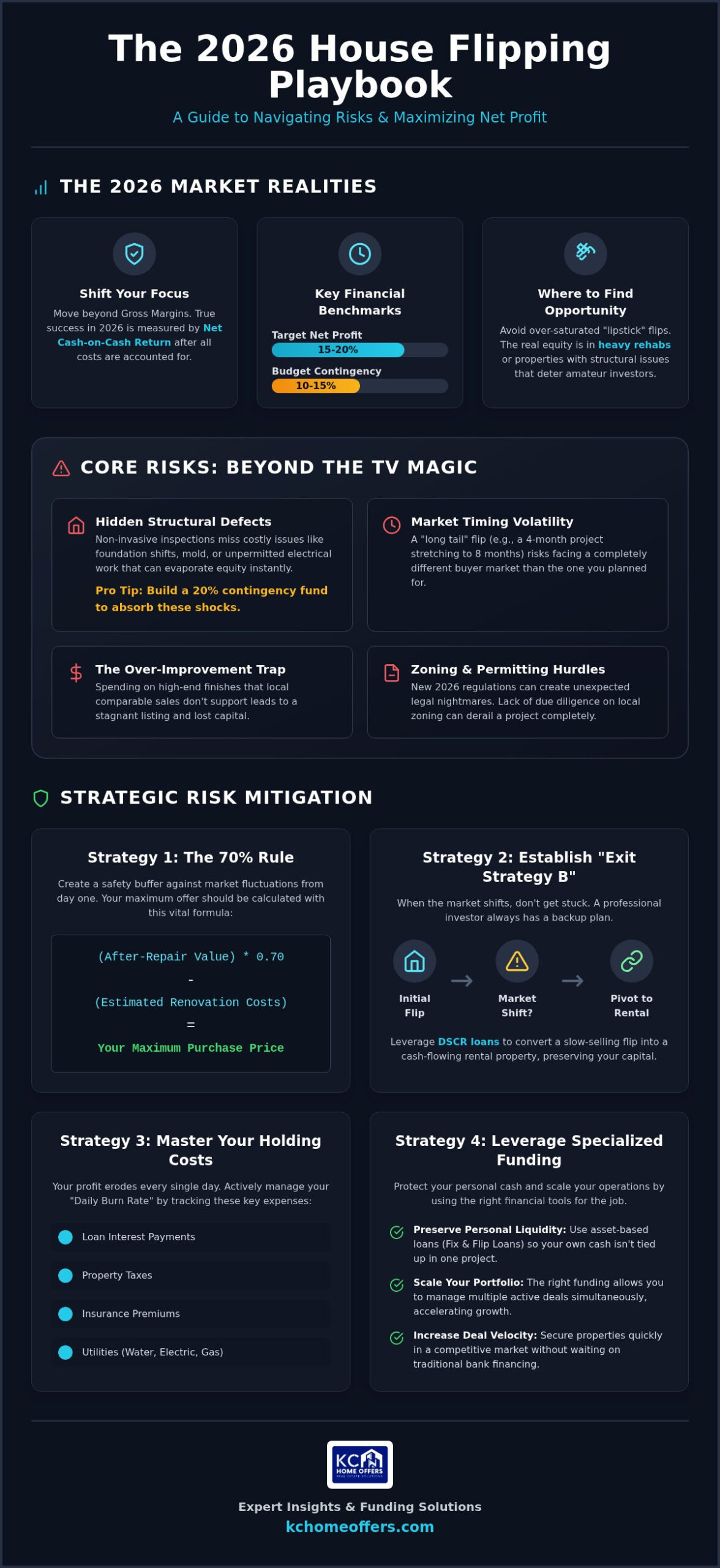
Current inventory levels continue to challenge the “buy low” part of the investment equation. Scarcity has turned traditional MLS searching into a bidding war, forcing serious investors to rely on off-market deals and direct-to-seller marketing. While the 2026 interest rate environment has stabilized, it has also created a more discerning buyer pool. These buyers are no longer rushing into every listing; they demand high-end finishes and functional layouts. The 70% Rule dictates that an investor should pay no more than 70% of a property’s after-repair value minus renovation costs, a benchmark that remains vital in 2026 to ensure a safety buffer against market fluctuations.
The 2026 Profit Margin Benchmark
A healthy ROI in the current market typically targets a net profit of 15% to 20% of the total project cost. Gross profit is a vanity metric that ignores the “daily burn” of interest, utilities, and property taxes. With 2026 labor costs remaining a significant variable, your budget needs a built-in contingency of at least 10% to 15%. If your net return doesn’t significantly outperform passive investment vehicles, the effort and exposure aren’t justified. We focus on net liquidity because that’s what actually funds your next deal.
Market Saturation vs. Opportunity
Success in 2026 requires identifying micro-markets where local demand outpaces the general regional trend. Cosmetic “lipstick” flips are often over-saturated, leading to thin margins and high competition. The real opportunity lies in heavy rehabs or properties with structural issues that scare off less experienced amateurs. This is where fix and flip funding acts as your strategic engine. It provides the speed and liquidity needed to secure complex projects while managing the inherent risks of flipping houses. By tackling the projects others avoid, you secure the equity that drives long-term growth.
The Core Risks of Flipping Houses: Beyond the “TV Magic”
TV isn’t reality. While a producer might cut from a demolition scene to a finished kitchen in seconds, the actual timeline involves permits, inspections, and the constant threat of discovering a cracked sewer line. The “Renovation Rabbit Hole” is where most amateur investors lose their shirts. Hidden structural issues don’t just delay your project; they evaporate equity faster than you can revise your spreadsheet. When you open a wall and find unpermitted electrical work or a compromised load-bearing beam, your profit margin isn’t just squeezed, it’s often eliminated.
Market timing risk represents another significant hurdle in 2026. The danger of the “long tail” flip is real in a shifting economy. If a standard four-month project stretches into eight months due to supply chain hiccups or labor shortages, the buyer demand you counted on during the acquisition phase might look different by the time you list. You also face the “Over-Improvement” trap. Spending heavily on quartz countertops and smart home systems in a neighborhood where the comparable sales don’t support those premiums is a fast track to a stagnant listing. Successful investors know that risks of flipping houses are often found in the details of the local zoning office. 2026 has brought specific zoning changes in many municipalities aimed at increasing density, which can either be a goldmine or a legal nightmare depending on your due diligence.
Hidden Physical Defects and Inspection Gaps
Standard home inspections often miss the most expensive problems because they are non-invasive. You won’t know about a foundation shift or a slow-leaking pipe behind the master shower until the demo crew arrives. Surprises like mold or outdated knob-and-tube wiring can add five figures to a budget instantly. We recommend building a 20% contingency fund into every project budget to absorb these shocks without derailing your liquidity. If you need a partner who understands these local market dynamics, KC Home Offers LLC provides the professional insight needed to evaluate a deal’s true potential.
Legislative and Tax Pitfalls
Profit isn’t just about the sale price; it’s about what you keep after the government takes its share. Short-term capital gains taxes apply to most flips, and these rates are significantly higher than long-term rates. Additionally, 2026 has seen a rise in local “anti-flipping” ordinances and vacant property fees designed to discourage rapid turnover. These legislative risks of flipping houses can eat into your ROI if you haven’t consulted a CPA to structure your business correctly. Professional investors treat taxes and local fees as fixed costs, not afterthoughts, ensuring the net return remains worth the effort.
Financial Pitfalls: Why Holding Costs and Underfunding Kill ROI
A budget might look solid on paper, but the “Daily Burn Rate” is the silent killer of many investment projects. Every day a property remains under renovation or sits on the market, it consumes capital through interest payments, property taxes, and utility bills. These carrying costs are often underestimated by newcomers who focus solely on the purchase price and material costs. In 2026, where utility rates and property tax reassessments have seen upward trends, these daily expenses add up quickly.
Another overlooked financial hurdle is insurance. Relying on a standard homeowner’s policy during a major renovation is one of the most dangerous risks of flipping houses. Most standard policies have exclusions for vacant properties or buildings under construction. If a pipe bursts or a fire occurs, you could find yourself with a total loss and no coverage. Professional investors switch to builder’s risk insurance to protect their equity and ensure a single accident doesn’t bankrupt the project.
Tying up all your liquid capital in a single project also creates a significant opportunity cost. If a better deal comes along while your cash is locked in a slow-moving flip, you’re stuck on the sidelines. Understanding the fix and flip loan process allows you to leverage your capital, preserving liquidity so you can scale and manage multiple projects simultaneously. Professional financing provides the structure needed to treat your investment as a business rather than a high-stakes hobby.
Calculating the True Cost of Time
Time is literally money in real estate. A 2-month delay in obtaining permits or waiting for a specific contractor can easily drain $10,000 or more in carrying costs. Speed to market isn’t just about efficiency; it’s your most important profit protector. In the 2026 market, where property tax reassessments can trigger mid-project, every extra week on the calendar erodes your net return. We prioritize speed and transparency because we know that the faster you exit, the higher your actual ROI becomes.
Liquidity Crises and Mid-Project Stalls
Liquidity crises often strike when the project is 80% complete. Running out of cash before the kitchen is finished forces many into the trap of using high-interest personal credit cards for rehab materials. This move destroys your ROI and increases the risks of flipping houses by creating unmanageable debt. A professional lender uses a structured draw schedule; this ensures funds are released as specific milestones are met. This partnership prevents mid-project stalls and ensures the property reaches the finish line without financial friction. Investors who want to avoid this scenario entirely should explore rehab loans designed to fund property transformations from acquisition through completion, providing the capital structure needed to see every project through to a profitable exit.
Strategic Risk Mitigation: How Pro Investors Hedge Their Bets
Professional investors view the risks of flipping houses as variables to be solved rather than obstacles to be feared. They build an “Exit Strategy B” into every deal before the first contract is signed. This mindset shifts the focus from hoping for a quick sale to ensuring the project remains viable regardless of short-term market fluctuations. By categorizing risks into manageable line items, you can move with the speed and confidence required in the 2026 market.
Effective contractor management is a cornerstone of this strategy. By using milestone-based payments, you ensure performance before capital is released. This protects your liquidity and keeps the project on schedule. You must also exercise strict scope creep control. Stick to the “Minimum Viable Product” that meets the neighborhood standard. Adding high-end finishes that the local market won’t pay for is a common mistake that erodes your margin. Market absorption analysis provides the data needed to price your exit correctly. Knowing exactly how many days houses are sitting on the market in your specific zip code allows you to adjust your holding cost projections. If the local DOM (Days on Market) is increasing, your strategy must account for a longer carry period.
The “Buy and Hold” Safety Net
Plan B is your insurance against a sudden market dip. If a property doesn’t sell within your target window, you need to know if it can function as a high-performing rental. A DSCR loan for rental property is the ideal tool for this pivot. It focuses on the property’s cash flow rather than your personal income, allowing you to refinance out of a short-term flip loan and wait for a better selling environment. Calculating the break-even rent against your projected mortgage payment is a non-negotiable step in your pre-acquisition analysis. This pivot preserves your equity while the market stabilizes.
Due Diligence as a Risk Shield
Your 48-hour feasibility study is your most powerful defense. Check the title, verify local zoning, and walk the property with a trusted contractor before your earnest money becomes non-refundable. When verifying After Repair Value (ARV), rely strictly on 2026 “sold” data rather than “active” listings. Active prices are just aspirations; sold prices are reality. Reviewing fix and flip loan requirements early in the process helps validate your deal. If the numbers don’t meet professional lending standards, it’s a strong signal that the deal carries too much exposure. Ready to scale your portfolio with a lender that acts as a strategic ally? Explore our investor-focused loan products and get started today.
Leveraging Specialized Funding to Minimize Investor Exposure
Many investors believe that using their own cash is the safest way to operate, but this strategy often increases the risks of flipping houses by creating a liquidity trap. When your entire net worth is tied up in a single piece of real estate, you have zero margin for error. Specialized funding allows you to preserve your cash reserves for unexpected renovation hurdles or to secure multiple properties at once. By leveraging capital, you diversify your exposure and ensure that one difficult project doesn’t paralyze your entire business. In the 2026 market, liquidity is your most valuable asset.
Asset-based lending shifts the focus from your personal W2 income to the actual potential of the property. This model acts as a vital safety check for your investment strategy. Think of a professional lender’s appraisal as a high-level second opinion; if a seasoned expert isn’t willing to put capital behind your deal, it’s a strong indicator that your ARV or renovation budget is unrealistic. This partnership approach removes friction and provides a layer of professional oversight that protects your personal assets from the volatility of the market. It allows you to move with the confidence of a seasoned pro, even if you don’t have a traditional corporate income profile.
Fix & Flip Loans vs. Traditional Financing
Traditional banks are rarely equipped to handle the realities of distressed property investment. They often refuse to fund homes that don’t meet strict habitability standards, which is exactly where the profit lives in a flip. This refusal creates a significant risk for investors who might lose a deal while waiting weeks for a bank’s approval process. Specialized Fix & Flip loans provide a speed advantage, allowing you to close in days and beat out competitors who are stuck in red tape. Additionally, interest-only payments during the rehab phase significantly improve your monthly cash flow. This keeps your “daily burn” manageable while you focus on the construction phase. Understanding the full spectrum of rehab loans available in 2026 ensures you select the right financing structure for each unique property transformation.
Scaling Your Portfolio with Confidence
Scaling your business from one project a year to three or more requires a shift in how you view debt. Using leveraged capital reduces your personal risk by ensuring you aren’t “all in” on every individual deal. This asset-based structure allows you to scale without the hurdle of personal income verification, focusing instead on the strength of the investment itself. It’s about moving with momentum and efficiency to capture market opportunities as they arise. Ready to fund your next project? See our Fix & Flip loan options and take the next step toward a more resilient investment strategy.
Mastering the 2026 Investment Landscape
Flipping remains a viable path to wealth for those who treat it as a disciplined business. Success in 2026 requires more than just finding a property; it demands a deep understanding of market absorption and a rigid adherence to net profit benchmarks. By accounting for the risks of flipping houses through strategic “Plan B” rentals and milestone-based contractor management, you shift from gambling to calculated growth. You’ve learned that liquidity is your most powerful asset and that specialized funding is the engine that drives momentum.
We act as your strategic ally, providing the liquidity and expertise needed to move at the speed of the market. Our specialized Fix & Flip and DSCR loans require no personal income verification, allowing you to focus on the asset’s potential rather than red tape. With fast approvals for your time-sensitive deals and deep expertise in national investment property markets, we help you remove friction from every transaction. Get a Fast Quote for Your Next Fix & Flip Project and start scaling your portfolio with confidence. You have the knowledge and the strategy; now it’s time to execute.
Frequently Asked Questions
Is flipping homes lucrative for beginners in 2026?
Yes, flipping remains lucrative for beginners who prioritize local market data over speculation. Success in 2026 depends on finding off-market opportunities rather than relying on saturated public listings. You should aim for a net profit margin of at least 15% to 20% to ensure the effort is worth the exposure. Beginners must treat their first deal as a learning phase where risk mitigation is more important than hitting a home run.
What are the most common risks of flipping houses?
The most common risks of flipping houses include hidden structural defects, inaccurate After Repair Value (ARV) projections, and rising holding costs. Unexpected issues like mold or foundation shifts can instantly evaporate your equity if you don’t have a contingency fund. Additionally, market timing risk can leave you holding a property longer than planned, which increases your interest and utility carry. Professional investors use thorough due diligence to turn these risks into manageable line items.
How much money do I need to start flipping houses safely?
You typically need enough capital to cover a 10% to 20% down payment, closing costs, and a 20% renovation contingency fund. While specialized loans cover a large portion of the purchase and rehab, having your own reserves ensures you can handle mid-project surprises without stalling. Safety in flipping comes from liquidity; running out of cash before the project is 100% complete is a leading cause of investor failure in any market.
Can I flip a house with no experience and no W2 income?
Yes, you can flip a house without a W2 or prior experience by using asset-based lending. Specialized Fix & Flip loans focus on the property’s potential and the strength of the deal rather than your personal employment history. We partner with investors based on the project’s After Repair Value, which allows ambitious individuals to scale their businesses without the constraints of traditional residential mortgage requirements. It’s about the deal, not your paycheck.
How do I calculate the After Repair Value (ARV) accurately?
Calculate ARV by analyzing at least three “sold” comparable properties within a half-mile radius that have been renovated to a similar standard. Use data from the last 90 to 180 days to ensure your numbers reflect the current 2026 market reality. Avoid using “active” listings as benchmarks; these are just asking prices and don’t represent what buyers are actually willing to pay. Accurate ARV is the foundation of your entire profit projection.
What happens if a house flip doesn’t sell as fast as expected?
If a flip doesn’t sell quickly, your best move is to execute an “Exit Strategy B,” such as converting the property into a rental. You can use a DSCR loan to refinance out of your short-term debt and into a long-term mortgage based on the property’s rental income. This pivot protects your equity while you wait for a more favorable selling window. It effectively turns a stagnant listing into a cash-flowing asset.
Are fix and flip loans better than using my own cash?
Fix and flip loans are often superior to using cash because they preserve your liquidity and allow you to scale your portfolio. Tying up all your capital in one deal increases the risks of flipping houses by leaving you with no backup funds for emergencies. Leveraging specialized capital allows you to manage multiple projects simultaneously, which increases your overall annual ROI and protects your personal net worth from project-specific volatility.
What is the “70% Rule” in real estate flipping?
The 70% Rule states that an investor should pay no more than 70% of the After Repair Value (ARV) minus the estimated cost of renovations. For example, if a house will be worth $300,000 and needs $50,000 in repairs, your maximum purchase price should be $160,000. This formula provides a built-in safety buffer to cover holding costs, commissions, and those unexpected surprises that naturally occur during the rehab phase.