

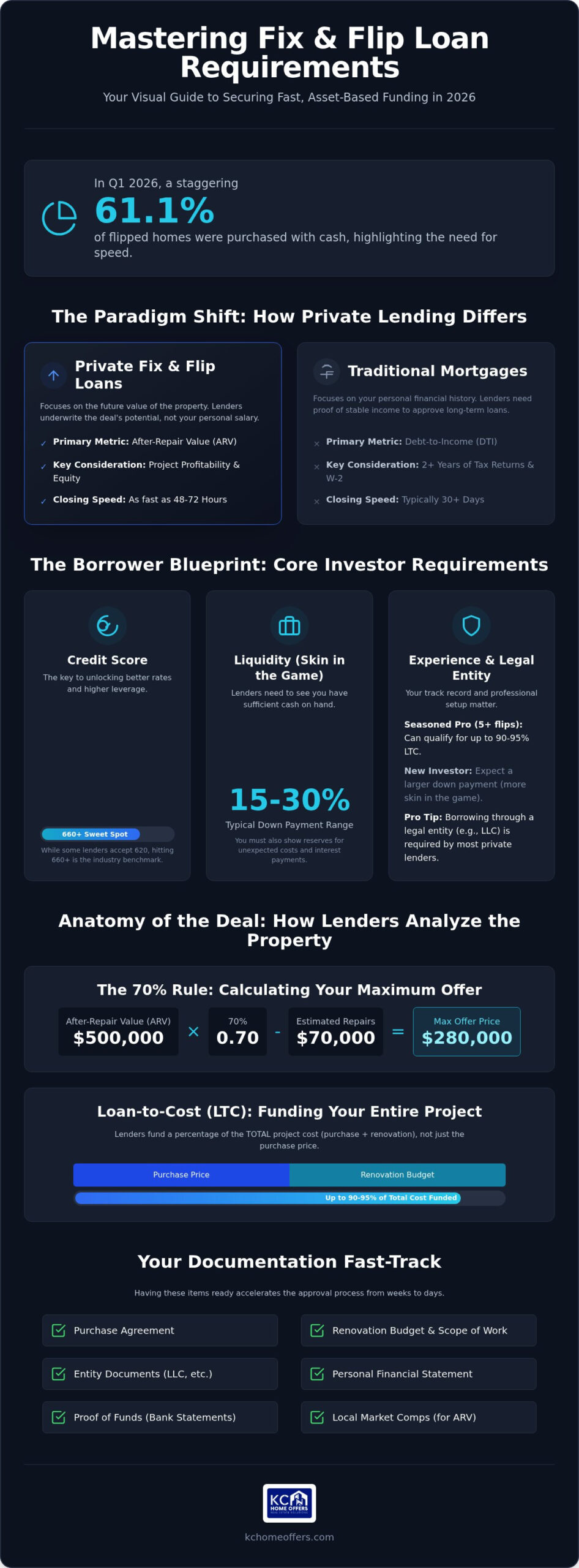
In the first quarter of 2026, 61.1% of flipped homes nationwide were purchased with cash, leaving many financed investors struggling to keep pace. You’ve likely felt the sting of losing a deal because your funding wasn’t ready, or perhaps you’re navigating the confusion surrounding shifting fix and flip loan requirements in a high-velocity market. It’s a common friction point; without a clear path to capital, even the best property deals can slip through your fingers while you wait for a traditional bank to review your personal income.
At KC Home Offers LLC, we believe that understanding the exact criteria private lenders use to fund deals is the key to scaling your portfolio. This guide provides a direct roadmap to loan approval, showing you how to leverage property equity and project feasibility instead of just your personal tax returns. We’ll preview the credit benchmarks, liquidity standards, and documentation checklists you need to master to secure a reliable funding partner and close with the confidence of a cash buyer.
Key Takeaways
- Learn why private lenders prioritize property performance and After-Repair Value instead of traditional W-2 income metrics.
- Master the essential fix and flip loan requirements for 2026, including the 660+ credit score benchmark for securing competitive rates.
- Understand how to leverage Loan-to-Cost and the 70% Rule to maximize your funding while minimizing personal cash outlays.
- Discover the necessity of borrowing through a legal entity like an LLC to align with professional underwriting standards.
- Gain a clear roadmap for organizing your financial documentation to accelerate the approval process and close deals faster.
Why Fix and Flip Loan Requirements Differ from Traditional Mortgages
Traditional mortgage lenders focus almost entirely on your past. They demand two years of tax returns, a steady W-2, and a low debt-to-income ratio to prove you can handle a thirty-year commitment. For a real estate investor, this backward-looking approach is a massive bottleneck. In the specialized world of house flipping, the value isn’t found in what you earned last year; it’s found in what the property will be worth six months from now. Private lenders operate on a different set of fix and flip loan requirements because they are underwriting the deal, not just the person.
This fundamental shift moves the focus from the current purchase price to the After-Repair Value (ARV). While a traditional bank might only lend based on the current distressed state of a home, a private capital partner looks at the finished product. This allows you to secure the renovation capital necessary to actually execute the project. It’s a high-velocity, short-term model that prioritizes asset performance over personal history, creating a risk-reward profile that favors speed and equity over long-term interest payments.
Asset-Based vs. Income-Based Underwriting
In private finance, your debt-to-income (DTI) ratio carries significantly less weight than it does at a local credit union. Lenders aren’t concerned if your personal income fluctuates, provided the property shows a strong potential profit margin. The property’s projected equity becomes your primary income qualification during the underwriting process. While you’ll still provide a personal financial statement, your tax returns take a backseat to the renovation budget and the local market comps. This approach allows ambitious investors to scale their portfolios without being capped by their personal salary limits.
The Speed Factor in Competitive Markets
Speed is the ultimate currency in the 2026 real estate market. A traditional 30-day closing window is often a deal-killer when you’re negotiating with distressed sellers who need an immediate exit. Meeting specific fix and flip loan requirements early allows for funding cycles as fast as 48 to 72 hours. Having your documentation organized and transparent from the start eliminates the friction that usually slows down traditional underwriting. When you’re pre-approved based on these asset-focused rules, you can walk into a negotiation with the same confidence as a cash buyer. This momentum is what separates successful flippers from those who are constantly stuck in the waiting for bank approval loop.
The Core Borrower Requirements: Credit, Liquidity, and Experience
While private capital focuses heavily on the property, your personal financial profile remains a critical component of the approval process. Lenders view fix and flip loan requirements as a measure of your ability to manage a project through to completion without defaulting. In 2026, a credit score of 660 has emerged as the industry sweet spot. While some lenders accept scores as low as 620, hitting that 660 mark often unlocks significantly better interest rates and higher leverage, reducing your out-of-pocket costs at the closing table.
Integrity and transparency are the bedrock of these partnerships. Beyond the numbers, lenders perform background checks to ensure there are no recent bankruptcies, foreclosures, or legal issues that could jeopardize the project. They also utilize a tiered experience system. Seasoned pros who have completed five or more flips in the last three years often qualify for 90% or even 95% Loan-to-Cost (LTC). If you’re a beginner, expect to bring a larger down payment to the table as you build your track record in fix and flip loans.
Credit Scores and Interest Rate Tiers
Your FICO score is a direct lever for your project’s profitability. Higher scores don’t just lower your interest rate; they dictate how much of the purchase and renovation costs the lender will cover. If your credit is bruised, you aren’t necessarily disqualified. Many investors overcome lower scores by partnering with someone who has stronger credit or by accepting a lower LTC, which requires more personal cash. Most private lenders now offer soft credit pulls for initial pre-qualification, meaning you can check your eligibility without impacting your score.
Proof of Funds and Liquidity Standards
Liquidity is about more than just the down payment. Lenders want to see that you have “skin in the game” and enough cash on hand to handle the unexpected. Industry standards for down payments typically range from 15% to 30%. You must also prove you have interest reserves and a “cushion” for the first few construction draws. Liquid assets can include cash in savings, brokerage accounts, or even a portion of your 401k. If you’re short on cash, gap funding from a secondary partner is an option, but lenders will still want to see that you have some personal capital at risk to ensure you stay committed to the deal.
If you’re ready to see how your current profile aligns with these 2026 standards, you can explore our specialized Fix & Flip Loan options to get a clear picture of your borrowing power.
Property and Project Requirements: ARV and LTC Frameworks
While your credit and liquidity open the door, the property’s potential is what actually secures the funding. Private lenders use a specific set of fix and flip loan requirements to stress-test your project before committing capital. They aren’t just looking at the house as it stands today; they are evaluating the feasibility of your vision. Unlike the rigid, debt-to-income focus of Traditional Mortgages, fix and flip underwriting is dynamic. It balances the current purchase price against the eventual exit value, ensuring there is enough meat on the bone to cover the debt and generate a profit.
Lenders typically operate within a 65% to 75% After-Repair Value (ARV) cap. If your project’s total loan amount exceeds 75% of what the home will be worth, the deal is likely too risky for most private firms. This is the “70% Rule” in action, a benchmark used to mitigate risk against market fluctuations and renovation overruns. If you’re a newer investor with less experience, a lender might ask you to bring more cash to the table to compensate, effectively lowering the Loan-to-Value (LTV) to protect the investment. Understanding the full spectrum of risks of flipping houses in 2026, from hidden renovation costs to shifting market conditions, is essential before you commit capital to any project.
Calculating the After-Repair Value (ARV)
ARV is the estimated market value of a property after all planned renovations are completed. To verify this number, underwriters scrutinize your “Comps” or comparable sales report. In 2026, lenders prioritize 12-month trailing market data, looking for at least three properties of similar size and condition within a one-mile radius that have sold recently. They don’t just want to see high prices; they want to see a consistent upward trend in the neighborhood that justifies your projected sale price. If your comps are weak or too far away, expect the lender to trim your loan amount.
Loan-to-Cost (LTC) and Rehab Budget Limits
Loan-to-Cost (LTC) represents the percentage of the total project cost the lender will fund. Most 2026 fix and flip loan requirements cap this at 85% to 90% of the purchase price, though they often fund 100% of the renovation costs. This rehab capital isn’t handed over at the closing table. Instead, it’s managed through a “Draw Schedule.” You complete a specific phase of work, such as the roof or electrical, and the lender sends an inspector to verify the progress before releasing the funds as a reimbursement. This structure ensures the project stays on track and the capital is used exactly as planned. For a deeper dive into how renovation financing is structured across different property types and investor profiles, our complete guide to rehab loans for 2026 breaks down every layer of the process.
Property type also dictates eligibility. Single-family homes are the gold standard for speed and liquidity. While multi-unit or mixed-use properties are fundable, they often come with stricter requirements and lower leverage. Your application must prove the neighborhood can support the finished product’s price point, or the project will fail the feasibility test before it ever reaches the appraisal stage.
The Investor’s Documentation Checklist: Preparing for Underwriting
Paperwork is often where the momentum of a deal dies. While the property potential drives the initial interest, your ability to provide a clean, professional documentation package is what actually triggers the wire. Meeting fix and flip loan requirements in 2026 means moving beyond handwritten notes and vague estimates. You need a structured Personal Financial Statement (PFS) that clearly outlines your assets and liabilities, allowing underwriters to verify your liquidity at a glance. Additionally, you’ll need to secure title insurance and specialized builder’s risk insurance to protect the project from the day of closing.
Underwriters in 2026 are looking for a cohesive story. Your PFS should not just be a list of numbers; it should show a trajectory of growth and financial stability. If you’re using retirement accounts as part of your liquidity, provide the latest statements that show the vested balance. Regarding insurance, ensure your policy includes a vacancy clause. Many standard homeowners’ policies will deny claims on a property that is unoccupied during a renovation. This level of detail shows the lender you are a seasoned expert who understands the operational risks of the business.
Entity and Corporate Documentation
Private lenders almost exclusively lend to business entities rather than individuals. This structure limits liability for the investor and streamlines the legal process for the lender if the project fails. You’ll need your Articles of Organization, a signed Operating Agreement, and your federal EIN. Even though the loan is made to your LLC or S-Corp, expect to sign a Personal Guaranty. This document ensures you remain personally accountable for the debt, bridging the gap between your corporate structure and your personal commitment to the project’s success.
The Scope of Work (SOW) and Construction Bid
The Scope of Work (SOW) is the most scrutinized document in your application. Underwriters use it to determine if your budget is realistic for the market and the property condition. A professional SOW must include specific timelines and contractor signatures to be considered valid. Vague categories like “kitchen remodel” won’t cut it. You must provide detailed line-items for materials, labor, and a 10% to 15% contingency fund for the inevitable surprises found behind the drywall. Using detailed contractor bids as backup documentation proves you’ve done the legwork and have a reliable team ready to break ground.
Documentation speed is the key to beating out cash buyers in a tight market. If you’re ready to move forward, you can start your application with KC Home Offers today and get your paperwork in front of our underwriting team immediately.
Navigating Fix and Flip Requirements with KC Home Offers LLC
Meeting the 2026 fix and flip loan requirements is a major milestone, but a checklist is only as good as the lender standing behind it. At KC Home Offers LLC, we don’t just check boxes; we build partnerships. We understand that in a market where cash is king, your financing needs to be just as liquid and reliable. Our approach is built on transparency and speed, ensuring you don’t lose a deal to a slower competitor or a bureaucratic bank. We act as a dependable guide through the complex financial landscape, providing the professional weight you need to close with confidence.
We pride ourselves on being more than just a source of capital. We are a high-integrity facilitator deeply knowledgeable about market dynamics. By removing the friction from the funding process, we allow you to focus on what you do best: finding and renovating properties. Our communication style is fundamentally confident and transparent, aiming to project a sense of unwavering reliability. We avoid the cold, detached feel of traditional corporate banking, opting instead for a style that feels like a partnership between seasoned experts and ambitious investors.
Tailored Financing for Every Investor Tier
First-time flippers often feel overwhelmed by the standard requirements found in traditional finance. We simplify that by focusing on the property’s potential and your commitment to the project. For seasoned developers looking to scale their operations, our fix and flip funding options are designed for volume and efficiency. We prioritize the performance of the asset above all else. If the property has the right margins and the exit strategy is sound, we’ll find a way to make the numbers work. This “deal-first” philosophy is why national investors trust KC Home Offers LLC to handle their most complex projects without the friction of traditional underwriting.
Fast-Track Approval: From Application to Funding
Our fix and flip loan process is engineered for momentum. It starts with a simple three-step review. First, you submit the property details and your high-level budget. Second, our team performs a rapid internal valuation to confirm the ARV and project feasibility. Third, we issue a transparent term sheet that outlines exactly what you need for a fast close. There are no hidden fees or last-minute surprises. We’re straight shooters who value your time as much as our own, providing clear communication from the initial quote to the final construction draw.
Scaling a real estate portfolio requires more than just knowing the fix and flip loan requirements; it requires a strategic ally who understands the local market dynamics. Whether you’re tackling your first renovation or your fiftieth, KC Home Offers LLC provides the professional oversight and capital flexibility you need to succeed. We remove the friction of the funding process so you can focus on finding the next deal. Reach out today for a transparent, no-obligation quote and let’s get your next project funded.
Secure Your Capital and Scale Your Portfolio
Mastering the fix and flip loan requirements for 2026 is what separates hobbyists from professional investors. We’ve explored how shifting from a W-2 focus to asset performance allows you to unlock equity and move with the speed of a cash buyer. By aligning your credit profile, liquidity reserves, and corporate entity structure with these private lending standards, you remove the primary barriers to rapid growth and portfolio expansion.
KC Home Offers LLC provides the national lending expertise and transparent terms needed to execute your strategy without the typical friction of traditional banking. Our commitment to fast approvals and straightforward communication ensures you can bid on properties with absolute certainty. When you work with a straight-shooting partner who values results, you gain more than just capital; you gain a strategic ally dedicated to your long-term success in a competitive market.
Don’t let financing delays prevent you from capturing the next high-margin deal. You have the checklist; now it’s time to leverage it. Apply for a Fix and Flip Loan with KC Home Offers LLC Today and start scaling your portfolio with a partner who understands the 2026 market dynamics. Success is built on preparation and reliable funding; let’s get your next project started.
Frequently Asked Questions
What is the minimum credit score for a fix and flip loan in 2026?
The minimum credit score generally falls between 620 and 680, depending on the specific lender’s risk appetite. While a 620 score can get you in the door, achieving a 660 or higher is often the benchmark for unlocking more competitive interest rates and higher leverage. Lenders prioritize your financial reliability to ensure you can manage the project’s debt service through completion without friction.
Can I get a fix and flip loan with no experience?
You can absolutely secure a loan with no prior experience, though your initial terms may reflect a higher risk profile. First-time investors are usually required to bring a larger down payment, often around 25% to 30%, to provide a greater equity cushion. As you complete more projects and build a track record, you’ll move up the experience tiers and qualify for lower out-of-pocket costs and better leverage.
How much down payment is typically required for a rehab loan?
Most private lenders require a down payment between 15% and 30% of the property’s purchase price. This ensures you have significant “skin in the game” and reduces the lender’s exposure if the market shifts during your renovation. Higher down payments are common for beginners, while seasoned pros with a history of successful exits can often secure funding with as little as 10% to 15% down.
Do fix and flip lenders require income verification or tax returns?
Fix and flip lenders prioritize asset-based underwriting over traditional income verification or personal tax returns. Instead of focusing on your debt-to-income ratio, they evaluate the property’s After-Repair Value and your detailed renovation budget. While you’ll still provide a personal financial statement to prove liquidity, the primary “income” used for approval is the projected profit from the property itself rather than your W-2 history.
What property types are eligible for fix and flip financing?
Eligible property types typically include single-family homes, 2 to 4 unit multi-family properties, and sometimes mixed-use buildings. Single-family residences are the most common because they offer the highest liquidity and the most straightforward market comparables. While some lenders fund commercial or larger multi-unit projects, these often come with stricter fix and flip loan requirements and lower leverage thresholds to mitigate the increased complexity.
How long does it take to get approved for a fix and flip loan?
Approval for a fix and flip loan typically takes between 5 and 14 days, which is significantly faster than traditional bank financing. This speed allows investors to compete with cash buyers and close on distressed properties before they hit the open market. Having your entity documents, scope of work, and proof of funds ready can often accelerate this timeline to under a week for qualified borrowers.
What is a ‘Draw Schedule’ and how does it work for renovations?
A draw schedule is a structured reimbursement system where the lender releases renovation funds in stages as specific work is completed. You finish a phase, such as the plumbing or roofing, and the lender sends an inspector to verify the progress. Once the work is confirmed, the funds are released from the renovation escrow to cover those specific costs, ensuring the project stays on budget and the capital is used correctly.
Can I use a fix and flip loan to buy a rental property?
You can use a fix and flip loan to purchase a property you intend to keep as a rental, provided you have a clear long-term exit strategy. This is often the first step in the BRRRR method, where you use short-term rehab loans to renovate and then refinance into a long-term DSCR loan once the property is stabilized. It’s a powerful way to meet fix and flip loan requirements while building a long-term portfolio using property equity.