


Traditional banks often view a distressed property as a liability, yet seasoned investors recognize that the true value is found in the transformation. If you’ve ever faced a rejection because a house wasn’t habitable or felt anxious about how 2026 interest rates impact your bottom line, you aren’t alone. Mastering the fix and flip loan process is the critical difference between a stalled project and the $66,000 average gross profit seen by investors earlier this year. We’re moving past the red tape of corporate banking to focus on asset-based lending that prioritizes your deal’s potential over your personal tax returns.
You need a financing partner that values speed and transparency as much as you do. This guide teaches you how to secure capital that covers both the acquisition and the rehab, ensuring your renovation momentum never slows down. We’ll explore the mechanics of calculating a precise After-Repair Value (ARV) for lenders and explain the exact timeline for fund releases. You’ll walk away with a clear roadmap to navigate the 2026 market with confidence, allowing you to scale your portfolio and maximize your returns.
Key Takeaways
- Learn why traditional banks reject distressed properties and how bridge financing solves the problem for un-livable homes.
- Master the fix and flip loan process by understanding how lenders use After-Repair Value (ARV) to determine your initial purchase advance.
- Compare hard money and private capital options to identify the best fit for your speed and underwriting requirements.
- Discover how to build a professional Scope of Work (SOW) that acts as the blueprint for your rehab fund releases.
- Gain a strategic roadmap for scaling your portfolio through transparent, asset-based partnerships that prioritize market momentum.
What is a Fix and Flip Loan and Why Do You Need One?
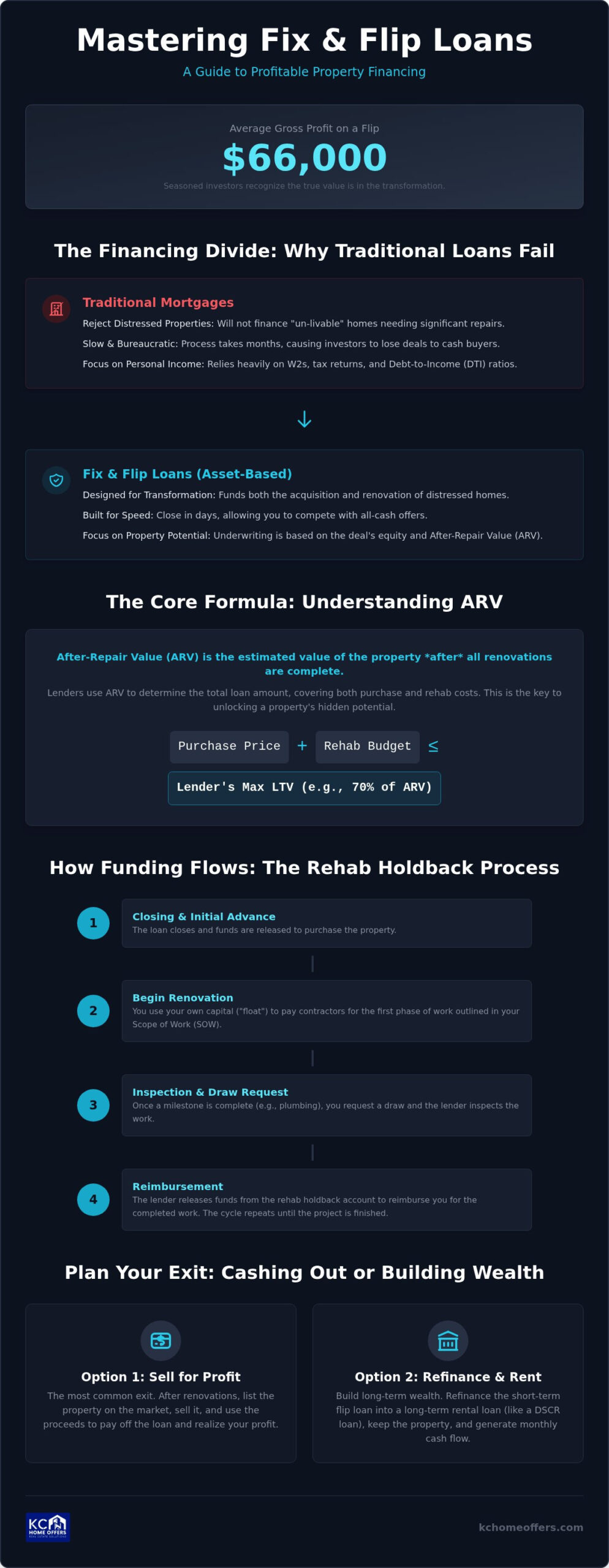
At its foundation, What is a Fix and Flip Loan is a specialized bridge product designed to facilitate the rapid acquisition and renovation of distressed real estate. Unlike a standard home loan, this is a short-term financial tool built for speed and property transformation. Traditional mortgages fail in this space because banks generally refuse to finance properties in “un-livable” condition. If a house has a failing foundation, a stripped kitchen, or significant structural damage, a conventional lender sees a liability rather than an opportunity. They require a certificate of occupancy that most flip projects simply cannot provide at the start.
The fix and flip funding model provides the agility needed to compete with all-cash buyers in a high-velocity market. Understanding the fix and flip loan process allows you to close deals in days rather than months, which is often the only way to secure deeply discounted properties. Lenders evaluate these deals using two primary metrics: Loan-to-Value (LTV) and Loan-to-Cost (LTC). While LTV focuses on the final appraised value of the home, LTC looks at the total project cost, covering both the purchase price and the renovation budget. This structure ensures you have the liquidity to complete the project without draining your personal reserves.
Asset-Based Lending vs. Conventional Mortgages
The most significant shift in the fix and flip loan process is the move toward asset-based underwriting. In this model, your credit score and personal history matter far less than the property’s potential for profit. Private lenders prioritize the deal’s equity and the projected After-Repair Value (ARV) over your W2 income. This approach eliminates the restrictive Debt-to-Income (DTI) requirements that often stop growing investors in their tracks. By using the property itself as the primary collateral, the financing feels more like a partnership between experts who understand the local market’s dynamics and the speed required to execute a successful renovation.
The Short-Term Nature of Flip Financing
These loans are built for momentum, not long-term holding. Typical terms range from 6 to 18 months, providing just enough time to execute the scope of work and list the property for sale. Most of these products feature interest-only payments, which helps keep your monthly carrying costs low while you focus your capital on materials and labor. Before the loan matures, you must execute an exit strategy. Most investors pay off the balance by selling the property for a profit, while others choose to keep the asset and refinance into a DSCR loan for rental property to build long-term wealth. This flexibility allows you to pivot based on market demand and your specific investment goals.
How Fix and Flip Loans Work: ARV and Rehab Holdbacks
The fix and flip loan process begins with the initial advance. This is the portion of the loan released at the closing table specifically to cover the property acquisition. While some lenders might cover a high percentage of the purchase price, you typically need some skin in the game. This capital allows you to move with the speed of a cash buyer, securing the property before competitors can even get a traditional appraisal scheduled.
Central to this entire structure is the After Repair Value (ARV). Lenders don’t just look at what the house is worth today; they look at what it will be worth once your vision is realized. This is determined through a specialized appraisal that compares your finished scope of work against similar renovated homes in the immediate area. Accurate ARV calculations are the lifeblood of your profit margin, as they dictate exactly how much total capital a lender is willing to commit to your project.
The Mechanics of the Rehab Holdback
Renovation funds are almost never distributed upfront. Instead, lenders use a system where the renovation budget is kept in escrow. A rehab holdback acts as a safety mechanism for both the lender and the investor to ensure the project reaches completion. You receive these funds through a series of draws after completing specific milestones, such as plumbing or drywall. Because draws are retrospective, you need sufficient float capital to pay contractors for the first phase of work before the lender reimburses you. Lenders utilize rehab holdbacks to manage risk and ensure the property value increases in alignment with the capital deployed.
Dutch vs. Non-Dutch Interest: Impact on Your ROI
Choosing the right interest structure can significantly alter your net profits. In a Dutch interest model, you pay interest on the entire loan amount, including the funds still sitting in the rehab holdback, from day one. This is common with many institutional lenders. Conversely, Non-Dutch interest only charges you for the capital you have actually drawn down and put to work. Managing the fix and flip loan process efficiently requires knowing which interest model serves your exit strategy. If you have a massive renovation budget that will take six months to deploy, Non-Dutch interest is often the superior choice for protecting your ROI. If you want to see how these numbers look for your next deal, you can review our loan terms to find a structure that fits your timeline.
Evaluating Your Funding Options: Hard Money vs. Private Capital
After you’ve mapped out the mechanics of ARV and holdbacks, the next step in the fix and flip loan process is identifying the right source of capital. While some beginners look toward traditional banks, experienced flippers know that standard institutions aren’t built for the speed or the condition of distressed assets. Understanding How Fix and Flip Loans Work across different lending categories is essential for maintaining your project’s momentum. You need a partner that understands the local market and prioritizes the deal’s potential over a stack of W2 forms.
Hard money lenders serve as the industry standard for those who need to move quickly. These are asset-based lenders who focus primarily on the property’s value and your renovation plan. Private capital, often provided by specialized firms like KC Home Offers, offers a similar level of speed but frequently operates with a more partnership-driven mindset. These firms act as strategic allies, providing the transparency and integrity required to scale a real estate business. Other creative avenues include using a Home Equity Line of Credit (HELOC) on your primary residence or negotiating seller financing, though these methods often come with higher personal risk or limited availability in competitive markets.
Why Investors Choose Hard Money Over Banks
Speed is the primary currency in real estate investing. A hard money lender can typically move from application to closing in 7 to 10 days, whereas a traditional bank often requires 45 days or more. This rapid turnaround allows you to secure high-margin deals that would otherwise go to all-cash buyers. Beyond speed, these lenders offer a level of flexibility you won’t find at a corporate branch. They understand the nuances of renovation costs and local market trends, allowing them to negotiate terms based on the actual complexity of your specific project rather than a rigid, one-size-fits-all checklist.
Analyzing the True Cost of Capital
Evaluating a loan requires looking beyond the interest rate. You must account for origination points, which in 2026 typically range from 1.5 to 3 percent of the loan amount. Additional expenses such as appraisal fees, which average around $500, and draw fees for rehab inspections must be factored into your ROI calculations. While the interest rates on these loans are higher than a 30 year mortgage, the cost is often justified by the ability to secure a profitable deal. A slightly higher rate is a small price to pay for the capital that enables a $66,000 gross profit. Focus on the total cost of the fix and flip loan process to ensure your exit strategy remains lucrative. Before committing to any project, it’s equally important to understand the full risks of flipping houses in 2026 so you can accurately assess whether a deal’s margins justify the capital deployed.
The 5-Step Process to Securing Fix and Flip Funding
Execution is everything in real estate. Once you’ve identified a potential property, you must move through the fix and flip loan process with precision to ensure your capital is ready when you are. This isn’t about jumping through hoops; it’s about validating your investment strategy so that both you and your lender can move forward with confidence. Efficiency during these steps often determines whether you secure a high-margin deal or lose it to a faster competitor.
- Step 1: Deal Analysis. Before you even reach out to a lender, ensure the deal offers a minimum 30% profit margin. This buffer is essential to account for the median 165-day flip time and unexpected holding costs.
- Step 2: Preparing the Scope of Work (SOW). This is your project’s financial blueprint. It details every renovation cost from demolition to the final coat of paint.
- Step 3: Loan Application and Pre-Approval. Submit your deal for review. A strong application establishes your credibility and allows the lender to issue a proof of funds letter, which is vital for making competitive offers.
- Step 4: The Feasibility Appraisal. The lender will order an appraisal to verify your projected After-Repair Value. This step confirms that your renovation plan will actually result in the market value you’ve estimated.
- Step 5: Closing and Initial Disbursement. Once approved, you’ll head to the closing table. The lender provides the initial advance for the purchase, the clock starts, and you get the keys to begin work.
Creating a Lender-Ready Scope of Work (SOW)
A professional SOW breaks down your budget into clear categories such as plumbing, electrical, structural, and cosmetic finishes. You should use actual contractor bids to validate these numbers rather than relying on rough estimates. This level of detail shows the lender that you’ve done your homework and understand the practical realities of the job site. A detailed SOW is the #1 way to build trust with a private lender. Before you submit your application, reviewing the full fix and flip loan requirements and eligibility checklist ensures your documentation package is complete and lender-ready from day one.
Navigating the Draw Schedule During Renovation
Understanding the draw schedule is critical for maintaining your project’s momentum. You’ll request inspections as specific milestones are completed to release funds from the rehab holdback. You must provide documentation including photos, receipts, and lien waivers to trigger a disbursement. It’s vital that your contractor understands the reimbursement nature of these draws, as they’ll need to complete the work before the lender releases the capital. To get your next project started with a partner that values transparency, you can apply for a Fix & Flip Loan today.
Scaling Your Portfolio with KC Home Offers
Scaling a real estate business requires moving beyond the mindset of a single transaction. It’s about creating a repeatable system where capital is a tool for growth rather than a source of stress. The fix and flip loan process with KC Home Offers is designed to act as that catalyst. We don’t just provide funding; we offer a framework built on transparency and integrity. By removing the friction often found in traditional lending, we help ambitious investors maintain the momentum needed to dominate their local markets.
Building a recurring investment engine means focusing on the velocity of money. The faster you can move through the acquisition, renovation, and exit phases, the higher your annual ROI becomes. Our streamlined approval process is tailored for investors who are looking to close multiple deals per year. We prioritize efficiency because we know that in a competitive market, a delay of even a few days can mean the difference between securing a property and watching it go to a competitor. This speed allows you to recycle your capital faster, effectively doing more deals with the same amount of equity.
As you scale, you might find that your strategy evolves. Many of our clients start with high-margin flips to build their cash reserves before transitioning into long-term wealth strategies. By moving from short-term flips into rental properties, you can begin to capture the benefits of appreciation and passive income. Having a lender that understands both the fix and flip loan process and the requirements for long-term rental financing ensures a seamless transition as your portfolio grows and your financial goals shift toward permanent stability.
Why a Partnership Matters More Than a Loan
A successful investment career isn’t built on isolated loans. It’s built on a partnership with a “straight shooter” who acts as a strategic ally. We vet your deals with the same scrutiny we use for our own, providing honest feedback on your ARV projections and renovation budgets. This localized expertise is a significant advantage over national lenders who might not understand the specific nuances of a neighborhood. When your lender is as motivated as you are to see a project succeed, the entire financing journey becomes a collaborative effort rather than a bureaucratic obstacle. This relationship provides the security needed to take on larger, more complex projects that others might avoid.
Ready to Fund Your Next Project?
The transition from education to execution is where wealth is created. You now understand the mechanics of ARV, the importance of a detailed Scope of Work, and the strategic choice between different interest structures. Whether you’re looking to flip for immediate profit or eventually transition into long-term wealth through rentals, having the right capital partner is the most important decision you’ll make. We’re here to provide the professional authority and localized support you need to scale your venture with confidence and integrity.
Get a fast quote for your next fix and flip deal and take the first step toward your next successful transformation.
Take Control of Your Investment Momentum
Navigating the 2026 real estate market requires more than just a good eye for property; it demands a sophisticated approach to capital. You’ve learned how After-Repair Value (ARV) serves as the foundation for your funding and why a detailed Scope of Work is non-negotiable for securing rehab draws. By mastering the fix and flip loan process, you position yourself to act with speed and precision while others are still waiting on traditional bank approvals. Success in this industry is built on the velocity of your money and the strength of your professional network.
KC Home Offers is ready to act as your strategic ally. We provide fast approvals and the ability to close in as little as 7 days, ensuring you never lose a high-margin deal to a cash buyer. Our asset-based lending model focuses entirely on your project’s ARV, providing transparent terms with no hidden fees. It’s time to stop letting financing friction hold back your growth and start executing your vision with a partner who values your results as much as you do.
Apply for your Fix and Flip Loan today with KC Home Offers and start building the investment portfolio you’ve envisioned. We’re here to help you turn every distressed house into a profitable opportunity.
Frequently Asked Questions
How much money do I need down for a fix and flip loan?
You typically need between 10% and 25% of the purchase price as a down payment. While many private lenders fund 100% of the renovation costs, they require you to have skin in the game for the property acquisition. You should also prepare for closing costs, which usually range from 3% to 6% of the loan amount. Having this liquidity ready is essential for a smooth fix and flip loan process.
Can I get a fix and flip loan with no experience?
Yes, you can secure funding even if you’re a first-time flipper. While experienced investors often receive better interest rates or higher leverage, private lenders primarily focus on the profitability of the deal itself. To offset a lack of experience, you should provide a highly detailed Scope of Work and use bids from licensed contractors. This professionalism demonstrates that you’ve mitigated the operational risks of the renovation.
How does the rehab draw process actually work?
The rehab draw process operates on a reimbursement model rather than an upfront payment. You complete a specific milestone from your Scope of Work, such as the rough-in plumbing or drywall, and then request an inspection. Once the lender verifies the work is complete, they release the corresponding funds from the escrow holdback. This system ensures that the property value increases in alignment with the capital being deployed.
Do fix and flip lenders look at my credit score?
Lenders do check your credit score, but it isn’t the primary factor in the approval decision. Because these are asset-based loans, the property’s After-Repair Value and the strength of the deal carry the most weight. A lower credit score might result in a slightly higher interest rate or a larger down payment requirement. It rarely acts as a total deal-breaker if the equity and profit margins are strong. For a full breakdown of what lenders evaluate, see the complete fix and flip loan requirements investors need to meet in 2026.
What is the typical interest rate for a fix and flip loan in 2026?
In 2026, interest rates for most fix and flip loans range from 8.00% to 14.00%. Hard money loans specifically tend to sit between 9.5% and 13.0%, while highly experienced investors with a proven track record may qualify for rates as low as 7.75%. You should also expect to pay origination points, which currently range from 1.5 to 3 percent of the total loan amount.
How long does it take to get approved for a fix and flip loan?
Approval times are significantly faster than traditional bank financing, usually ranging from 7 to 10 days. At KC Home Offers, we prioritize efficiency and can often move from application to closing in as little as 7 days. This speed is a core component of the fix and flip loan process, allowing you to beat out competitors who are stuck waiting for corporate underwriting cycles.
What happens if I don’t finish the renovation before the loan term ends?
If you run past your deadline, you should contact your lender immediately to discuss a loan extension. Most private lenders offer 3 to 6 month extensions for an additional fee or a slight increase in the interest rate. It’s vital to maintain open communication to avoid default. Lenders generally prefer to see the project finished and sold rather than initiating a foreclosure process on a mid-renovation property.
Is it better to use a hard money loan or a HELOC for a flip?
Hard money is generally better for scaling because it doesn’t put your primary residence at risk. A HELOC uses your home as collateral, which can be dangerous if a project stalls or the market shifts. While a HELOC might offer a lower interest rate, hard money provides the speed and asset-based focus that professional investors need. It allows you to keep your personal assets separate from your business ventures.