

What if your personal tax returns were treated as irrelevant to your next property acquisition? Most ambitious investors eventually hit a wall where their strategic tax write-offs, while excellent for wealth preservation, make them look “unqualified” to a traditional bank. You’ve likely felt the sting of a rejection letter based on a debt-to-income ratio that doesn’t reflect your actual success. Securing a DSCR loan no personal income requirement is the pivot that turns your portfolio from a stagnant collection of units into a rapidly scaling empire.
We believe that the merit of the deal should speak louder than your W-2. In this guide, you’ll learn how to secure investment property financing by leveraging rental income alone, bypassing the need for intrusive financial history requests. We’ll outline the path to closing deals in three weeks or less, moving at the speed of the 2026 market rather than the 60-day crawl of a big bank. We’re breaking down everything from current interest rate spreads to AI-driven underwriting so you can scale your ventures without personal income limits holding you back.
Key Takeaways
- Qualify for financing based on a property’s cash flow rather than your personal earnings, allowing you to move beyond the limitations of tax returns.
- Leverage a DSCR loan no personal income requirement to bypass traditional debt-to-income ratios and scale your real estate portfolio without a W2.
- Master the fundamental DSCR formula to ensure your rental income effectively covers the principal, interest, taxes, insurance, and HOA dues.
- Understand the specific credit and reserve requirements needed to secure competitive rates and move from application to closing in under three weeks.
- Identify the strategic differences between standard and no-ratio loans to select the best financing path for every asset in your portfolio.
Breaking the W2 Ceiling: What is a DSCR Loan with No Personal Income?
Most investors reach a point where their personal income, on paper, stops reflecting their true buying power. A DSCR loan no personal income qualification allows you to break through that ceiling. This is an investment property mortgage where the lender determines eligibility based on the property’s ability to generate revenue rather than your individual tax returns or W2 statements. In 2026, this asset-based approach has become the standard for those looking to scale quickly without the friction of traditional underwriting.
The shift toward this model is driven by efficiency. While big banks are bogged down in personal financial histories, the market rewards those who can close with speed and certainty. By focusing on the asset, you turn the property into a self-contained business entity that pays for itself. It represents a fundamental change in how capital is deployed, moving away from personal creditworthiness and toward property performance.
The Core Difference: DTI vs. DSCR
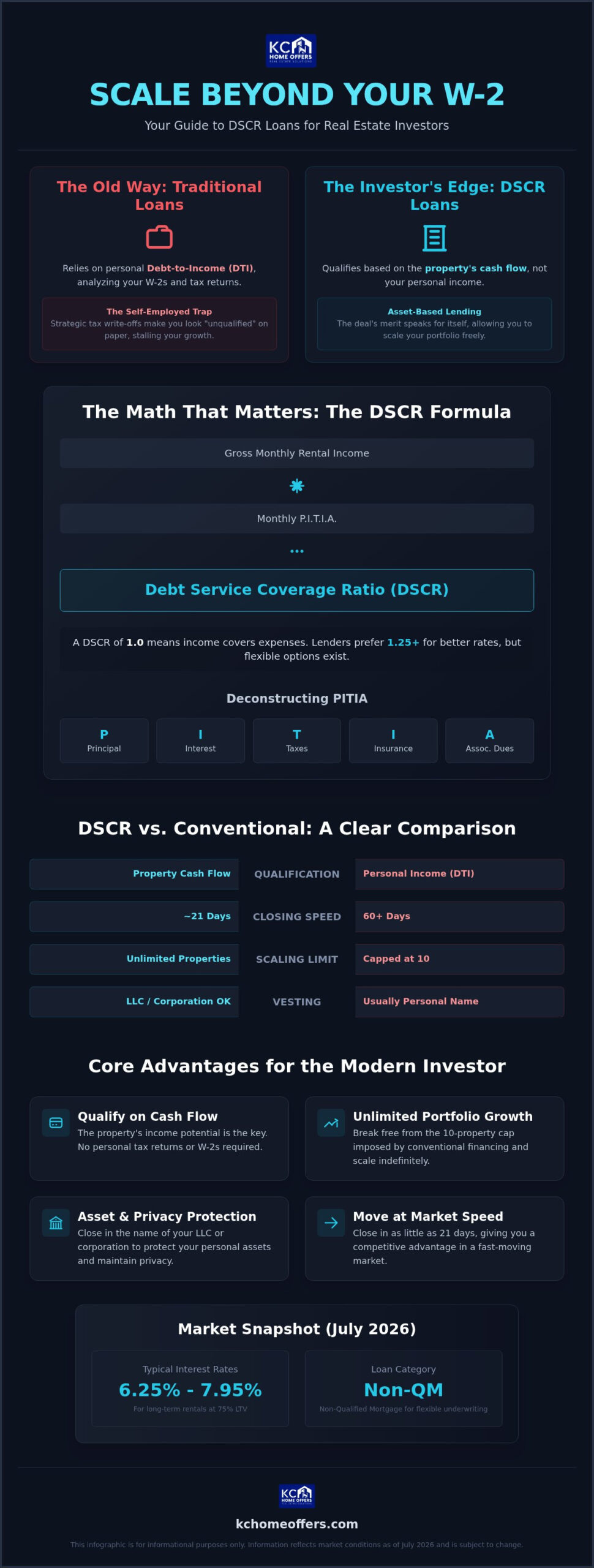
Traditional mortgages rely on Debt-to-Income (DTI). This metric compares your personal monthly debt payments to your gross monthly income. For the self-employed investor, this often leads to the “Self-Employed Trap.” You use legal tax write-offs to reduce your tax liability, but the bank sees that lower net income as a lack of qualifying power. It’s a frustrating cycle where being tax-efficient makes you look “poor” to a retail lender.
We solve this by using the Debt Service Coverage Ratio (DSCR) instead. This formula looks at the property’s gross rental income against its debt obligations. If the property’s cash flow covers the mortgage, taxes, and insurance, the deal makes sense. It’s a pragmatic way to lend that prioritizes the health of the investment over your personal paycheck. It treats you like a partner in a business venture rather than a consumer buying a home.
Why Real Estate Investors Prefer Non-QM Loans
These products fall into the Non-Qualified Mortgage (Non-QM) category. This doesn’t mean they are subprime; it means they don’t fit the rigid, one-size-fits-all box required by government-backed entities. Non-QM loans offer a level of flexibility that traditional products simply can’t match. Investors prefer this route for several specific reasons:
- Entity Vesting: You can close in the name of an LLC or corporation to protect your personal assets and maintain privacy.
- Unlimited Scaling: Conventional loans often cap you at 10 properties. A DSCR loan no personal income path allows you to scale indefinitely based on the merit of each new deal.
- Operational Momentum: Speed is a currency in a hot market. While retail banks take 60 days to process paperwork, our focus on asset-based lending allows for closings in as little as 21 days.
Choosing this path means you aren’t just a borrower; you’re a strategic operator. You’re securing capital that recognizes the property’s merit, allowing you to move as fast as the next opportunity arises without being slowed down by personal income limits.
The Math of Asset-Based Lending: Calculating Property Cash Flow
Success in asset-based lending isn’t about how much you earn at your day job. It’s about the property’s ability to stand on its own financial feet. When you pursue a DSCR loan no personal income verification, the lender focuses on a single, critical number: the Debt Service Coverage Ratio. This metric is the pulse of your investment. It tells us whether the property generates enough revenue to cover its own weight. If the math works, the deal moves forward. If not, the property is a liability rather than an asset.
The fundamental formula is straightforward. You take the Gross Monthly Rental Income and divide it by the monthly PITIA. In the 2026 market, interest rates play a significant role in this calculation. As of July 2026, fixed rates for long-term rentals at 75% LTV typically range between 6.25% and 7.95%. These rates directly influence the “Interest” portion of your debt, meaning your rental income must be high enough to offset these costs and maintain a healthy coverage ratio. While some traditional lenders demand a ratio of 1.25, our flexible approach allows for lower ratios, or even no-ratio options, depending on the strength of your strategy.
Deconstructing the PITIA Formula
Accuracy is your best friend during the underwriting process. PITIA stands for Principal, Interest, Taxes, Insurance, and HOA dues. PITIA is the definitive denominator that determines whether your investment property qualifies as a self-sustaining business entity.
Investors often overlook the impact of taxes and HOA fees. In 2026, property tax reassessments and rising insurance premiums can quickly shrink your coverage ratio. If you’re looking at a condo, the HOA fee is a non-negotiable part of the math. High monthly dues can turn a cash-flowing unit into a deal that doesn’t meet the minimum DSCR requirements. We recommend getting firm quotes for insurance and taxes early in your due diligence to ensure your DSCR loan stays on track for a fast closing.
Market Rent vs. Actual Rent
Lenders don’t just take your word for what a property will earn. We use the 1007 Appraisal form to verify income potential. This document provides an independent assessment of what similar properties in the immediate area are actually renting for. If the property is currently leased, we’ll use that figure. However, if the property is vacant, the market rent determined by the appraiser becomes the baseline for your qualification.
If you’re purchasing a vacant property that needs minor cosmetic work, you can boost your market rent projections by providing evidence of the planned improvements. Modernizing fixtures or improving curb appeal can justify a higher rent estimate on the appraisal. This proactive approach ensures your DSCR loan no personal income application reflects the true future value of the asset. By focusing on these property-specific details, you can secure financing that retail banks would likely decline based on your personal debt-to-income ratio.
Standard DSCR vs. No-Ratio Loans: Which Path Should You Take?
Choosing the right financing structure is a tactical decision that depends on your specific goals for an asset. While every DSCR loan no personal income application removes the hurdle of tax returns, the ratio itself dictates your leverage and cost of capital. You aren’t just looking for an approval; you’re looking for the specific loan product that optimizes your cash-on-cash return. In the 2026 market, the distinction between a standard ratio and a no-ratio loan is often the difference between a deal that sits and a deal that scales.
A standard DSCR loan typically requires a ratio between 1.0 and 1.25. This means the property’s gross income either matches or exceeds the debt obligations by 25%. This is the “sweet spot” for most investors because it unlocks the most competitive pricing. As of July 2026, fixed rates for long-term rentals at 75% LTV sit between 6.25% and 7.95%. If your property hits these coverage benchmarks, you’re positioned to receive the best terms available in the private capital market.
Conversely, no-ratio loans are designed for properties that don’t currently meet those cash flow requirements. Perhaps the property is in a high-appreciation neighborhood where rents haven’t caught up to values, or you’re transitioning a long-term rental into a short-term stay. Some lenders in 2026 allow ratios as low as 0.75, while true no-ratio programs ignore the cash flow entirely. The trade-off is typically found in the loan-to-value (LTV) ratio and the interest rate. You’ll likely need a larger down payment, often 35%, to offset the lender’s risk.
When to Choose a Standard DSCR Loan
This path is ideal for high-yield properties in emerging markets where the rent-to-price ratio is strong. If your property easily covers its PITIA, you should maximize your leverage. Many investors use these products to achieve up to 80% LTV, keeping more of their own capital liquid for the next acquisition. It’s a long-term hold strategy that focuses on lowering the cost of capital to maximize monthly distributions. When the math is strong, the standard ratio is your most efficient tool.
The Power of the No-Ratio Loan
No-ratio loans are a tactical win for the “Equity Play.” If you’ve identified a property with massive appreciation potential but low initial cash flow, this product keeps the deal alive. It’s also a favorite for short-term rental (STR) investors. Since STR income can be volatile and may not have a two-year history on the books, a no-ratio loan allows you to secure the asset based on its value rather than its current ledger. While rates for Airbnb and STR properties in July 2026 range from 7.00% to 9.00%, the ability to close at a 65% LTV without income verification allows you to capture high-value assets that traditional banks would never touch.
Qualifying for a DSCR Loan: Documentation You Actually Need
The beauty of a DSCR loan no personal income requirement is the streamlined nature of the underwriting. You aren’t digging through three years of tax returns or hunting down dusty W2s from a previous employer. However, “no personal income” does not mean “no documentation.” Lenders still need to verify the viability of the asset and your ability to manage the debt. In the 2026 landscape, the focus shifts from your paycheck to your credit history and your liquidity. We want to see that you have the financial foundation to support the property if a vacancy occurs.
Most investor-focused products require a minimum credit score between 620 and 660. While you can secure a deal with a score in that range, the most favorable terms are reserved for those with a 700 or higher. Beyond credit, lenders look for liquid reserves. This is your “cushion,” typically measured as 3 to 12 months of PITIA payments held in a bank or brokerage account. This ensures that even if a tenant moves out, the mortgage stays current. Whether you are buying a single-family residence or a 2-4 unit multi-family property, these reserves prove you are a low-risk operator.
The Investor Checklist (What to Prepare)
To keep the momentum of a 21-day closing, you should have your documentation ready before you sign the purchase agreement. If you are scaling a portfolio, you are likely using a business entity to hold your assets. You will need to provide the following items to move through underwriting quickly:
- Entity Documentation: Articles of Organization and an EIN for your LLC or corporation to facilitate entity vesting.
- Asset Statements: Two months of bank statements showing you have the down payment and the required 3 to 12 months of reserves.
- Income Verification: A current rent roll or lease agreement for the property, or a 1007 appraisal form to establish market rent.
- Identification: A valid government-issued ID and an insurance quote for the subject property.
Credit and LTV Dynamics
Your credit score is the primary engine that drives your loan-to-value (LTV) options. While traditional banks might look at your debt-to-income ratio, we care more about your history of managing credit. A credit score of 720 or higher is the primary lever that unlocks premium pricing and the most aggressive 80% LTV options available in the 2026 private lending market. If your score is lower, you may be required to bring a larger down payment to the table, often in the 25% to 30% range. This dynamic ensures that the lender’s risk is balanced against the property’s performance. If you are ready to stop letting your tax write-offs hold you back, it’s time to apply for a DSCR loan and let the property qualify itself.
Scaling Your Portfolio with KC Home Offers LLC
Speed is the ultimate currency in real estate. While retail banks are buried under layers of bureaucracy, the most successful investors are already closing on their third or fourth property of the year. Utilizing a DSCR loan no personal income structure allows you to move at the speed of the market, not the speed of an underwriting department’s vacation schedule. KC Home Offers LLC provides the capital that matches your momentum, ensuring that a great deal doesn’t slip through your fingers while waiting for a retail loan officer to call you back.
Partnering with an investor-focused lender like KC Home Offers LLC means you’re working with experts who speak your language. We don’t ask about your personal debt-to-income ratio because we know that metric doesn’t define your success as an operator. We focus on the numbers that matter: your property’s cash flow and your strategic vision. Our process is built for transparency. This means you won’t encounter hidden junk fees or last-minute surprises at the closing table. You get a term sheet in 24 hours so you can make offers with absolute confidence.
Repeatable Capital: The Key to the BRRRR Method
The biggest hurdle to building wealth is the exhaustion of capital. Traditional lenders often impose a “10-loan limit,” effectively capping your growth just as you’re hitting your stride. Our DSCR products remove this ceiling. By qualifying based on the asset’s merit, you can scale from one property to one hundred without hitting personal income roadblocks. This makes the DSCR loan no personal income path the perfect exit strategy for the BRRRR method (Buy, Rehab, Rent, Refinance, Repeat).
You can use our capital to cash-out refinance your current holdings, pulling out equity to fund your next acquisition. This creates a cycle of repeatable capital that fuels exponential growth. If you’re currently in the initial stages of a project, learn more about our Fix & Flip options for the ‘Buy’ phase. We provide the bridge to get you to the long-term DSCR finish line.
Your Next Step toward Financial Independence
Scaling a portfolio shouldn’t feel like a second full-time job. Our goal is to remove the friction from the financing process so you can focus on finding the next high-performing asset. We’ve streamlined our intake to a 5-minute pre-qualification process that respects your time and your ambitions. Whether you’re looking to acquire your first rental or optimize a mature portfolio, our team acts as a strategic ally to find the right leverage for your 2026 goals. Don’t let bank red tape dictate your net worth. Get Your DSCR Loan Quote Today and start building the portfolio you deserve.
Take Control of Your Growth Strategy
Building a massive real estate portfolio shouldn’t be limited by how you manage your personal taxes. We’ve explored how shifting the focus to property cash flow rather than your individual paycheck allows for unlimited scaling and significantly faster closings. By choosing a DSCR loan no personal income path, you’re prioritizing the performance of your investments and the speed of your growth. This strategy allows you to bypass the restrictive red tape of retail banks and secure financing that respects your status as a professional operator.
You can maintain your competitive edge by closing in as little as 21 days, all without the need for tax returns or W2 documentation. Closing in your LLC through KC Home Offers LLC adds a necessary layer of protection for your personal assets as your empire grows. It’s time to leverage the merit of your deals to secure the capital you need for the next phase of your journey. Scale your portfolio today with a DSCR loan quote from KC Home Offers LLC. Your next acquisition is within reach; let’s get it funded.
Frequently Asked Questions
Can I get a DSCR loan if I am currently unemployed?
Yes, you can secure a DSCR loan while unemployed because the lender prioritizes the property’s revenue over your job status. Qualification for a DSCR loan no personal income requirement relies on the asset’s cash flow and your liquid reserves. This makes it a powerful tool for full-time investors who don’t collect a traditional salary but have the capital and credit to manage new acquisitions efficiently.
What is the minimum credit score required for a no-personal-income loan?
The typical minimum credit score floor is between 620 and 660 for most investor-focused products. While you can get approved with a lower score, higher scores unlock much better terms. For instance, a score of 720 or higher is often required to access the most aggressive loan-to-value (LTV) options and the lowest available interest rates in the 2026 market.
Do DSCR loans require a higher down payment than conventional loans?
Yes, DSCR loans usually require a larger down payment than conventional residential mortgages. Most programs expect a 20% to 25% down payment to ensure the property remains well-capitalized. While some conventional loans allow smaller down payments for homeowners, investor-grade capital requires more skin in the game to balance the risk associated with non-recourse or entity-based lending structures.
Can I close a DSCR loan in the name of my LLC?
Yes, closing in the name of an LLC is a standard practice and is often encouraged by asset-based lenders. This structure provides a layer of legal protection for your personal assets and keeps the investment debt separate from your personal financial profile. It’s a strategic move for investors who want to scale their portfolios while maintaining a professional and protected business entity.
How do 2026 interest rates for DSCR loans compare to standard mortgages?
DSCR loan rates are generally higher than standard residential mortgages, typically by 1% to 2%. In July 2026, fixed rates for long-term rentals generally fall between 6.125% and 7.95%. While the cost of capital is higher, the trade-off is the ability to bypass personal income verification and close deals much faster than a retail bank would allow.
Are there prepayment penalties on DSCR loans?
Most DSCR loans do come with a prepayment penalty, typically lasting between three and five years. These are often structured as a step-down penalty, such as 3% in the first year, 2% in the second, and 1% in the third. Some lenders allow you to buy out this penalty upfront if you plan on flipping or refinancing the property in the near future.
Can I use a DSCR loan for a short-term rental like an Airbnb?
Yes, you can use these loans for short-term rentals, provided the property meets specific income benchmarks. Lenders often use specialized data or historical short-term rental ledgers to determine the ratio. Keep in mind that rates for Airbnb properties in July 2026 are often slightly higher, ranging from 7.00% to 9.00%, to account for the increased volatility of short-stay income.
What happens if my property’s DSCR ratio is below 1.0?
If your property’s ratio is below 1.0, you can still qualify through a no-ratio DSCR loan no personal income program. These tactical loans ignore the cash flow deficit but require a larger down payment, often 35% or more. This allows you to secure high-appreciation assets or properties in transition that haven’t reached their full rental potential yet without needing a personal paycheck to bridge the gap.