


If you’re treating your rental portfolio like a business, you shouldn’t be financing it like a personal hobby. Conventional loans are designed for homeowners, but for investors looking to scale in 2026, they often become a progress-killing bottleneck. Choosing between a DSCR vs conventional loan isn’t just about interest rates; it’s about whether you want to be limited by your tax returns or empowered by your property’s cash flow.
You probably know the frustration of having a perfect deal stall because of intrusive W2 documentation or hitting the rigid 10-property limit. It’s common to feel like your personal debt-to-income ratio is working against your professional growth. We’ll show you how to bypass these hurdles and determine which loan structure will scale your portfolio faster this year. This comparison explores the critical differences in leverage, speed, and documentation requirements to help you move with more momentum. You’ll get a clear look at how 2026 market trends and current lending standards impact your ability to finance properties without using personal income verification.
Key Takeaways
- Break through the 10-property limit and scale your portfolio by shifting from personal-backed financing to asset-based lending.
- Learn how to qualify for financing using only the property’s rental income. This removes the friction of tax returns and W2 documentation.
- Evaluate the critical trade-offs in the DSCR vs conventional loan debate to decide between lower interest rates or higher execution speed.
- Master the 1.0 debt service coverage ratio threshold to ensure your acquisitions pay for themselves and remain attractive to lenders.
- Discover how a strategic partnership can simplify your transition to professional-grade financing with transparent terms and zero hidden fees.
DSCR vs Conventional Loan: Defining the Two Paths to Real Estate Wealth
Real estate wealth isn’t a single destination, and the road you take depends entirely on how you view your portfolio. In the current 2026 market, many investors find themselves at a crossroads. They are forced to choose between the familiar, lower-rate path of government-backed lending and the streamlined, business-centric world of private capital. This choice between a DSCR vs conventional loan is more than just a financial decision. It’s a choice between being treated like a consumer or being treated like a business owner.
Conventional loans are the bedrock of the American housing market. These mortgages are typically backed by Fannie Mae or Freddie Mac. Their primary focus is on the borrower’s personal financial health. Because of this, traditional banks have spent much of 2026 tightening their belts. They’ve increased scrutiny on personal reserves and income stability. The fundamental conflict here is simple: these institutions prioritize your personal creditworthiness over the actual performance of the property you’re buying. For the ambitious investor, this often creates a ceiling that’s hard to break through.
The Core Philosophy of Conventional Financing
Conventional financing relies heavily on “the big three”: W2 income, tax returns, and debt-to-income (DTI) ratios. These loans were designed for families buying a primary residence, not for investors building an empire. This is why the process often feels like a second job. You’ll spend weeks digging up old pay stubs and explaining minor fluctuations in your bank statements. The “Red Tape” factor is real. Between the manual underwriting and bureaucratic hurdles, a conventional closing rarely happens in under 45 to 60 days. If you’re trying to move fast on a hot deal, that timeline is a liability.
The Asset-Based Philosophy of DSCR Lending
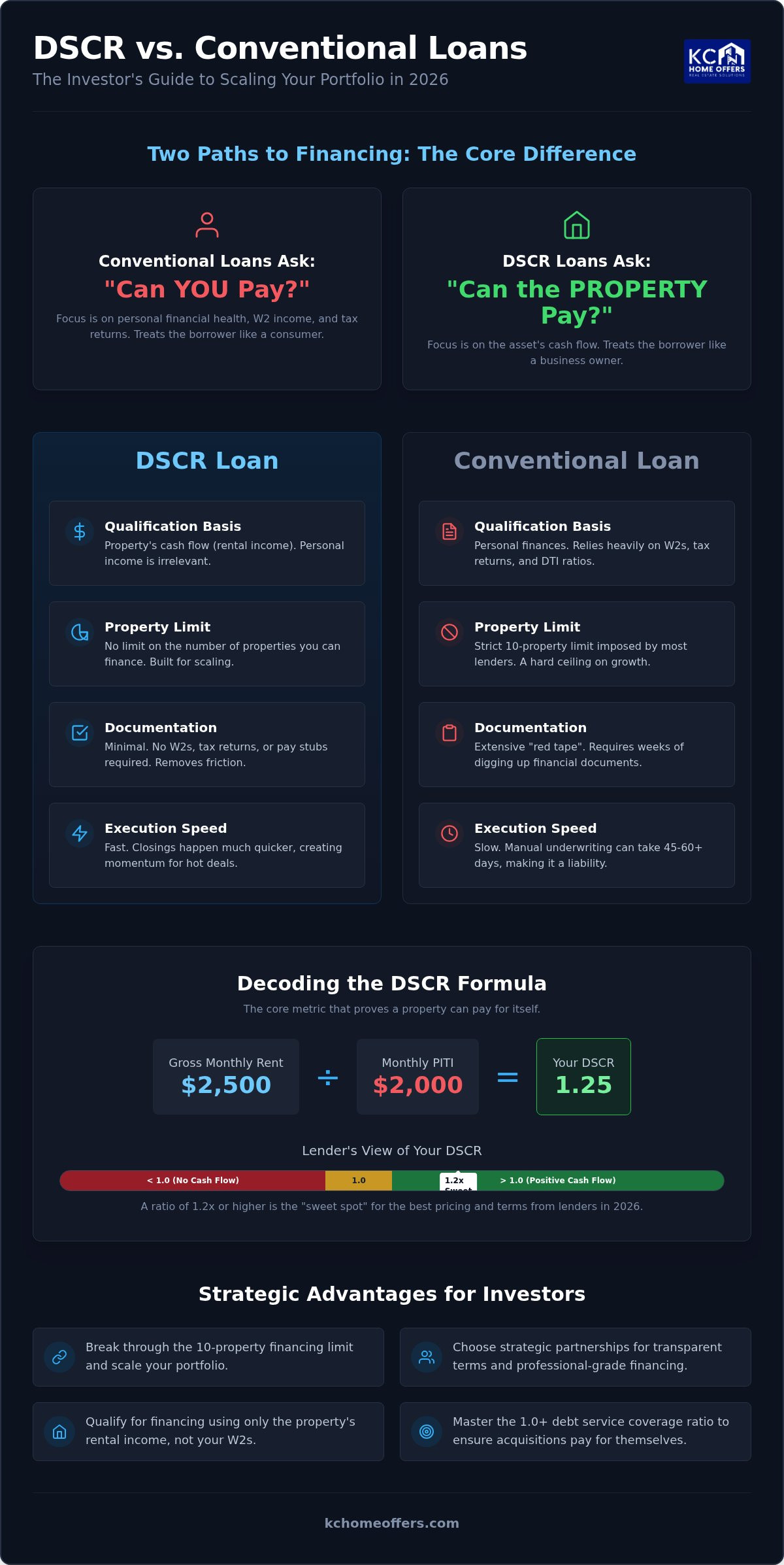
DSCR lending flips the script. Instead of asking “Can you pay?”, lenders ask “Can the house pay?”. Your personal income is irrelevant to the underwriting process because the loan is secured by the asset’s performance. The Debt Service Coverage Ratio (DSCR) is the primary metric used to determine eligibility. Specifically, DSCR is defined as the ratio of Gross Monthly Rental Income to the property’s PITI (Principal, Interest, Taxes, and Insurance). This asset-focused approach removes the friction that stops most investors from scaling. When you compare a DSCR vs conventional loan, you’re looking at the difference between a process that slows you down and one that creates momentum.
Deep Dive into DSCR: How Investors Scale Without Personal Income
Scaling a rental portfolio requires a shift in how you view debt. If you rely on traditional financing, you eventually hit a wall. Most conventional lenders impose a strict 10-property limit. Once you reach that cap, your growth stops regardless of how much cash you have in the bank. This is where the DSCR vs conventional loan debate becomes a matter of survival for your business. DSCR loans are classified as Non-QM (Non-Qualified Mortgage) products. They don’t follow the rigid guidelines set by government agencies, allowing you to bypass property counts and focus on the numbers that actually matter.
The magic of this structure lies in the Debt Service Coverage Ratio itself. To calculate it, you simply divide the Gross Monthly Rent by the Monthly Debt Service. If a property brings in $2,000 and the mortgage payment is $2,000, your ratio is 1.0. This is the break-even threshold. While some lenders offer “no-ratio” programs, a 1.0 ratio proves the property can pay its own way without dipping into your personal savings. This fundamental shift from personal liability to asset performance is why professional investors are moving away from conventional mortgage requirements and toward private capital. For self-employed investors whose tax write-offs make them look unqualified on paper, securing a DSCR loan with no personal income requirement is the pivot that transforms a stagnant portfolio into a rapidly scaling empire.
Calculating Your Ratio: A Step-by-Step Example
Imagine you’re eyeing a duplex that rents for $2,500 per month. After running the numbers, your total mortgage payment (including principal, interest, taxes, and insurance) comes to $2,000. By dividing $2,500 by $2,000, you get a DSCR of 1.25. Lenders will verify this using the lower of your actual lease agreement or the market rent determined by an appraiser on Form 1007. In the 2026 lending environment, a 1.2x ratio is the “sweet spot” for best pricing because it provides a 20% safety margin for the lender. If your property hits this mark, you’re positioned for the most competitive terms available.
Documentation: What You Don’t Need
The biggest friction point in real estate is the paperwork. With a DSCR loan, you can stop digging through years of tax returns and pay stubs. There is no employment verification because your job isn’t what’s paying the mortgage. This lack of red tape has a massive impact on execution speed. While a traditional bank might take two months to verify your life history, a DSCR loan can often close in as little as 21 days. This speed is vital for self-employed investors or those with complex tax structures who show minimal “on-paper” income due to high business write-offs. You get to keep your tax advantages while still accessing the leverage needed to grow.
The Conventional Mortgage Reality Check: When Low Rates Are Not Enough
It’s tempting to look at a 30-year fixed rate for a rental and assume the lowest number wins. In the DSCR vs conventional loan comparison, conventional mortgages have historically carried an interest rate advantage of 1% to 2%. Even in July 2026, with conventional rates averaging between 6.49% and 6.64%, they often appear cheaper on paper than a fixed DSCR loan. However, that lower rate comes with strings that can tangle up a growing business. Traditional banks aren’t your partners; they are gatekeepers. They look at your personal life under a microscope. Your car payment, your primary mortgage, and even your student loans create a “DTI Trap.” If your debt-to-income ratio is too high, the bank doesn’t care how much profit the rental property makes. They’ll deny the loan based on your personal liabilities.
Then there’s the issue of “seasoning.” If you buy a property, renovate it, and want to pull your equity out to buy the next one, conventional lenders often make you wait 6 to 12 months. This forced pause kills your momentum. Additionally, Conventional Investment Loan Requirements are notoriously strict regarding property condition. If a house has a dated roof or a non-functional HVAC system, a traditional bank won’t fund it. This limits you to “turn-key” properties where the margins are often much thinner. You’re left fighting over the same scraps as every other retail buyer.
The Hidden Costs of Conventional Paperwork
The administrative burden of a conventional loan is a hidden tax on your time. You aren’t just providing a credit score. You’re handing over two years of tax returns, months of bank statements, and every pay stub you’ve ever received. This underwriting friction often leads to missed closing dates. In a competitive market, a delay can mean losing your earnest money or having a seller walk away. The “cheapest” rate becomes the most expensive mistake if the deal never crosses the finish line. Professional investors value certainty of execution over a few basis points of interest.
The 10-Property Ceiling
Most investors don’t realize that Fannie Mae and Freddie Mac have a hard limit on the number of financed properties one person can hold. Once you hit 10 properties, the conventional well runs dry. This forces successful investors to switch to commercial or DSCR products anyway. By starting with a DSCR loan earlier in your journey, you keep your personal credit report “clean” for other uses, like a primary home upgrade or a personal line of credit. You’re building a business that stands on its own assets, rather than one that’s tethered to your personal W2 status. This is how you build a scalable machine rather than just a collection of houses.
Strategic Comparison: Rates, Terms, and Execution Speed
While the underwriting philosophies differ, the physical leverage often looks similar on the surface. Both products typically require a 20% to 25% down payment for investment properties. However, the similarities end there. When evaluating a DSCR vs conventional loan, the strategic advantage lies in the fine print of the loan agreement. DSCR loans often include prepayment penalties, which protect the lender’s yield. In exchange for this commitment, you get the ability to close in an LLC and move at a pace that traditional banks simply cannot match.
Conventional loans generally lack prepayment penalties, allowing you to refinance the moment rates drop. This sounds like a win, but it comes at the cost of your privacy and protection. Because conventional loans are government-backed, they require you to be personally liable. If you’re looking for professional-grade financing that recognizes your business as a separate entity, the trade-off of a structured prepayment window is often worth the increased operational freedom.
Vesting in an LLC: Asset Protection vs. Privacy
Most serious investors operate through a business entity to limit personal liability. Conventional loans usually require you to close in your personal name. If you try to transfer the title to an LLC after closing via a quitclaim deed, you risk triggering a “due on sale” clause. This can force an immediate payoff of the loan. DSCR loans are built for professional structures from day one. You can vest in an LLC at the closing table. This ensures your personal assets remain shielded from property-specific liabilities without looking over your shoulder for a bank audit. It’s a cleaner, more secure way to manage a growing portfolio.
The Opportunity Cost of Waiting
Speed is a currency in the real estate market. A conventional loan typically takes 45 to 60 days to clear the bureaucratic hurdles of a big bank. In contrast, a DSCR loan can often close in 14 to 30 days. If you’re competing against multiple offers, being able to close in three weeks makes you a “cash-like” buyer. Think about the cost of a 30-day delay. If a missed closing causes you to lose a deal with $30,000 in equity, the slightly lower interest rate of a conventional loan becomes irrelevant. The spread in interest rates is negligible when compared to the profit of securing even one extra deal per year because you could move faster than the competition. Ready to see how fast you can grow? Get a quote for a DSCR loan and skip the bank’s red tape.
Scaling Your Portfolio with KC Home Offers LLC: The Strategic Allied Advantage
Transitioning your investment strategy from personal to professional shouldn’t be a headache. While many lenders treat the DSCR vs conventional loan decision as a rigid binary, we treat it as a strategic shift for your business. KC Home Offers LLC simplifies this transition by removing the friction of traditional banking. We don’t just provide capital; we provide a roadmap for scaling your business without the baggage of personal income verification or restrictive DTI limits mentioned earlier.
Our “Straight Shooter” promise is the foundation of every deal we fund. You’ll never see hidden junk fees or opaque terms that shift at the last minute. Transparency is our primary currency. We provide clear, upfront communication because we know that in a fast-paced market, trust is just as important as the interest rate. You deserve a partner who follows through on commitments and values your time as much as you do.
Local market knowledge is a critical advantage when it comes to the appraisal process. Since a DSCR loan relies heavily on the property’s rental income, an inaccurate appraisal can kill your leverage before the deal even starts. KC Home Offers LLC ensures that the data reflects the actual market rents in your specific neighborhood. This accuracy gives you the highest possible Loan-to-Value (LTV) ratio and ensures your debt coverage calculation is based on reality, not just a generic database average.
Why Investors Choose KC Home Offers LLC Over Big Banks
Working with Ashley and Aspen means you aren’t just another loan number in a cold corporate database. You get personalized service from experts who are deeply embedded in the local landscape. KC Home Offers LLC combines the speed of a private lender with the professional standards of a national firm. This unique position allows us to fund complex deals that traditional banks won’t touch. Whether you’re dealing with unique property types or complex ownership structures, we find the path to “yes” while others are still checking your tax returns.
Ready to Scale? Your Next Deal Starts Here
Stop letting personal debt ratios and property caps hold your business back. Our no-income-verification process is designed for the modern investor who values efficiency and momentum. Getting started with KC Home Offers LLC is a straightforward 3-step process:
- Step 1: Submit your property details and current or projected rental income.
- Step 2: Receive a transparent term sheet within 24 hours.
- Step 3: Complete the appraisal and close in as little as 21 days.
Your next acquisition is waiting for the right financing. Get a fast, transparent DSCR quote from KC Home Offers LLC today and experience the strategic allied advantage that helps you grow faster.
Build Your Rental Empire with Professional Financing
The choice between a DSCR vs conventional loan is really a choice about the future of your business. If you want to stay small and move slowly, traditional mortgages offer lower rates but come with a ceiling that’s impossible to ignore. For those ready to scale, asset-based lending is the only way to bypass the DTI trap and the 10-property limit. You’ve seen how speed and execution often outweigh a minor interest rate spread when it comes to winning deals in a competitive market.
KC Home Offers LLC acts as your strategic ally, offering fast approvals and closing in as little as 14 days. Since we require no personal income or W2 verification, you can focus on finding the next deal while our team of seasoned real estate investors handles the professional oversight. We provide the transparency and momentum you need to stay ahead of the competition without the bureaucratic delays of traditional banking.
Unlock your portfolio growth with a DSCR loan from KC Home Offers LLC. Don’t let bureaucratic red tape stop your momentum. Your next acquisition is just a term sheet away.
Frequently Asked Questions
Is a DSCR loan better than a conventional loan for first-time investors?
DSCR loans are better for first-time investors who prioritize scaling over the lowest possible interest rate. While a conventional loan offers a lower monthly payment, it ties up your personal debt-to-income ratio. Choosing a DSCR path allows you to keep your personal credit profile clean for future primary home purchases or other life needs. It sets the foundation for a professional business structure right from your very first acquisition.
How much higher are DSCR interest rates compared to conventional mortgages?
In the 2026 market, DSCR interest rates are typically 1% to 2% higher than conventional mortgages. For example, if a conventional investment loan is at 6.5%, you can expect a fixed DSCR rate to sit between 7.5% and 8.5%. This spread is a trade-off for the lack of income verification and the ability to close in an LLC. Many investors find the extra cost is offset by the speed of execution.
Can I get a DSCR loan if the property is currently vacant?
You can certainly get a DSCR loan for a vacant property. Lenders rely on a market rent analysis, known as an appraisal Form 1007, to estimate what the property will earn once listed. This allows you to secure financing for a newly renovated or recently purchased asset that doesn’t have a tenant yet. It’s a common strategy for investors who want to lock in long-term debt immediately after completing a project.
Do DSCR loans require a minimum credit score?
Yes, most DSCR programs require a minimum credit score between 620 and 680. While your personal income isn’t a factor, your creditworthiness serves as a proxy for your reliability as a borrower. Higher scores, typically 720 or above, unlock the most competitive interest rates and higher loan-to-value limits. This score is one of the few personal metrics that lenders will scrutinize during the underwriting process for these asset-based loans.
What is the typical down payment for a DSCR vs conventional investment loan?
The typical down payment for both a DSCR vs conventional loan on an investment property is 20% to 25%. While some conventional programs occasionally offer a 15% option for single-family homes, most lenders in 2026 require at least 20% to mitigate risk. DSCR loans often provide more flexibility on the source of these funds, allowing for gift funds or business capital that traditional banks might question.
Can I use a DSCR loan to refinance an existing conventional mortgage?
You can use a DSCR loan to refinance an existing conventional mortgage at any time. This is a popular move for investors who have hit their personal debt-to-income limits and need to move debt off their personal credit report. It also allows for cash-out refinances based on the property’s appraised value rather than your original purchase price, providing the capital needed to fund your next rental acquisition.
How does the 10-property limit work for conventional loans?
The 10-property limit is a hard cap set by Fannie Mae and Freddie Mac on the number of financed properties an individual can own. This includes your primary residence and any other rentals with a mortgage. Once you reach this limit, conventional lenders will generally stop approving new investment loans for you. Moving to a DSCR structure allows you to continue growing your portfolio indefinitely because these loans don’t have property count restrictions.
Are DSCR loans considered “hard money” or “private money”?
DSCR loans are Non-QM (Non-Qualified Mortgage) products rather than traditional hard money. Hard money is usually a short-term bridge loan for fix-and-flip projects, lasting 6 to 12 months. A DSCR loan is a long-term, 30-year debt product that functions more like a traditional mortgage but with the flexible underwriting of private capital. It offers the stability of permanent financing with the speed of a private lender.