Guides › Private lending
Short-Term Real Estate Loans: When They Make Sense for Investors

Explore when short term real estate loans make sense for investors. Compare financing options, evaluate exit strategies, and plan your project timelines today.
A short rental stay and a short loan term are two different things. The key distinction is the financing timeline, not whether you plan to rent a property by the night. Short term real estate loans can fund an acquisition, renovation, construction project, or refinance when a deal has a defined payoff plan.
Funding speed matters, but the loan also needs to fit the work ahead and the way you expect to repay it. A project that runs behind schedule can put pressure on your exit. Choosing financing based on the property’s rental strategy alone can miss the bigger question: when and how will the loan be paid off?
This guide compares common short-term financing options, repayment structures, and qualification approaches. It also explains what to prepare for a financing discussion, from the property and work scope to your planned sale, refinance, or other exit. KC Home Offers connects investors with business-purpose loan options through lending partners. All loans are subject to the lending partner’s approval.
Key Takeaways
- Short term real estate loans are defined by their financing timeline, not by whether a property is operated as a short-term rental.
- Match the financing category to the project: acquisition and renovation, a temporary funding gap, rental income, or new construction.
- Before comparing structures, map out the project scope, capital needs, timeline, and intended repayment or exit.
- Stress-test your exit plan against possible delays so a postponed sale or refinance doesn’t catch your project unprepared.
- Prepare property details, the project plan, borrower information, and your exit strategy to make financing discussions more focused.
Table of Contents
- What Are Short-Term Real Estate Loans, and What Does “Short-Term” Mean?
- How Short-Term Real Estate Financing Works Across a Deal Timeline
- Short-Term Real Estate Loan Options: Compare the Fit, Not Just the Label
- When Does Short-Term Real Estate Financing Make Sense, and What Can Go Wrong?
- Plan Your Next Financing Step With KC Home Offers
What Are Short-Term Real Estate Loans, and What Does “Short-Term” Mean?
Short-term real estate financing is funding for an investment-property project with a defined, relatively near-term repayment plan. That plan may depend on completing renovations, selling the property, refinancing, or reaching a more stable operating stage. Unlike financing designed for long-term ownership, this approach is often tied to a specific project phase and a planned exit.
The label alone doesn’t tell you what a loan will fund or how repayment works. Terms and qualification depend on the financing structure and the project. Investors may encounter options such as bridge, fix-and-flip, or construction financing. Hard money loans are another category commonly associated with short-term real estate projects. Start by identifying what the property needs now and which milestone is expected to let you repay or replace the financing.
A loan’s term describes its financing period; a property’s rental model describes how it earns income. Keep those questions separate. A property can operate as a short-term rental while using financing with a longer repayment horizon.
Short-term loan versus short-term rental: how the terms differ
A short-term rental is a property rented to guests for temporary stays. That operating strategy doesn’t determine how long the financing lasts. An investor could use longer-horizon financing to hold a guest-rental property, or temporary financing to acquire or improve a property intended for long-term tenants. The loan addresses funding and repayment; the rental model addresses how the property is used.
Why investors use financing with a limited project horizon
Temporary financing may support an acquisition, renovation, construction project, or transition to a later financing arrangement. For example, an investor might purchase a property, complete improvements, then sell or refinance it. The financing period should fit that sequence, not simply the intended tenant type.
A defined project horizon can help an investor organize capital around a clear milestone. But a planned exit isn’t guaranteed. Renovation work can take longer than expected, a sale may be delayed, or a refinance may not proceed as planned. Build a realistic schedule and decide what you would do if a milestone moves. Financing structure and approval depend on the project and the lending partner’s review. KC Home Offers connects investors with business-purpose loan options through lending partners, and all loans are subject to the lending partner’s approval.
How Short-Term Real Estate Financing Works Across a Deal Timeline
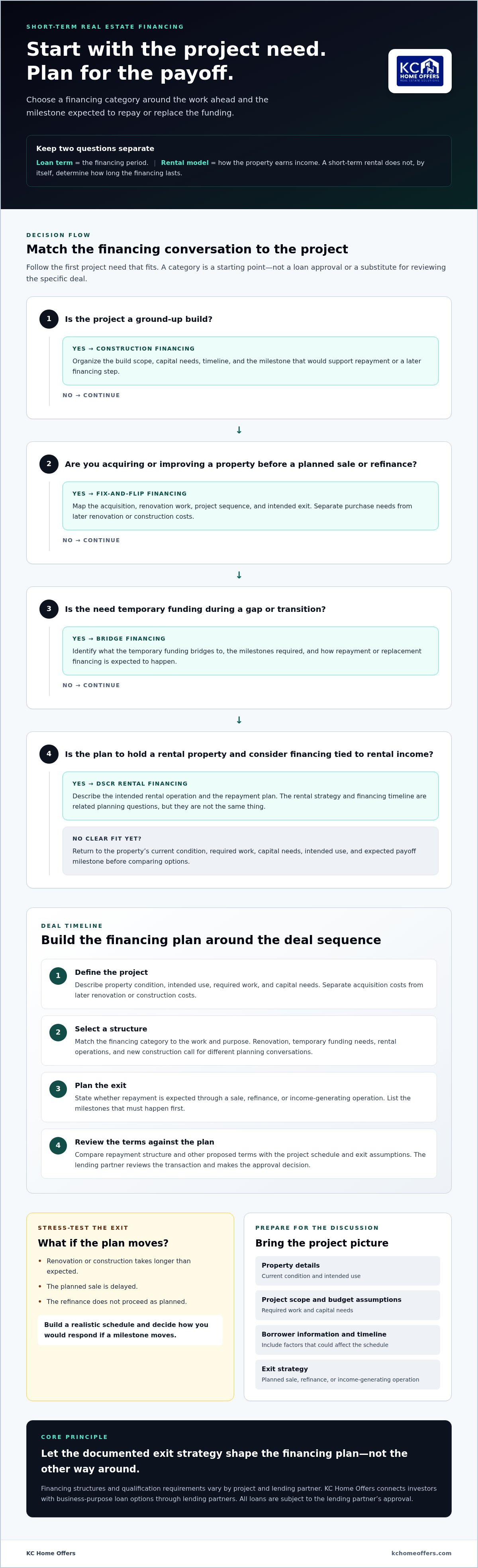
A financing plan works best when it follows the deal’s actual sequence, not just the purchase date. With short term real estate loans, a lending partner’s review may consider the property, project scope, intended use, and borrower information. Map out the project before comparing structures so the discussion starts with what you’re trying to accomplish and how you expect to repay the loan.
Use this sequence to organize the decision:
- Define the project. Describe the property’s current condition, intended use, required work, and capital needs. Separate acquisition costs from later renovation or construction costs so each stage is clear.
- Select a structure. Match the financing category to the work and purpose. A renovation plan, for example, has different needs from new construction or rental operations.
- Plan the exit. Identify whether you expect repayment through a sale, refinance, or income-generating operation. List the milestones that need to happen first.
- Review the terms. Compare the proposed repayment structure and other terms with the project schedule and exit assumptions. The lending partner makes the approval decision, and approval isn’t guaranteed.
Let the documented exit strategy shape the financing plan rather than relying on financing to create an exit. Rocket Mortgage’s overview of a short-term mortgage offers general context on shorter repayment periods. For short term real estate loans, evaluate the specific investment property, deal plan, and lending partner’s requirements.
From acquisition or project start to the planned exit
At acquisition, the immediate need may be purchase funding. Renovation or construction shifts attention to project costs and completion milestones. Stabilization may then lead to a planned sale or refinance. For example, an investor buying a property to improve can outline the work, estimate its sequence, and identify whether the intended exit is a sale or refinance. Include that exit in the financing discussion from the start.
What investors may prepare for a financing discussion
Organize property details, project scope, budget assumptions, intended use, borrower information, and a realistic timeline. Note what could affect the schedule and how your plan would respond. For renovation context, the fix-and-flip funding guide provides a related starting point.
Clear information helps focus a discussion about business-purpose financing options. KC Home Offers connects investors with lending partners, and
Short-Term Real Estate Loan Options: Compare the Fit, Not Just the Label
The right category depends on what the property needs now and what is expected to repay the financing later. A renovation, temporary funding gap, rental hold, and ground-up build call for different planning conversations. Use this comparison to narrow the fit, then review the specific transaction. Structures and qualification requirements vary by lending partner and project.
| Financing category | Typical purpose | Planning focus | Exit or repayment considerations |
|---|---|---|---|
| Fix-and-flip | Acquiring and improving a property intended for resale | Purchase needs, renovation scope, budget assumptions, and completion plan | Plan for a sale after the work, with room for schedule or market delays |
| Bridge | Addressing a temporary funding need or transition between project stages | What the interim financing covers and which milestone ends the need | Identify the expected payoff source, such as a sale or refinance |
| DSCR rental | Financing an investment property held for rental income | Rental use and the property’s income plan | Consider the intended hold and how rental income relates to repayment |
| Construction | Funding a ground-up investment project | Build scope, project stages, budget assumptions, and completion plan | Map the path from construction to sale, refinance, or operation |
Fix-and-flip and bridge financing for time-bound projects
Fix-and-flip financing may fit a purchase-and-renovation plan where resale is the anticipated exit. Bridge financing may fit a temporary gap, such as moving from acquisition to a later project stage. For either, define the use of funds, budget for the work, and set out a practical exit. Investors exploring asset-based financing can review this hard money loan guide for added context.
The distinction is the project need, not just the label. If improvements are central to the plan, organize the work scope and anticipated resale path. If the need is temporary, explain what event or financing change is expected to repay the bridge. Neither category guarantees a particular outcome. The lending partner reviews the proposed plan and transaction details.
DSCR rental and construction financing for different plans
DSCR, or debt service coverage ratio, financing is associated with rental-property income and may suit an investor planning to hold and operate a property rather than sell immediately after improvements. Construction financing addresses a different task: building an investment property from the ground up. Compare the project’s intended use and eventual repayment approach when evaluating these categories. For more on rental financing, see the DSCR loan investor guide.
These business-purpose categories aren’t interchangeable with every housing finance program. For general information about FHA loans, HUD is a government resource. Keep that separate from evaluating project-specific business-purpose options. KC Home Offers connects investors with lending partners for financing discussions, and loans are subject to the lending partner’s approval. For an overview of the company’s options, review KC Home Offers’ investor financing options.
When Does Short-Term Real Estate Financing Make Sense, and What Can Go Wrong?
Short-term financing may fit when the project has a defined scope, a workable timeline, capital needs that align with the plan, and a credible way to repay the loan. It may be a mismatch when the exit depends on optimistic assumptions or the required work is still unclear. Assess the whole deal: short term real estate loans should support a realistic project plan, not just the next purchase step.
Before choosing a structure, answer four questions: What work is certain? How long could it realistically take? What capital does each stage require? What is the repayment plan if the expected exit is delayed?
- Project certainty: Separate known work from estimates that could change after the project begins.
- Timeline: Account for the steps between acquisition, completion, and the planned sale, refinance, or operating stage.
- Capital needs: Consider whether available funds and the project budget match the full scope.
- Exit credibility: Identify the expected payoff source and a backup plan if it takes longer to reach.
A delayed sale or refinance can increase financing pressure. The property may remain financed while project expenses continue and repayment is postponed. With short term real estate loans, a schedule with no room for slippage can limit options if a milestone moves. Consider how the plan changes if completion, sale, or refinancing takes longer than expected.
Test the exit plan before committing to a financing structure
Run a delay scenario before settling on a structure. If construction or renovation takes longer, can the project budget and schedule absorb the change? If a sale or refinance is postponed, what other steps could support repayment? These are planning questions, not forecasts. Loan obligations are governed by the applicable lending-partner documents, so understand the repayment requirements and what happens if the expected exit shifts.
Recognize when a different financing horizon may fit better
Time-sensitive project funding may suit an acquisition or renovation with a defined next milestone. A property intended for a stabilized rental hold may call for a financing horizon aligned with ongoing operations instead. The shortest available option isn’t automatically the right fit. Compare the project scope, timeline, capital needs, and exit together rather than choosing based on one loan label.
Keep operating risks distinct from financing risks. Renovation delays can disrupt a project schedule; variable rental revenue can affect an operating plan. Neither changes the need to meet the loan’s documented obligations. Stress-test both sides: the property’s expected performance and the repayment plan if performance or timing differs from expectations.
KC Home Offers connects investors with business-purpose loan options through lending partners. Include your project plan and intended exit when you review financing for your investment project.
Plan Your Next Financing Step With KC Home Offers
A focused financing discussion starts with the deal, not a loan label. Before exploring short term real estate loans, connect the property’s intended use to the work ahead and the way you expect to repay the financing. This gives the conversation a practical frame and helps identify which business-purpose category may fit the project.
Use this sequence to prepare:
- Clarify the project. Summarize the property, its current stage, intended use, and the work needed to reach the next milestone.
- Select a financing category. Identify whether the project centers on renovation, rental operations, a temporary funding need, or new construction.
- Test the exit. State whether the expected payoff comes from a sale, refinance, or ongoing property operations. Note assumptions that could change the timing or plan.
- Prepare deal details. Gather property information, project scope, budget assumptions, borrower details, and a realistic timeline for discussion.
Bring a clear project brief to the financing conversation
A concise brief should show how the project moves from its current stage to the planned exit. Include the property’s intended use, renovation or construction scope, anticipated timeline, and assumptions behind your sale, refinance, or operating plan. Flag dependencies, such as work that must be completed before the property can be occupied or marketed. Clear inputs make it easier to discuss the deal’s financing needs.
Be specific about the type of need. A renovation project differs from a rental hold; a bridge need differs from a ground-up build. If the plan has multiple stages, describe each one and when the funding need may change. This keeps the discussion tied to the project instead of treating every investment as the same kind of loan request.
Explore financing options with KC Home Offers
KC Home Offers connects real estate investors with lending partners for business-purpose financing. Categories include fix-and-flip, DSCR rental, bridge, and construction financing. The property, project plan, intended use, and exit help frame which category may be relevant. The lending partner reviews the transaction and makes the approval decision.
Prepare to discuss both the opportunity and its constraints. Share what could affect the schedule, how you’ve approached the project budget, and what you would do if the expected exit takes longer. This doesn’t remove uncertainty, but it makes your assumptions visible as you evaluate a financing structure.
To discuss business-purpose financing options for your investment project, explore financing with KC Home Offers.
Move Forward With a Clear Decision
Before advancing a deal, turn your financing assumptions into decision points. What project change would make you revisit the budget? Which delay would require a revised timeline? What would cause you to reconsider the planned exit? Writing down those triggers gives you a practical way to respond as new information emerges, rather than relying on the original plan to stay unchanged.
That discipline matters with short term real estate loans because the financing choice is tied to both the property and the path you expect it to take. A strong next step isn’t simply moving quickly. Make sure the deal’s known details and remaining uncertainties are visible before proceeding.
When you’re ready to discuss how an investment project might align with available options, explore investor financing options with KC Home Offers. Bring your project details and intended direction, then move forward with a clear view of the plan. Every loan is subject to the lending partner’s approval.
Frequently Asked Questions
What is a short-term real estate loan?
A short-term real estate loan is financing for an investment with a limited project or holding horizon. The exact duration, repayment structure, and other obligations are set out in the loan documents and depend on the lending partner. It differs from a short-term rental loan, which describes a property rented for temporary guest stays. For planning, focus on the loan’s repayment schedule and maturity, not the property’s rental label.
Is a short-term rental loan the same as a short-term real estate loan?
No. A short-term rental loan relates to a property operated for temporary guest stays, while a short-term real estate loan generally refers to financing with a limited term or project horizon. The terms can overlap if temporary-stay rental operations use short-duration financing, but they aren’t interchangeable. When reviewing a deal, identify both the property’s intended use and the financing’s repayment structure so one isn’t mistaken for the other.
Can investors use short-term financing to buy a rental property?
Yes, it may be considered if the plan includes a defined transition, such as buying a property, completing improvements, and then preparing it for a rental hold. The fit depends on the property, project assumptions, exit plan, and lending partner’s requirements. Map out what happens if the expected refinance or sale is delayed. A future rental strategy alone doesn’t establish that a particular financing structure will fit.
What happens if a property does not sell before the loan term ends?
A delayed sale can leave the investor facing a mismatch between the expected payoff and the financing timeline. Review the loan documents to understand the applicable obligations, then communicate with the lending partner about the situation and any available options. Before committing, model a delayed sale and identify a contingency plan. Don’t assume an extension, refinance, or other solution will be available.
How do lenders evaluate a short-term real estate loan application?
Evaluation varies by financing structure and lending partner. The review may consider the property, intended use, project scope, borrower information, budget assumptions, and proposed exit. For rental-focused financing, property income or revenue assumptions may also be relevant. Prepare accurate information, including a clear account of the property’s current condition and planned work. Approval isn’t guaranteed, and the lending partner’s requirements govern the decision.
Can a short-term real estate loan be refinanced into long-term financing?
A refinance may be part of an investor’s planned exit, but it isn’t automatic or guaranteed. The property’s condition and income, borrower information, market circumstances, and the later lender’s requirements may affect eligibility. For example, if improvements are still incomplete, the property may not be in the position the investor expected when planning the refinance. Build a backup plan and follow the current loan documents for existing obligations.
How is bridge financing different from a fix-and-flip loan?
Bridge financing generally addresses a temporary funding need between project stages or transactions. Fix-and-flip financing is associated with purchasing and renovating a property for resale. A project may involve a transition need as well as renovation, so the labels alone may not settle the fit. Compare the intended use, work scope, repayment structure, and expected exit against the actual deal, then review the lending partner’s requirements.
Does KC Home Offers directly fund short-term real estate loans?
KC Home Offers connects real estate investors with lending partners for business-purpose financing options, including fix-and-flip, DSCR rental, bridge, and construction categories. Investors can organize property information, project scope, intended use, and exit assumptions to support a financing discussion. Each loan is subject to the lending partner’s approval, and the partner determines whether to approve the transaction.
Frequently asked
What is a short-term real estate loan?
A short-term real estate loan is financing for an investment with a limited project or holding horizon. The exact duration, repayment structure, and other obligations are set out in the loan documents and depend on the lending partner. It differs from a short-term rental loan, which describes a property rented for temporary guest stays. For planning, focus on the loan’s repayment schedule and maturity, not the property’s rental label.
Is a short-term rental loan the same as a short-term real estate loan?
No. A short-term rental loan relates to a property operated for temporary guest stays, while a short-term real estate loan generally refers to financing with a limited term or project horizon. The terms can overlap if temporary-stay rental operations use short-duration financing, but they aren’t interchangeable. When reviewing a deal, identify both the property’s intended use and the financing’s repayment structure so one isn’t mistaken for the other.
Can investors use short-term financing to buy a rental property?
Yes, it may be considered if the plan includes a defined transition, such as buying a property, completing improvements, and then preparing it for a rental hold. The fit depends on the property, project assumptions, exit plan, and lending partner’s requirements. Map out what happens if the expected refinance or sale is delayed. A future rental strategy alone doesn’t establish that a particular financing structure will fit.
What happens if a property does not sell before the loan term ends?
A delayed sale can leave the investor facing a mismatch between the expected payoff and the financing timeline. Review the loan documents to understand the applicable obligations, then communicate with the lending partner about the situation and any available options. Before committing, model a delayed sale and identify a contingency plan. Don’t assume an extension, refinance, or other solution will be available.
How do lenders evaluate a short-term real estate loan application?
Evaluation varies by financing structure and lending partner. The review may consider the property, intended use, project scope, borrower information, budget assumptions, and proposed exit. For rental-focused financing, property income or revenue assumptions may also be relevant. Prepare accurate information, including a clear account of the property’s current condition and planned work. Approval isn’t guaranteed, and the lending partner’s requirements govern the decision.
Can a short-term real estate loan be refinanced into long-term financing?
A refinance may be part of an investor’s planned exit, but it isn’t automatic or guaranteed. The property’s condition and income, borrower information, market circumstances, and the later lender’s requirements may affect eligibility. For example, if improvements are still incomplete, the property may not be in the position the investor expected when planning the refinance. Build a backup plan and follow the current loan documents for existing obligations.
How is bridge financing different from a fix-and-flip loan?
Bridge financing generally addresses a temporary funding need between project stages or transactions. Fix-and-flip financing is associated with purchasing and renovating a property for resale. A project may involve a transition need as well as renovation, so the labels alone may not settle the fit. Compare the intended use, work scope, repayment structure, and expected exit against the actual deal, then review the lending partner’s requirements.
Does KC Home Offers directly fund short-term real estate loans?
KC Home Offers connects real estate investors with lending partners for business-purpose financing options, including fix-and-flip, DSCR rental, bridge, and construction categories. Investors can organize property information, project scope, intended use, and exit assumptions to support a financing discussion. Each loan is subject to the lending partner’s approval, and the partner determines whether to approve the transaction.
Need financing on a deal like this?
DSCR, fix & flip and new construction loans, underwritten on the deal rather than your tax returns. Soft credit pull only.
Apply in 5 minutes