Guides › Private lending
Rehab Loans for Investors: Types, Costs and How to Qualify

Learn how rehab loans work for real estate investors. Compare loan types, understand costs, and discover how to qualify for your next renovation project today.
What if the right rehab loans depend less on the property than on what you plan to do with it next? Rehab financing isn’t one universal product. Depending on the structure, a loan may cover the purchase, renovation costs, or both. The right fit depends on the project scope and your exit strategy.
Before committing, get clear on what the funds may cover, how investor financing differs from a residential renovation mortgage, and how a schedule or budget change could affect the project. Match the loan structure to the deal, then build a plan that accounts for costs, timing, and the path to resale or rental.
This guide compares common rehab-loan options, explains costs and qualification factors investors may encounter, and outlines what to prepare before discussing financing. You’ll also see how fix-and-flip loans differ from bridge and DSCR financing. KC Home Offers connects investors with lending partners for business-purpose financing, subject to partner approval.
Key Takeaways
- Rehab loans may support a purchase, renovation, or both, depending on the loan purpose and funding structure.
- Compare fix-and-flip and bridge financing against the project’s needs, property status, and intended exit.
- Prepare acquisition assumptions, renovation scope, budget, reserves, and an exit plan before discussing financing.
- Understand the lender’s funding and repayment process instead of assuming every project follows the same schedule.
- KC Home Offers connects investors with lending partners for business-purpose financing, including fix-and-flip options for eligible projects.
Table of Contents
- What Are Rehab Loans, and Which Property Projects Can They Fund?
- How Rehab Loans Work: Project Budget, Funding, and Repayment
- Rehab Loan Options Compared: Fix-and-Flip, Bridge, and Other Financing
- How to Prepare for a Rehab Loan: A Practical Investor Checklist
- Explore Rehab Financing Through KC Home Offers' Lending Partners
What Are Rehab Loans, and Which Property Projects Can They Fund?
Rehab loans finance the purchase, renovation, or improvement of a property, with the loan purpose and funding structure set by the lender and program. Some options may combine acquisition and renovation financing; others may cover only one part of the project. Property eligibility, borrower requirements, covered work, and the process for releasing funds vary. Treat “rehab loan” as an umbrella term, not a promise that every project expense can be financed.
For investors, start by matching the financing to the property’s condition and your plan for it. A purchase-and-renovation project may involve acquisition costs, defined improvements, and an exit through resale or rental. Which costs fit a financing structure depends on the specific program and review.
How investors use rehab loans
Consider this hypothetical example: an investor plans to buy a vacant property, update its kitchen and bathrooms, and resell it after the work. This example illustrates a possible project, not approval or a predicted result. The investor would describe the purchase, assess the property’s condition, define the renovation scope, and estimate the project budget. The financing request might cover both acquisition and renovation, but that doesn’t mean every cost will qualify.
Scope and condition shape the project’s financing needs. Limited cosmetic work differs from major repairs or extensive improvements. The exit strategy matters, too: renovating for resale is different from renovating and holding the property as a rental. A clear project outline connects the requested financing to the work and the intended next step.
Rehab financing versus an owner-occupied renovation mortgage
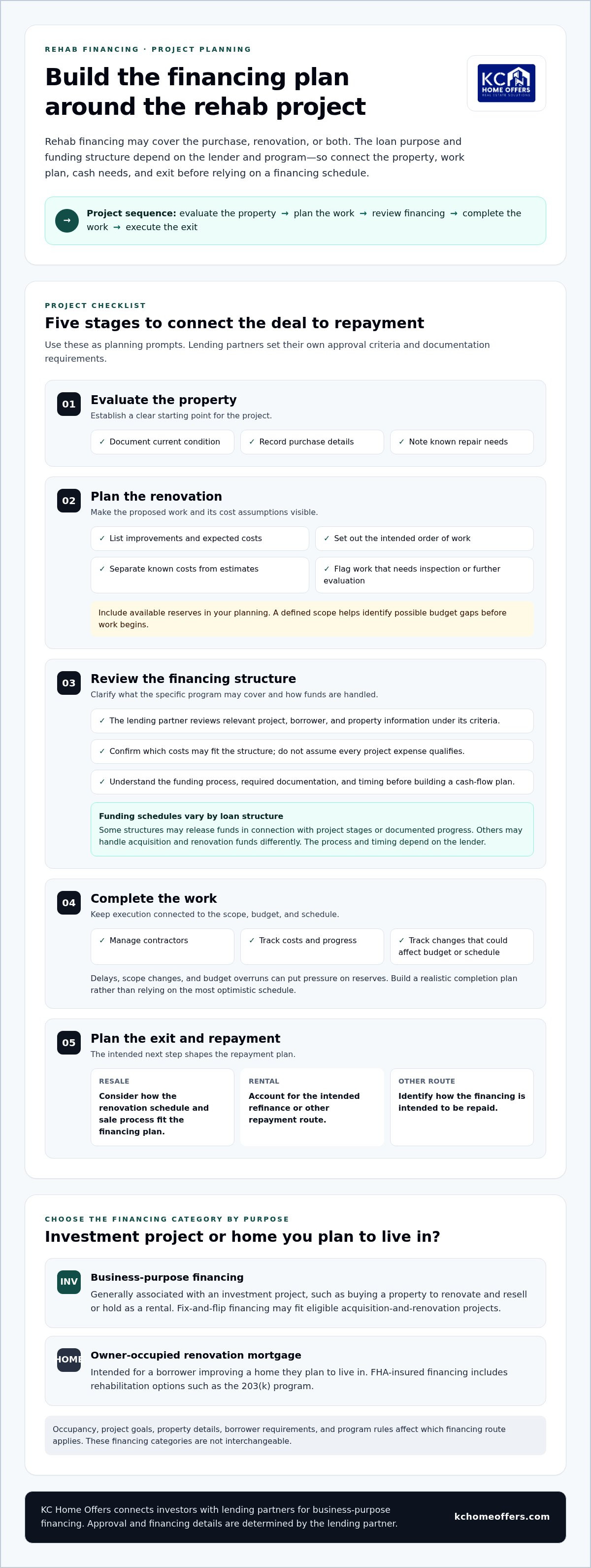
The key distinction is the borrower’s purpose and intended use of the property. Business-purpose financing is generally associated with an investment project, such as buying a property to renovate and resell or hold as a rental. An owner-occupied renovation mortgage is intended for a borrower improving a home they plan to live in. Occupancy and loan purpose can affect which financing route applies, alongside program-specific property and borrower requirements.
For example, FHA-insured financing includes rehabilitation options such as the 203(k) program. The FHA insured loan overview provides broader context on FHA loan types. That residential route differs from investor-focused business-purpose financing. Don’t assume the products are interchangeable: occupancy, project goals, and program rules shape the relevant financing category.
KC Home Offers connects investors with lending partners for business-purpose loan options, including fix-and-flip financing for eligible acquisition-and-renovation projects. The lending partner determines approval and financing details.
How Rehab Loans Work: Project Budget, Funding, and Repayment
Financing a renovation takes more than estimating the purchase price and repair bill. Connect the property’s condition, work plan, cash needs, funding process, and exit into a workable sequence. Rehab loans can be structured differently, so the lender’s review and funding requirements affect how that sequence plays out.
- Evaluate the property. Document its current condition, purchase details, and known repair needs. This gives you a clear starting point for defining the work.
- Plan the renovation. List proposed improvements, expected costs, and the intended order of work.
- Review financing. The lending partner assesses the project and relevant borrower and property information under its criteria.
- Complete the work. Manage contractors, costs, and progress against the plan. Track changes that could affect the budget or schedule.
- Execute the exit. Plan for the intended sale, refinance, or other route for repaying the financing.
A defined renovation scope helps a lending partner assess how the property’s condition, proposed work, itemized budget, available reserves, completion plan, and intended exit connect to the financing request. It also gives you a baseline for identifying budget gaps before work begins.
What a lender may review in a rehab project
A project review may consider the property’s details and condition, purchase information, proposed renovation scope, and your overall plan. A working budget and contractor estimates can help explain expected costs and how the work is organized. They are planning inputs, not universal requirements.
Keep assumptions visible. Separate known costs from estimates, flag work that depends on an inspection or further evaluation, and account for reserves to manage unexpected needs. Lending partners set their own approval criteria and documentation requirements, so one checklist won’t apply to every financing structure.
Funding and repayment depend on the loan structure
Some financing structures may release funds in connection with project stages or documented progress. Others may handle acquisition and renovation funds differently. The process, documentation, and timing depend on the lender. Don’t build a cash-flow plan around an assumed draw schedule before the applicable terms are clear.
Start repayment planning with the exit. For a resale, consider how the renovation schedule and sale process fit the financing plan. For a rental strategy, account for the intended refinance or other repayment route. Delays, scope changes, and budget overruns can put pressure on reserves, so build a realistic completion plan rather than relying on the most optimistic schedule.
KC Home Offers connects investors with lending partners for business-purpose financing, including fix-and-flip options. Review investor financing options to explore the available business-purpose categories. Financing is subject to the lending partner’s approval.
Rehab Loan Options Compared: Fix-and-Flip, Bridge, and Other Financing
Choose a financing category by working backward from the project’s goal. Renovating for resale, covering a short-term funding gap, holding a rental, and building a property each call for a different financing discussion. The categories below describe common uses, not guaranteed eligibility or standard terms. The lender’s underwriting and the property’s details determine which structure may fit.
| Financing type | Project purpose | Property status and funding need | Potential exit |
|---|---|---|---|
| Fix-and-flip | Acquire and renovate an investment property for resale. | May suit a property needing defined improvements; the request may relate to acquisition and renovation, depending on the program. | Sell after completing the planned work. |
| Bridge | Address a temporary financing need or funding gap. | Can be considered for an investment property when the investor needs short-term project financing; structure and use vary. | Sell, refinance, or transition to another financing plan. |
| DSCR rental | Finance or refinance an income-producing rental property. | More relevant to a rental strategy than to funding renovation work alone; underwriting focuses on the rental investment. | Hold the property for rental income. |
| Construction | Fund a building project rather than a standard renovation alone. | May be relevant when the plan involves new construction; the project and funding structure depend on lender review. | Sell, rent, or hold the completed property. |
When fix-and-flip financing may fit a renovation project
Fix-and-flip financing may suit an investor planning to purchase a property, complete renovations, and resell it. Frame the financing discussion around the scope, acquisition assumptions, budget, reserves, and target sale, not just the purchase price. An investor’s experience and ability to manage the work may also be relevant to a lending partner’s review. For additional context, see the guide Fix and Flip Funding: The 2026 Investor’s Guide to Profitable Property Financing.
When bridge, DSCR, or construction financing may be relevant
Bridge financing may be considered when an investor needs short-term funding tied to a project or a transition between financing stages. It isn’t automatically interchangeable with a fix-and-flip loan. DSCR financing may be relevant for a rental property intended to generate income, while construction financing is geared toward a building plan. Investors exploring asset-based approaches can also refer to Hard Money Loans: 2026 Guide to Asset-Based Lending.
Use this practical test: does the financing purpose match the property’s current condition, the project’s funding needs, and the planned exit? Rehab loans aren’t one standard product, and similar projects can receive different underwriting outcomes. KC Home Offers connects investors with lending partners for business-purpose options, including fix-and-flip, bridge, DSCR, and construction financing. The lending partner determines approval and terms.
How to Prepare for a Rehab Loan: A Practical Investor Checklist
A well-organized project plan makes a financing discussion more focused, but preparation doesn’t guarantee approval. Separate what you can document and control from what the lending partner must evaluate. Use this sequence to clarify the deal before discussing financing.
- Set out the acquisition assumptions. Record purchase details, expected acquisition costs, and conditions that could affect the plan. Label estimates clearly rather than presenting them as confirmed figures.
- Document the property’s current condition. Note visible repair needs and relevant property details. Distinguish your observations from items that still need professional evaluation.
- Define the renovation scope. Organize planned work by major category, such as structural repairs, mechanical systems, or interior finishes. Identify what is included, what is optional, and what remains uncertain.
- Build a working budget and reserve plan. Separate confirmed estimates from allowances and unresolved assumptions. Consider how available reserves could address cost changes or unexpected work without relying on additional financing.
- Set a realistic completion plan. Outline the work sequence and dependencies. Consider how a delay or scope change could affect holding costs, cash needs, and the next step.
- Define and test the exit. State whether you plan to sell, refinance, or hold the property as a rental. Revisit the numbers and assumptions if the work takes longer or costs more than expected.
Build a credible property and renovation plan
Use one working file for property information, acquisition assumptions, scope notes, estimates, and schedule. Mark each item as confirmed, estimated, or unresolved. This makes gaps visible and helps keep the budget consistent with the proposed work. Then stress-test the exit: would the plan still make sense if a repair expands, an estimate changes, or completion is delayed? If not, identify the assumption that needs attention before proceeding.
A clear renovation scope and realistic exit plan help frame a financing discussion by showing what the project needs, how the work supports the investment strategy, and how repayment may fit the intended outcome.
Organize the financing conversation
Gather available property and purchase information, the renovation budget, estimates, reserve assumptions, and a concise description of how you’ll manage the project. This preparation helps explain the deal but doesn’t replace underwriting. The lending partner determines its approval criteria, requested documents, and financing conditions.
Prepare focused questions about how funds may be structured and released, repayment expectations, applicable fees, and conditions that could affect funding. Ask how a material scope change or delay should be handled under the proposed structure. Keep the answers with your project file so you can compare them with the budget and exit plan.
KC Home Offers connects investors with lending partners for business-purpose financing, including fix-and-flip options for eligible projects. Explore investor financing options as you organize your project plan. Financing is subject to lending-partner approval.
Explore Rehab Financing Through KC Home Offers' Lending Partners
A property investment needs financing that fits the work and the plan for what comes next. KC Home Offers connects real estate investors with lending partners for business-purpose loan options. For an eligible acquisition-and-renovation project, fix-and-flip financing may be relevant when you intend to complete improvements and sell. The property, project scope, borrower information, and intended exit shape the financing discussion.
How project-focused financing can support an investor plan
Start with the deal itself. Describe the property’s current condition, planned work, acquisition assumptions, budget, and expected next step. A resale plan differs from a rental hold or a new-build project, so identify the strategy rather than treating every investment property as the same opportunity.
KC Home Offers connects investors with lending partners across several business-purpose categories. Fix-and-flip financing may align with an eligible purchase-and-renovation project planned for resale. Bridge financing may be relevant to a short-term funding need or transition. DSCR financing is a separate category for an income-producing rental strategy, while construction financing relates to a building project. These are distinct options, not interchangeable products, and none necessarily fits every property or applicant.
Your project plan can clarify which category merits discussion. If the main need is financing defined renovations before resale, explain the improvements and sale strategy. If you plan to hold a completed property as a rental, describe that instead. The lending partner assesses the deal and determines which financing structure, if any, may apply.
What to expect when exploring financing
Bring a concise project scope and preliminary budget. Include available property and acquisition details, major work categories, estimates or allowances, reserve assumptions, and your intended exit. Estimates don’t need to be final if they’re still being developed. Label what’s confirmed and what remains an assumption so the financing discussion starts with a clear view of the project.
It’s also useful to identify questions about funding structure and release, repayment, fees, documentation, and approval conditions. Those details depend on the lending partner and proposed financing. KC Home Offers is not a direct lender. Lending partners assess applications and determine approval, rates, and terms; financing is subject to their approval.
If you’re evaluating rehab loans for an investment property, bring your project outline and financing goals to the conversation. Discuss your project with KC Home Offers at (816) 608-7837 to explore business-purpose options through lending partners. A clear plan helps focus the discussion, while the lending partner makes the financing decisions.
Turn Your Project Plan Into a Confident Next Step
Before pursuing a property, set a clear decision point: what needs to remain true for the deal to make sense? Review expected costs, completion assumptions, and the exit strategy together. If a change to the work or schedule would alter your plan, account for that uncertainty before committing. This gives you a practical basis for discussing rehab loans without treating financing as a substitute for disciplined deal analysis.
Then bring your project goals into a financing conversation. KC Home Offers connects investors with lending partners across fix-and-flip, DSCR, bridge, and construction loan categories. Each option is subject to the lending partner’s review and approval, so keep your expectations grounded in your project details.
Explore investor-focused financing options and take the next step with a clear view of the property, your investment strategy, and the outcome you’re working toward. A well-prepared plan can help you move forward with purpose.
Frequently Asked Questions
Are rehab loans only for real estate investors?
No. Some renovation financing is designed for people improving a home they intend to occupy, while investor financing serves business-purpose property projects. The two routes can have different occupancy rules, underwriting criteria, and permitted uses. Renovating a home to live in differs from buying a property to resell. Match the financing purpose to how you’ll use the property, and don’t assume one loan category applies to both situations.
Can a rehab loan cover both the property purchase and renovation work?
It may, depending on the loan program, property, and lending partner’s structure. Some financing can cover both acquisition and approved improvements, while other options address a narrower need. Don’t assume every line in your project budget is eligible. Before relying on financing for a particular expense, determine how the proposed loan treats that cost and what documentation the lending partner requires.
What types of properties can rehab loans be used for?
Eligible property types vary by program and lending partner, so there isn’t one universal list. A lender may distinguish among a detached home, a small multifamily property, a vacant building, or a property already producing rental income. Condition and intended use may matter, too. Describe the property accurately, including occupancy and current use, rather than assuming it qualifies based only on the planned renovation.
Can a rehab loan be used for structural repairs?
Possibly, but structural work may be treated differently from cosmetic updates, and the financing program determines what work may be considered. Foundation repairs, changes to load-bearing elements, or roof framing work can affect the project scope and risk. If an inspection reveals a structural issue, document the finding and its estimated impact on the plan. Don’t assume the existing budget or funding arrangement automatically covers newly discovered repairs.
What happens if renovation work takes longer than expected?
A delay can affect carrying costs, contractor coordination, and the planned sale or refinance. Review the loan documents to understand applicable deadlines and repayment obligations, then promptly update the lending partner if the schedule or scope changes. An extension or other adjustment isn’t automatic. Keep a revised timeline and budget, and consider how a longer hold could affect reserves and exit assumptions.
Can I refinance or sell a property before a rehab loan is fully repaid?
That may be possible, but the loan agreement and lending partner’s requirements control. A sale may require a payoff as part of the transaction, so obtain the applicable payoff information and account for it in your sale planning. Refinancing involves a new financing review and doesn’t by itself remove the existing balance. Check how either option would affect repayment, costs, and the timing of your exit.
Do rehab loans require contractor estimates before applying?
Not always. Whether contractor estimates or bids are needed depends on the financing program and lending partner’s review. Even before you have final bids, a preliminary breakdown by work category can help explain the project and identify uncertain costs. Clearly label estimates, allowances, and items still awaiting evaluation. This makes the numbers easier to assess without presenting preliminary figures as confirmed commitments.
Frequently asked
Are rehab loans only for real estate investors?
No. Some renovation financing is designed for people improving a home they intend to occupy, while investor financing serves business-purpose property projects. The two routes can have different occupancy rules, underwriting criteria, and permitted uses. Renovating a home to live in differs from buying a property to resell. Match the financing purpose to how you’ll use the property, and don’t assume one loan category applies to both situations.
Can a rehab loan cover both the property purchase and renovation work?
It may, depending on the loan program, property, and lending partner’s structure. Some financing can cover both acquisition and approved improvements, while other options address a narrower need. Don’t assume every line in your project budget is eligible. Before relying on financing for a particular expense, determine how the proposed loan treats that cost and what documentation the lending partner requires.
What types of properties can rehab loans be used for?
Eligible property types vary by program and lending partner, so there isn’t one universal list. A lender may distinguish among a detached home, a small multifamily property, a vacant building, or a property already producing rental income. Condition and intended use may matter, too. Describe the property accurately, including occupancy and current use, rather than assuming it qualifies based only on the planned renovation.
Can a rehab loan be used for structural repairs?
Possibly, but structural work may be treated differently from cosmetic updates, and the financing program determines what work may be considered. Foundation repairs, changes to load-bearing elements, or roof framing work can affect the project scope and risk. If an inspection reveals a structural issue, document the finding and its estimated impact on the plan. Don’t assume the existing budget or funding arrangement automatically covers newly discovered repairs.
What happens if renovation work takes longer than expected?
A delay can affect carrying costs, contractor coordination, and the planned sale or refinance. Review the loan documents to understand applicable deadlines and repayment obligations, then promptly update the lending partner if the schedule or scope changes. An extension or other adjustment isn’t automatic. Keep a revised timeline and budget, and consider how a longer hold could affect reserves and exit assumptions.
Can I refinance or sell a property before a rehab loan is fully repaid?
That may be possible, but the loan agreement and lending partner’s requirements control. A sale may require a payoff as part of the transaction, so obtain the applicable payoff information and account for it in your sale planning. Refinancing involves a new financing review and doesn’t by itself remove the existing balance. Check how either option would affect repayment, costs, and the timing of your exit.
Do rehab loans require contractor estimates before applying?
Not always. Whether contractor estimates or bids are needed depends on the financing program and lending partner’s review. Even before you have final bids, a preliminary breakdown by work category can help explain the project and identify uncertain costs. Clearly label estimates, allowances, and items still awaiting evaluation. This makes the numbers easier to assess without presenting preliminary figures as confirmed commitments.
Need financing on a deal like this?
DSCR, fix & flip and new construction loans, underwritten on the deal rather than your tax returns. Soft credit pull only.
Apply in 5 minutes