Guides › Private lending
Real Estate Investment Loans: DSCR, Hard Money and Bridge Compared

Compare real estate investment loans to match your strategy. Explore DSCR, hard money, and bridge options for rentals, fix-and-flips, and transitional deals.
The loan that gets a deal moving isn’t always the loan that fits the investment. Real estate investment loans can sound alike, but the right option depends on what the property needs to do and how you expect to repay the financing.
If you’re weighing DSCR, hard money, and bridge financing, compare the deal rather than the labels. A rental’s income, a renovation plan, and the expected exit all affect which financing category may fit. A mismatch between the loan structure and the project can create pressure later, so understand the differences before committing.
This guide explains investor loan categories and how to compare them for a rental, fix-and-flip, or transitional property plan. It also covers the property, financial, and timeline details to prepare for a lending-partner discussion. KC Home Offers LLC connects investors with lending partners for business-purpose financing, including DSCR, fix-and-flip, bridge, and new-construction loans. Financing is subject to the lending partner’s approval.
Key Takeaways
- Match financing to the property’s business plan, whether you intend to hold, renovate, resell, bridge a transition, or build.
- Compare real estate investment loans by intended use, repayment source, project stage, and underwriting factors.
- DSCR financing is designed for rental properties, while fix-and-flip financing aligns with acquisition and renovation plans.
- Prepare property details, projected income, your project plan, and repayment strategy before discussing financing.
- KC Home Offers connects investors with lending partners for DSCR rental, fix-and-flip, bridge, and new-construction financing. Approval is subject to the lending partner.
Table of Contents
- What Are Real Estate Investment Loans, and What Do They Finance?
- Which Real Estate Investment Loan Types Fit Different Property Plans?
- How Do Real Estate Investment Loans Compare for Risk, Timing, and Repayment?
- How Should Investors Prepare to Compare Real Estate Investment Loans?
- How KC Home Offers Connects Investors With Real Estate Loan Options
What Are Real Estate Investment Loans, and What Do They Finance?
Real estate investment loans finance the purchase or improvement of property for an investment purpose, such as rental income, resale, or new construction. Intended use matters: holding a completed rental is a different business plan from renovating a property for resale or funding a ground-up build.
Start with the property’s role in your investment strategy. A rental purchase centers on ongoing income and longer-term ownership. A renovation project depends on completing improvements and selling or refinancing the property. Bridge financing can fund a transition between stages, while construction financing is structured around a ground-up project. The broader Real Estate Investing Overview describes the variety of strategies investors use. The financing still needs to fit the specific property and plan.
How investment property financing differs from a home mortgage
Occupancy and purpose can affect the financing path. A home mortgage is generally associated with a property used as a residence, while business-purpose investor financing supports an investment plan. These categories aren’t interchangeable. A property intended for rental or renovation may call for financing designed around that use, rather than assumptions tied to owner occupancy.
Don’t assume conventional mortgage criteria apply to every investor loan. Documentation and underwriting depend on the lending partner, property, borrower profile, and specific loan program.
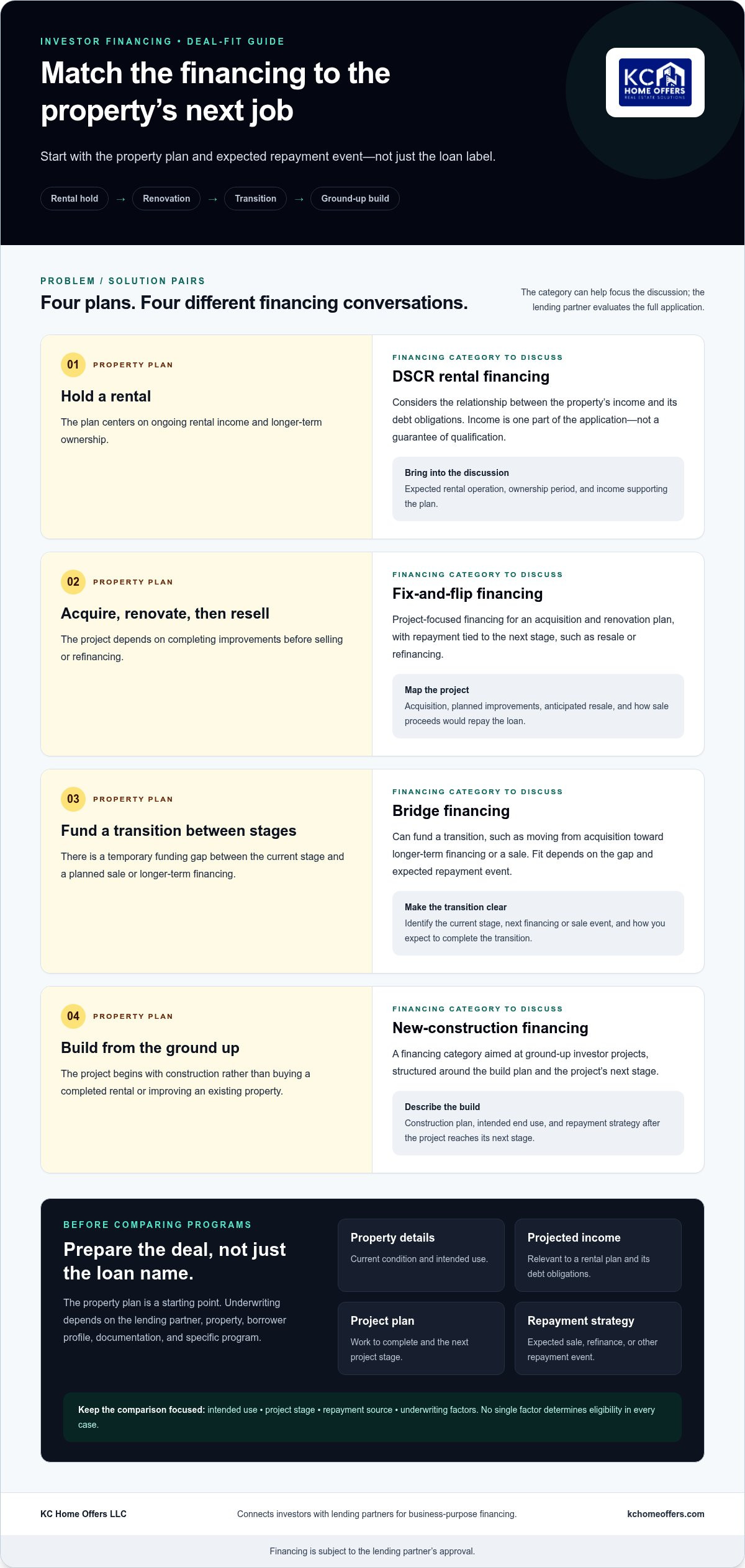
Start with the property plan, not the loan label
Before comparing loan names, write down how you intend to use the property and what event will repay the financing. This makes it easier to discuss relevant programs and identify details that could affect eligibility.
- Hold as a rental: Outline the expected rental operation, ownership period, and income supporting the plan.
- Renovate and resell: Map the acquisition, planned improvements, anticipated resale, and how sale proceeds would repay the loan.
- Bridge a transition: Identify the current stage, the next financing or sale event, and how you expect to complete the transition.
- Build from the ground up: Describe the construction plan, intended end use, and repayment strategy after the project reaches its next stage.
Then consider how the borrower profile, property condition, and project details relate to the program’s underwriting approach. No single factor determines eligibility in every case. The plan is the starting point, while the lending partner evaluates the full application under its program. Be specific about intended use, ownership period, and repayment source to keep the discussion focused on the deal rather than the loan label.
Which Real Estate Investment Loan Types Fit Different Property Plans?
Choose financing based on the work the property needs to do, not just the name of the loan. A stabilized rental, a home needing renovations, a property in transition, and a ground-up build involve different stages and repayment plans. Those distinctions help narrow the relevant real estate investment loans and guide a discussion with a lending partner.
Rental-property loans: DSCR and other financing paths
A DSCR loan is a rental-property financing option that considers the relationship between a property’s income and its debt obligations. That relationship is one part of the application, not a promise that current or projected rent alone will qualify a borrower. The property, borrower profile, documentation, and lending partner’s program also matter. Investors considering this approach can review the DSCR loan investor guide.
Other financing paths may include investment-property mortgages or options tied to existing property equity. These differ from project financing for active renovation or construction. A mortgage designed for a rental hold may not suit a plan that depends on completing improvements before selling. Equity-based financing also relies on a different source than a loan structured around a specific project.
Project loans: fix-and-flip, bridge, and construction
Fix-and-flip financing is for a plan to acquire and renovate a property, with repayment tied to the project’s next stage, such as resale or refinancing. The fix-and-flip funding guide explores this project-focused approach. Bridge financing, by contrast, can provide short-term funding during a transition, such as moving from acquisition toward longer-term financing or a sale. Its fit depends on the gap it needs to cover and the expected repayment event.
New-construction financing is aimed at ground-up investor projects. Unlike buying an existing rental or improving a completed property, the plan centers on building from the start. Review the new-construction financing guide to explore this category. Program details and underwriting vary across project types, so don’t assume a particular leverage level, timeline, or approval outcome.
To distinguish the categories, identify the property’s current stage and intended next step:
- Operating rental: Assess rental income and ongoing debt obligations for a hold strategy.
- Renovation: Map the acquisition, planned work, and anticipated sale or refinance.
- Transition: Define the temporary funding need and the event expected to repay it.
- Ground-up project: Describe the build plan and intended next stage after construction.
For broader context on real estate finance markets, the Mortgage Bankers Association Industry Insights covers residential, commercial, and multifamily finance. KC Home Offers connects investors with lending partners to discuss business-purpose options, with approval subject to the lending partner. Investors planning a rental or project can explore business-purpose loan options.
How Do Real Estate Investment Loans Compare for Risk, Timing, and Repayment?
No single financing type fits every deal. Compare the loan’s purpose, the property’s stage, the expected repayment source, and what could disrupt the plan. Use the table as a starting point. Actual rates, fees, terms, collateral, and qualification criteria vary by lending partner and program.
| Financing type | Intended use | Project stage | Expected repayment source | Key underwriting variables |
|---|---|---|---|---|
| DSCR | Rental-property investment | Property operating as, or being prepared for, a rental | Rental income, refinance, or another planned exit | Property income, debt obligations, property details, borrower profile |
| Fix-and-flip | Acquisition and renovation for resale or refinance | Purchase and improvement phase | Sale proceeds or refinancing, depending on the plan | Property condition, renovation scope, project plan, borrower profile |
| Bridge | Temporary funding during a financing or property transition | Between acquisition and a longer-term loan, sale, or other next step | The defined transition event, such as a sale or refinance | Current property position, transition plan, expected repayment event |
| New construction | Ground-up investor project | Planning and construction | Sale, refinance, or income from the completed project, as planned | Project scope, property details, borrower profile, completion plan |
Compare financing against the investment timeline
Start with when you expect the property to generate income or reach an exit. A long-term rental plan calls for financing aligned with rental-property ownership. Acquisition followed by renovation has a different sequence: purchase, complete the work, then sell or refinance. A bridge plan needs to account for the period between stages, while construction financing should reflect the path from project start to completion and the next repayment step.
Timelines are plans, not guarantees. Leave room to reassess if work takes longer than expected or the intended financing or sale doesn’t happen on schedule. The loan’s structure and duration should make sense alongside project milestones, not just the initial purchase.
Assess repayment source, cash flow, and downside exposure
Be explicit about what you expect to repay the debt: rental cash flow, sale proceeds, a refinance, or progress toward a completed project. Then test the plan against setbacks. Vacancy can reduce rental income. Renovation delays can push back a sale or refinance. Changes in costs, scope, or expected value can weaken the assumptions behind a project exit.
Projected rent and resale value are estimates, not guaranteed repayment. Consider your response if expected income or an exit is delayed or lower than planned. This downside review can help distinguish financing that matches your investment strategy from an option that only appears to fit at the outset. Compare real estate investment loans against the full project plan, including timing, cash flow, and repayment.
How Should Investors Prepare to Compare Real Estate Investment Loans?
A focused financing discussion starts with a clear deal summary. Before comparing real estate investment loans, organize the property facts, project plan, expected income or exit, and questions you need answered. This keeps the conversation tied to the investment rather than an advertised rate in isolation.
Build a property and project snapshot
Record the property type, current condition, intended use, and the stages between acquisition and repayment. For a rental, outline estimated income and operating assumptions, treating projections as estimates. For renovation or construction, prepare the planned scope, budget assumptions, and milestones. These details give a lending partner a practical view of the project.
Review loan fit and partner requirements
Compare the proposed repayment source with the property’s realistic operating plan. Then organize relevant financial and project information for the loan category under discussion. Documentation and underwriting vary by partner and program, so use the discussion to understand the requirements for your proposal.
- Define the investment goal. State whether you plan to hold the property as a rental, renovate it for resale, bridge a transition, or build from the ground up.
- Describe the property. Summarize its type, condition, intended use, purchase status, and known work needed. Include relevant property information you have available.
- Map the project stages. Note the expected sequence, from acquisition through renovation, lease-up, construction, sale, or refinance. Identify milestones that could affect the financing timeline.
- Document income and repayment assumptions. For a rental, estimate income and operating costs. For a project, explain whether repayment is expected from sale proceeds, refinancing, rental income, or another defined exit. Keep estimates separate from confirmed figures.
- Prepare for the lending-partner discussion. Gather relevant financial records, property details, project scope, and supporting estimates. Ask how the program evaluates the proposed use, repayment source, and borrower and property information.
Look beyond an advertised rate. Compare the full obligations and risks, including fees, terms, collateral, required documentation, repayment structure, and what happens if your timeline or assumptions change. A lower headline rate doesn’t necessarily mean the financing aligns with the project stages or expected exit. Understand the complete cost and repayment plan presented for your situation.
Bring specific questions: What costs and fees apply? What property or other collateral is involved? Which documents are needed? How does the repayment plan fit the expected timeline? What alternatives or exit steps would matter if a sale, refinance, or project milestone is delayed? These questions can surface important differences before you commit.
KC Home Offers connects investors with lending partners for business-purpose financing. Any loan is subject to the lending partner’s approval and program requirements. To discuss a project and explore possible paths, explore investor financing options.
How KC Home Offers Connects Investors With Real Estate Loan Options
A financing discussion starts with a clear account of the deal. KC Home Offers connects real estate investors with lending partners for business-purpose financing, framing the conversation around the property, project stage, and intended repayment plan. Lending partners review financing requests, and approval is subject to their requirements.
Financing categories include DSCR rental, fix-and-flip, bridge, and new-construction loans. Each serves a different investment plan. Use the property’s purpose and next milestone to decide which category to discuss rather than treating the labels as interchangeable.
Match the financing conversation to the investment strategy
For a rental investment, discuss DSCR financing with a lending partner and be ready to describe the property’s expected rental operation. For renovation and resale, fix-and-flip financing aligns with the acquisition and improvement project. Bridge financing may fit a defined transition between stages, while new-construction financing relates to a ground-up project.
These categories are starting points, not a promise that a particular program will fit or that a request will be approved. A useful conversation connects the proposed financing to the property’s current stage and your repayment plan.
What to expect when exploring financing through KC Home Offers
Bring a concise summary of the property and your plan. Include its current status, intended use, planned work, expected project stages, and proposed repayment strategy. Organize any income estimates, renovation or construction scope, and relevant project documents so the lending partner can understand the proposal. Clear details keep the discussion focused on the deal.
As you compare options, ask about program requirements, documentation, obligations, collateral, and how the repayment plan fits the timeline. Rates, terms, and other conditions depend on the lending partner and loan program. Review the complete financing proposal rather than assuming the category name alone determines fit.
KC Home Offers connects your project plan with lending partners to discuss business-purpose financing. Share the investment purpose and property details to begin a focused conversation. Approval is subject to the lending partner’s review. Discuss your real estate financing needs.
Put Your Financing Plan Into Motion
Turn your analysis into a clear deal brief. Set out what you know, what you’re estimating, and which parts of the plan could change. This helps focus the financing discussion and highlights assumptions to revisit before you commit.
As you evaluate real estate investment loans, keep the decision anchored to the property’s purpose and your ability to manage repayment. Consider how the plan would hold up if rental income starts later than expected, renovation work takes longer, or your intended exit changes. You don’t need to predict every outcome, but you should understand the obligations and consider reasonable alternatives.
KC Home Offers connects investors with lending partners. Discuss your real estate financing needs and take the next step with a clear view of your investment strategy.
Frequently Asked Questions
How much down payment do real estate investment loans require?
Down payment requirements vary by loan program, property, borrower profile, and lending partner. The amount may also depend on whether you’re buying a rental, funding a renovation, or financing another project. To prepare, estimate the cash you can contribute and account for other project expenses, such as planned improvements or reserves. The lending partner can explain the requirements for the program under review.
Can I get a real estate investment loan through an LLC?
Some investor loan programs may allow an LLC to borrow, but eligibility and documentation depend on the lending partner and program. Be ready to provide details about the entity, ownership, and property, along with any borrower information the program requires. Before arranging a purchase through an LLC, consider how the ownership structure fits the financing and discuss it with the lending partner. Approval remains subject to its review.
Do real estate investment loans require personal income documentation?
Programs don’t all evaluate income the same way. A rental-focused loan may give substantial attention to the property’s income and debt obligations, but that doesn’t mean personal financial documentation is automatically unnecessary. A lending partner may request borrower, entity, asset, or other records based on its program. Be ready to explain how the property will be used and provide the documents requested for that financing path.
Can a DSCR loan be used for a property that is not yet rented?
Possibly, depending on the lending partner’s program and how it evaluates an unrented property. For example, a recently acquired unit may be vacant while you complete basic preparation for tenants. The lender may consider rental information or other property details under its underwriting approach. Don’t treat estimated rent as a guarantee of qualification. Clarify which documentation is relevant and how vacancy affects the application.
What happens if rental income does not cover the loan payment?
If rental income falls short, the property owner may need to cover the payment from other available funds, subject to the loan agreement. Vacancy, unexpected repairs, or lower-than-expected rent can put pressure on cash flow. Before borrowing, model a scenario with reduced income and include operating costs beyond the loan payment. This helps you assess whether the investment remains manageable if the property doesn’t perform as projected.
Can I use one investment property loan for both purchasing and renovating?
Some fix-and-flip financing programs are intended to cover acquisition and renovation as part of one project, but the scope and structure depend on the lending partner. A property needing substantial work before resale, for example, calls for a different financing discussion than a move-in-ready rental. Bring a clear renovation scope and budget assumptions, and confirm which project costs the proposed program considers.
Are real estate investment loans available for new construction?
Yes, new-construction financing is a category for ground-up investor projects. The lending partner’s program determines which project details and borrower documents are needed. Prepare a description of the planned build, available property or site information, and what you expect to do when construction is complete, such as sell, refinance, or operate the property as a rental. Financing and approval depend on the partner’s review.
Frequently asked
How much down payment do real estate investment loans require?
Down payment requirements vary by loan program, property, borrower profile, and lending partner. The amount may also depend on whether you’re buying a rental, funding a renovation, or financing another project. To prepare, estimate the cash you can contribute and account for other project expenses, such as planned improvements or reserves. The lending partner can explain the requirements for the program under review.
Can I get a real estate investment loan through an LLC?
Some investor loan programs may allow an LLC to borrow, but eligibility and documentation depend on the lending partner and program. Be ready to provide details about the entity, ownership, and property, along with any borrower information the program requires. Before arranging a purchase through an LLC, consider how the ownership structure fits the financing and discuss it with the lending partner. Approval remains subject to its review.
Do real estate investment loans require personal income documentation?
Programs don’t all evaluate income the same way. A rental-focused loan may give substantial attention to the property’s income and debt obligations, but that doesn’t mean personal financial documentation is automatically unnecessary. A lending partner may request borrower, entity, asset, or other records based on its program. Be ready to explain how the property will be used and provide the documents requested for that financing path.
Can a DSCR loan be used for a property that is not yet rented?
Possibly, depending on the lending partner’s program and how it evaluates an unrented property. For example, a recently acquired unit may be vacant while you complete basic preparation for tenants. The lender may consider rental information or other property details under its underwriting approach. Don’t treat estimated rent as a guarantee of qualification. Clarify which documentation is relevant and how vacancy affects the application.
What happens if rental income does not cover the loan payment?
If rental income falls short, the property owner may need to cover the payment from other available funds, subject to the loan agreement. Vacancy, unexpected repairs, or lower-than-expected rent can put pressure on cash flow. Before borrowing, model a scenario with reduced income and include operating costs beyond the loan payment. This helps you assess whether the investment remains manageable if the property doesn’t perform as projected.
Can I use one investment property loan for both purchasing and renovating?
Some fix-and-flip financing programs are intended to cover acquisition and renovation as part of one project, but the scope and structure depend on the lending partner. A property needing substantial work before resale, for example, calls for a different financing discussion than a move-in-ready rental. Bring a clear renovation scope and budget assumptions, and confirm which project costs the proposed program considers.
Are real estate investment loans available for new construction?
Yes, new-construction financing is a category for ground-up investor projects. The lending partner’s program determines which project details and borrower documents are needed. Prepare a description of the planned build, available property or site information, and what you expect to do when construction is complete, such as sell, refinance, or operate the property as a rental. Financing and approval depend on the partner’s review.
Need financing on a deal like this?
DSCR, fix & flip and new construction loans, underwritten on the deal rather than your tax returns. Soft credit pull only.
Apply in 5 minutes