Guides › Private lending
How to Find Private Money Lenders for Real Estate

Learn how to find private money lenders for real estate deals. Compare loan terms, discover key funding sources, and pitch investors with complete confidence.
A bank isn’t the only way to fund an investment property. Private real estate lenders are individuals or companies that provide financing for real estate investments, and finding private money lenders for real estate often starts with investor referrals, lender directories, and introductions from real estate professionals. The right fit depends on how the loan’s terms, timeline, and structure match your deal.
Speed matters when considering private financing, but so do the cost, repayment plan, and lender’s track record. Knowing what to compare helps you approach potential lenders with clear questions.
This guide explains how private money loans differ from bank financing, where to find lenders, what to include in an initial conversation, and how to evaluate a potential funding partner. It also covers investor-focused financing for rental, fix-and-flip, and construction projects.
Key Takeaways
- Compare private financing with bank loans by looking beyond speed to underwriting focus, repayment structure, and overall fit for your investment.
- Assess whether a private loan’s flexibility suits your project, and weigh its terms against your timeline and exit plan.
- Research potential lenders through investor referrals, professional introductions, and lender directories, then compare offers for your deal.
- Prepare a clear project summary and supporting property and financial documents to make lender conversations more productive.
- For investor-focused financing, KC Home Offers connects real estate investors with lending partners for DSCR, fix-and-flip, and new construction loans, subject to the lending partner’s approval.
Table of Contents
- How are private money loans different from traditional bank financing?
- Benefits of private money loans
- Due diligence when choosing a lender
- Finding and contacting private real estate lenders
- What information and documents should I prepare before approaching a private lender?
- KC Home Offers: DSCR Loan
How are private money loans different from traditional bank financing?
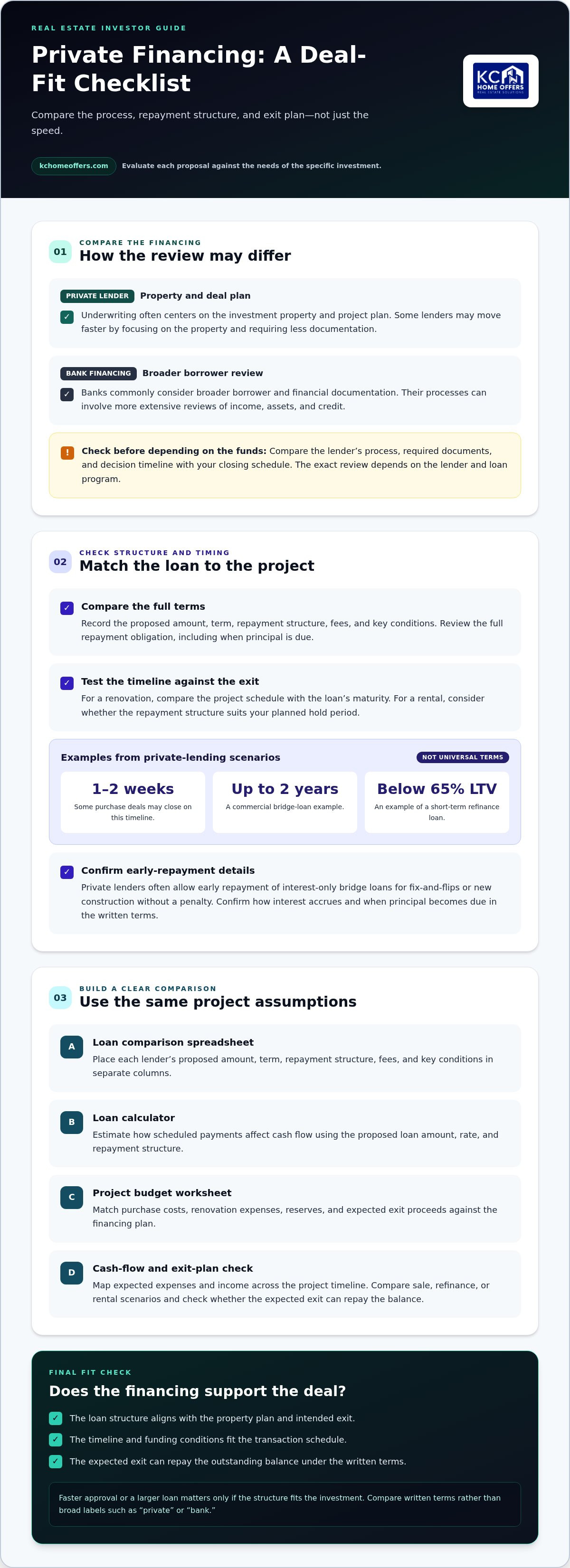
Private money loans fund real estate investments through individuals or companies, rather than conventional bank lending. In the United States, these lenders provide billions of dollars in loans each year. Their underwriting often centers on the investment property and deal plan, while banks commonly consider broader borrower and financial documentation. The exact review depends on the lender and loan program.
That difference can affect timing and paperwork. Private lenders may be able to move faster by focusing on the property and requiring less documentation. Bank processes can involve more extensive reviews of income, assets, and credit. For a time-sensitive purchase, compare each lender’s process, required documents, and decision timeline before depending on financing for closing.
Loan amounts and availability also vary. Private lenders may finance larger real estate deals than traditional lenders, and some can structure funding around a property’s value or project plan. A commercial bridge loan lasting up to two years is a typical private-lending scenario. Short-term refinance loans below 65% loan-to-value are another example. These are examples, not universal limits or terms.
Private financing may offer flexibility in loan length, amount, structure, and repayment terms, which can help align the financing with your investment’s exit plan. An investor buying a property to renovate and resell, for example, might compare a short-term loan with a bank product built around a different timeline. Review the full repayment obligation, including when principal is due, rather than focusing only on the initial payment.
Use a few practical tools to compare financing for the specific deal:
- Loan comparison spreadsheet: Record each lender’s proposed amount, term, repayment structure, fees, and key conditions in separate columns.
- Loan calculator: Estimate how scheduled payments affect cash flow using the proposed loan amount, rate, and repayment structure.
- Project budget worksheet: Match purchase costs, renovation expenses, reserves, and expected exit proceeds against the financing plan.
These tools clarify trade-offs between bank financing and private lending. A spreadsheet makes terms easier to compare, a calculator tests payment assumptions, and a budget worksheet ties financing to the property plan. Use the same project assumptions for every proposal, then check whether the expected exit can repay the balance. Faster approval or a larger loan matters only if the structure fits the investment.
Compare written terms, not broad labels such as “private” or “bank.” For a rental, you may prioritize a repayment structure that suits your planned hold period. For a renovation, the funding available and project timeline may matter more. Set your priorities first, then compare the lender’s proposal with the deal’s requirements.
Benefits of private money loans
Private financing can help match capital to a property’s business plan. A purchase that needs renovation, for example, may call for funds structured around the work and planned resale. A rental acquisition may need a different repayment approach. Define the project first so you can assess whether a lender’s proposal supports the investment, rather than forcing the deal into an unsuitable structure.
Timing is another potential benefit. Private-lending scenarios include purchase deals closing in 1-2 weeks. That can help an investor move through a transaction with a compressed timeline. Build a schedule showing the purchase date, renovation milestones, and expected exit. Then compare it with the lender’s process and funding conditions. A quick closing only helps if the funds arrive in time for the actual transaction.
Repayment flexibility can also support a project’s exit plan. Private lenders often allow early repayment of interest-only bridge loans for fix-and-flips or new construction without a penalty. For example, an investor who sells a renovated property ahead of schedule may be able to repay the bridge loan early. Confirm how interest accrues and when principal becomes due in the written loan terms.
Use project tools to test whether financing works beyond the purchase:
- Cash-flow forecast: Map expected expenses and income across the project timeline, including periods without rent or sale proceeds.
- Loan payment calculator: Estimate scheduled payments using the proposed repayment structure and loan details.
- Exit-plan comparison: Compare sale, refinance, or rental scenarios and identify how each could repay the outstanding balance.
These tools can reveal pressure points before you commit. For a fix-and-flip, compare the renovation schedule with the loan’s maturity date. For a rental, test whether projected income supports carrying costs and repayment. A spreadsheet doesn’t replace the loan documents, but it makes your assumptions visible and easier to discuss with a lender.
A lender relationship can become part of your financing network. Clear communication on one project helps establish a record of your planning and execution. Keep project budgets, progress updates, and exit calculations organized. If another opportunity arises, these materials make it easier to explain the deal and its capital needs.
Private money isn’t automatically right for every property. Compare the full repayment obligations, timing, and flexibility with the project’s risks and expected exit. A disciplined review helps you determine whether speed or adaptable repayment genuinely benefits the investment or simply adds financing complexity.
Due diligence when choosing a lender
Private lenders commonly assess factors such as credit, property value, project scope, investing experience, and exit strategy, but criteria vary. For a fix-and-flip, for example, a lender may consider the renovation budget and resale plan alongside borrower finances.
Review default, foreclosure, balloon-payment, and personal-guarantee provisions before signing. A missed payment can trigger contractual remedies; a balloon payment may require a large balance at maturity; and a personal guarantee can create obligations beyond the property.
Start with the proposed loan documents. Read the promissory note, security instrument, and any guarantee together, because each can describe different obligations. Identify the payment schedule, maturity date, default triggers, extension options, and conditions for releasing the property lien. If a written term differs from the lender’s verbal explanation, request clarification before proceeding.
Check the lender’s identity and applicable rules. State and federal laws regulate private lending, and licensing requirements can limit how many loans a lender may provide. The American Association of Private Lenders does not license private lenders and warns that claims of AAPL licensure are a scam. Treat such a claim as a reason to pause and investigate.
Private lenders are not conventional banks, but they must follow applicable rules. Requirements can depend on the loan, borrower, property, and location. Confirm the lender’s legal name and the entity named in the loan documents, and make sure payment instructions identify the correct party. Compare those details across the term sheet, closing documents, and correspondence.
Use a consistent review process for each lender:
- Term sheet comparison: Put proposed amount, rate, fees, maturity, repayment structure, and default provisions side by side.
- Property review file: Organize the valuation, inspection findings, scope of work, and project budget to test the lender’s assumptions.
- Exit-strategy worksheet: Model the planned sale, refinance, or rental income against the payoff date and outstanding balance.
- Document checklist: Track received agreements, amendments, payment instructions, and unresolved questions in one record.
These tools can reveal differences a headline rate may hide. Compare the balloon-payment date with the project’s expected sale or refinance date, for example. A mismatch could require repayment before your planned exit. Use the worksheet to test scenarios such as a delayed sale or lower resale proceeds, too.
Due diligence means assessing fit as well as identity. Compare the proposed structure with the property’s condition, your experience, and the project timeline. Keep questions and written answers together, and have qualified legal or financial professionals review complex documents. A careful paper trail makes the decision clearer before the investment moves forward.
Finding and contacting private real estate lenders
In the United States, state and federal lending laws regulate private lenders, and licensing requirements can limit how many loans they may provide. Pooling private money for real estate is legal when the proper legal frameworks are followed, including applicable fundraising limits. Lender research and deal preparation are important parts of the process.
To learn how to find private money lenders for real estate, start with people who know investment activity in your target market. Ask experienced investors which lenders have funded projects like yours, such as a rental acquisition or bridge loan. You can also seek introductions from real estate agents, title companies, or attorneys experienced with private lenders. Referrals can point you toward lenders familiar with your property type and market.
Lender directories can help you identify potential funding sources and compare their stated terms and rates. Treat a directory as a starting point, not an endorsement. Record each lender’s focus, geographic coverage, loan types, and contact details. A spreadsheet can organize the information and show which lenders appear aligned with your investment plan.
Before reaching out, prepare a concise deal summary. Include the property location, purchase or refinance goal, planned work, estimated budget, and intended exit. For example, explain whether you need a bridge loan for a purchase followed by renovation and resale. A clear summary helps the lender understand your request and identify the information needed to assess it.
Contact several potential lenders, present the same project assumptions, and request written quotes for terms and rates. Compare responses in a consistent worksheet. Track the proposed amount, repayment structure, term, fees, conditions, and expected funding process. Using the same assumptions makes differences between proposals easier to spot.
- Lender directories: Find private lenders and compare the loan types and terms they publish.
- Investor referral log: Track introductions, referral sources, and follow-up details.
- Deal summary template: Present the property, project budget, and exit plan consistently.
- Offer comparison spreadsheet: Review written quotes side by side using matching assumptions.
As you consider how to find private money lenders for real estate, use each conversation to understand the lender’s focus. State the funding purpose, explain the property’s role in the investment, and outline your repayment plan. Record follow-up requests and share relevant documents together to keep communication organized.
Save lender details, referral sources, proposals, and notes on each lender’s fit. A well-maintained network can help you identify relevant financing options for a future property or bridge-loan need.
State and federal lending laws regulate private real estate loans, and licensing requirements may limit how many loans a lender can provide. Pooling private money is legal when applicable legal frameworks and fundraising limits are followed.
What information and documents should I prepare before approaching a private lender?
Prepare a concise funding package before your first lender conversation. Start with a one-page summary that identifies the property, purchase or refinance purpose, requested financing, project plan, and intended exit. Explain whether you plan to renovate and resell or hold the property as a rental. Clear details help a lender understand the investment and identify follow-up questions.
Include property records that support your description. Gather the purchase agreement or current ownership information, listing details, inspection reports, photographs, and available title documents. If the property needs work, organize contractor estimates and a scope of work by project stage. The lender can compare these materials with the property’s condition and your proposed use of funds.
Build a project budget with separate lines for acquisition, renovations, carrying costs, and reserves. Note the source for each estimate, such as a contractor proposal or insurance quote. Then prepare a timeline for key milestones, including closing, construction, leasing, or resale. If renovation takes longer than planned, show how the revised schedule affects your repayment strategy.
Organize borrower information in a secure folder. A lender may request a personal financial statement, proof of available funds, credit authorization, entity documents, or details about previous real estate projects. Keep files current and label them clearly, with separate folders for personal finances, property records, and business ownership documents.
Prepare evidence for your exit plan. For a resale, include comparable properties and explain how the renovation supports your projected sale. For a rental, provide rent assumptions and expected operating expenses. If refinancing is the planned exit, explain how the property’s condition and income plan support that approach. Keep assumptions consistent across the summary, budget, and supporting documents.
A few simple tools can make the package easier to review:
- Document checklist: Track each requested file, its date, and whether it’s ready to share.
- Project budget spreadsheet: Compare estimates with actual expenses as work progresses.
- Timeline worksheet: Link project milestones to expected funding and repayment dates.
- Secure file-sharing folder: Keep sensitive records organized and limit access to intended recipients.
Before sending anything, check that names, property details, and figures match across documents. For example, a purchase agreement and budget with different addresses can slow the review. Remove unrelated personal information from shared files, and use a secure method for sensitive records.
Investors preparing a project can discuss investor financing options while organizing their property and financial documents.
KC Home Offers: DSCR Loan
KC Home Offers LLC provides DSCR Loans for investors financing rental properties. A DSCR Loan is designed around a property’s income potential and can suit an income-producing rental. Prepare the property details, expected rental income, expenses, and investment plan for review. KC Home Offers LLC offers DSCR loans with no income documentation or tax returns required, and uses a soft credit pull that does not affect your credit score.
KC Home Offers LLC also connects investors with lending partners for fix-and-flip and new construction loans. The right option depends on the property and project purpose, so organize your deal information before discussing financing.
To discuss investor financing, contact KC Home Offers LLC at (816) 608-7837.
Put Your Financing Plan Into Motion
Turn your lender research into a clear decision for the property in front of you. Match the proposed financing to your project budget, repayment plan, and intended exit before moving forward. Consider how finding private money lenders for real estate can build useful connections for future investments, not just one transaction.
KC Home Offers connects real estate investors with lending partners for DSCR, Fix & Flip, and New Construction loans. These options serve different investment plans, from rental acquisitions to renovations and ground-up projects. Loan requests are subject to the lending partner’s approval, and the partner determines the available terms.
Share your project details and financing goals to explore a relevant next step. Contact KC Home Offers to discuss your investment plans. A well-prepared deal gives you a stronger starting point for your next financing conversation.
Frequently Asked Questions
What are private lenders for real estate?
Private real estate lenders are individuals or companies that finance property investments outside conventional bank lending. An investor might seek a private loan to fund a rental acquisition or renovation, for example. The loan agreement sets out repayment obligations and may secure the loan against the property. Lenders differ in the projects they consider, their underwriting approach, and their loan structures.
Can you help me search for a lender?
KC Home Offers connects real estate investors with lending partners for business-purpose financing, including DSCR, fix-and-flip, and new construction loans. To discuss a potential fit, share the property’s purpose, project scope, and financing goal. The lending partner reviews the request and makes its own approval and loan-term decisions. This is a way to explore investor financing, not a promise of approval or a specific offer.
What should I compare when reviewing private loan offers?
Compare the total cash needed to close, scheduled payments, repayment deadline, and balance due at maturity. Review how each offer handles late payments, extensions, and early payoff, since those terms can affect your exit costs. A lower scheduled payment, for example, may still leave a large balance due. Put each proposal into the same comparison sheet before choosing.
What is a private money lender for real estate, and how does private lending work?
A private money lender provides capital for a real estate investment under a written loan agreement. The investor submits the deal for review, and the lender evaluates the borrower, property, and proposed repayment plan. If approved, closing documents establish the loan terms and any property security. The borrower then repays under the agreement, often using sale proceeds, rental income, or refinancing.
Where can real estate investors find private money lenders locally and online?
Investors can use lender directories and real estate investment groups to identify potential funding sources. Title companies, attorneys, and agents may know lenders who have funded similar property types. Online, compare lenders’ stated focus and loan structures rather than relying on a listing alone. Keep a record of each lead’s source and the projects that lender considers.
How can I network with private lenders through real estate investment clubs, agents, and referrals?
Attend an investment club meeting with a concise description of your project and the financing you’re exploring. Ask investors about their experience with lenders, then request an introduction if there’s a relevant connection. When seeking a referral from an agent, title company, or attorney, explain the property type and investment plan. Follow up with a brief deal summary rather than a broad request for money.
What are typical private money loan rates, points, fees, down payments, and loan terms?
Private lenders don’t all offer the same rates or terms. Pricing and cash required depend on the property, loan structure, borrower, project, and repayment plan. Compare the interest rate alongside points, other fees, down-payment requirements, payment schedule, and maturity date. Request complete written terms so you can calculate the full amount due and assess whether your exit plan covers repayment.
How do private money loans compare with hard money loans, bank loans, and conventional mortgages?
Private money is a broad category of financing from nonbank sources. Hard money commonly refers to short-term, property-focused investment loans and may overlap with private lending. Bank loans come from banks and follow their underwriting processes. Conventional mortgages are generally structured for home purchases or refinances, while private investment loans focus on business-purpose property deals. Compare the loan purpose, collateral, repayment structure, and contract terms.
Frequently asked
What are private lenders for real estate?
Private real estate lenders are individuals or companies that finance property investments outside conventional bank lending. An investor might seek a private loan to fund a rental acquisition or renovation, for example. The loan agreement sets out repayment obligations and may secure the loan against the property. Lenders differ in the projects they consider, their underwriting approach, and their loan structures.
Can you help me search for a lender?
KC Home Offers connects real estate investors with lending partners for business-purpose financing, including DSCR, fix-and-flip, and new construction loans. To discuss a potential fit, share the property’s purpose, project scope, and financing goal. The lending partner reviews the request and makes its own approval and loan-term decisions. This is a way to explore investor financing, not a promise of approval or a specific offer.
What should I compare when reviewing private loan offers?
Compare the total cash needed to close, scheduled payments, repayment deadline, and balance due at maturity. Review how each offer handles late payments, extensions, and early payoff, since those terms can affect your exit costs. A lower scheduled payment, for example, may still leave a large balance due. Put each proposal into the same comparison sheet before choosing.
What is a private money lender for real estate, and how does private lending work?
A private money lender provides capital for a real estate investment under a written loan agreement. The investor submits the deal for review, and the lender evaluates the borrower, property, and proposed repayment plan. If approved, closing documents establish the loan terms and any property security. The borrower then repays under the agreement, often using sale proceeds, rental income, or refinancing.
Where can real estate investors find private money lenders locally and online?
Investors can use lender directories and real estate investment groups to identify potential funding sources. Title companies, attorneys, and agents may know lenders who have funded similar property types. Online, compare lenders’ stated focus and loan structures rather than relying on a listing alone. Keep a record of each lead’s source and the projects that lender considers.
How can I network with private lenders through real estate investment clubs, agents, and referrals?
Attend an investment club meeting with a concise description of your project and the financing you’re exploring. Ask investors about their experience with lenders, then request an introduction if there’s a relevant connection. When seeking a referral from an agent, title company, or attorney, explain the property type and investment plan. Follow up with a brief deal summary rather than a broad request for money.
What are typical private money loan rates, points, fees, down payments, and loan terms?
Private lenders don’t all offer the same rates or terms. Pricing and cash required depend on the property, loan structure, borrower, project, and repayment plan. Compare the interest rate alongside points, other fees, down-payment requirements, payment schedule, and maturity date. Request complete written terms so you can calculate the full amount due and assess whether your exit plan covers repayment.
How do private money loans compare with hard money loans, bank loans, and conventional mortgages?
Private money is a broad category of financing from nonbank sources. Hard money commonly refers to short-term, property-focused investment loans and may overlap with private lending. Bank loans come from banks and follow their underwriting processes. Conventional mortgages are generally structured for home purchases or refinances, while private investment loans focus on business-purpose property deals. Compare the loan purpose, collateral, repayment structure, and contract terms.
Need financing on a deal like this?
DSCR, fix & flip and new construction loans, underwritten on the deal rather than your tax returns. Soft credit pull only.
Apply in 5 minutes