Guides › Private lending
How to Finance a Multifamily Home: Loan Options Compared

Discover how to finance a multi family home with this detailed comparison of DSCR, bridge, and construction loans to match your real estate investing plans.
The right multifamily loan isn’t determined by unit count alone. If you’re weighing how to finance a multi family home, start with your plan: Will you live in the property, hold it as a rental, or renovate it before leasing? Matching financing to the property and project stage makes it easier to assess what kind of funding the deal needs.
Down payments, income records, rental income, and property condition can all affect a financing review. The factors lenders weigh vary by loan type and intended use. Long-term rental financing, for example, serves a different purpose from short-term funding for renovation or construction.
This guide compares common financing paths and explains what lenders may review so you can prepare a clearer loan request. You’ll see how DSCR rental, fix-and-flip, bridge, and new construction options can fit different investment plans. KC Home Offers connects investors with lending partners for business-purpose loans. Approval and terms are subject to the lending partner’s review.
Key Takeaways
- To decide how to finance a multi family home, start with the property’s unit count, your occupancy plans, and whether the project involves renting, renovating, or building.
- Compare loan paths by how they’re repaid, what lenders review, and the project stage they’re designed to support.
- Debt service coverage ratio and loan-to-value can shape underwriting, but lenders set their own measures and requirements.
- Organize property details, rent assumptions, renovation scope, and an operating plan to make your loan request clearer.
- KC Home Offers connects investors with lending partners for business-purpose financing, with approval and terms subject to the lending partner’s review.
Table of Contents
- How to finance a multifamily home starts with the property and your plan
- Multifamily home financing options for buying, renovating, or building
- Compare multifamily financing by repayment, underwriting, and deal risk
- Prepare a multifamily financing plan before pursuing a property
- Explore multifamily financing with KC Home Offers and its lending partners
How to finance a multifamily home starts with the property and your plan
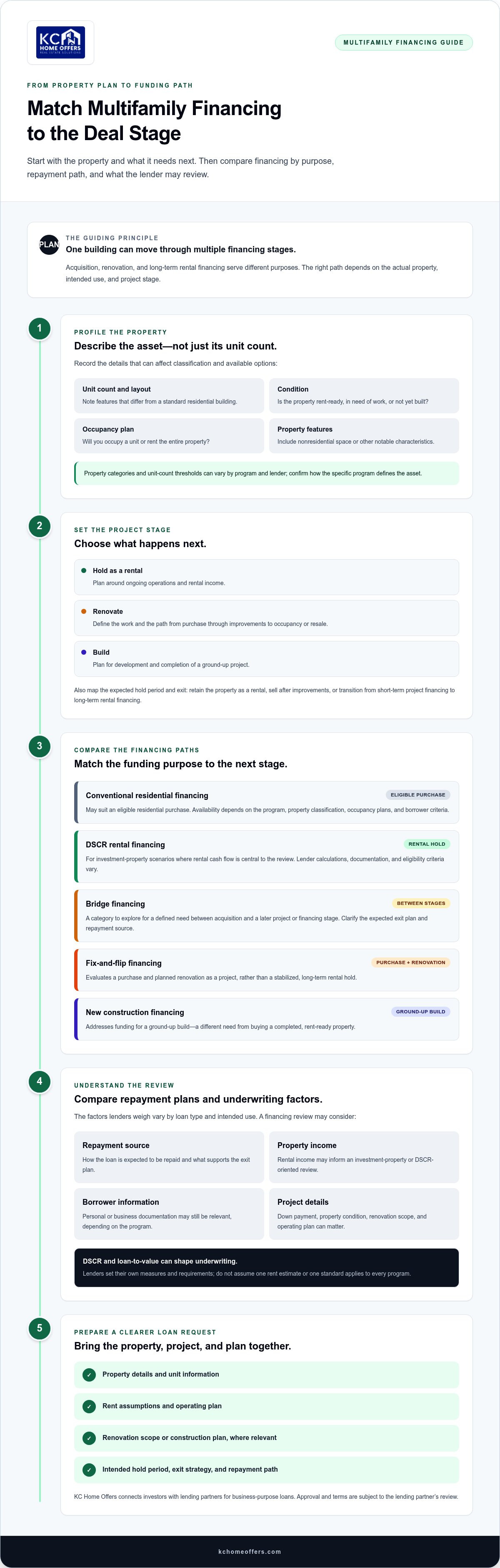
Multifamily financing is funding selected for a property with multiple residential units and the way you intend to use it. Acquisition financing funds a purchase, renovation financing supports planned improvements, and long-term rental financing is structured around holding the property as an income-producing asset. One building can move through all three stages, but its financing needs may change along the way.
The term multifamily residential describes housing with multiple dwelling units, but that broad description doesn’t determine how a loan program will classify a specific property. Unit count, layout, condition, occupancy, and intended use can all affect the options. Describe the actual property and business plan rather than assuming one loan category fits every multi-unit building.
Start with unit count, occupancy, and intended use
First, decide whether you’ll occupy a unit or rent the entire property. An owner-occupancy plan and a full-investment strategy can involve different financing criteria. Record the unit count and note features that could affect classification, such as nonresidential space or a layout that differs from a standard residential building.
Small residential properties and larger commercial multifamily assets may be assessed under different programs, but there isn’t one universal cutoff for every lender or product. Confirm how the relevant program defines the property and which requirements apply before treating a unit-count threshold as a rule. This helps prevent a mismatch between the financing you pursue and the asset you’re buying.
Map the deal stage before choosing a loan
A rent-ready building has a different financing profile from a property that needs substantial work or a site that still needs to be built. For a stabilized rental, the plan may center on ongoing operations and rental income. A renovation project needs a defined scope and a path from purchase through improvements to occupancy or resale. A construction project calls for planning around development and completion.
Your expected hold period and exit strategy matter, too. Decide whether you intend to retain the property as a long-term rental, sell after completing improvements, or move from short-term project financing into longer-term rental financing. This clarifies the purpose and expected repayment path for each phase. A short-term loan and a long-term hold aren’t interchangeable just because they relate to the same property.
Personal-income underwriting isn’t the only possible evaluation approach. Some business-purpose financing may consider property income or project factors alongside borrower information, but the review depends on the specific program and lender. Don’t assume rental projections replace personal or business documentation. Map the property, your role, its current condition, the planned work, and the intended exit before comparing options. That gives the financing conversation a practical starting point and helps surface questions early.
Multifamily home financing options for buying, renovating, or building
The financing route should match what the property needs next. A rent-ready building, a renovation project, and a ground-up development have different funding purposes and repayment plans. As you compare how to finance a multi family home, focus on the loan’s use, what repayment may depend on, and what you need to understand before moving forward.
Conventional residential financing: May suit an eligible residential purchase. Availability depends on the program, property classification, occupancy plans, and borrower criteria.
DSCR rental financing: Designed for investment property scenarios where rental cash flow is central to the review. Lender calculations and eligibility criteria vary.
Bridge financing: A category to explore for a defined need between acquisition and a later project or financing stage. Clarify the expected exit plan and repayment source.
Fix-and-flip financing: Suited to evaluating a purchase and planned renovation as a project, rather than a stabilized, long-term rental hold.
New construction financing: Addresses funding for a ground-up build, a different need from buying a completed, rent-ready property.
Long-term rental financing, including DSCR loans
For a rental investment, a DSCR-oriented review focuses on the relationship between property income and debt obligations. Projected or actual rents may inform the analysis, but the lender’s calculation, required documentation, and eligibility standards depend on its program. Don’t assume a single rent estimate determines the outcome. The DSCR loan investor guide offers more context for comparing rental-property financing.
Conventional residential financing is another possible route, but it isn’t interchangeable with business-purpose investor financing. The property’s classification and the borrower’s circumstances affect which programs may apply. The HUD Multifamily Housing Programs page provides information on HUD’s multifamily programs, including mortgage insurance and rental assistance. It’s a reference for understanding those programs, not a guarantee that a particular property or borrower qualifies.
Short-term financing for renovation or ground-up projects
Bridge financing and fix-and-flip financing can address different project needs. Bridge financing can support a transition between deal stages, while fix-and-flip financing is associated with a purchase and renovation plan. For either option, outline the work, expected timeline, repayment source, and exit strategy. For renovation-focused planning, review this fix-and-flip funding guide.
New construction financing serves a separate purpose: funding development rather than acquiring a completed rental. If you plan to build, define the project scope and intended end use before comparing options. KC Home Offers connects investors with lending partners for business-purpose financing, including DSCR rental, fix-and-flip, bridge, and new construction loans. Explore investor loan options. Approval and terms are subject to the lending partner’s review.
Compare multifamily financing by repayment, underwriting, and deal risk
A loan’s headline feature won’t tell you whether it fits the deal. To decide how to finance a multi family home, compare the repayment source, project stage, expected hold, and exit plan alongside the lender’s review criteria. A rent-focused loan, for example, may be evaluated differently from temporary financing for a property that needs work.
Use these comparison points to assess each option:
- Repayment source: Identify whether repayment is expected to come from ongoing rental income, a sale after improvements, or another defined source.
- Project stage: Match the financing purpose to acquisition, renovation, stabilization, or construction.
- Documentation: Identify which property, income, financial, and project records the program requires.
- Collateral and risk: Consider how the property’s condition and value relate to the amount being financed.
- Exit plan: Make sure the expected payoff or transition to longer-term financing is realistic for the project.
Debt service coverage ratio (DSCR) generally compares property income with debt obligations, while loan-to-value (LTV) compares a loan amount with a property’s value. These are lender-defined measures, not universal pass-or-fail thresholds. Calculation methods, accepted income assumptions, and valuation approaches can differ by program. Fannie Mae multifamily financing is one reference for understanding an institutional multifamily financing channel, though its programs may not fit every property or investor.
What lenders may review in a multifamily loan request
A review may consider property income and operating assumptions, borrower financial information, the asset’s condition, and the project plan. A renovation proposal, for instance, needs enough detail to explain the work and how it supports the intended outcome. Requested documents vary with the lender, program, property, and transaction. Don’t treat any single credit score, down payment, DSCR, or leverage figure as a rule for all loans.
Experience may also enter a lender’s assessment, depending on the program. Present the deal clearly: distinguish current rents from projections, describe known repairs, and align the proposed financing with the intended use. Program requirements and approval decisions depend on the lending partner’s review.
How to compare loan structure and repayment expectations
Temporary project financing and longer-term rental financing serve different purposes. Compare the repayment schedule and term structure with the time needed to complete work, lease the property, or reach the planned exit. Review disclosed fees, prepayment provisions, and reserve requirements as part of the full structure, rather than judging an offer by one feature.
Then test the economics under practical conditions. If renovation work takes longer than planned or rental income differs from your estimate, consider how that could affect repayment and the exit strategy. A strong financing plan aligns the loan structure, property assumptions, and operating plan. Lender-specific terms and approval remain subject to the lending partner’s review.
Prepare a multifamily financing plan before pursuing a property
A clear financing plan starts before you submit a loan request. Define how you intend to use the property, then organize the facts that support the purchase, rental assumptions, and planned work. This helps you compare options on the same basis and spot gaps before they slow down your review. It also turns the question of how to finance a multi family home into a practical deal-planning process.
Work through these steps in order:
- Set the strategy. Record whether you plan to occupy a unit, rent the property, renovate and sell, or build for a later use.
- Describe the asset. Gather the unit mix, purchase details, current occupancy, known condition issues, and available operating records.
- Build supportable assumptions. Separate current rent and expenses from estimates. Note the sources behind projections and avoid relying only on optimistic scenarios.
- Define the project. Summarize renovation or construction work, likely milestones, timeline assumptions, and the expected hold or exit plan.
- Compare and submit. Review financing structure and repayment obligations, then provide the information requested for the relevant program and transaction.
Build a deal file lenders can evaluate
Keep property facts, borrower details, and project assumptions in separate sections. This makes it easier to update an estimate without confusing it with verified operating information. A lender’s requested financial or entity documents can vary by program and transaction, so treat your file as an organized starting point, not a universal checklist.
- Property: Purchase details, unit mix, condition notes, and available operating records.
- Borrower or entity: Financial and entity information requested for the specific review.
- Project assumptions: Rent estimates, expense assumptions, work scope, timeline, and planned exit or hold.
For example, label a rent figure as current, projected, or based on a specific assumption. That distinction helps the reviewer understand what the property produces now and what the business plan expects it to produce later. Comparing DSCR rental, renovation, bridge, and construction financing categories can also put the project in context before you prepare a specific request.
Review proposed financing before moving forward
Compare written terms across available options, including repayment obligations, term structure, disclosed fees, collateral, conditions, prepayment provisions, and required reserves. Look beyond one appealing feature. A structure that fits a renovation timeline may not suit a long-term rental hold, especially if the projected exit depends on work or leasing that takes longer than expected.
As part of the review, clarify how projected income and property condition factor into underwriting, and identify which assumptions need supporting records. KC Home Offers connects investors with lending partners for business-purpose loan options. Program requirements and approval decisions depend on the lending partner’s review, and loans are subject to that partner’s approval. To explore financing options for your investment plan, connect with KC Home Offers.
Explore multifamily financing with KC Home Offers and its lending partners
Choosing a loan category is only part of the financing decision. The property’s current condition, intended use, and path to repayment all help define the financing conversation. KC Home Offers LLC connects real estate investors with lending partners for business-purpose financing, including DSCR rental, fix-and-flip, bridge, and new construction loans. Start with the deal itself and consider which category aligns with its stage and investment strategy.
Match the financing conversation to the investment strategy
For a rental hold, frame the plan around the property’s income and DSCR rental financing. For a property that needs improvements, explain the work and whether you plan to renovate and resell or transition toward long-term rental ownership. Fix-and-flip and bridge financing relate to project-stage needs, while new construction financing addresses a ground-up development plan.
These categories aren’t interchangeable. A rent-ready asset with a long-term hold strategy presents a different financing purpose from a building that needs renovation before it can support the intended use. A construction plan also needs to be described as a development project, not simply as the purchase of a rental. Clear distinctions help lending partners understand what the requested financing is meant to support.
Take the next step with a clear deal summary
Prepare a concise overview before discussing how to finance a multi family home. Include the property’s unit mix, whether it’s under consideration or already owned, its current condition, and your intended use. Then summarize the project stage, rent or operating assumptions where relevant, and the expected repayment strategy or exit. Keep known facts separate from estimates so the plan is easy to follow.
An organized summary helps focus the financing conversation on the questions that matter: Does the deal involve a rental hold, renovation, bridge period, or new build? What information supports the assumptions? How does the intended repayment plan fit the project timeline? Lending partners review each request and determine whether it meets their program criteria and what terms may be available. Loan approval and terms are subject to the lending partner’s review.
KC Home Offers LLC connects investors with lending partners to explore business-purpose loan options suited to their project stage. Bring your property details, strategy, and financing goals to the conversation. To discuss a multifamily property and the financing path you’re considering, contact KC Home Offers LLC at (816) 608-7837.
Move forward with a financing plan built around your deal
Turn the investment idea into a clear decision framework. Before pursuing a property, identify the outcome you’re targeting and the assumptions that could change it, such as rental performance, required improvements, or the timing of your exit. That clarity helps you assess how to finance a multi family home based on the deal in front of you, not just a loan category’s headline features.
You don’t need every detail finalized to start a useful financing conversation. Bring the property information you have, explain what remains uncertain, and outline how you expect the project to repay or transition. A focused discussion can help identify which questions to resolve as you evaluate the opportunity. Loan approval and terms remain subject to the lending partner’s review.
Ready to discuss your investment plan? Explore multifamily financing options with KC Home Offers.
Frequently Asked Questions
Can I finance a multifamily home with a DSCR loan?
Yes, a DSCR loan may be an option for an investment property, depending on the lending partner’s program and review. For example, an investor considering a building with existing tenants can organize lease and rent information to explain the property’s income profile. The lender’s calculation and treatment of actual or projected rents depend on the program. Approval and terms are subject to the lending partner’s review.
Can I use a conventional mortgage to buy a multifamily property?
Possibly. Conventional residential financing may fit some multifamily purchases, depending on the property classification, occupancy plan, borrower profile, and program rules. A buyer planning to live in one unit may face different criteria from an investor intending to rent every unit. Identify the property’s unit count and intended use, then compare those facts with the specific program’s current requirements.
How much down payment do I need for a multifamily home?
There isn’t one down-payment amount that applies to every multifamily loan. The required contribution can depend on the financing program, property, occupancy plan, borrower qualifications, and transaction structure. As an early planning step, estimate available funds for the purchase and other project needs, then review how the lender defines the required borrower contribution. Don’t use a percentage from a different loan type as a reliable estimate for your deal.
What credit score do I need to finance a multifamily property?
There’s no single credit-score threshold for every multifamily financing option. Each lending partner and program sets its own eligibility standards, and credit may be considered alongside other borrower and property information. A useful preparation step is to review your credit reports for errors and gather context for any unusual items before submitting a request. A score alone doesn’t determine eligibility or predict the decision.
Can rental income help me qualify for a multifamily loan?
Yes, rental income may factor into some lenders’ reviews, especially for investment-focused financing. How much weight it receives and how it’s calculated depend on the program. For instance, a vacant unit may be treated differently from one supported by a current lease, depending on lender rules. Keep actual lease information distinct from market-rent estimates so each can be assessed appropriately.
What documents should I prepare to finance a multifamily home?
Start with records that explain the property and your plan, then follow the lending partner’s document request for the transaction. Useful starting materials may include purchase information, a unit and occupancy summary, available leases or operating records, and a description of planned work. Borrower, financial, and entity documents may also be requested. Requirements vary, so treat a general list as a starting point rather than a complete checklist.
Can I finance a multifamily property that needs renovations?
Yes, some financing options may support a property that needs work, subject to program criteria and the lending partner’s review. The right fit depends on the condition, scope, and intended outcome. A property needing updates before rental may call for a different approach from one being renovated for resale. Prepare a clear scope, identify known condition issues, and explain how the improvements connect to your repayment or exit plan.
Frequently asked
Can I finance a multifamily home with a DSCR loan?
Yes, a DSCR loan may be an option for an investment property, depending on the lending partner’s program and review. For example, an investor considering a building with existing tenants can organize lease and rent information to explain the property’s income profile. The lender’s calculation and treatment of actual or projected rents depend on the program. Approval and terms are subject to the lending partner’s review.
Can I use a conventional mortgage to buy a multifamily property?
Possibly. Conventional residential financing may fit some multifamily purchases, depending on the property classification, occupancy plan, borrower profile, and program rules. A buyer planning to live in one unit may face different criteria from an investor intending to rent every unit. Identify the property’s unit count and intended use, then compare those facts with the specific program’s current requirements.
How much down payment do I need for a multifamily home?
There isn’t one down-payment amount that applies to every multifamily loan. The required contribution can depend on the financing program, property, occupancy plan, borrower qualifications, and transaction structure. As an early planning step, estimate available funds for the purchase and other project needs, then review how the lender defines the required borrower contribution. Don’t use a percentage from a different loan type as a reliable estimate for your deal.
What credit score do I need to finance a multifamily property?
There’s no single credit-score threshold for every multifamily financing option. Each lending partner and program sets its own eligibility standards, and credit may be considered alongside other borrower and property information. A useful preparation step is to review your credit reports for errors and gather context for any unusual items before submitting a request. A score alone doesn’t determine eligibility or predict the decision.
Can rental income help me qualify for a multifamily loan?
Yes, rental income may factor into some lenders’ reviews, especially for investment-focused financing. How much weight it receives and how it’s calculated depend on the program. For instance, a vacant unit may be treated differently from one supported by a current lease, depending on lender rules. Keep actual lease information distinct from market-rent estimates so each can be assessed appropriately.
What documents should I prepare to finance a multifamily home?
Start with records that explain the property and your plan, then follow the lending partner’s document request for the transaction. Useful starting materials may include purchase information, a unit and occupancy summary, available leases or operating records, and a description of planned work. Borrower, financial, and entity documents may also be requested. Requirements vary, so treat a general list as a starting point rather than a complete checklist.
Can I finance a multifamily property that needs renovations?
Yes, some financing options may support a property that needs work, subject to program criteria and the lending partner’s review. The right fit depends on the condition, scope, and intended outcome. A property needing updates before rental may call for a different approach from one being renovated for resale. Prepare a clear scope, identify known condition issues, and explain how the improvements connect to your repayment or exit plan.
Need financing on a deal like this?
DSCR, fix & flip and new construction loans, underwritten on the deal rather than your tax returns. Soft credit pull only.
Apply in 5 minutes