Guides › Private lending
Fix and Flip Loan Requirements: Credit, Experience and Down Payment

Understand fix and flip loan requirements, including credit, experience, and down payment. Learn how lending partners evaluate projects and prepare to apply.
A strong credit score alone may not be enough to finance a fix-and-flip project. Lending partners may also review the property, your available funds, the renovation plan, and how you expect to repay the loan. Understanding fix and flip loan requirements means looking at how these pieces work together, not treating any one qualification as decisive.
Questions about credit, down payment, or limited renovation experience are common. Criteria vary by lending partner, and a clear, realistic project plan helps explain how you intend to manage the work and repay the financing. No single borrower profile guarantees approval.
This guide covers how lending partners may assess your credit and experience, the property’s value and condition, and your renovation budget, timeline, and exit plan. You’ll also find practical steps for organizing documents and presenting your assumptions clearly. KC Home Offers connects real estate investors with business-purpose fix-and-flip financing through lending partners. All loans are subject to the lending partner’s approval.
Key Takeaways
- Fix and flip loan requirements vary by lending partner, deal structure, property, and renovation plan, so prepare for a project-specific review.
- Credit, available funds, and relevant investment experience may inform a lending partner’s assessment, but no single borrower factor tells the whole story.
- Connect the purchase assumptions, property condition, renovation scope, and estimated after-repair value in one consistent project analysis.
- Use a checklist to organize property details, renovation costs, timeline, and exit assumptions before assembling your application.
- Match the financing path to your plan: a fix-and-flip loan may suit a purchase-and-renovate project, while rental or ground-up construction plans call for different financing considerations.
Table of Contents
- What Fix and Flip Loan Requirements Usually Cover
- Borrower Requirements: Credit, Experience, Liquidity, and Documentation
- Property and Project Requirements: Budget, ARV, and Exit Plan
- Prepare a Stronger Application With This Project Checklist
- Choose a Financing Path and Take the Next Step
What Fix and Flip Loan Requirements Usually Cover
Fix-and-flip financing is business-purpose funding for acquiring and rehabilitating an investment property. The strategy is to buy a property, make improvements, and aim to sell it, as outlined in What is house flipping? A financing review considers this plan as a whole, rather than looking only at the purchase.
There’s no single checklist for every deal. Lending partners may set different fix and flip loan requirements based on the transaction structure, property, and renovation scope. General guidance can help you prepare, but it isn’t a promise of specific loan terms, and meeting common criteria doesn’t guarantee approval.
Which parts of a fix-and-flip deal are evaluated?
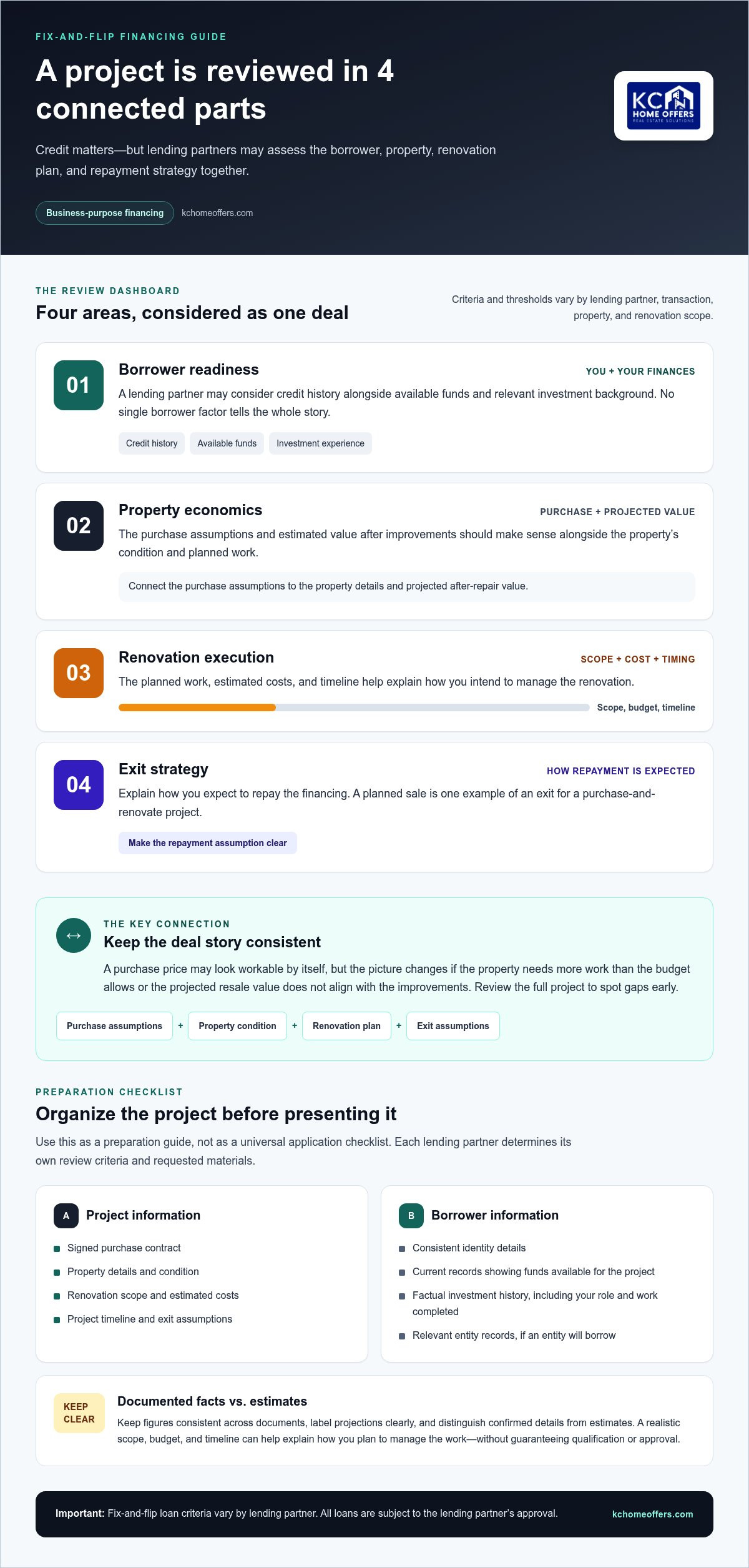
A lending partner may consider the borrower and project together. Borrower readiness can include financial capacity and relevant investment background. The project review may cover the property’s condition, purchase assumptions, renovation needs, estimated value after improvements, and repayment or sale plan. Criteria and thresholds depend on the lending partner.
The four core review areas are borrower readiness, property economics, renovation execution, and the exit strategy.
- Borrower readiness: Your financial and investment background as presented in the application.
- Property economics: Whether the purchase assumptions and projected value support the deal.
- Renovation execution: The planned work, estimated costs, and how they fit the project.
- Exit strategy: How you expect to repay the financing, such as through a planned sale.
These factors are connected. A purchase price may look workable on its own, but the deal can look different if the property needs more work than the budget allows or the projected resale value doesn’t align with the planned improvements. Reviewing the full project helps you identify gaps before they create problems in the application.
How to read a requirements checklist
Use a general checklist to organize your information, not to assume you meet a particular lending partner’s terms. Here, business-purpose financing means funding considered for an investment activity, such as acquiring and rehabilitating a property for resale. It isn’t a statement about legal or tax treatment.
As you prepare, distinguish documented facts from estimates. A signed purchase contract, property details, renovation scope, budget, timeline, and exit assumptions can help explain the deal. Keep figures consistent across documents and label projections clearly. Each lending partner determines its own review criteria and requested materials.
KC Home Offers connects investors with business-purpose fix-and-flip financing through lending partners. A project-focused financing discussion can help organize the property details and plan. All loans are subject to the lending partner’s approval.
Borrower Requirements: Credit, Experience, Liquidity, and Documentation
Borrower review can involve more than a credit score. A lending partner may consider credit history alongside investment experience, available funds, and the quality of the project information you provide. Specific criteria vary, so treat common application topics as preparation guidance, not universal qualification rules.
Credit history can help a lending partner understand how you’ve managed financial obligations. It’s one part of the review, not a guaranteed pass-or-fail cutoff for every fix-and-flip loan. For an overview of the financing approach, How do fix and flip loans work? provides additional context. Present an accurate picture of your credit history rather than relying on assumptions about a particular score threshold.
Does limited fix-and-flip experience automatically disqualify you?
Not necessarily. Experience may inform a lending partner’s assessment, but it’s one factor in a broader review, and requirements differ. If you’re newer to renovation projects, make your execution plan easy to follow. A defined work scope, realistic timeline, and budget that reflects the property’s needs can show how you intend to manage the project. Preparation doesn’t guarantee qualification or approval.
Relevant experience may include previous investment or renovation work. Describe what you did and the role you played, keeping the details factual. If you haven’t completed a flip, don’t imply otherwise. Instead, explain the project plan, the resources you expect to use, and the decisions you’ve made about the property.
What borrower information should you organize?
Build a clear financial overview and keep records current. Depending on the transaction and lending partner, common examples may include identity details, financial records showing available funds, and information about your investment history. If an entity will borrow, organize its relevant records as well. Use these as preparation examples, not as a final document checklist.
- Identity information: Keep basic identification details consistent across application materials.
- Financial overview: Assemble records that accurately show funds available for the project and other relevant financial information.
- Investment history: Note prior property investments or renovations, including your role and the work completed.
- Entity records: If an entity is the borrower, gather its relevant formation and governing documents.
- Project materials: Keep purchase information and renovation assumptions with the borrower file so the project details match the financing request.
Plan your available funds carefully. They may matter not only for the initial transaction but also for expenses as work progresses. Don’t present funds as available if they’re committed elsewhere. Distinguish confirmed resources from estimates so the lending partner gets a clear picture of your capacity to carry out the plan.
The lending partner sets the final document list and any financial thresholds. As you organize your borrower profile, a project-focused discussion through KC Home Offers’ fix-and-flip financing connections can help frame the information for the financing process.
Property and Project Requirements: Budget, ARV, and Exit Plan
A property’s purchase price tells only part of the story. A lending partner may review the acquisition assumptions alongside the home’s current condition, the work needed, and the projected outcome. The parts need to fit together. If the renovation scope doesn’t address the property’s condition, or the projected value depends on work missing from the budget, it may be harder to assess the deal’s feasibility.
After-repair value, or ARV, is an estimate of a property’s value after planned improvements. It isn’t a guaranteed resale price. A strong ARV projection alone doesn’t guarantee qualification. A broader review may also consider the purchase assumptions, renovation costs, execution risks, and proposed exit. Fix and flip loan requirements depend on the lending partner and project, so don’t treat general guidance as a promised loan term.
How lenders may assess renovation scope and budget
Make the planned work specific enough to evaluate. An itemized scope should describe each major improvement and connect it to a documented estimate where available. State the assumptions behind the figures, including which areas will be updated and what work is excluded. Separate known repairs from conditions you haven’t been able to assess. Don’t present an unknown as a confirmed cost or completed plan.
For example, a budget that groups every task under “renovation” gives little context. Breaking out kitchen work, flooring, and exterior repairs makes the scope easier to compare with the property’s condition and projected resale assumptions. If details change, update the related figures so the budget, work plan, and value estimate stay aligned. Avoid unsupported cost assumptions, and don’t assume a particular contractor or inspection is required. Lending partner requests vary.
Why the exit strategy matters to project review
Explain how you intend to repay the financing. A resale plan is one possible exit, but its assumptions should connect to the property, completed work, and estimated market value. A projected sale price is a planning input, not a guaranteed outcome. If you plan to keep the property as a rental, that hold strategy may point to a different financing fit than a short-term purchase-and-resale plan.
Before presenting the deal, check that the purchase analysis, renovation budget, timeline, ARV estimate, and exit assumptions tell one consistent story. If one changes, review the others. This makes gaps easier to spot and gives a lending partner a clearer view of how the project is expected to work. KC Home Offers connects investors with fix-and-flip financing through lending partners. Its fix-and-flip funding guide provides further context for evaluating a project’s financing approach.
Prepare a Stronger Application With This Project Checklist
A well-organized project file helps a lending partner follow the deal from acquisition through renovation and exit. Use this sequence to assemble the key assumptions, then check that figures agree across your documents. The lending partner may request additional materials, and requirements can differ by application.
Build a lender-ready project file
Start with the property and purchase details, then add condition notes and the proposed work. Keep estimates and financial assumptions traceable to their source. If a cost or property condition is unknown, label it as an open item rather than presenting an estimate as confirmed. This helps distinguish what’s established from what may change.
- Summarize the property and purchase. Record the property details, proposed purchase terms, and information about its current condition. Note any areas that need further assessment.
- Describe the renovation scope. Break planned work into clear categories, such as interior updates or exterior repairs. Distinguish defined work from items still under consideration.
- Support the budget. Organize available estimates and explain the assumptions behind each figure. Identify exclusions and unresolved costs instead of hiding them in a broad total.
- Map the timeline. Show the expected sequence of work and note dependencies, such as one task needing to finish before another can begin. Treat dates as projections, not guarantees.
- Connect the value and exit assumptions. Label the after-repair value as an estimate and explain how the planned work supports it. State whether the intended exit is resale or a different hold strategy.
Review the deal before submitting it
Check the project file for consistency before sharing it. If the work scope changes, update the related budget and value assumptions. If the exit plan relies on a completed renovation, make sure the timeline reflects the steps required to reach that condition. Flag schedule dependencies and risks plainly. Avoid promising a completion date when it depends on work or conditions that may change.
Use a concise document checklist to keep supporting records together. Depending on the transaction and lending partner, examples may include:
- Purchase information and property condition notes
- Renovation scope, estimates, and timeline assumptions
- Projected value and exit analysis, with estimates identified as projections
- Borrower financial records and relevant investment history
- Entity documents, if an entity will be the borrower
This preparation helps explain how the acquisition, planned work, and exit fit together, but it doesn’t replace the lending partner’s final checklist. Compare business-purpose loan options by considering how each financing path aligns with your investment plan and intended property use. Once your project file is organized, discuss fix-and-flip financing options through KC Home Offers’ lending partner connections.
Choose a Financing Path and Take the Next Step
Let your investment plan lead the financing discussion. A fix-and-flip loan may fit an acquisition where you plan to renovate the property and pursue a resale. The intended use and exit matter: financing for a short-term renovation project may not match a plan to hold a property as a rental or build a new property from the ground up.
Use the project’s purpose to narrow the conversation, not to assume one loan type is always cheaper, faster, or more suitable. The fix and flip loan requirements in this guide can help you prepare, but the lending partner assesses the specific transaction and decides whether it fits its program.
Match the financing discussion to the investment plan
Before discussing options, be ready to explain what you’ll do with the property after acquisition. If you plan to renovate and resell, describe the work and intended exit. If you expect to retain the property for rental income, a rental-focused path such as DSCR financing may be more relevant. The DSCR loan investor guide covers that alternative. A ground-up build is a different project structure and may call for construction financing.
These distinctions keep the conversation focused. A rental hold, a resale after rehabilitation, and a new build involve different property plans and repayment assumptions. State your intended use clearly, especially if it may change. Then the financing discussion can focus on whether the project and proposed loan type align, rather than comparing options based on broad claims.
What to expect when exploring financing through KC Home Offers
KC Home Offers connects real estate investors with lending partners for business-purpose financing, including fix-and-flip options. KC Home Offers is not the direct lender. The lending partner reviews the application and project to determine eligibility and whether to approve financing. The partner also determines rates, terms, and timing, so don’t assume an outcome before the review is complete.
A useful starting point is a concise summary of the property, planned work, intended exit, and questions you want to resolve. Bring your project assumptions and distinguish estimates from confirmed details. That gives the financing discussion a practical basis without treating an early conversation as approval or a commitment to specific terms.
If your project plan is taking shape, explore investor loan options with KC Home Offers. Share whether you’re buying to renovate and resell, holding for rental income, or pursuing a ground-up build so the financing conversation starts with the right investment objective.
Move Your Investment Plan Forward
A financing decision is also a chance to test how well your investment plan holds together. Consider what could change the project assumptions, how you’d respond, and whether the expected exit still fits your goals if the work or market outlook shifts. Clear answers can help you make a more deliberate decision, even before a lending partner assesses your application.
Use your understanding of fix and flip loan requirements to turn preparation into a practical next step: bring your current project assumptions into a financing discussion and identify what still needs attention. Keep the conversation grounded in your acquisition, planned work, and intended use of the property. Approval, rates, terms, and timing depend on the lending partner’s review.
Explore investor loan options with KC Home Offers and take the next step toward evaluating financing for your project. A clear plan gives you a practical starting point for deciding what to pursue.
Frequently Asked Questions
Can a fix-and-flip loan be used for a property I already own?
Possibly. Financing a property you already own depends on the lending partner’s program, the property’s equity and condition, and the work you plan to complete. Don’t assume the requirements for a purchase loan also apply to a property you own. Explain how you acquired it, what financing you’re seeking, and how you’ll use the funds. The lending partner determines approval and any available terms.
Do I need to borrow through an LLC for a fix-and-flip project?
Not in every case. Entity requirements depend on the lending partner and transaction. An LLC doesn’t guarantee approval, and an individual borrower isn’t automatically eligible for every program. Decide whether you or an entity will apply, then provide the corresponding records requested during review. Keep borrower names consistent across the application and project materials. This is a financing-process consideration, not legal or tax advice.
Can a fix-and-flip loan be used to buy a property at auction?
It may be possible, depending on the lending partner, property, and transaction structure. Auction purchases can involve firm deadlines and specific documentation, so don’t assume financing will be ready by the required date. Account for timing uncertainty and consider how the property’s condition or sale terms may affect the review. Explain the auction process during the financing discussion, including any applicable deadlines.
How are renovation funds disbursed on a fix-and-flip loan?
Renovation-fund procedures vary by lending partner and loan structure. Some arrangements may involve documentation or review connected to completed work, but there’s no universal draw schedule, inspection rule, or release timeline. Read the loan documents carefully before coordinating contractor payments. Map the agreed disbursement process against your project cash flow so you understand what funds may be available at each stage and can plan expenses accordingly.
What should I do if the renovation scope changes after closing?
Document the revised work and communicate material changes as described in your loan documents. A scope change can affect the budget, project assumptions, and completion planning, so keep updated estimates and records together. For example, if an unexpected repair changes the planned work, record what changed and revise the related figures. Don’t assume additional funds will be available or that a requested change will be approved.
Can I use a fix-and-flip loan for a home I plan to occupy?
Fix-and-flip financing is generally discussed for investment projects, while occupancy and eligibility depend on the financing structure and documents. Don’t present the loan as a consumer mortgage or assume plans to occupy are permitted. Describe your intended use accurately during the financing process, including whether you expect to live in the property. Follow the occupancy terms that apply to your transaction and resolve questions before relying on an assumption.
Does the after-repair value guarantee what I can sell the property for?
No. After-repair value is a projection, not a guaranteed sale price or profit. The eventual result can be affected by market conditions, the completed work, buyer demand, and when the property is sold. Even if a lending partner reviews an estimate, that review doesn’t remove market risk or promise a particular return. Use the projection as one planning assumption and consider how a different sale price could affect your exit plan.
Frequently asked
Which parts of a fix-and-flip deal are evaluated?
A lending partner may consider the borrower and project together. Borrower readiness can include financial capacity and relevant investment background. The project review may cover the property’s condition, purchase assumptions, renovation needs, estimated value after improvements, and repayment or sale plan. Criteria and thresholds depend on the lending partner. The four core review areas are borrower readiness, property economics, renovation execution, and the exit strategy. These factors are connected. A purchase price may look workable on its own, but the deal can look different if the property needs more work than the budget allows or the projected resale value doesn’t align with the planned improvements. Reviewing the full project helps you identify gaps before they create problems in the application.
Does limited fix-and-flip experience automatically disqualify you?
Not necessarily. Experience may inform a lending partner’s assessment, but it’s one factor in a broader review, and requirements differ. If you’re newer to renovation projects, make your execution plan easy to follow. A defined work scope, realistic timeline, and budget that reflects the property’s needs can show how you intend to manage the project. Preparation doesn’t guarantee qualification or approval. Relevant experience may include previous investment or renovation work. Describe what you did and the role you played, keeping the details factual. If you haven’t completed a flip, don’t imply otherwise. Instead, explain the project plan, the resources you expect to use, and the decisions you’ve made about the property.
What borrower information should you organize?
Build a clear financial overview and keep records current. Depending on the transaction and lending partner, common examples may include identity details, financial records showing available funds, and information about your investment history. If an entity will borrow, organize its relevant records as well. Use these as preparation examples, not as a final document checklist. Plan your available funds carefully. They may matter not only for the initial transaction but also for expenses as work progresses. Don’t present funds as available if they’re committed elsewhere. Distinguish confirmed resources from estimates so the lending partner gets a clear picture of your capacity to carry out the plan. The lending partner sets the final document list and any financial thresholds. As you organize your borrower profile, a project-focused discussion through KC Home Offers’ fix-and-flip financing connections can help frame the information for the financing process. A property’s purchase price tells only part of the story. A lending partner may review the acquisition assumptions alongside the home’s current condition, the work needed, and the projected outcome. The parts need to fit together. If the renovation scope doesn’t address the property’s condition, or the projected value depends on work missing from the budget, it may be harder to assess the deal’s feasibility. After-repair value, or ARV, is an estimate of a property’s value after planned improvements. It isn’t a guaranteed resale price. A strong ARV projection alone doesn’t guarantee qualification. A broader review may also consider the purchase assumptions, renovation costs, execution risks, and proposed exit. Fix and flip loan requirements depend on the lending partner and project, so don’t treat general guidance as a promised loan term.
Can a fix-and-flip loan be used for a property I already own?
Possibly. Financing a property you already own depends on the lending partner’s program, the property’s equity and condition, and the work you plan to complete. Don’t assume the requirements for a purchase loan also apply to a property you own. Explain how you acquired it, what financing you’re seeking, and how you’ll use the funds. The lending partner determines approval and any available terms.
Do I need to borrow through an LLC for a fix-and-flip project?
Not in every case. Entity requirements depend on the lending partner and transaction. An LLC doesn’t guarantee approval, and an individual borrower isn’t automatically eligible for every program. Decide whether you or an entity will apply, then provide the corresponding records requested during review. Keep borrower names consistent across the application and project materials. This is a financing-process consideration, not legal or tax advice.
Can a fix-and-flip loan be used to buy a property at auction?
It may be possible, depending on the lending partner, property, and transaction structure. Auction purchases can involve firm deadlines and specific documentation, so don’t assume financing will be ready by the required date. Account for timing uncertainty and consider how the property’s condition or sale terms may affect the review. Explain the auction process during the financing discussion, including any applicable deadlines.
How are renovation funds disbursed on a fix-and-flip loan?
Renovation-fund procedures vary by lending partner and loan structure. Some arrangements may involve documentation or review connected to completed work, but there’s no universal draw schedule, inspection rule, or release timeline. Read the loan documents carefully before coordinating contractor payments. Map the agreed disbursement process against your project cash flow so you understand what funds may be available at each stage and can plan expenses accordingly.
What should I do if the renovation scope changes after closing?
Document the revised work and communicate material changes as described in your loan documents. A scope change can affect the budget, project assumptions, and completion planning, so keep updated estimates and records together. For example, if an unexpected repair changes the planned work, record what changed and revise the related figures. Don’t assume additional funds will be available or that a requested change will be approved.
Can I use a fix-and-flip loan for a home I plan to occupy?
Fix-and-flip financing is generally discussed for investment projects, while occupancy and eligibility depend on the financing structure and documents. Don’t present the loan as a consumer mortgage or assume plans to occupy are permitted. Describe your intended use accurately during the financing process, including whether you expect to live in the property. Follow the occupancy terms that apply to your transaction and resolve questions before relying on an assumption.
Does the after-repair value guarantee what I can sell the property for?
No. After-repair value is a projection, not a guaranteed sale price or profit. The eventual result can be affected by market conditions, the completed work, buyer demand, and when the property is sold. Even if a lending partner reviews an estimate, that review doesn’t remove market risk or promise a particular return. Use the projection as one planning assumption and consider how a different sale price could affect your exit plan.
Need financing on a deal like this?
DSCR, fix & flip and new construction loans, underwritten on the deal rather than your tax returns. Soft credit pull only.
Apply in 5 minutes