Guides › Private lending
Financing Short-Term Rentals: DSCR and Other Loan Options

Explore financing for short term rentals. Learn how DSCR loans and other options evaluate rental income, seasonal shifts, and expenses to fund your deal.
A strong booking forecast doesn’t automatically make a strong loan application. Financing for short term rentals depends on more than projected nightly income: the property’s intended use, operating costs, occupancy assumptions, and seasonal demand all affect how a deal is evaluated.
If you’re comparing conventional financing with a DSCR loan or short-term asset-based financing, understand how each option treats rental income, personal use, and your investment timeline before committing to a property. Short-term rental income may be assessed differently across loan programs, and eligibility depends on the property and the lending partner’s criteria.
This guide explains how common financing paths work and what to examine in your projections, from vacancy and expenses to seasonal revenue shifts. You’ll also learn how to assess property use and your exit plan before choosing a financing structure. KC Home Offers connects real estate investors with lending partners for business-purpose financing, including DSCR loans. All loans are subject to the lending partner’s approval. A realistic plan helps you compare options against the deal in front of you.
Key Takeaways
- Match financing for short term rentals to the property’s intended use, your investment timeline, and the deal’s projected performance.
- Compare conventional mortgages, DSCR loans, HELOCs, and short-term asset-based loans by how each evaluates the deal and supports your exit plan.
- Stress-test your revenue forecast against vacancies, seasonal shifts, repairs, management costs, insurance, taxes, and debt payments.
- Organize purchase details, rental projections, expense estimates, and renovation assumptions before comparing loan structures.
- KC Home Offers connects investors with lending partners for business-purpose financing, including DSCR loans. A DSCR Loan is described as a long-term rental loan, and financing is subject to partner approval.
Table of Contents
- Financing for Short Term Rentals Starts With the Property and Revenue Plan
- Compare Short-Term Rental Financing Options by Use and Timeline
- Evaluate the Deal Before Choosing Short-Term Rental Financing
- Prepare a Short-Term Rental Financing Plan Step by Step
- Explore Investor Financing Through KC Home Offers
Financing for Short Term Rentals Starts With the Property and Revenue Plan
Short-term rental financing is capital used to acquire, refinance, or improve a property intended to earn income from temporary guest stays. The right financing path depends on how you’ll use the property, the deal structure, your borrower profile, and the lending partner’s underwriting criteria. A loan path suited to a dedicated rental may not fit a property you plan to use personally for part of the year.
Start with a clear operating plan. Specify whether the property will be rented throughout the year, during selected seasons, or only when you’re not using it. A vacation rental held primarily for income is different from a second home used occasionally by its owner. That distinction can affect how the deal is evaluated, so describe personal use and guest rental plans accurately.
How rental use changes the financing question
Intended occupancy and rental strategy help frame the loan request. A property designed for frequent guest turnover may have different projected revenue and operating costs than one rented for longer stays or used mainly as a private retreat. State your planned use plainly. Lending partner rules determine which property uses and rental income can be considered, so don’t assume short-term rental revenue qualifies automatically.
A short-term rental generally provides temporary lodging, often through online marketplaces. For financing purposes, the label alone doesn’t explain the investment. Outline how often you expect to rent the property, when you may occupy it, and what operating model supports the forecast. This gives the deal a more useful starting point than simply calling it a vacation rental.
Which revenue assumptions should an investor examine?
Build projections from comparable listings, seasonal demand, expected occupancy, and nightly rates. Record how you reached each estimate, comparing properties with similar size, amenities, and guest capacity where possible. Don’t use a peak-season rate as a year-round average. Model slower periods and unbooked nights, too.
Then subtract the costs required to operate the rental. Include management, cleaning, utilities, maintenance, taxes, insurance, and platform-related expenses. Separate one-time improvements from recurring costs, and account for any repairs needed before guests can stay. This helps estimate how much revenue may remain for debt obligations instead of relying on gross booking income alone.
Keep estimates distinct from documented operating results. If the property has no rental history, label projected occupancy and rates as assumptions. If it has prior records, organize them separately and note the period they cover. For example, a forecast based on strong seasonal demand should also show how you would cover expenses and debt payments during quieter months. This makes financing for short term rentals easier to assess against the actual property plan, while leaving underwriting decisions to the lending partner.
Compare Short-Term Rental Financing Options by Use and Timeline
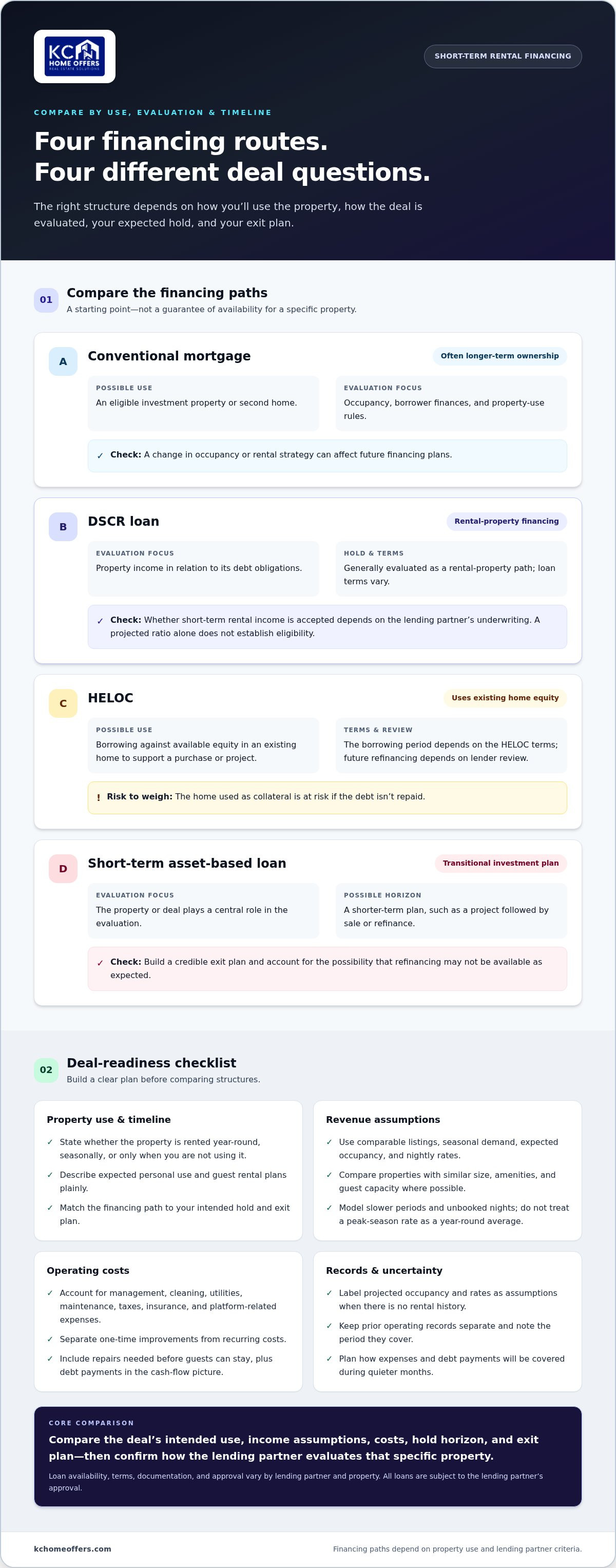
No single loan structure fits every short-term rental. Compare options by how you’ll use the property, how repayment is evaluated, how long you expect to hold the asset, and what happens if your rental plan changes. The overview below is a starting point, not a guarantee that a specific option will be available for a particular property.
| Financing route | Common purpose and underwriting focus | Typical hold horizon | Documentation and refinance considerations |
|---|---|---|---|
| Conventional mortgage | May be used for an eligible investment property or second home. Occupancy, borrower finances, and property-use rules matter. | Often considered for longer-term ownership. | Documentation and eligibility depend on the loan and intended use. A change in occupancy or rental strategy can affect future financing plans. |
| DSCR loan | Rental-property financing that evaluates property income in relation to debt obligations. Acceptance of short-term rental income depends on lending partner underwriting. | Generally evaluated as a rental-property financing path. Loan terms vary. | Requirements vary by lending partner and property. A later refinance would involve new underwriting, particularly if the strategy or income changes. |
| HELOC | Uses available equity in an existing home as a borrowing source, with that home serving as collateral. | May support a purchase or project over a period determined by the HELOC terms. | The borrower’s home is at risk if the debt isn’t repaid. Future refinancing depends on the property, borrower, and lender review. |
| Short-term asset-based loan | May support a transitional investment plan, with the property or deal playing a central role in evaluation. | Generally considered for a shorter-term plan, such as a project followed by sale or refinance. | Terms, documentation, and approval vary. Build a credible exit plan and account for the possibility that refinancing may not be available as expected. |
When a DSCR loan may fit an STR investment
A Debt Service Coverage Ratio compares income available from a property with its debt obligations. The Debt Service Coverage Ratio (DSCR) helps explain this relationship, but a projected ratio alone doesn’t establish eligibility. KC Home Offers connects investors with lending partners for DSCR loans, and its DSCR Loan is described as a long-term rental loan. Whether a lending partner accepts short-term rental income or a specific property depends on its underwriting.
How other financing routes differ
With a conventional mortgage, pay close attention to the property’s stated use and occupancy, especially if you plan to combine personal stays with guest rentals. A HELOC taps equity in a separate existing home, so weigh that home’s exposure alongside the potential investment. Asset-based financing may suit a transitional plan, but terms and approval vary. Match the option to your actual timeline, not an optimistic exit assumption.
KC Home Offers connects real estate investors with lending partners for business-purpose financing, including DSCR rental loans. All loans are subject to lending partner approval. Compare each structure against your use plan and exit strategy before choosing a path.
Evaluate the Deal Before Choosing Short-Term Rental Financing
A promising revenue forecast is only one part of the financing picture. Before selecting a loan, translate expected bookings into estimated net operating cash flow, then compare that figure with the property’s debt obligations. Projected rental revenue is a planning assumption, not dependable net cash flow until operating costs, vacancies, and debt payments are accounted for.
Make the calculation easy to follow. Start with expected booking revenue, subtract operating expenses, and account for the full debt payment. Separate recurring costs from irregular expenses so the model doesn’t hide repairs or replacement needs in an average monthly figure. This reveals which assumptions matter most and where the deal may be vulnerable.
Stress-test revenue, expenses, and reserves
Build a base case from your best-supported estimates, then create a conservative case with lower occupancy and nightly rates. Test the effect of a slower season, more vacant nights, or a temporary interruption in operations. A property that works only under the most optimistic forecast leaves little room for ordinary setbacks.
Review expenses just as carefully. Include cleaning, management, utilities, insurance, taxes, maintenance, repairs, and platform-related costs. Identify which expenses continue even when the property is unoccupied. Set aside liquidity for repairs and slower periods, and account for possible operating interruptions rather than assuming every month will run as planned.
Next, compare estimated net income with expected debt service. There is no universal cash-flow threshold that settles the decision; consider the result alongside the loan structure, property condition, and your ability to cover shortfalls. If a repair or weak booking period would make payments difficult, revisit the assumptions, available reserves, or purchase plan before proceeding.
Match the loan structure to the investment horizon
Make the expected hold period explicit. A loan that fits a long-term rental strategy may not align with a plan to renovate, stabilize, and refinance or sell. Compare the anticipated repayment schedule with the time you expect to own the property. Treat a future refinance as an assumption, not a certainty.
Write down the intended exit: continued operation, refinance, sale, or another planned transition. For a transitional investment, identify what must happen before that exit is realistic, such as completing improvements or establishing documented rental performance. Consider how a delay could affect debt payments and reserves. This makes the exit plan a practical part of the financing decision, not just a line in a spreadsheet.
Strong deal analysis doesn’t guarantee occupancy, net income, or loan approval. Lending partner underwriting determines how the property and its income are evaluated. A clear downside model helps you compare financing for short term rentals against the deal’s capacity to carry debt and identify where your projections need more support.
Prepare a Short-Term Rental Financing Plan Step by Step
A well-organized financing plan explains how the property will operate, what the numbers assume, and how the debt fits your investment timeline. Prepare the deal before comparing loan structures. The lending partner reviews the application and completes underwriting before making a financing decision, so clear, consistent information matters.
- Define the property’s use. State whether you plan to operate it as a short-term rental, use it personally at times, or follow another strategy. Describe the intended occupancy and operating model accurately.
- Set out the purchase and property details. Gather the purchase contract, property information, condition notes, and details about planned improvements. Make the requested financing purpose clear.
- Document rental assumptions. Organize projected occupancy, nightly rates, seasonal patterns, and expected rental income. Label estimates as projections and keep any available operating records separate from forecasts.
- Build the expense and renovation picture. List expected operating costs, repair needs, renovation scope, and project expense assumptions. Include available liquidity information to show how you plan to manage costs and interruptions.
- Compare loan structures and review terms. Evaluate repayment structure, term, leverage basis, and product-specific conditions against your planned hold period and exit. Treat refinance assumptions carefully rather than counting on a future refinance.
Assemble a clear property and operating file
Keep the materials organized in one file, clearly distinguishing documented figures from estimates. Identify which rental figures come from existing records and which are forward-looking projections. Make renovation assumptions traceable to the planned scope, and separate expense estimates from actual costs where available. This gives reviewers a clear view of the deal without blurring expectations and results.
Review financing terms and contingencies
Read the proposed structure in relation to your operating plan. Compare the repayment schedule and term with the expected hold, and understand the leverage basis and any conditions that apply to the financing option. Short-term rental use and projected income are subject to lending partner underwriting, so a workable forecast alone doesn’t establish eligibility.
Build a contingency into the plan for slower bookings, repair needs, or a delayed exit. Consider whether the deal remains workable if assumptions change, and decide what you would do if refinancing takes longer than expected or isn’t available on the anticipated terms. Financing for short term rentals should support a realistic investment plan, not depend on every forecast landing exactly as expected.
KC Home Offers connects real estate investors with lending partners for business-purpose financing, and all loans are subject to partner approval. Once your property file and assumptions are organized, explore real estate investment loan options as part of your financing plan.
Explore Investor Financing Through KC Home Offers
Choosing a financing path is only part of preparing an investment. The structure also needs to align with the property’s intended use, projected performance, and ownership timeline. KC Home Offers LLC connects real estate investors with lending partners for business-purpose financing. Its core principles are integrity & transparency, competitive financing, local expertise, and reliability & trust.
KC Home Offers connects investors with lending partners for DSCR Loans, which are described as long-term rental loans. Whether a specific property and rental plan qualify depends on the property, intended use, projected income, and lending partner’s underwriting.
What investors can expect from the financing relationship
KC Home Offers connects investors with business-purpose loan options through lending partners. The application process uses a soft credit pull, which does not affect the borrower’s credit score. The lending partner reviews the application, completes underwriting, and makes the financing decision. KC Home Offers facilitates the connection; approval and applicable loan terms are subject to partner review.
Transparency also means presenting the deal as it is. Explain whether the property is intended for short-term guest stays, longer-term rental, or a mix of rental and personal use. Share projected revenue as an estimate and identify the assumptions behind it. A clear picture helps frame the financing conversation, while underwriting determines whether a particular use, property, or revenue source qualifies.
Take the next step with a deal-specific plan
Before discussing a financing structure, prepare a concise summary of the investment. Include the property’s intended use, purchase details, projected revenue, expected expenses, renovation assumptions, and investment timeline. Note whether you plan to operate the rental, refinance later, sell, or transition to another strategy. Clear inputs make it easier to consider financing in the context of the full deal.
For short-term rentals, keep forecasts separate from documented operating results and don’t rely on peak-season performance alone. The lending partner reviews the application, underwriting, and closing requirements. That review determines whether the requested financing aligns with the property and proposed use; approval, rates, terms, and closing timing aren’t guaranteed.
If you’re evaluating financing for short term rentals, organize your deal details and operating assumptions before comparing options. Discuss financing for an investment property with KC Home Offers and take a clearer, deal-specific plan into the lending-partner review. KC Home Offers was founded by Ashley Abbott, a real estate investor and direct home buyer.
Move Forward With a Clear Investment Plan
The next step isn’t to force a promising property into a particular loan. Make sure the financing strategy supports how you intend to operate, the risks you can manage, and the outcome you’re working toward. A thoughtful approach to financing for short term rentals keeps the plan grounded in the property’s realities, not just its potential.
Before advancing, identify the assumptions that matter most. Which operating costs could shift? How would your plan respond to a slower booking period or a delayed transition? Where does the financing structure leave room for uncertainty? Answering these questions can help refine your approach and focus your review of the deal.
KC Home Offers connects real estate investors with lending partners for business-purpose financing, including DSCR Loans described as long-term rental loans. Ashley Abbott leads the company, and loans are subject to lending partner approval. To discuss your investment financing plan, explore investor financing options with KC Home Offers or call (816) 608‑7837.
Frequently Asked Questions
Can I use a DSCR loan to finance a short-term rental?
A DSCR loan isn’t automatically suitable for every short-term rental. Lending partners set their own underwriting criteria, including how they evaluate the property, its intended use, and projected or documented income. KC Home Offers connects investors with lending partners for DSCR Loans, which are described as long-term rental loans. Any financing decision is subject to the lending partner’s review and approval.
Do lenders count Airbnb income the same way as long-term rent?
No, treatment can differ by lender and loan program. An underwriter may assess short-term rental income differently from a conventional lease and may consider the property’s operating history or projections. Platform booking totals also aren’t the same as net income: cancellations, fees, vacant nights, and operating expenses affect what remains. Keep booking records and forecasts clearly separated, and don’t assume one lender’s approach applies to another.
Is a conventional mortgage an option for a vacation rental?
It may be an option, depending on whether the property is treated as an investment property or a second home and how you plan to occupy it. Those uses can have different eligibility and underwriting rules. Be precise about personal stays and guest rentals in your application. If the operating plan changes after financing, that change may affect how the loan and property use are evaluated.
How do occupancy rates affect short-term rental financing?
Occupancy assumptions influence projected booking revenue, which can affect how an underwriter views a property’s ability to support its debt. A forecast based on high demand may look different under a lower-booking scenario. Consider booked nights across strong and slow seasons, and account for periods when the property is unavailable. Market occupancy data can inform a projection, but it doesn’t guarantee that your property will achieve the same results.
Can I refinance a property that I already operate as a short-term rental?
Refinancing may be possible, but it depends on the property, your financial profile, current debt, intended use, and the new lender’s underwriting. Operating history could help document actual performance, but it doesn’t guarantee that short-term rental income will be accepted or that a refinance will be approved. Before relying on refinancing as an exit, consider how the investment would perform if new financing isn’t available on your expected schedule.
What documents should I prepare when financing a short-term rental?
Prepare a purchase contract if you’re acquiring the property, plus property details, photos, and any leases or operating records that apply. Organize your rental projections, expense estimates, and renovation scope separately, labeling estimates clearly. Requirements vary by financing option and lending partner. If the rental hasn’t operated yet, make clear which figures are projections rather than completed rental results.
Does a short-term rental need to be operating before I apply for financing?
Not necessarily. Some financing decisions may consider a property before it has welcomed guests, while others may place weight on operating history or specific income documentation. If the rental isn’t active, prepare a clear plan for its intended use, expected launch, and projected performance. Treat those figures as estimates, not proof of future bookings, and expect the lending partner to determine what information its underwriting requires.
Frequently asked
Which revenue assumptions should an investor examine?
Build projections from comparable listings, seasonal demand, expected occupancy, and nightly rates. Record how you reached each estimate, comparing properties with similar size, amenities, and guest capacity where possible. Don’t use a peak-season rate as a year-round average. Model slower periods and unbooked nights, too. Then subtract the costs required to operate the rental. Include management, cleaning, utilities, maintenance, taxes, insurance, and platform-related expenses. Separate one-time improvements from recurring costs, and account for any repairs needed before guests can stay. This helps estimate how much revenue may remain for debt obligations instead of relying on gross booking income alone. Keep estimates distinct from documented operating results. If the property has no rental history, label projected occupancy and rates as assumptions. If it has prior records, organize them separately and note the period they cover. For example, a forecast based on strong seasonal demand should also show how you would cover expenses and debt payments during quieter months. This makes financing for short term rentals easier to assess against the actual property plan, while leaving underwriting decisions to the lending partner. No single loan structure fits every short-term rental. Compare options by how you’ll use the property, how repayment is evaluated, how long you expect to hold the asset, and what happens if your rental plan changes. The overview below is a starting point, not a guarantee that a specific option will be available for a particular property.
Can I use a DSCR loan to finance a short-term rental?
A DSCR loan isn’t automatically suitable for every short-term rental. Lending partners set their own underwriting criteria, including how they evaluate the property, its intended use, and projected or documented income. KC Home Offers connects investors with lending partners for DSCR Loans, which are described as long-term rental loans. Any financing decision is subject to the lending partner’s review and approval.
Do lenders count Airbnb income the same way as long-term rent?
No, treatment can differ by lender and loan program. An underwriter may assess short-term rental income differently from a conventional lease and may consider the property’s operating history or projections. Platform booking totals also aren’t the same as net income: cancellations, fees, vacant nights, and operating expenses affect what remains. Keep booking records and forecasts clearly separated, and don’t assume one lender’s approach applies to another.
Is a conventional mortgage an option for a vacation rental?
It may be an option, depending on whether the property is treated as an investment property or a second home and how you plan to occupy it. Those uses can have different eligibility and underwriting rules. Be precise about personal stays and guest rentals in your application. If the operating plan changes after financing, that change may affect how the loan and property use are evaluated.
How do occupancy rates affect short-term rental financing?
Occupancy assumptions influence projected booking revenue, which can affect how an underwriter views a property’s ability to support its debt. A forecast based on high demand may look different under a lower-booking scenario. Consider booked nights across strong and slow seasons, and account for periods when the property is unavailable. Market occupancy data can inform a projection, but it doesn’t guarantee that your property will achieve the same results.
Can I refinance a property that I already operate as a short-term rental?
Refinancing may be possible, but it depends on the property, your financial profile, current debt, intended use, and the new lender’s underwriting. Operating history could help document actual performance, but it doesn’t guarantee that short-term rental income will be accepted or that a refinance will be approved. Before relying on refinancing as an exit, consider how the investment would perform if new financing isn’t available on your expected schedule.
What documents should I prepare when financing a short-term rental?
Prepare a purchase contract if you’re acquiring the property, plus property details, photos, and any leases or operating records that apply. Organize your rental projections, expense estimates, and renovation scope separately, labeling estimates clearly. Requirements vary by financing option and lending partner. If the rental hasn’t operated yet, make clear which figures are projections rather than completed rental results.
Does a short-term rental need to be operating before I apply for financing?
Not necessarily. Some financing decisions may consider a property before it has welcomed guests, while others may place weight on operating history or specific income documentation. If the rental isn’t active, prepare a clear plan for its intended use, expected launch, and projected performance. Treat those figures as estimates, not proof of future bookings, and expect the lending partner to determine what information its underwriting requires.
Need financing on a deal like this?
DSCR, fix & flip and new construction loans, underwritten on the deal rather than your tax returns. Soft credit pull only.
Apply in 5 minutes