Guides › Private lending
Can You Get an Investment Property Loan With No Money Down?

Learn how to get a loan for an investment property with no money down using creative financing, co-borrowers, and home equity options in our detailed guide.
A rental property loan with no money down is possible, but it isn’t the standard route. Conventional investment-property loans don’t provide 100% financing, and buyers typically put down 15% to 25%. If you’re weighing how to get a loan for an investment property with no money down, the practical answer is to look beyond a standard investment mortgage, including seller financing or using equity from another property.
It makes sense to look for a way into a rental without tying up a large amount of cash. The key is understanding what each path requires and what financial risk it shifts elsewhere. This guide explains how co-borrowers, property equity, and alternative financing may help, then covers affordability, typical down payments, and conventional loan-to-value limits so you can assess the trade-offs before pursuing a deal.
Key Takeaways
- No-money-down purchases usually depend on creative financing or using equity from another asset, and each approach shifts risk in a different way.
- A co-borrower can strengthen a loan application, but both borrowers share responsibility for repayment.
- Estimate affordability using more than the down payment: account for closing costs, reserves, debt obligations, and realistic rental income.
- Compare the property’s loan-to-value limit with the cash you can contribute to see where a conventional loan may fall short.
- KC Home Offers LLC connects real estate investors with DSCR rental loans through lending partners, subject to the lending partner’s approval.
Table of Contents
- 1. How can I buy a rental property with no money?
- 2. Co-borrowers and investment partnerships
- 3. How much investment property can I afford?
- 4. Typical down payments for investment properties
- 5. Conventional investment-property loan-to-value limits
- KC Home Offers: DSCR Loan
1. How can I buy a rental property with no money?
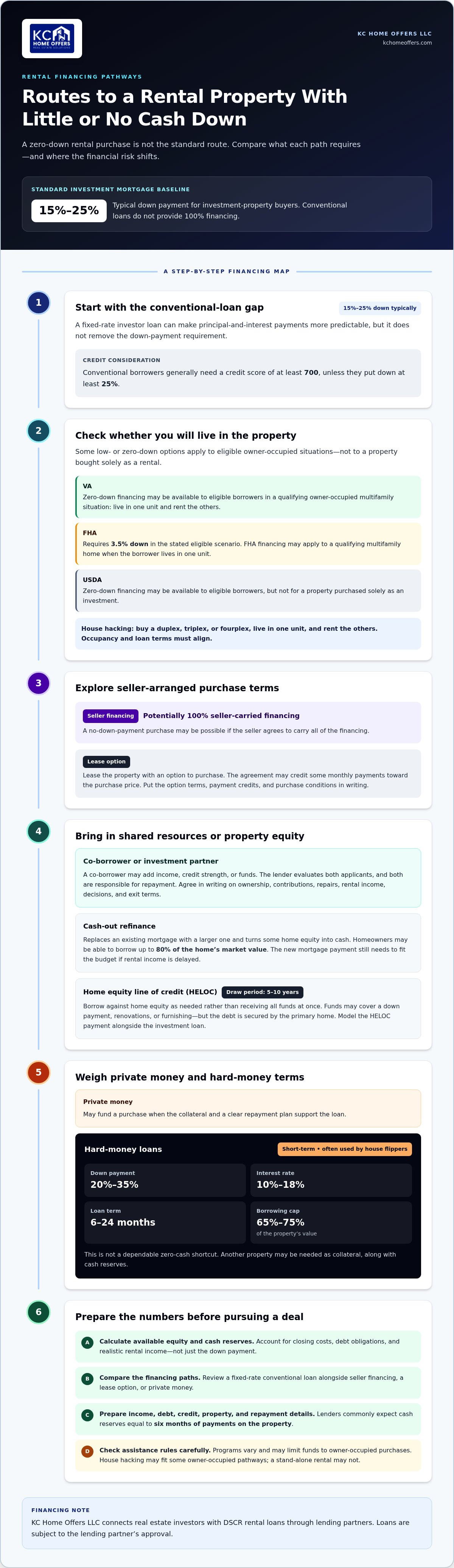
For a property bought strictly as a rental, conventional financing usually requires a substantial down payment. Investment-property buyers typically put down 15% to 25%, and conventional loans don’t provide 100% financing. Conventional borrowers generally need a credit score of at least 700 unless they put down at least 25%. Buyers considering how to get a loan for an investment property with no money down should know that a fixed-rate investor loan can make principal-and-interest payments more predictable, but it doesn’t remove the down-payment requirement.
What loan programs allow zero-down financing for investment properties? VA and USDA loans can offer zero-down financing to eligible borrowers, but they aren’t a route to buying a property solely as a rental. FHA loans require 3.5% down in the stated eligible scenario; FHA and VA financing may apply when a borrower buys a qualifying multifamily property and occupies one unit.
Can you use FHA, VA, or USDA loans to buy a rental or investment property? An eligible borrower may use FHA or VA financing for a multifamily home while living in one unit and renting the others. A zero-down VA loan may be available in that owner-occupied situation. FHA requires a down payment, and USDA zero-down financing is not for a property purchased solely as an investment.
Seller financing can create a no-down-payment purchase if the seller agrees to carry 100% of the financing. A lease option offers a different path: the renter leases the property with an option to purchase, and the agreement may credit some monthly payments toward the purchase price. Set out the option terms, payment credits, and purchase conditions in writing before committing.
How do house hacking, partnerships, or private money make a no-money-down investment possible? House hacking means buying a duplex, triplex, or fourplex, living in one unit, and renting the others. A partner can contribute cash while another brings credit, deal analysis, or project oversight; agree in writing on ownership, expenses, and exit terms. Private money may fund a purchase when collateral and a clear repayment plan support the loan.
Hard-money loans are short-term financing often used by house flippers, not a dependable zero-cash shortcut. They commonly require 20% to 35% down, carry interest rates of 10% to 18%, and usually run six to 24 months. Lenders often cap borrowing at 65% to 75% of the property’s value, so borrowers may need another property as collateral and cash reserves.
What steps should borrowers take to qualify with little or no cash? First, calculate available equity and reserves. Then compare a fixed-rate conventional loan with seller financing, a lease option, or private money. Prepare income, debt, credit, property, and repayment details; lenders commonly expect six months of payments on the property in cash reserves.
What state or local programs offer assistance for rental purchases? Assistance rules vary, and programs may restrict funds to an owner-occupied purchase. Before counting assistance toward an investment deal, read its occupancy and eligible-use requirements; house hacking may fit some owner-occupied pathways, while a stand-alone rental may not. When weighing how to get a loan for an investment property with no money down, distinguish assistance for an owner-occupied home from financing for a rental-only purchase.
2. Co-borrowers and investment partnerships
A co-borrower can contribute income, credit strength, or funds toward an investment purchase. The lender evaluates both applicants, including their debts and ability to repay, rather than treating the stronger applicant as the only borrower. Both people become responsible for the loan. Before applying, agree on ownership shares, payment contributions, and what happens if one person wants to exit.
Separate the borrowing arrangement from the investment partnership. A co-borrower may share responsibility for the loan without holding the same ownership share. Document who contributes the down payment, covers repairs, receives rental income, and makes decisions. For example, one partner could provide cash while another manages renovations. Put each person’s role and a process for resolving disputes in a written agreement.
Home equity can provide funds for a down payment or other purchase expenses. A cash-out refinance replaces a homeowner’s existing mortgage with a larger one, using some available equity as cash. Cash-out refinancing may let homeowners borrow up to 80% of a home’s market value. The new mortgage payment must fit the owner’s budget even if the rental takes time to generate income.
A home equity line of credit, or HELOC, works differently. It allows a homeowner to borrow against home equity as needed, rather than receiving all funds at once. A HELOC draw period typically lasts 5-10 years. Funds can cover a rental property’s down payment, renovations, or furnishing, but borrowing increases debt secured by the primary home. Model the HELOC payment alongside the investment loan before committing.
House hacking can combine a co-borrower’s resources with owner-occupied financing. For example, two buyers might purchase a multifamily property, with one living in a unit and renting the others. The occupants, ownership structure, and loan application must align with the chosen financing terms. Don’t assume the property qualifies for owner-occupied financing if neither borrower plans to live there.
Before buying together, compare each person’s credit profile, monthly obligations, available equity, and cash reserves. Decide whether the property will be owned jointly or through a separate entity, and make sure the loan structure matches. A later refinance may change the debt and ownership plan, so agree before closing on how to handle a sale, buyout, missed payment, or disagreement. Clear terms help prevent conflicting expectations.
Build a shared purchase file with property details, projected rent, repair estimates, each borrower’s financial documents, and a written contribution plan. Use it to discuss the deal with a lender and compare borrowing against a primary residence with a partner’s contribution. Either approach may reduce the cash one investor brings to closing, but neither removes the need to repay debt or cover operating costs.
3. How much investment property can I afford?
An investment property is generally treated as non-owner-occupied when you buy it to rent and don’t live there. Owner-occupied financing requires you to live in a unit as your home. Renting every unit while living elsewhere doesn’t meet that condition. Occupancy affects the loan program, down payment, and how rental income is considered.
For a non-owner-occupied multifamily purchase, expect a down payment requirement of at least 15% or 20%, depending on the loan scenario. A conventional investment-property lender will assess a borrower’s debts relative to income, and qualifying limits can vary. Lenders typically count 75% of expected tenant income when qualifying a borrower, rather than treating projected rent as fully available to cover debt.
That distinction affects your budget. Start with the income a lender may count, then subtract existing debt payments and the proposed mortgage payment. Include operating expenses such as maintenance, taxes, insurance, and periods without rent. A property that appears affordable before these costs can strain your finances after purchase.
Estimate the full monthly obligation, not just principal and interest. Include payments on any home equity borrowing used for the purchase, along with the new property’s expected expenses. Compare the remaining cash flow with your reserves and personal budget. This gives you a more practical affordability limit than relying on the maximum loan amount alone.
Owner-occupying a multifamily property can open a different financing path. An eligible FHA borrower may buy a multifamily property, live in one unit, and put 3.5% down. An eligible VA borrower may use a VA loan with 0% down while occupying one unit. The owner’s actual occupancy is central to using these owner-occupied options.
This approach is often called house hacking: live in one unit while renting the others. A duplex, triplex, or fourplex can combine a primary home with rental income. Assess whether your income can support the full payment if a unit is vacant. Don’t base the purchase solely on projected rent, because lenders typically count only 75% of expected tenant income when qualifying.
A vacation home needs its own occupancy and rental analysis. For a U.S. vacation home rented to others, IRS rules allow rental-property treatment and rental expense deductions if the owner lives there for 10% of the time it is available for rent or more than 14 days, whichever is longer. A vacation home typically requires a minimum 10% down payment.
Before making an offer, compare the down payment, monthly debt, projected rent, and ongoing expenses in one budget. For real estate investing, the purchase price is only part of affordability. Occupancy plans and qualifying income also shape your financing options.
4. Typical down payments for investment properties
For a non-owner-occupied rental, plan around a down payment of 15% to 25%. Buyers often budget 20% to 30%, since the final requirement depends on property type, borrower qualifications, and loan terms. Down payment requirements for multifamily investment properties can vary by loan and borrower. Treat these figures as planning ranges, not interchangeable loan rules.
What are typical down payment, credit score, and cash reserve requirements? Investment-property down payments commonly fall between 15% and 25%; conventional borrowers generally need a credit score of at least 700 unless they put down at least 25%. Lenders typically require six months of payments on the subject property in cash reserves.
A smaller down payment can leave more capital available for repairs or other real estate expenses. But borrowers who put less than 20% down may have to pay mortgage insurance premiums. Compare the added payment with the cash preserved at closing. A larger down payment can lower the loan balance, while leaving less liquidity for vacancies, maintenance, or unexpected costs.
Loan programs also treat property types differently. Vacation homes, properties on leased land, some condos, and commercial properties may require 25% to 30% down. A vacation home typically requires at least 10%. If the property will be rented, distinguish it from a primary residence or vacation home before estimating the required cash.
Hard-money financing has a different cost and timeline profile. Hard-money lenders may require a substantial down payment. These short-term loans usually run six to 24 months, with interest rates of 10% to 18%. House flippers often use this financing for a purchase and renovation, then repay through a sale or refinance. The short term makes a clear exit plan essential.
Also budget for closing costs. Home purchase closing costs can range from 3% to 6% of the purchase price, separate from the down payment. A buyer planning a 20% down payment should calculate closing costs and reserves as additional cash needs, rather than assuming the down payment covers the full amount due.
Before making an offer, build a cash-to-close estimate with four parts: down payment, closing costs, required reserves, and immediate property work. Then compare that total with liquid savings, available home equity, and the monthly payment under the proposed mortgage. For example, a loan requiring 25% down may be less workable than a lower-down-payment option if it leaves no funds for repairs or rental interruptions.
Choose financing based on the property’s intended use, your available cash, and your repayment timeline. A long-term rental loan and a short-term Fix & Flip loan serve different investment plans, even when both finance real estate.
5. Conventional investment-property loan-to-value limits
Loan-to-value, or LTV, compares the mortgage amount with the property’s value. Combined loan-to-value, or CLTV, includes other loans secured by the same property. The stated conventional investment-property maximum is 95% for both LTV and CLTV as of October 2023. That ceiling describes a maximum, not the amount every borrower or property can receive.
A 95% LTV limit may suggest a smaller equity contribution than a 75% limit, but conventional loans don’t provide 100% financing. Buyers still need funds for the down payment, closing costs, and reserves. The applicable limit depends on property details and underwriting, so don’t base a purchase budget on the maximum alone. Compare the likely loan amount with cash available for the full transaction.
Historical limits help explain why multifamily investors should identify the property category. Before October 2023, the previous maximum conventional investment-property LTV was 85% for duplexes. For three- and four-unit properties, the previous maximum was 75% before October 2023. Those earlier limits required borrowers to bring a larger share of the property value from cash or another funding source.
To understand an LTV figure, multiply the property value used for underwriting by the allowed percentage. For example, at 75% LTV, the loan covers three-quarters of that value, leaving the borrower to fund the remainder and transaction costs. The lender’s valuation, loan structure, and other loans secured by the property affect how the calculation applies.
Loan-to-value, or LTV, is only one part of approval. A lender may also weigh credit, existing debt, cash reserves, and the property’s expected rental performance. These factors influence the loan amount and interest rate. A lower LTV can reduce borrowing needs, but using more cash upfront may leave less available for repairs, vacancies, and other expenses.
House hacking follows a different path from buying a non-owner-occupied multifamily rental. An eligible borrower who lives in one unit may use owner-occupied financing, while an investor living elsewhere applies under investment-property terms. Occupancy changes the financing category, but rental income, property expenses, and debt still affect affordability.
Before making an offer, compare the applicable LTV and combined loan-to-value limits with the expected property value, available down payment, other property-secured loans, and required reserves. Then test the projected payment against rental income and operating costs. This shows whether the deal works at a realistic loan amount, rather than relying on a headline maximum.
For help assessing financing options for an investment property, discuss your investment property financing.
KC Home Offers LLC: DSCR Loan
KC Home Offers LLC connects real estate investors with DSCR rental loans through lending partners. A DSCR loan may suit investors evaluating a rental purchase based on its income potential and property debt obligations rather than owner-occupancy financing. It isn’t a no-money-down promise, and approval is subject to the lending partner.
Bring the property details, expected rent, financing needs, and available funds into the discussion. This can help clarify whether a DSCR loan fits the deal and how its cash requirements compare with your investment plan. Contact KC Home Offers LLC to discuss DSCR financing through its lending partners.
Turn Your Investment Plan Into a Clear Next Step
Understanding how to get a loan for an investment property with no money down starts with matching financing to the property and your plan. Before pursuing a deal, decide how much capital you can commit, what risks you can carry, and whether the expected income supports the debt. That gives your financing conversation a practical foundation.
KC Home Offers LLC connects real estate investors with lending partners for DSCR, Fix & Flip, and New Construction loans. These options serve different investment strategies, from rental acquisitions to renovation and ground-up projects. Loans are subject to the lending partner’s approval, so prepare to discuss the property, your financing needs, and your investment plan.
Take the next step with a focused conversation about the deal you’re evaluating. Contact KC Home Offers LLC today to discuss a financing path for your investment goals. A well-planned purchase can move you closer to building a portfolio on terms that fit your strategy.
Frequently Asked Questions
How can I buy a rental property with no money?
Seller financing is one possible route: the seller may agree to finance the full purchase price. That does not automatically cover closing costs, repairs, or reserves, so “no down payment” does not always mean no cash needed. For example, a buyer could negotiate seller financing while budgeting separately for title expenses and initial maintenance. A written agreement should specify payment terms, the repayment schedule, and what happens after a missed payment.
Can I get a loan based on rental income?
Yes. A DSCR loan evaluates a rental property’s income in relation to its debt obligations. For example, a lender can assess lease information and projected rent alongside the property’s proposed loan payment. KC Home Offers LLC connects investors with DSCR loans through lending partners. Its product information describes no income documentation and a soft credit pull that doesn’t affect the borrower’s credit score. Loan approval remains subject to the lending partner.
How much investment property can I afford?
Set an affordability limit by calculating the full monthly cost, then comparing it with dependable income and available reserves. Include mortgage payments, taxes, insurance, maintenance, and any debt used to fund the purchase. If projected rent covers the mortgage but leaves little for repairs or a vacant unit, the deal may exceed your workable budget. A lender may count only part of the expected tenant income when assessing qualification.
Is it really possible?
Yes, but zero down usually requires an arrangement beyond a standard conventional investment loan. Seller financing may cover the purchase price, while a partner or home equity borrowing may provide funds another way. Each approach still creates obligations, such as repayment, shared ownership, or debt secured by another property. Before agreeing, map out who pays each expense and how the investment will work if rent falls short.
Can you buy an investment property with no money down in the United States?
Yes, through arrangements such as seller financing, or eligible owner-occupied programs that let a borrower rent other units. Eligible VA borrowers may qualify for 0% down when buying a multifamily property and occupying one unit. VA and USDA loans aren’t general-purpose financing for a property purchased solely as a rental. Conventional investment-property loans don’t provide 100% financing, so distinguish an investment-only purchase from an owner-occupied plan.
Can you use home equity, a HELOC, or a cash-out refinance as the down payment?
Yes. A homeowner can use funds from a home equity line of credit or cash-out refinance toward an investment purchase. Cash-out refinancing may allow borrowing up to 80% of a home’s market value. A HELOC lets the borrower draw against available equity, while refinancing replaces the existing mortgage. In either case, include the new debt payment in your budget and consider that the primary home secures the borrowing.
What closing costs and upfront expenses remain with a zero-down investment property loan?
A zero-down structure can still leave the buyer responsible for closing costs and property expenses. U.S. home purchase closing costs can range from 3% to 6% of the purchase price. Budget separately for inspections, appraisal, insurance, repairs, utilities, and reserves, as applicable to the deal. For instance, an older rental may need work before tenants move in, even if seller financing covers its purchase price.
What are the risks and costs of no-money-down real estate investing, including mortgage insurance and higher interest rates?
Borrowing the full purchase amount leaves less equity and can magnify losses if property value falls or rent doesn’t cover expenses. Borrowers putting less than 20% down may have to pay mortgage insurance premiums. Investment-property interest rates are typically at least half a percent higher than primary-residence rates. Hard-money financing can add substantial interest costs, with typical rates of 10% to 18%, so calculate repayment against realistic rental or resale income.
Frequently asked
How can I buy a rental property with no money?
Seller financing is one possible route: the seller may agree to finance the full purchase price. That does not automatically cover closing costs, repairs, or reserves, so “no down payment” does not always mean no cash needed. For example, a buyer could negotiate seller financing while budgeting separately for title expenses and initial maintenance. A written agreement should specify payment terms, the repayment schedule, and what happens after a missed payment.
Can I get a loan based on rental income?
Yes. A DSCR loan evaluates a rental property’s income in relation to its debt obligations. For example, a lender can assess lease information and projected rent alongside the property’s proposed loan payment. KC Home Offers LLC connects investors with DSCR loans through lending partners. Its product information describes no income documentation and a soft credit pull that doesn’t affect the borrower’s credit score. Loan approval remains subject to the lending partner.
How much investment property can I afford?
Set an affordability limit by calculating the full monthly cost, then comparing it with dependable income and available reserves. Include mortgage payments, taxes, insurance, maintenance, and any debt used to fund the purchase. If projected rent covers the mortgage but leaves little for repairs or a vacant unit, the deal may exceed your workable budget. A lender may count only part of the expected tenant income when assessing qualification.
Is it really possible?
Yes, but zero down usually requires an arrangement beyond a standard conventional investment loan. Seller financing may cover the purchase price, while a partner or home equity borrowing may provide funds another way. Each approach still creates obligations, such as repayment, shared ownership, or debt secured by another property. Before agreeing, map out who pays each expense and how the investment will work if rent falls short.
Can you buy an investment property with no money down in the United States?
Yes, through arrangements such as seller financing, or eligible owner-occupied programs that let a borrower rent other units. Eligible VA borrowers may qualify for 0% down when buying a multifamily property and occupying one unit. VA and USDA loans aren’t general-purpose financing for a property purchased solely as a rental. Conventional investment-property loans don’t provide 100% financing, so distinguish an investment-only purchase from an owner-occupied plan.
Can you use home equity, a HELOC, or a cash-out refinance as the down payment?
Yes. A homeowner can use funds from a home equity line of credit or cash-out refinance toward an investment purchase. Cash-out refinancing may allow borrowing up to 80% of a home’s market value. A HELOC lets the borrower draw against available equity, while refinancing replaces the existing mortgage. In either case, include the new debt payment in your budget and consider that the primary home secures the borrowing.
What closing costs and upfront expenses remain with a zero-down investment property loan?
A zero-down structure can still leave the buyer responsible for closing costs and property expenses. U.S. home purchase closing costs can range from 3% to 6% of the purchase price. Budget separately for inspections, appraisal, insurance, repairs, utilities, and reserves, as applicable to the deal. For instance, an older rental may need work before tenants move in, even if seller financing covers its purchase price.
What are the risks and costs of no-money-down real estate investing, including mortgage insurance and higher interest rates?
Borrowing the full purchase amount leaves less equity and can magnify losses if property value falls or rent doesn’t cover expenses. Borrowers putting less than 20% down may have to pay mortgage insurance premiums. Investment-property interest rates are typically at least half a percent higher than primary-residence rates. Hard-money financing can add substantial interest costs, with typical rates of 10% to 18%, so calculate repayment against realistic rental or resale income.
Need financing on a deal like this?
DSCR, fix & flip and new construction loans, underwritten on the deal rather than your tax returns. Soft credit pull only.
Apply in 5 minutes