Guides › Private lending
Buy and Hold Financing: How to Fund Long-Term Rentals

Master buy and hold financing for rental properties. Compare DSCR loans, analyze cash flow, and discover how to fund your long-term real estate investments.
The right financing for a rental can change as the property moves from purchase to long-term operation. Choosing buy and hold financing isn’t just about getting a loan to close. It’s about matching the financing structure to your plan and checking that expected rent can support payments and operating costs.
It’s reasonable to worry that debt payments could outpace rent, or that your personal finances may affect approval. A property’s projected income matters, but so do expenses such as taxes, insurance, maintenance, and vacancy. The financing structure and borrower qualifications can both shape whether a deal works over time.
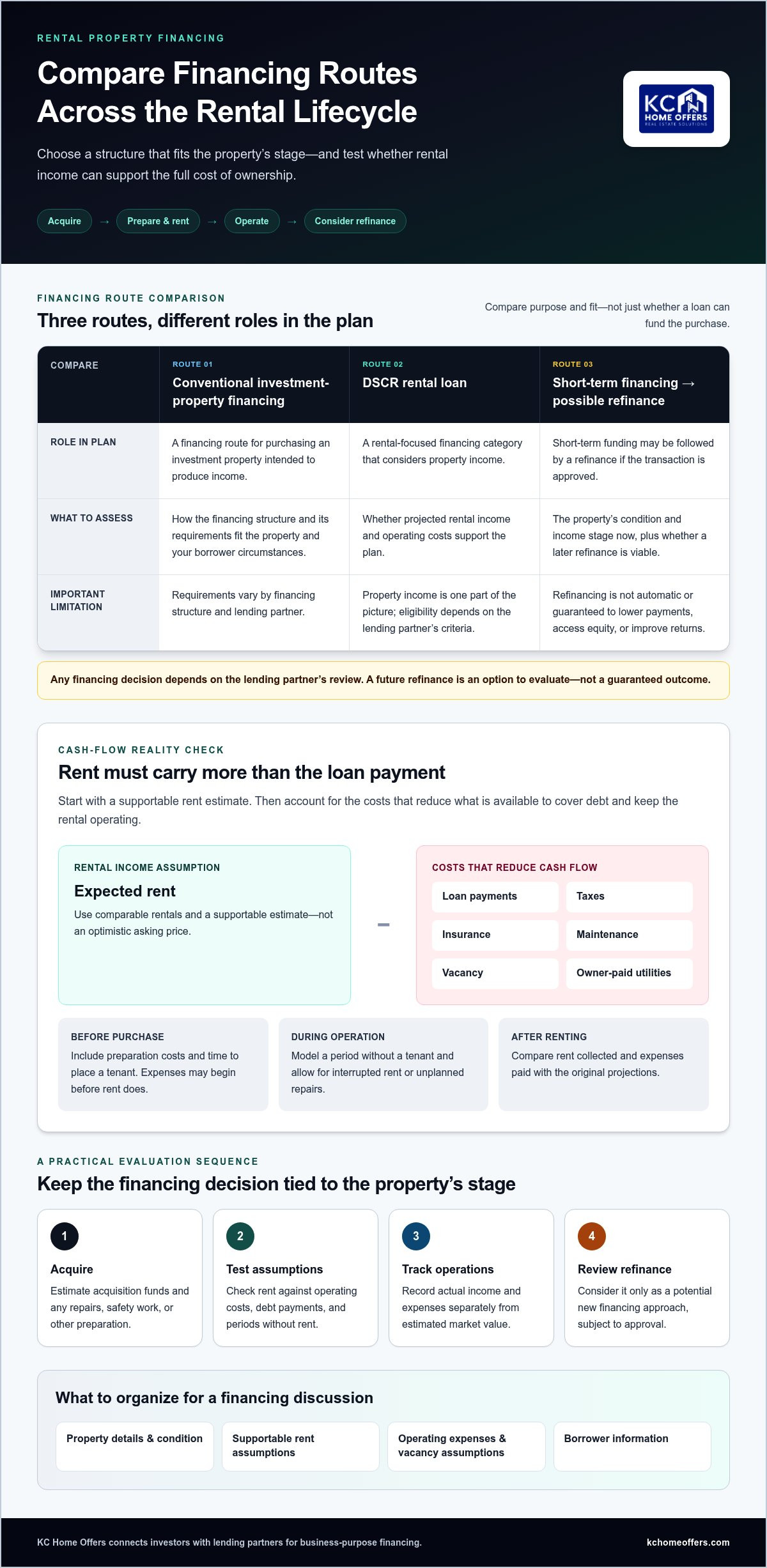
This guide compares common routes, including conventional investment-property financing, DSCR loans, and short-term financing followed by a possible refinance. You’ll learn how to test rental cash flow before committing, compare options across the hold period, and organize key property and borrower information for a financing discussion. KC Home Offers LLC connects investors with lending partners for business-purpose financing, including DSCR, bridge, fix-and-flip, and construction loans. Loans are subject to the lending partner’s approval.
Key Takeaways
- Match buy and hold financing to the property’s stage, from acquisition through stable rental operations.
- Compare rental-focused DSCR financing with short-term bridge options by considering each route’s purpose and trade-offs.
- Test projected rent against mortgage payments, taxes, insurance, maintenance, and vacancy before committing to a deal.
- Organize property details, income assumptions, expenses, and borrower information before a financing discussion.
- KC Home Offers connects investors with lending partners for business-purpose loans; financing is subject to the lending partner’s approval.
Table of Contents
- What Buy and Hold Financing Means for a Long-Term Rental
- How Buy and Hold Financing Fits the Rental Property Lifecycle
- Compare Financing Routes for a Buy and Hold Property
- Evaluate Rental Cash Flow and Prepare Before Seeking Financing
- Plan Your Buy and Hold Financing Next Steps with KC Home Offers
What Buy and Hold Financing Means for a Long-Term Rental
Buy-and-hold financing funds the purchase of an investment property that you intend to rent out and own over an extended period. The financing should support both the acquisition and a workable plan for carrying the property, including loan payments and ongoing operating costs. The aim is to make the rental operation sustainable, not simply to complete the purchase.
This differs from renovation-and-resale investing, where the plan centers on improving a property and selling it rather than operating it as a rental over time. A long hold gives an investor time to earn rental income and build equity, but neither outcome is guaranteed. Vacancies, repairs, changing expenses, or rent that falls short of expectations can put pressure on cash flow. Treat possible appreciation or a future sale as separate from the rental’s ability to cover its costs today.
How buy-and-hold investing works
The basic sequence is straightforward: acquire a property, prepare it for occupancy if needed, rent it, and hold it as an investment. The Buy and hold investment strategy describes the broader approach of retaining an asset over time rather than trading it frequently. For a rental property, that long-term outlook still needs to account for the day-to-day economics of owning and operating the home.
For example, an investor might assess a property using expected rent and recurring costs, then consider future resale value separately. If a unit sits vacant or needs an unplanned repair, the owner still has expenses to cover. A longer ownership horizon doesn’t erase those risks, so the financing plan shouldn’t depend on uninterrupted occupancy or rising property values to make the numbers work.
What financing needs to accomplish
Acquisition funding gets the property into your portfolio. Loan repayments then become part of the rental’s ongoing budget. Compare the expected payment with conservative rental-income assumptions and the other costs of ownership. A loan that fits the purchase price may still strain the operation if its payment schedule leaves too little room for expenses or periods without rent.
Three loan terms help clarify the commitment:
- Principal: The amount borrowed that remains to be repaid.
- Interest: The cost charged for borrowing, as set by the loan terms.
- Repayment schedule: The timing and structure of payments, including how principal and interest are paid.
Investment-property financing is intended for an income-producing asset, while a traditional residential mortgage is generally associated with buying a home to live in. The purpose and underwriting approach may differ, and requirements vary by financing structure and lending partner. KC Home Offers connects investors with lending partners for business-purpose financing, including DSCR rental loans. The lending partner evaluates each application and makes the approval decision.
How Buy and Hold Financing Fits the Rental Property Lifecycle
A rental’s financing needs can shift as it moves from purchase to active operation and, potentially, a later refinance. Thinking in stages helps you avoid treating the initial loan as the whole plan. Match each financing decision to the property’s condition, income, and your intended ownership strategy.
From purchase to rental operations
Start with acquisition. Before making an offer, estimate the funds needed to acquire the property and prepare it for rental use. Depending on its condition, preparation may include repairs, safety work, or other improvements. Include those costs and the time needed to place a tenant in your plan, since loan payments and ownership expenses may begin before rent does.
Then test the rental assumptions. Research comparable rentals and use a supportable rent estimate, not an optimistic asking price. Projected rent is not the same as collected income: a unit may take time to lease, a tenant may leave, or payments may be interrupted. Collected rent is not the same as available cash flow, either. Taxes, insurance, maintenance, utilities paid by the owner, vacancy, and debt payments all reduce what remains.
For example, model a period without a tenant and include recurring costs before deciding what payment the deal can carry. This helps you assess the acquisition on its operating fundamentals rather than assuming full occupancy from day one. Compare financing options by their intended use and how each fits the property’s next stage.
Once rented, track actual performance. Compare rent collected and expenses paid with your original projections. Keep the property’s operating record distinct from its estimated market value. That record can help you understand how the rental is performing and inform future financing decisions.
When refinancing may enter the plan
Refinancing replaces an existing loan with a new one, if the lender approves the transaction. An investor might explore it after the property has been operating to review the loan structure or consider a different financing approach. It’s an option to evaluate, not an automatic next step or a guaranteed way to access equity, lower payments, or improve returns.
The property’s rental performance is one part of the picture. Borrower circumstances, property details, the existing loan, and the lending partner’s criteria may also matter. A DSCR loan may be relevant for a rental investor because this financing category considers property income, but eligibility and assessment vary. Review the DSCR rental-property financing guide for more detail.
The FDIC’s guidance on residential real estate lending offers additional context on lending practices. KC Home Offers connects investors with lending partners for business-purpose financing. A prepared property plan is a practical starting point for a financing discussion.
Compare Financing Routes for a Buy and Hold Property
The right route depends on what the property needs now and how you plan to own it later. A rental that’s ready for tenants presents a different financing case from a vacant property needing substantial work or a home that has yet to be built. Compare each option’s purpose, timing, and repayment expectations before deciding what fits your buy-and-hold plan.
| Financing route | Typical role | Trade-offs to consider |
|---|---|---|
| DSCR rental financing | May suit an income-producing rental, with property income relevant to the financing assessment. | Property cash flow matters, but the lending partner also evaluates the deal and borrower circumstances. Approval isn’t automatic. |
| Bridge or hard-money financing | May support a transitional property or a purchase that needs work before longer-term rental operations. | It’s generally short-term capital, so the investor needs a realistic plan for repayment or a potential next financing step. |
| Fix-and-flip financing | May fund a renovation project planned for resale. | A resale strategy differs from holding a rental. If the plan changes, the investor still needs a workable route to long-term financing. |
| Construction financing | May fund a project to build a property before it can operate as a rental. | The property won’t produce rent during construction, so the project plan must account for the transition to occupancy and ongoing ownership. |
Rental-focused financing versus short-term capital
DSCR financing may be relevant when a property is operating, or intended to operate, as a rental. Rental income can be part of the assessment, making this route worth exploring for investors focused on ongoing property income. Rent alone doesn’t determine eligibility, and projected income doesn’t guarantee positive cash flow.
Bridge or hard-money financing may fit a different stage: acquiring a property that needs repairs, addressing a temporary funding need, or moving a project toward rental readiness. The trade-off is the need to plan beyond acquisition. Consider the work required, the time before the property can earn rent, and the repayment or transition strategy. A hard-money loan overview can help clarify this distinct use case.
Choose by property status and investment plan
Start with the property’s actual condition, then match the financing purpose to the next stage. A rent-ready home points toward evaluating rental-focused options. A property requiring significant renovation may call for a transitional approach, while a ground-up project has different funding needs from a resale renovation.
Be clear about your intended exit from any short-term loan. If you plan to retain the property, identify what must happen before it can support ongoing rental operations. Treat a later refinance as a possibility, not an assumption. KC Home Offers connects investors with lending partners for DSCR, bridge, fix-and-flip, and construction financing. The lending partner evaluates the deal and borrower circumstances and makes the approval decision.
Evaluate Rental Cash Flow and Prepare Before Seeking Financing
A rent estimate can make a property look viable on paper, but it doesn’t show how resilient the deal will be when expenses rise or income pauses. Before pursuing buy and hold financing, test the property’s operating numbers under both expected and less favorable conditions. A sound analysis helps you understand what the rental can support and gives a financing discussion a clearer foundation.
Rental income projections are not guaranteed income.
Stress-test the rental property’s numbers
Start with rental research for the property’s market. Compare similar properties and account for differences in condition, size, and features. Use a realistic rent assumption, then subtract operating expenses and the estimated financing payment to see what may remain. Don’t treat gross rent as spendable cash.
Build a baseline, then test what happens if the property is vacant longer than expected, a repair costs more than planned, or recurring costs change. Include:
- Mortgage principal and interest, along with any other required loan payments
- Property taxes and insurance
- Routine maintenance and a reserve for larger repairs
- Vacancy periods and other potential interruptions to rent collection
- Any additional operating expenses that apply to the property
If a deal only works when the home is continuously occupied and nothing needs repair, the margin for error may be thin. A vacancy or repair scenario can show whether you have funds to cover expenses without relying on rent arriving on schedule. Keep assumptions grounded in rental-market evidence, and update them if the property’s condition or competition changes.
Prepare deal and borrower information
Organize the facts so the lending partner can understand both the property and your plan. Requirements and evaluation methods vary by lending partner, so use this as preparation rather than a universal approval checklist.
- Property: Address, property type, current condition, and whether it’s vacant, occupied, or ready to rent.
- Purchase plan: Expected acquisition cost, intended use, and any work needed before rental operations begin.
- Rental assumptions: Supporting rent research, expected occupancy, and a breakdown of projected expenses.
- Project budget: A clear estimate of repairs or improvements, plus the funds you plan to use for reserves and operating costs.
- Borrower details: Relevant personal or entity information and an overview of your real estate investment experience, if requested.
Keep estimates and supporting documents consistent. If the purchase plan changes, update the budget and rent assumptions instead of relying on figures from an earlier version. Preparation won’t guarantee approval, but it can help surface gaps in the deal before you commit.
Once your numbers and property details are organized, discuss business-purpose financing options through KC Home Offers’ lending partners.
Plan Your Buy and Hold Financing Next Steps with KC Home Offers
A prepared rental analysis gives a financing conversation a clear starting point. Bring the property facts, your ownership plan, and the assumptions behind the deal. That makes it easier to explain what you’re trying to fund, whether you’re acquiring a rental, completing work before leasing, or financing a property that’s already operating.
What to bring to a financing conversation
Organize the details in a concise deal summary. Include the property’s location and condition, purchase plan, expected rental use, and any improvements needed before it can generate income. If the property is already rented, summarize its operating status and the rental information used in your analysis.
Be ready to explain your intended hold strategy and timeline. Distinguish a property that can be rented soon from one requiring substantial work first. Note the planned scope of improvements, estimated project budget, and the steps between acquisition and rental operations. If your plan includes a possible future refinance, describe it as an option to evaluate, not a guaranteed outcome or the only way the investment works.
Organize relevant borrower or entity information alongside the deal materials. The lending partner determines what documentation is needed, how the property and borrower are evaluated, and whether financing is approved. A well-organized summary is a useful starting point, not a promise of qualification or a substitute for the lending partner’s review.
How KC Home Offers connects investors with financing
KC Home Offers connects real estate investors with lending partners for business-purpose financing. The company is not a direct lender. The lending partner makes the approval decision and determines financing terms, so no rate, structure, or timeline is guaranteed before its review.
Describe the project plainly so the financing purpose is clear. A rental that’s ready to operate may lead to a discussion about DSCR rental financing. A property that needs short-term bridge financing to reach the next phase may call for a different approach. Fix-and-flip financing is for renovation projects planned for resale, while construction financing may fit a build project. These categories serve different purposes; the property’s status and your strategy help frame the inquiry.
For a useful financing discussion, have your assumptions and supporting details ready, and be direct about what remains uncertain. If rents, repair scope, or timing are still estimates, identify them as such. Clear inputs make it easier to describe the deal accurately without treating projections as guaranteed results. Financing is subject to the lending partner’s approval.
Ready to discuss a rental-property deal and its financing needs? Discuss financing for your investment property with KC Home Offers.
Set Your Rental Strategy in Motion
Before you pursue a property, decide what would make you pause. It might be a rent estimate that depends on perfect occupancy, repairs that exceed your budget, or a payment that leaves too little room for ordinary operating costs. Setting those limits in advance gives you a clear way to compare opportunities without letting pressure to close replace careful judgment.
That discipline is central to sustainable buy and hold financing. A property doesn’t need to promise a certain outcome to deserve consideration; it needs a plan that accounts for uncertainty and fits your investment goals. Use your assumptions as working numbers, revisit them when the property or market information changes, and keep the long-term operating plan at the center of each decision.
Ready to discuss financing for your rental deal? Start a conversation about your investment property with KC Home Offers.
Frequently Asked Questions
What is buy and hold financing for real estate investors?
Buy and hold financing supports an investor’s purchase and ownership of a rental intended to generate income over time, rather than a quick resale. For example, an investor might acquire a rent-ready duplex and keep it leased while managing operating costs. The financing plan should match the expected ownership period and rental use. Future appreciation or a later sale is a separate possibility, not a substitute for a workable rental plan.
Can you use a DSCR loan to finance a buy and hold rental?
Yes, a DSCR loan may be used for a rental property held as an investment. The property’s rental income is relevant to this financing approach, but it doesn’t guarantee qualification or establish that the deal will produce positive cash flow. An investor considering a vacant property, for example, should distinguish projected rent from income already being collected. The lending partner evaluates the specific property and borrower circumstances.
How do investors choose between a DSCR loan and a hard money loan?
Compare the property’s current condition and your next milestone. A rental already operating or close to rent-ready may make DSCR financing worth exploring. A property needing substantial work before it can be rented may call for a short-term funding strategy, such as bridge or hard-money financing. Before choosing, map out how the property will reach the next stage and how any short-term obligation could be repaid.
Do buy and hold loans require personal income verification?
It depends on the financing program and lending partner. With DSCR financing, the property’s income is an important part of the assessment, but that doesn’t mean the borrower’s circumstances or documentation are irrelevant. A lending partner may review additional information about the borrower or ownership entity. Don’t assume that a rental-focused loan eliminates personal financial review; requirements can differ by transaction and lender.
How much down payment do investors need for buy and hold financing?
There isn’t one down payment amount that applies to every buy-and-hold loan. The required contribution can depend on the financing structure, property, borrower profile, and lending partner’s evaluation. Also budget separately for purchase-related expenses, initial repairs, and funds to carry the property if rent is delayed. A down payment alone doesn’t show how much cash the investment may need before it becomes operational.
Can I refinance a rental property after buying it with short-term financing?
You can explore refinancing, but it isn’t automatic or guaranteed. For example, an investor might review refinance options after completing repairs and establishing rental operations. The property’s condition and income, the existing debt, borrower circumstances, and lending partner’s criteria may all affect the decision. Build a backup repayment plan for the short-term loan rather than relying on a future refinance as the only way to exit it.
What happens if rental income does not cover the property’s expenses?
A shortfall means you may need other funds to meet the property’s obligations while you reassess the investment. Review whether lower occupancy, delayed rent, an unexpected repair, or an expense estimate caused the gap. Keep records of actual income and costs, then revisit the rent assumptions and operating plan. If you’re concerned about making a loan payment, communicate with the loan servicer or lending partner promptly.
Are buy and hold loans guaranteed once a property has rental income?
No. Rental income alone doesn’t guarantee approval. The lending partner reviews the transaction under its own criteria, which may include property details, income information, and borrower circumstances. A signed lease can provide useful context, but it doesn’t promise that rent will always be collected or that a loan will be approved. KC Home Offers connects investors with lending partners, and all financing is subject to the lending partner’s approval.
Frequently asked
What is buy and hold financing for real estate investors?
Buy and hold financing supports an investor’s purchase and ownership of a rental intended to generate income over time, rather than a quick resale. For example, an investor might acquire a rent-ready duplex and keep it leased while managing operating costs. The financing plan should match the expected ownership period and rental use. Future appreciation or a later sale is a separate possibility, not a substitute for a workable rental plan.
Can you use a DSCR loan to finance a buy and hold rental?
Yes, a DSCR loan may be used for a rental property held as an investment. The property’s rental income is relevant to this financing approach, but it doesn’t guarantee qualification or establish that the deal will produce positive cash flow. An investor considering a vacant property, for example, should distinguish projected rent from income already being collected. The lending partner evaluates the specific property and borrower circumstances.
How do investors choose between a DSCR loan and a hard money loan?
Compare the property’s current condition and your next milestone. A rental already operating or close to rent-ready may make DSCR financing worth exploring. A property needing substantial work before it can be rented may call for a short-term funding strategy, such as bridge or hard-money financing. Before choosing, map out how the property will reach the next stage and how any short-term obligation could be repaid.
Do buy and hold loans require personal income verification?
It depends on the financing program and lending partner. With DSCR financing, the property’s income is an important part of the assessment, but that doesn’t mean the borrower’s circumstances or documentation are irrelevant. A lending partner may review additional information about the borrower or ownership entity. Don’t assume that a rental-focused loan eliminates personal financial review; requirements can differ by transaction and lender.
How much down payment do investors need for buy and hold financing?
There isn’t one down payment amount that applies to every buy-and-hold loan. The required contribution can depend on the financing structure, property, borrower profile, and lending partner’s evaluation. Also budget separately for purchase-related expenses, initial repairs, and funds to carry the property if rent is delayed. A down payment alone doesn’t show how much cash the investment may need before it becomes operational.
Can I refinance a rental property after buying it with short-term financing?
You can explore refinancing, but it isn’t automatic or guaranteed. For example, an investor might review refinance options after completing repairs and establishing rental operations. The property’s condition and income, the existing debt, borrower circumstances, and lending partner’s criteria may all affect the decision. Build a backup repayment plan for the short-term loan rather than relying on a future refinance as the only way to exit it.
What happens if rental income does not cover the property’s expenses?
A shortfall means you may need other funds to meet the property’s obligations while you reassess the investment. Review whether lower occupancy, delayed rent, an unexpected repair, or an expense estimate caused the gap. Keep records of actual income and costs, then revisit the rent assumptions and operating plan. If you’re concerned about making a loan payment, communicate with the loan servicer or lending partner promptly.
Are buy and hold loans guaranteed once a property has rental income?
No. Rental income alone doesn’t guarantee approval. The lending partner reviews the transaction under its own criteria, which may include property details, income information, and borrower circumstances. A signed lease can provide useful context, but it doesn’t promise that rent will always be collected or that a loan will be approved. KC Home Offers connects investors with lending partners, and all financing is subject to the lending partner’s approval.
Need financing on a deal like this?
DSCR, fix & flip and new construction loans, underwritten on the deal rather than your tax returns. Soft credit pull only.
Apply in 5 minutes