Guides › Private lending
Sell Your House to an Investor: A Fast, Professional Guide

Learn how to sell house to investor buyers fast. Skip costly repairs, avoid realtor commissions, and close on your schedule with guaranteed cash. Read more!
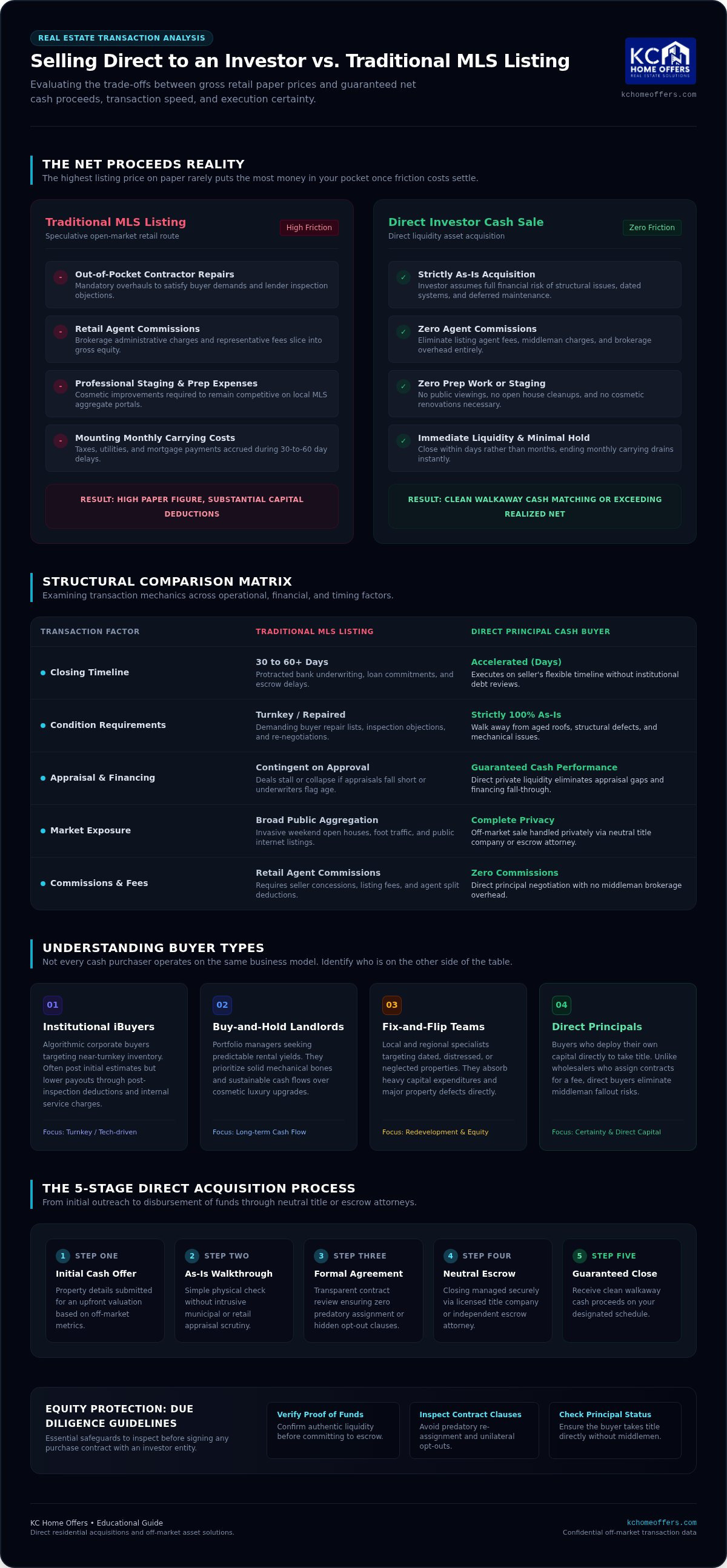
The highest listing price on paper rarely puts the most money in your pocket. When you market a home traditionally, thousands of dollars vanish into contractor repairs, professional staging, and mounting monthly carrying costs. Worse yet, conventional buyers often face financing hurdles that drag out escrow or collapse deals at the finish line. When you choose to sell house to investor specialists, you eliminate that friction and trade open-market uncertainty for guaranteed execution.
You already know that dealing with endless open houses, demanding buyer repair requests, and retail agent commissions is exhausting. You don't have to overhaul a property just to cash out your equity. In this guide, you will discover how direct acquisitions function from start to finish, how to calculate your true net proceeds after waiving commissions and fees, and how to close on a flexible timeline that suits your plans. We'll examine the financial trade-offs of cash sales so you can take control of your transaction with complete confidence.
Key Takeaways
- Understand the operational differences between institutional buyers, private portfolios, and direct fix-and-flip teams to select the right buyer for your property.
- Learn why evaluating your net walkaway cash often rivals a high retail listing price once you eliminate agent commissions, concessions, and holding costs.
- Discover how choosing to sell house to investor professionals allows you to offload real estate strictly as-is without spending time or money on repairs.
- Protect your equity by verifying authentic proof of funds and scrutinizing purchase agreements for predatory assignment or opt-out clauses.
- Master the five-stage acquisition process that takes you from an initial cash offer to a secure, guaranteed closing on your preferred schedule.
Table of Contents
- What Does It Mean to Sell Your House to an Investor?
- Evaluating the Pros and Cons of Selling to a Real Estate Investor
- Net Proceeds Breakdown: Investor Cash Offer vs. Traditional MLS Listing
- How to Choose and Vet a Trustworthy Real Estate Investor
- Step-by-Step Process: From Initial Cash Offer to Closing Day
What Does It Mean to Sell Your House to an Investor?
A direct property sale bypasses the conventional retail market entirely. Instead of listing your property on a local Multiple Listing Service (MLS), staging rooms, and coordinating open houses, you negotiate directly with an entity purchasing the real estate as an asset. Broadly speaking, real estate investing relies on private capital or institutional liquidity to acquire properties for long-term rental income, capital appreciation, or short-term redevelopment. When you sell house to investor entities, the entire transaction is structured around speed, privacy, and closing certainty.
Traditional sales lean heavily on conventional mortgage lenders, strict property appraisal standards, and prolonged inspection objection periods. If an appraisal falls short or the underwriter flags an aging roof, the deal stalls or completely unravels. Direct investors buy strictly as-is. They assume the full financial risk of deferred maintenance, structural repairs, and outdated systems, meaning you don't spend out-of-pocket funds or hire contractors before selling.
The Mechanics of an Off-Market Cash Sale
Off-market acquisitions operate on private liquidity rather than standard institutional debt. Because there are no retail mortgage underwriters involved, you don't face thirty-to-sixty-day waiting periods for loan approvals. The transaction executes through a neutral title company or escrow attorney on your timeline. Additionally, your home never appears on public aggregate listing sites, keeping your financial choices and personal transitions entirely private.
Types of Real Estate Investors in the Market
Not every cash buyer operates the same business model. Understanding who you are negotiating with protects your bottom line and guarantees a smooth exit:
- Institutional iBuyers: Algorithmic corporate buyers that focus on near-turnkey homes. They often generate quick preliminary estimates, but frequently reduce their net payouts later through post-inspection repair deductions and internal service charges.
- Buy-and-Hold Landlords: Portfolio managers acquiring residential real estate for ongoing rental yield. They prioritize solid mechanical bones and predictable tenant cash flow over high-end cosmetic renovations.
- Fix-and-Flip Acquisition Teams: Local or regional specialists who purchase distressed, dated, or neglected assets. They perform heavy capital repairs themselves, allowing you to walk away from severe property defects.
- Direct Principals vs. Wholesalers: Direct buyers utilize their own capital to take title directly. Wholesalers put homes under contract simply to assign that paperwork to third parties for a fee. Direct acquisition teams like KC Home Offers act as principal cash home buyers, deploying direct funds to eliminate middleman delays and secondary closing failures.
Choosing to sell house to investor buyers who purchase directly gives you full control over the transaction, avoiding retail red tape entirely.
Evaluating the Pros and Cons of Selling to a Real Estate Investor
Exiting a property through a private investor requires balancing convenience against top-line valuation. A traditional listing aims for the highest possible sale figure on the open market, but that number comes with substantial friction. Private sales streamline the entire operation, exchanging a speculative retail premium for immediate liquidity and contract certainty. Deciding to sell house to investor groups comes down to which variables matter most to your current financial goals.
Key Advantages: Speed, Certainty, and Zero Repairs
Working with professional buyers removes the standard hurdles of retail sales. You bypass the disruption of weekend open houses, invasive buyer inspections, and demands for credit allowances. Key benefits include:
- Accelerated Closings: Complete the transaction in days rather than waiting on sixty-day bank underwritings.
- Zero Repair Obligations: Walk away from major structural issues, roof leaks, or outdated electrical panels without spending a dime.
- No Retail Commissions: Keep your proceeds clean by cutting out agent listing fees and brokerage administrative charges.
- Guaranteed Performance: Cash transactions eliminate appraisal gaps and loan fall-through risks entirely.
To see how direct transactions eliminate listing friction and accelerate your timeline, review our detailed guide to selling your house fast.
Potential Drawbacks: Gross Valuation and Contract Terms
The trade-offs centered around gross price must also be evaluated honestly. Cash buyers allocate funds for future renovations, holding expenses, and investment margins. Because of this, an investor offer will typically come in lower than a peak market listing. Additionally, you forfeit the chance of an emotional bidding war between retail buyers.
Unqualified operators can also pose serious risks. Some individuals tie up properties with vague clauses, only to demand price drops right before closing. Checking credentials helps avoid these pitfalls. As outlined in a Federal Trade Commission warning, deceptive real estate practices and predatory contracts can trap unprepared sellers. Working with verified direct buyers protects your equity and keeps your timeline on schedule.
If you prefer an efficient exit without the headache of showings and costly updates, connecting directly with KC Home Offers can give you clear visibility on your options.
Net Proceeds Breakdown: Investor Cash Offer vs. Traditional MLS Listing
Gross sale price is a vanity metric. What matters at settlement is your net walkaway figure, the actual capital deposited into your account once all obligations are satisfied. On the retail open market, that top-line number suffers massive erosion from multiple sources before you see a single dollar. Understanding this distinction changes how you evaluate whether to sell house to investor buyers or list through standard retail channels.
Calculating your true walkaway equity requires a straightforward mathematical framework:
Net Walkaway Cash = Gross Offer − Out-of-Pocket Renovations − Holding Expenses − Agent Commissions − Buyer Concessions − Closing Fees
When you sell directly, almost every variable after the gross offer drops to zero, protecting your bottom line.
The True Cost of Preparing a Home for Retail Buyers
Retail buyers rely heavily on strict mortgage guidelines, meaning your property must meet rigid habitability codes. Out-of-pocket expenses start stacking up weeks before your first listing photo:
- Major Mechanical and Structural Updates: Replacing aging HVAC equipment, securing compromised foundations, or addressing an old roof requires immediate liquidity from your savings.
- Cosmetic Staging and Prep Work: Professional deep cleaning, high-end staging, architectural photography, and whole-house painting require upfront financial commitments with no guarantee of a return.
- Inspection Demands: Retail buyers frequently use professional home inspection reports to renegotiate pricing, demanding thousands in credits or direct repairs prior to escrow release.
Holding Costs and Timeline Risks on the Open Market
Every single day your home sits on the market, it bleeds money. Property taxes, mortgage interest, homeowner association dues, hazard insurance, and basic utility bills accrue relentlessly. If a property languishes for months, buyers assume defects exist, prompting steep price reductions that erode your equity even faster.
Direct acquisitions bypass these carrying costs entirely. Partnering with established cash home buyers establishes an immediate financial baseline. You stop the clock on recurring carrying expenses, bypass retail agent commissions entirely, and convert your real estate asset into liquid capital on your terms. This predictability is why choosing to sell house to investor professionals often yields comparable net returns to a drawn-out public listing.
How to Choose and Vet a Trustworthy Real Estate Investor
Protecting your equity starts with rigorous due diligence before signing any paperwork. Not every operator waving a purchase agreement possesses the liquidity or operational discipline to reach the closing table. When you prepare to sell house to investor entities, separating experienced principal buyers from speculative middlemen keeps you from losing weeks to stalled transactions.
Follow these five non-negotiable verification steps to protect your interests:
- Demand Authentic Proof of Funds: Request a recent bank statement or private line-of-credit verification directly from a legitimate financial institution showing liquid balances.
- Audit Business Registrations and Track Records: Confirm the buying entity is actively registered in good standing, with verified client reviews and a track record of completed settlements.
- Require Meaningful Earnest Money: Insist on a non-refundable deposit held securely with a third-party, licensed title agency or escrow attorney.
- Examine Assignment Language: Identify whether the contract allows unilateral assignment, which indicates the person negotiating might not actually buy the property themselves.
- Use an Independent Closing Agent: Ensure an independent title company or closing attorney handles title searches, settlement statements, and fund disbursements.
Vetting Legitimate Buyers vs. Inexperienced Wholesalers
Direct buyers deploy their own balance sheets to take title directly. Inexperienced wholesalers, by comparison, put residential properties under contract with zero capital, attempting to resell that contract to third parties before closing. Watch out for open-ended inspection periods that let buyers walk away for any reason without financial penalty. Legitimate principals risk earnest money and follow through on agreed timelines.
Critical Contract Clauses Homeowners Must Review
Read the fine print to confirm closing dates are strictly binding, backed by daily penalty clauses if the buyer requests unauthorized extensions. Clarify exactly who covers title insurance policies, local transfer taxes, and administrative escrow fees. When managing specialized circumstances like probate or inherited assets, specialized guidance is essential. Review our resource on selling an inherited house to navigate title clearing and multi-heir agreements seamlessly.
If you want a reliable exit backed by clear terms and verified capital, reach out to KC Home Offers to receive a transparent, no-obligation cash offer on your timeline.
Step-by-Step Process: From Initial Cash Offer to Closing Day
Moving from an initial inquiry to cash in hand requires an organized, predictable workflow. When you decide to sell house to investor professionals, the acquisition moves along an accelerated timeline designed to eliminate administrative lag. The entire transaction typically unfolds across five distinct stages:
- Stage 1: Property Submission: You provide basic property specifications, recent utility baselines, and general condition details to receive an initial valuation.
- Stage 2: On-Site Walkthrough: The buyer conducts an informal walkthrough to verify major structural components and mechanical systems.
- Stage 3: Contract Execution: Both parties execute a direct purchase and sale agreement featuring straightforward as-is covenants.
- Stage 4: Title Processing: An independent, licensed title company conducts municipal lien searches, reviews boundary records, and prepares closing documents.
- Stage 5: Settlement and Disbursement: You sign final closing paperwork, title transfers, and net proceeds wire directly to your bank account.
Property Assessment and Finalizing Purchase Terms
Unlike retail buyer visits, an investor walkthrough does not scrutinize paint colors, scuffed baseboards, or aging carpets. The assessment centers exclusively on core infrastructure, including the roof, foundation, plumbing, and electrical capacity. This stage also gives you complete control over closing parameters. You can set the settlement date around your moving schedule, and even coordinate short-term leaseback agreements if you need additional days to transition into your next residence.
Title Work, Escrow, and Disbursement of Funds
Once the purchase agreement is executed, a licensed title company or closing attorney acts as a neutral third party to manage escrow. They perform title searches to verify clear ownership, request loan payoff statements, and confirm property tax standing. If delinquent utility bills, tax assessments, or contractor liens exist, the title agency settles those liabilities directly from gross proceeds at closing, freeing you from resolving them beforehand.
This streamlined escrow process proves invaluable when facing time-sensitive life events or pending auction dates. If you are dealing with strict deadlines, review our practical guide on how to avoid foreclosure to protect your financial record. Executing a decision to sell house to investor teams provides a clean, predictable departure on your terms. Connect directly with KC Home Offers to receive your fair cash offer today.
Execute a Clean, Confident Exit on Your Terms
Navigating a property sale doesn't have to mean enduring contractor delays, open-house disruptions, or buyer financing collapses. When you choose to sell house to investor professionals, you trade retail volatility for immediate certainty and complete control over your moving schedule.
Skipping retail commissions, avoiding out-of-pocket repair bills, and eliminating ongoing carrying costs often bridges the gap between an unpredictable listing price and your actual net proceeds. As direct principal buyers purchasing properties nationwide strictly as-is, we eliminate middleman fees and administrative costs entirely. Independent, licensed title and escrow professionals manage the settlement process, ensuring every detail closes securely on your preferred timeline.
You don't have to spend your savings just to cash out your equity. Take charge of your property transition today: Request a fast, no-obligation cash offer from KC Home Offers and move forward with total financial clarity.
Frequently Asked Questions
Do I have to clean out the house or make repairs before selling to an investor?
No, you don't need to make repairs, paint, or clean out the property before selling. Direct investors purchase homes strictly as-is. You can pack the personal belongings you want to keep and leave behind unwanted furniture, outdated appliances, or accumulated clutter. The investor manages full property cleanout, hazardous remediation, and structural renovations after closing occurs.
How fast can an investor close on a home purchase?
Direct cash investors can close in as little as a few days once the title search is complete. Because transactions rely on private liquidity rather than standard bank underwriting, you avoid residential appraisal delays and loan processing queues. If you need additional time to arrange your move, investors can also adjust the closing date to fit your exact schedule.
How do real estate investors calculate their cash offers?
Real estate investors calculate cash offers by establishing the property's projected after-repair value and subtracting anticipated renovation and holding costs. They evaluate recent comparable sales of fully updated homes nearby, estimate necessary structural and mechanical updates, and factor in investment risk margins. This formula results in an upfront offer that reflects real asset condition without contingent renegotiations.
Are there any hidden fees or agent commissions when selling to an investor?
Reputable direct buyers don't charge agent commissions, administrative service fees, or transaction surcharges. When you sell house to investor principals, the agreed figure is what you work from at settlement. Aside from paying off your existing mortgage balance and prorated property taxes through escrow, your proceeds aren't reduced by the middleman costs common in traditional listings.
Can I sell my house to an investor if I am behind on mortgage payments or facing foreclosure?
Yes, selling directly to a cash buyer is an effective way to resolve delinquent payments and halt foreclosure before an auction date. The title company coordinates directly with your mortgage servicer to obtain payoff figures. Outstanding loan balances, late fees, and arrears are paid directly out of the sale proceeds at settlement, protecting your credit from a completed foreclosure judgment.
What is the difference between a direct property buyer and a wholesaler?
A direct property buyer deploys their own capital to purchase and take title to your home, whereas a wholesaler markets the contract to third parties. When you sell house to investor principals, you negotiate with the actual decision-maker. Wholesalers often insert broad inspection contingencies, allowing them to cancel the agreement if they can't assign the contract to an outside buyer for a profit.
Will I need to pay closing costs when selling directly to an investor?
Most professional investors cover typical closing fees, including title search charges, escrow fees, and transfer taxes. In a standard retail transaction, these administrative costs reduce seller equity at closing. With a direct acquisition agreement, the buyer generally covers these operational expenses, meaning your net walkaway payout remains predictable and free from surprise settlement deductions.
Frequently asked
Do I have to clean out the house or make repairs before selling to an investor?
No, you don't need to make repairs, paint, or clean out the property before selling. Direct investors purchase homes strictly as-is. You can pack the personal belongings you want to keep and leave behind unwanted furniture, outdated appliances, or accumulated clutter. The investor manages full property cleanout, hazardous remediation, and structural renovations after closing occurs.
How fast can an investor close on a home purchase?
Direct cash investors can close in as little as a few days once the title search is complete. Because transactions rely on private liquidity rather than standard bank underwriting, you avoid residential appraisal delays and loan processing queues. If you need additional time to arrange your move, investors can also adjust the closing date to fit your exact schedule.
How do real estate investors calculate their cash offers?
Real estate investors calculate cash offers by establishing the property's projected after-repair value and subtracting anticipated renovation and holding costs. They evaluate recent comparable sales of fully updated homes nearby, estimate necessary structural and mechanical updates, and factor in investment risk margins. This formula results in an upfront offer that reflects real asset condition without contingent renegotiations.
Are there any hidden fees or agent commissions when selling to an investor?
Reputable direct buyers don't charge agent commissions, administrative service fees, or transaction surcharges. When you sell house to investor principals, the agreed figure is what you work from at settlement. Aside from paying off your existing mortgage balance and prorated property taxes through escrow, your proceeds aren't reduced by the middleman costs common in traditional listings.
Can I sell my house to an investor if I am behind on mortgage payments or facing foreclosure?
Yes, selling directly to a cash buyer is an effective way to resolve delinquent payments and halt foreclosure before an auction date. The title company coordinates directly with your mortgage servicer to obtain payoff figures. Outstanding loan balances, late fees, and arrears are paid directly out of the sale proceeds at settlement, protecting your credit from a completed foreclosure judgment.
What is the difference between a direct property buyer and a wholesaler?
A direct property buyer deploys their own capital to purchase and take title to your home, whereas a wholesaler markets the contract to third parties. When you sell house to investor principals, you negotiate with the actual decision-maker. Wholesalers often insert broad inspection contingencies, allowing them to cancel the agreement if they can't assign the contract to an outside buyer for a profit.
Will I need to pay closing costs when selling directly to an investor?
Most professional investors cover typical closing fees, including title search charges, escrow fees, and transfer taxes. In a standard retail transaction, these administrative costs reduce seller equity at closing. With a direct acquisition agreement, the buyer generally covers these operational expenses, meaning your net walkaway payout remains predictable and free from surprise settlement deductions.
Need financing on a deal like this?
DSCR, fix & flip and new construction loans, underwritten on the deal rather than your tax returns. Soft credit pull only.
Apply in 5 minutes