Guides › Private lending
How to Secure Max Cash Offers: 2026 Homeowner Guide

Learn how to secure genuine max cash offers in 2026. Protect your home equity, bypass wholesaling middlemen, and maximize your net walkaway proceeds today.
The highest cash offer on paper is rarely the check you actually take to the bank. Across the country, homeowners seeking max cash offers frequently watch an attractive initial proposal crumble under last-minute repair credits, administrative deductions, and wholesale middleman markups. If you're wary of predatory re-trading tactics or confused about the real gap between a gross purchase price and your net walkaway proceeds, you aren't alone. It's frustrating to feel like the deck is stacked against you before escrow even opens.
This guide pulls back the curtain on the exact mathematical formulas direct property buyers use to value residential real estate, showing you how to lock in genuine top-dollar proceeds without commission cuts or surprise penalties. You'll discover how to bypass unlicensed contract assignors, verify real repair liabilities, and enforce contract safeguards that guarantee a smooth closing on your preferred schedule. Here is how you can take control of the selling process and secure a transparent transaction that maximizes your bottom line.
Key Takeaways
- Decode the exact underwriting formula direct property investors use, evaluating purchase proposals based on net walkaway proceeds rather than inflated marketing figures.
- Distinguish balance-sheet investors from wholesale middlemen to secure genuine max cash offers that close without speculative assignment delays.
- Assemble essential mechanical and structural documentation ahead of time to eliminate unjustified repair deductions before property walkthroughs occur.
- Protect your equity from predatory re-trading tactics by enforcing short inspection windows, meaningful earnest money deposits, and strict anti-assignment clauses.
- Streamline your exit timeline to complete transactions in as few as seven to fourteen days while bypassing agent commissions and financing contingencies.
Table of Contents
- Demystifying Max Cash Offers: How Professional Property Investors Calculate Value
- Evaluating Buyer Types: Direct Investors vs. Wholesalers vs. Tech iBuyers
- The Step-by-Step Checklist to Secure Your Maximum Cash Offer
- Protecting Your Equity: Avoiding Re-Trading and Predatory Price Drops
- Executing a Direct Cash Sale: Speed, Certainty, and Net Value
Demystifying Max Cash Offers: How Professional Property Investors Calculate Value
A legitimate cash purchase is not a shot-in-the-dark estimate. Professional acquisitions teams calculate genuine max cash offers through rigorous mathematical formulas rather than speculative guesswork. At its foundation, an investor valuation reflects what an asset is worth right now, adjusted for capital requirements and transaction velocity. Legitimate direct buyers establish firm pricing using internal balance-sheet liquidity, ensuring the number written on your purchase contract matches the wire delivered on closing day.
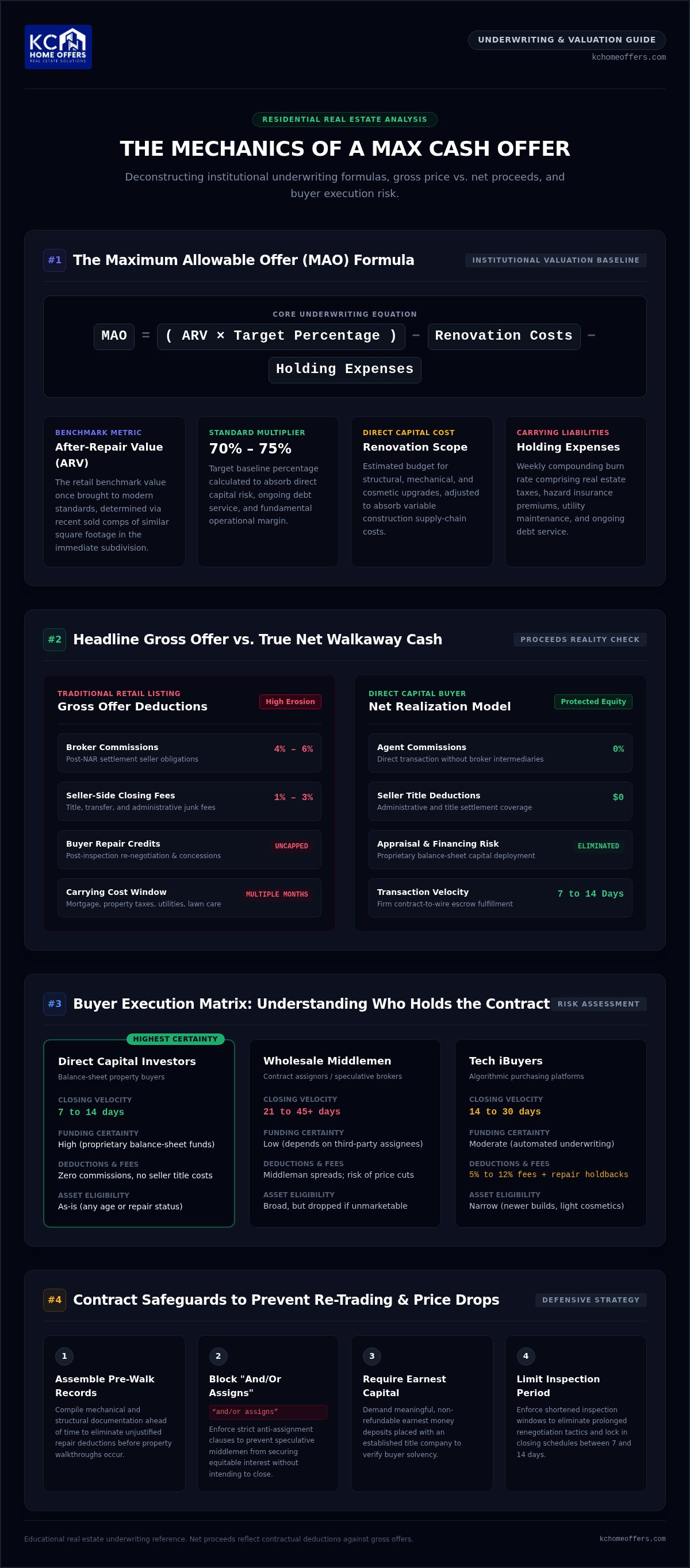
The standard underwriting formula centers on property math:
- Maximum Allowable Offer (MAO): (After-Repair Value × Target Percentage) − Estimated Renovation Costs − Holding Expenses.
- Target Percentage: Typically ranges between 70% and 75% to account for capital risk, debt service, and operational margin.
- Net Realization: Unlike speculative listings, this figure eliminates financing delays and appraisal contingencies entirely.
Understanding After-Repair Value (ARV) and Holding Cost Calculations
After-Repair Value represents the retail benchmark of your home once brought to modern standards. Direct investors evaluate this by pulling recent sold comparables of similar square footage within your immediate subdivision. From that baseline, underwriting factors in carrying expenses. Holding costs accumulate every single week a property sits in development, including real estate taxes, hazard insurance, utility maintenance, and debt service. As the anticipated scope of structural or cosmetic repairs expands, the investor's operational margin adjusts to absorb construction supply-chain variables and market exposure.
Gross Offer vs. Net Walkaway Cash: The True Financial Picture
Headline figures can be deceiving. A retail listing price sounds impressive until transaction overhead cuts into your bottom line. Traditional sales routinely surrender 4% to 6% in broker commissions post-NAR settlement, another 1% to 3% in seller-side closing fees, and thousands more in negotiated buyer repair concessions. Add multiple months of mortgage payments, property taxes, and lawn care while waiting for a lender approval, and your realized equity drops fast.
Direct acquisitions rebalance this dynamic. When working with direct capital buyers, sellers sidestep agent commissions, inspection renegotiation games, and administrative title junk fees. Consulting a proven guide to sell my house fast highlights how skipping open-market delays protects your total walkaway proceeds. By evaluating the real net spread rather than an inflated gross pitch, you can secure max cash offers that put verified funds in your account without unexpected deductions.
Evaluating Buyer Types: Direct Investors vs. Wholesalers vs. Tech iBuyers
Not all cash buyers operate from the same playbook. Understanding who sits on the other side of the contract determines whether you receive true max cash offers that close on time or end up trapped in stalled negotiations. Direct balance-sheet investors purchase assets using their own capital reserves, whereas contract wholesalers and algorithmic platforms introduce secondary layers of risk, extended timelines, and fee deductions.
| Buyer Category | Closing Velocity | Funding Certainty | Deductions & Fees | Asset Eligibility |
|---|---|---|---|---|
| Direct Capital Investors | 7 to 14 days | High (proprietary balance-sheet funds) | Zero commissions, no seller title costs | As-is (any age or repair status) |
| Wholesale Middlemen | 21 to 45+ days | Low (depends on third-party assignees) | Middleman spreads; risk of price cuts | Broad, but dropped if unmarketable |
| Tech iBuyers | 14 to 30 days | Moderate (automated underwriting) | 5% to 12% service fees, repair holdbacks | Narrow (newer builds, light cosmetics) |
Identifying Direct Capital Buyers Versus Wholesalers
Wholesalers rarely intend to buy your property outright. Instead, they secure equitable interest using purchase agreements containing language such as "and/or assigns" alongside their entity name. During an extended inspection window, they market your home to end-buyers for an assignment markup. If an assignee does not materialize, the wholesaler usually cancels the contract or demands an eleventh-hour price drop. To ensure you partner with bona fide direct home buyers, demand a verified proof-of-funds letter issued within the last 30 days and strike out all assignment clauses before signing.
The Hidden Penalties of Algorithmic iBuyer Platforms
Algorithmic platforms market instant convenience, but their transactional math often surprises homeowners. Rather than waiving overhead, tech iBuyers deduct variable service fees reaching up to 12%, alongside standard closing fees and transfer taxes. Following a preliminary digital proposal, they dispatch inspectors who formulate extensive, non-negotiable repair credits that reduce your net payout. These platforms also reject assets needing major structural or mechanical work, limiting genuine cash options for aging properties.
The Step-by-Step Checklist to Secure Your Maximum Cash Offer
Securing top dollar in a direct sale does not require high-cost staging or cosmetic upgrades. Professional investors price risk, not wallpaper patterns. When you remove operational unknowns from the equation, buyers do not need to pad their underwriting with defensive cost buffers. Following a deliberate preparation checklist positions your home to capture genuine max cash offers while keeping transaction leverage firmly in your corner.
- Assemble asset documentation: Compile utility bills, permits, and age records for all major capital systems.
- Solicit verified institutional bids: Gather multiple offers strictly from vetted balance-sheet buyers with confirmed liquid reserves.
- Evaluate net deal structures: Compare bottom-line proceeds after factoring out title costs, transfer taxes, and timeline risks.
Documenting Property Condition and Major System Lifespans
Underwriting teams scrutinize big-ticket mechanicals first. You can proactively defend your valuation by assembling clear records for the four core infrastructure pillars:
- Roof installation year and permit documentation
- HVAC manufacture date and routine servicing receipts
- Electrical service panel capacity and wiring type
- Plumbing supply lines and sewer lateral condition
Cosmetic flaws rarely deter professional purchasers, but structural questions trigger wide repair estimates. Providing invoices that prove a furnace was serviced or a roof was replaced five years ago eliminates guesswork. When buyers see verified lifespans, they remove worst-case replacement allowances from their valuation formulas.
Negotiating Strategic Closing Terms and Concessions
Price is only one component of a successful agreement. Structuring favorable contractual terms often preserves more capital than haggling over baseline figures. Insist that the purchasing entity covers standard title insurance, escrow settlement fees, and local transfer taxes. These transactional items typically drain 1% to 3% from your equity in an open-market sale.
Additionally, negotiate operational flexibility into the deal. If you need time to locate your next residence, request a short-term post-closing occupancy agreement or a customized closing window. By coupling flexible timelines with clean agreements devoid of appraisal hurdles, you capture true max cash offers that protect both your net proceeds and your moving schedule.
Protecting Your Equity: Avoiding Re-Trading and Predatory Price Drops
The most destructive pitfall in the direct sale space is a tactic known as re-trading. Unethical operators lock a home under contract with an inflated initial figure, only to manufacture catastrophic repair claims 48 hours before closing. By that point, the homeowner has packed boxes, terminated utilities, and committed to a moving date. Desperate to keep the timeline intact, many sellers surrender tens of thousands in equity. Securing authentic max cash offers requires identifying these predatory mechanisms before you put pen to paper.
Middlemen rely on contractual loopholes to stall transactions while hunting for third-party buyers. When an operator lacks capital, they use your living room as a showroom for their network. If they fail to locate an investor willing to pay their inflated spread, they slash your purchase price or walk away completely, leaving you with zero recourse.
Recognizing Red Flags in Cash Purchase Contracts
Predatory agreements consistently share distinct contractual patterns. Watch for these structural warning signs in any proposed purchase agreement:
- Extended feasibility periods: Inspection windows stretching beyond seven to ten business days on purported rapid transactions.
- Token earnest money: Deposit commitments of only one hundred to five hundred dollars, representing zero real financial exposure for the buyer.
- Broad access clauses: Terms permitting unrestricted entry for "contractors, partners, or associates," which serves as code for unvetted wholesale assignees.
Locking In Contractual Certainty Before Signing
You can insulate your transaction by enforcing protective covenants that strip away renegotiation leverage. Insist that the buyer deposit a legitimate earnest money deposit, typically 1% to 2% of the purchase price, into an independent title escrow account within 48 hours of execution. Make that deposit non-refundable immediately upon the expiration of a strict five-day inspection window.
Next, bind the agreement with explicit as-is language. Specify that the inspection period grants a binary choice to proceed or terminate, prohibiting subsequent repair credits or price reductions. Finally, institute a daily per diem financial penalty for closing extensions caused by buyer delays. If you want to bypass speculative contract brokers and work directly with verified capital, consult professional cash home buyers who commit to transparent pricing without eleventh-hour retrading games.
Executing a Direct Cash Sale: Speed, Certainty, and Net Value
Completing a traditional home sale often feels like taking on an unpaid second job. Between coordinating open houses, accommodating disruptive weekend showings, and waiting out forty-five days of mortgage processing, the standard listing route drains substantial personal energy. In contrast, working directly with established capital buyers removes the friction from property disposition. By cutting out consumer mortgage underwriting, genuine max cash offers deliver transaction certainty and complete settlements in as few as seven to fourteen business days.
This operational velocity translates into concrete financial savings. Sellers avoid months of carrying expenses, interest payments, and seasonal upkeep costs that quietly erode equity. More importantly, direct acquisitions eliminate the need for costly deep cleaning, deferred maintenance corrections, or professional staging, allowing you to walk away on your own terms with guaranteed proceeds.
The Streamlined Direct Acquisition Workflow
A direct purchase follows a clear, repeatable process designed for efficiency and transparency:
- Initial property intake: Submit baseline home details, systems history, and general square footage for immediate underwriting analysis.
- Single on-site verification: Complete a solitary physical walkthrough to confirm structural fundamentals, bypassing recurring retail open houses.
- Firm valuation delivery: Review a binding, transparent purchase agreement showing your exact net walkaway sum with zero commission deductions.
Taking Control of Your Real Estate Timeline
Closing on your preferred schedule provides invaluable peace of mind. Whether you need an immediate seven-day exit or require sixty days to coordinate a smooth household relocation, direct acquisitions align with your life. You pick the closing date that fits your calendar rather than answering to a buyer's lender milestones.
On the specified settlement day, an independent, licensed title agency oversees execution and disburses proceeds directly to your account via certified bank wire. Once your equity is liberated, you have liquid capital ready to deploy into your next residence or alternative investment opportunity. Ambitious property entrepreneurs looking to reinvest their capital into value-add residential projects can also accelerate their growth by reviewing fix and flip funding options to finance upcoming rehab opportunities with agile leverage.
Ultimately, a direct transaction prioritizes clarity above all else. When you strip away intermediary spreads, speculative assignments, and hidden platform fees, you secure max cash offers that reflect true net value, protecting your equity from contract to closing.
Maximize Your Net Equity on Your Own Terms
Navigating property disposition doesn't require sacrificing your hard-earned equity to high-pressure renegotiations or open-market listing delays. As you evaluate your exit strategy, remember that genuine max cash offers hinge on transparent underwriting and guaranteed net walkaway funds, not inflated headline figures eroded by commissions and surprise repair penalties. By verifying direct buyer liquidity, eliminating assignment loopholes, and enforcing tight inspection terms, you keep total control over your asset from the initial contract to the settlement table.
Working directly with verified capital buyers eliminates intermediary markups and administrative drag. Through direct balance-sheet property acquisitions featuring zero broker commissions and flexible closing schedules tailored to your relocation requirements, you can transition seamlessly into your next chapter without financing contingencies or closing delays. Request a transparent cash offer for your property today and discover how predictable, direct liquidity can streamline your sale.
Frequently Asked Questions
What does max cash offer actually mean in real estate?
In real estate, genuine max cash offers represent the highest possible net payout a balance-sheet direct buyer can provide based on actual property condition. Unlike marketing estimates or wholesale pitches, this figure eliminates financing contingencies, repair concessions, and agent commissions. It reflects the exact liquid capital you walk away with at closing rather than an inflated headline price subject to backend deductions.
How do professional cash buyers calculate what to pay for a house?
Professional buyers determine values using the Maximum Allowable Offer formula. They start with the After-Repair Value based on recent neighborhood comparable sales, multiply that by a risk-adjusted baseline percentage, and subtract itemized renovation costs alongside carrying expenses. This mathematical approach removes emotional speculation, accounting for capital risks while ensuring the buyer can complete the purchase using verified balance-sheet funds without third-party lender involvement.
Can you negotiate when selling your house to a cash buyer?
Yes, homeowners can negotiate both price and contractual terms with cash buyers. While purchase prices depend on hard renovation math, you often gain substantial financial leverage by negotiating non-monetary items. Sellers routinely negotiate for the buyer to absorb all standard title and escrow fees, request extended or post-closing occupancy periods, or establish strict earnest money terms that eliminate renegotiation risks before settlement.
Is selling to a cash buyer better than listing on the MLS?
Direct sales are better when speed, certainty, and condition flexibility outweigh retail exposure. An open-market listing might achieve a higher gross figure, but agent commissions, repair allowances, buyer concessions, and holding costs during extended financing approvals erode net equity. Direct cash buyers provide a guaranteed, as-is exit on a predictable timeline, making it ideal for inherited homes, distressed assets, or time-sensitive relocations.
Who pays the closing costs during a direct cash home sale?
In legitimate direct acquisitions, the purchasing entity typically covers all standard seller title insurance fees, escrow charges, and administrative closing expenses. Traditional sales require sellers to pay 1% to 3% in settlement overhead on top of agent commissions. Direct balance-sheet buyers structure transactions as zero-fee transfers, meaning the contractual purchase price matches your final net walkaway wire at closing.
What happens if a cash buyer attempts to lower their offer after inspection?
If a buyer attempts an eleventh-hour price drop, known as re-trading, you can reject the amendment immediately. If your contract includes strict as-is provisions and tight inspection timelines, the buyer must either proceed at the agreed price or terminate the agreement. Securing legitimate max cash offers means partnering with reputable direct buyers whose initial valuations already account for property condition, preventing unprincipled price reductions right before closing.
How quickly can a homeowner receive funds from a verified cash sale?
Homeowners can receive net settlement funds in as few as seven to fourteen business days. Because direct capital buyers bypass mortgage underwriting, property appraisals, and institutional lender approvals, the title company only needs enough time to verify ownership and prepare legal transfer documents. Once closing paperwork is signed, funds disburse immediately via secure, certified bank wire transfer.
Frequently asked
What does max cash offer actually mean in real estate?
In real estate, genuine max cash offers represent the highest possible net payout a balance-sheet direct buyer can provide based on actual property condition. Unlike marketing estimates or wholesale pitches, this figure eliminates financing contingencies, repair concessions, and agent commissions. It reflects the exact liquid capital you walk away with at closing rather than an inflated headline price subject to backend deductions.
How do professional cash buyers calculate what to pay for a house?
Professional buyers determine values using the Maximum Allowable Offer formula. They start with the After-Repair Value based on recent neighborhood comparable sales, multiply that by a risk-adjusted baseline percentage, and subtract itemized renovation costs alongside carrying expenses. This mathematical approach removes emotional speculation, accounting for capital risks while ensuring the buyer can complete the purchase using verified balance-sheet funds without third-party lender involvement.
Can you negotiate when selling your house to a cash buyer?
Yes, homeowners can negotiate both price and contractual terms with cash buyers. While purchase prices depend on hard renovation math, you often gain substantial financial leverage by negotiating non-monetary items. Sellers routinely negotiate for the buyer to absorb all standard title and escrow fees, request extended or post-closing occupancy periods, or establish strict earnest money terms that eliminate renegotiation risks before settlement.
Is selling to a cash buyer better than listing on the MLS?
Direct sales are better when speed, certainty, and condition flexibility outweigh retail exposure. An open-market listing might achieve a higher gross figure, but agent commissions, repair allowances, buyer concessions, and holding costs during extended financing approvals erode net equity. Direct cash buyers provide a guaranteed, as-is exit on a predictable timeline, making it ideal for inherited homes, distressed assets, or time-sensitive relocations.
Who pays the closing costs during a direct cash home sale?
In legitimate direct acquisitions, the purchasing entity typically covers all standard seller title insurance fees, escrow charges, and administrative closing expenses. Traditional sales require sellers to pay 1% to 3% in settlement overhead on top of agent commissions. Direct balance-sheet buyers structure transactions as zero-fee transfers, meaning the contractual purchase price matches your final net walkaway wire at closing.
What happens if a cash buyer attempts to lower their offer after inspection?
If a buyer attempts an eleventh-hour price drop, known as re-trading, you can reject the amendment immediately. If your contract includes strict as-is provisions and tight inspection timelines, the buyer must either proceed at the agreed price or terminate the agreement. Securing legitimate max cash offers means partnering with reputable direct buyers whose initial valuations already account for property condition, preventing unprincipled price reductions right before closing.
How quickly can a homeowner receive funds from a verified cash sale?
Homeowners can receive net settlement funds in as few as seven to fourteen business days. Because direct capital buyers bypass mortgage underwriting, property appraisals, and institutional lender approvals, the title company only needs enough time to verify ownership and prepare legal transfer documents. Once closing paperwork is signed, funds disburse immediately via secure, certified bank wire transfer.
Need financing on a deal like this?
DSCR, fix & flip and new construction loans, underwritten on the deal rather than your tax returns. Soft credit pull only.
Apply in 5 minutes