Guides › Private lending
DSCR Loan vs Conventional Loan: Choosing the Best Path for Your Rental Portfolio in 2026

Choosing between a DSCR loan vs conventional loan? This 2026 guide shows investors how to scale past 10 properties without personal income verification.
Why are the most successful real estate investors in 2026 intentionally choosing interest rates that are nearly a full percentage point higher than the national average? It sounds counterintuitive until you hit the Fannie Mae wall at ten properties or find yourself buried under a mountain of tax returns and W2 requirements. If you've ever lost a deal because a traditional bank took sixty days to clear your debt-to-income ratio, you know that the cheapest debt isn't always the most profitable. Understanding the nuances of a DSCR loan vs conventional loan is no longer just a financial exercise; it's a strategic requirement for anyone serious about scaling a rental portfolio in today's market.
You likely agree that an investment's success should depend on the property's performance, not your personal paycheck. This guide promises to help you discover whether a DSCR loan or a conventional mortgage is the right move to scale your assets without suffocating red tape. We will compare the two paths based on speed, documentation, and 2026 market realities. You'll gain a clear roadmap to buy more properties faster while finally decoupling your personal finances from your professional investment portfolio.
Key Takeaways
- Learn how to distinguish between asset-based financing and traditional mortgages to determine which structure aligns with your 2026 growth goals.
- Compare the specific requirements of a DSCR loan vs conventional loan, including credit scores and down payment thresholds, to avoid surprises during underwriting.
- Discover why conventional financing often hits a wall at ten properties and how to bypass debt-to-income limits that stall your portfolio's expansion.
- Understand the tactical advantages of closing in an LLC and protecting your personal credit while accelerating your acquisition speed.
- Identify the exact scenarios where switching to investor-focused capital provides the momentum needed to outpace the competition in a stabilizing market.
Table of Contents
- Beyond the W2: Why Investors Choose Between DSCR and Conventional Loans
- Side-by-Side Comparison: DSCR vs Conventional Loan Requirements
- The Scalability Factor: When Conventional Loans Hit the Wall
- Strategic Decision: Which Loan is Right for Your Next Deal?
- Scale Your Portfolio with KC Home Offers
Beyond the W2: Why Investors Choose Between DSCR and Conventional Loans
Investors often view financing as a binary choice: either you qualify or you don't. That is a mistake. The real decision involves choosing between two entirely different underwriting philosophies. A conventional loan is a federally backed mortgage where the lender scrutinizes your personal life, your tax returns, and your W2 income. Conversely, a DSCR loan is an asset-based financing tool. It prioritizes the Debt Service Coverage Ratio (DSCR), which measures whether the property's rental income can cover its own mortgage payments.
In 2026, the lending environment has shifted. Traditional banks have tightened Debt-to-Income (DTI) requirements, making it harder for even high-earning professionals to secure multiple mortgages. This creates a "DTI Wall" where your success in acquiring properties actually works against you in the eyes of a conventional underwriter. Every new rental you buy adds to your personal debt load, eventually triggering a hard stop from traditional banks regardless of how much cash you have in the bank.
The Traditional Path: Conventional Mortgage Pros and Cons
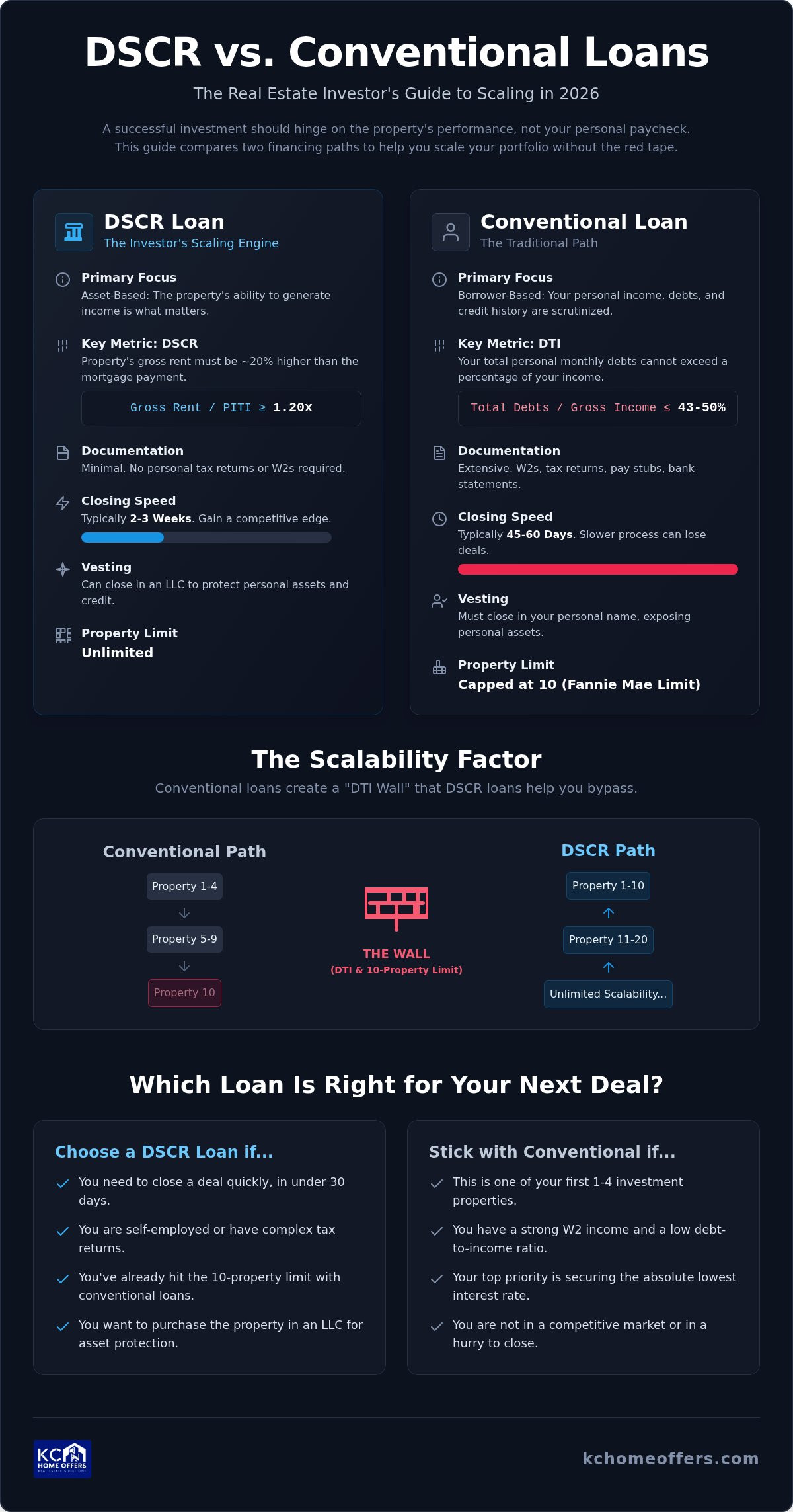
Conventional loans remain the primary choice for cost. If you are a Tier 1 borrower with a steady W2 job and low personal debt, you'll find the lowest interest rates here. However, the trade-offs are rigid. Most conventional lenders enforce a strict DTI limit between 43% and 50%. Once your personal debt, combined with your existing mortgage payments, hits that ceiling, the bank stops lending. Additionally, federal guidelines typically cap you at ten financed properties. For an investor looking to build a legacy portfolio, these rules represent a dead end rather than a path forward.
The Investor's Alternative: The DSCR Scaling Engine
This is where the DSCR loan vs conventional loan debate becomes a matter of business strategy. DSCR loans remove the friction of personal financial disclosure. There are no tax returns to submit and no employment verification calls. The lender focuses on the asset's cash flow. If the property generates enough rent to cover the debt, you qualify. This allows for unlimited scalability. You can close deals in the name of an LLC, protecting your personal credit and allowing your business to grow as fast as you can find profitable deals. In 2026, this speed and flexibility are what separate hobbyists from professional portfolio managers who value time as much as capital.
Side-by-Side Comparison: DSCR vs Conventional Loan Requirements
Choosing between a DSCR loan vs conventional loan requires a clear look at the specific underwriting hurdles you'll face. While conventional mortgage loans often offer slightly lower interest rates, they demand a level of personal transparency that many professional investors find intrusive. Both products typically require a minimum credit score of 620, but that is where the similarities end. In the 2026 market, the "hassle factor" of a conventional loan includes weeks of verifying every aspect of your financial life, whereas a DSCR lender focuses almost exclusively on the property's income potential.
The down payment requirements also differ based on your strategy. Conventional investment loans usually require between 15% and 25% down. DSCR loans typically sit in the 20% to 25% range. The most significant gap, however, is speed. A conventional bank often takes 45 to 60 days to navigate their internal bureaucracy. A specialized investor lender can often fund a DSCR deal in two to three weeks. In a market where the best deals are gone in days, that time difference is often the margin between a winning bid and a lost opportunity.
Financial Metrics: DTI vs DSCR Ratio
The core of the DSCR loan vs conventional loan debate lies in how the lender calculates risk. Conventional underwriting relies on your Debt-to-Income (DTI) ratio. This is a backward-looking metric that tallies your personal debts against your historical income. Ironically, a debt-free investor with high cash reserves might fail a DTI test if their tax returns show heavy depreciation or business write-offs. DSCR lenders ignore your personal tax returns. They use a forward-looking ratio, typically requiring a 1.2x coverage, meaning the property's gross rent must be 20% higher than the total mortgage payment. This shift in focus allows you to qualify based on the asset's performance rather than your personal paycheck.
Loan Terms and Flexibility
Flexibility is the primary driver for professional portfolio growth. Conventional loans generally forbid you from closing in an LLC, forcing you to hold title in your own name and exposing your personal assets to liability. DSCR loans are designed for LLC ownership from day one. You'll also find interest-only options widely available in the DSCR space, which can significantly boost monthly cash flow. While DSCR loans often include prepayment penalties, many investors find this a fair trade for the ability to scale without limits. If you're ready to bypass traditional bank delays, reviewing our investor-focused loan products can give you a clear advantage in a competitive market.
The Scalability Factor: When Conventional Loans Hit the Wall
Scaling a rental portfolio requires more than just finding good deals; it requires a financing strategy that doesn't penalize your growth. Most investors begin with conventional mortgages to capture low rates, but they eventually reach a hard ceiling. Fannie Mae and Freddie Mac guidelines typically cap a single borrower at ten financed properties. Once you hit this limit, traditional banks view you as a high-risk liability rather than a successful entrepreneur. This is the moment the DSCR loan vs conventional loan debate shifts from interest rates to survival.
The DTI Wall is the point where personal income can no longer support additional leverage. Even if your properties are cash-flowing well, a conventional lender's strict debt-to-income calculations often fail to account for the full reality of an investor's balance sheet. Your success in acquiring assets becomes the very thing that prevents you from getting another loan. DSCR loans provide the necessary "Portfolio Solution" because they are business-purpose loans. They look at the asset's performance, allowing you to scale to 20, 50, or 100 properties without ever looking at your personal W2 income again.
Closing in an LLC for Asset Protection
Professional investors prioritize asset protection to insulate their personal wealth from property-related liabilities. Conventional lenders almost universally require you to hold the title in your personal name, which creates a significant legal exposure. In contrast, DSCR loans are built for the modern investor's legal and tax strategies. They allow you to close directly in an LLC, providing a clear separation between your personal life and your business assets. This structure isn't just about safety; it's about building a professional enterprise that can be easily managed and eventually exited.
Speed as a Competitive Advantage
In the fast-moving 2026 market, the ability to close quickly is often more valuable than a slightly lower interest rate. Conventional underwriting is notoriously slow, often taking 45 days or more to navigate through committees. This delay can cost you off-market deals or distressed properties that require a quick turnaround. For those dealing with properties that need immediate attention or unique financing structures, understanding Hard Money Loans: 2026 Guide to Asset-Based Lending can provide additional perspective on how speed wins deals. While a DSCR loan vs conventional loan comparison usually focuses on long-term holds, the streamlined approval process of DSCR capital ensures you don't lose the deal while waiting for a traditional bank's red tape to clear.
Strategic Decision: Which Loan is Right for Your Next Deal?
Deciding between a DSCR loan vs conventional loan depends on your current portfolio size and your specific tax structure. Opt for conventional financing if you have a high W2 income, low personal debt, and are targeting your first few properties. The lower interest rate is a clear benefit when you can easily meet the bank's documentation demands. However, prioritize a DSCR loan if you are self-employed, have complex tax returns with heavy depreciation, or want to close in an LLC for privacy. Many professional investors utilize a hybrid strategy. They secure conventional mortgages for their first four properties to lock in the lowest rates, then pivot to DSCR for the next forty doors to maintain momentum.
Calculating the ROI requires looking past the interest rate. Does a 1% or 2% higher rate matter if the property still cash flows and you can close the deal in 14 days? If the asset supports the debt and meets your cash-on-cash return goals, the financing is simply a tool to secure the asset. In the 2026 market, cash flow remains king, and the "cheapest" loan is the one that actually gets you to the closing table.
The Cost of Capital vs. The Cost of Opportunity
Successful investors analyze the spread between these two products as a cost of doing business. While a conventional mortgage might save you a few hundred dollars a month, the opportunity cost of a 60-day closing window can be thousands in lost rent or missed off-market deals. If a DSCR loan allows you to close three deals in the time it takes to close one conventional loan, the speed justifies the capital cost. For a deeper dive into these metrics, see our DSCR Loans: The 2026 Investor Guide to Scaling.
Exit Strategies and Refinancing
Your exit strategy often dictates your choice. DSCR products are the ideal "Buy and Hold" vehicle for the final phase of a BRRRR (Buy, Rehab, Rent, Refinance, Repeat) strategy. They allow you to refinance out of high-interest bridge or hard money debt into a stable, long-term product without the DTI hurdles that stop conventional banks. You can learn more about these transitions in our Real Estate Investment Loans: The 2026 Investor’s Guide. If you are ready to stop fighting with traditional banks and start scaling, view our competitive DSCR terms to see how much your next property can support.
Scale Your Portfolio with KC Home Offers
Choosing the right financing is the most critical hurdle in your acquisition strategy. At KC Home Offers LLC, we don't just act as a lender; we operate as a strategic ally for investors who are ready to move fast. Our approach is built on transparency and a deep understanding of the 2026 real estate market. While traditional institutions are bogged down by red tape, we provide a streamlined path to capital that prioritizes your results and your time. We've designed our DSCR terms to support growth, ensuring that your decision in the DSCR loan vs conventional loan comparison leads to actual property ownership rather than endless paperwork.
Traditional corporate banking often feels cold and detached. You aren't just a loan number to us; you are a partner in a high-stakes market. We understand that in 2026, market dynamics shift quickly. A delay of even a few days can mean the difference between a successful cash-out refinance and a missed opportunity. Our momentum-driven workflow is designed to match the speed of professional real estate. We provide the professional authority of a large-scale firm with the accessibility of a local innovator, offering a level of integrity that big banks simply cannot replicate. When you work with us, you're gaining a teammate who values your portfolio's health as much as you do.
Expertise You Can Trust
Our leadership team, Ashley and Aspen, are active investors themselves. They know the frustration of losing a deal to a slow bank or a rigid underwriter. This first-hand experience drives our commitment to a partnership model that respects your goals. We offer tailored solutions for DSCR, Fix & Flip, and New Construction loans, providing the flexibility needed for complex investment scenarios. Our process removes the friction typically found in private finance, allowing you to focus on finding the next asset while we handle the capital. We assume a high level of professional literacy from our clients, and we meet that with technical expertise that ensures your DSCR loan vs conventional loan strategy is executed flawlessly.
Ready to Move? Your Next Deal Starts Here
Whether you're looking to refinance your fourth property or fund your fiftieth, our national reach ensures you have consistent access to capital. We eliminate the W2 requirements and tax return scrutiny that stall traditional mortgages. By focusing on the asset's performance, we help you bypass the DTI limits and property caps that stop most investors in their tracks. It's time to treat your rental portfolio like the business it is. You don't need another bank; you need a strategic partner who follows through on commitments. Get Your DSCR Loan Quote from KC Home Offers LLC today and see how fast your portfolio can grow when you have the right team behind you.
Master Your Financial Strategy for 2026
The decision between a DSCR loan vs conventional loan isn't about finding the lowest interest rate; it's about identifying the right tool for your specific stage of growth. Conventional mortgages serve as an excellent entry point for new investors, but they eventually create a bottleneck that slows momentum. Professional portfolio managers recognize that the speed, LLC flexibility, and removal of personal documentation requirements are what allow for true scalability in a stabilizing market.
You deserve a financing partner that understands the nuances of complex deals and moves as fast as you do. With our national lending expertise and fast, investor-focused approvals, we remove the friction that traditional banks create. Because we require no personal income verification, your tax returns will never be the reason you miss an opportunity. Don't let DTI limits stop your expansion. Scale Your Portfolio with a DSCR Loan from KC Home Offers and secure the capital you need to dominate your market. Your next deal is waiting.
Frequently Asked Questions
Is a DSCR loan better than a conventional loan for rental property?
A DSCR loan is often superior for investors prioritizing growth and asset protection, while conventional loans are better for those seeking the absolute lowest interest rate. If you value closing speed and the ability to scale without debt-to-income limits, the DSCR path wins. However, if you're a hobbyist with only one or two properties and a high W2 income, the lower cost of a conventional mortgage might outweigh the flexibility of investor-focused capital.
Do DSCR loans have higher interest rates than conventional mortgages?
Yes, DSCR loans generally carry interest rates 0.5% to 1.0% higher than conventional investment mortgages. In the 2026 market, domestic investors typically see DSCR rates between 6.12% and 8.00%. While the capital is more expensive, professional investors view this as a necessary business expense for the ability to bypass tax return verification. The DSCR loan vs conventional loan cost difference is often offset by the speed of acquiring more high-performing assets.
Can I get a DSCR loan with a 620 credit score?
You can typically secure a DSCR loan with a 620 credit score, though many lenders prefer a 660 or higher for the best terms. While conventional loans also have a 620 minimum, their underwriting is much stricter regarding your overall debt profile. In the DSCR space, a lower score might result in a slightly lower loan-to-value ratio, but the property's cash flow remains the primary qualifying factor rather than your personal credit history alone.
How much down payment is required for a DSCR loan vs conventional?
Down payment requirements for a DSCR loan usually range from 20% to 25% of the purchase price. Conventional loans for investment properties can sometimes go as low as 15%, though 20% to 25% is more common to avoid high costs. The primary advantage of the DSCR model isn't the size of the down payment, but the removal of personal income scrutiny that often stops conventional deals from reaching the closing table in 2026.
Can I close a conventional loan in the name of an LLC?
Conventional loans generally require you to hold the title in your personal name, making it difficult to close directly in an LLC. Most lenders following federal guidelines forbid business-entity ownership at the time of closing. DSCR loans are specifically designed for business entities. They allow you to close in an LLC from day one, which is essential for investors who prioritize asset protection and want to keep their personal and professional finances separate.
Does a DSCR loan show up on my personal credit report?
Most DSCR loans don't appear on your personal credit report because they're business-purpose loans issued to an LLC. While the lender will perform a credit pull to verify your score, the debt itself is tied to the business entity. This is a massive advantage for the DSCR loan vs conventional loan comparison, as it keeps your personal debt-to-income ratio clean, allowing you to qualify for other personal financing like a primary residence mortgage.
What happens if the property's DSCR ratio is below 1.0?
If a property's ratio falls below 1.0, it means the rental income doesn't cover the full mortgage payment. While most lenders require a 1.2x ratio, some "no-ratio" DSCR programs exist for properties with high appreciation potential or distressed assets. However, these often require a larger down payment or higher interest rates. It's usually better to look for assets that meet the coverage requirements to ensure your portfolio remains healthy and self-sustaining.
How many properties can I finance using DSCR loans?
There is no limit to the number of properties you can finance using DSCR loans. This is the primary reason professional investors switch to this product after hitting the ten-property cap imposed by conventional lenders. Because each loan is underwritten based on the individual asset's performance, your portfolio can grow to 50 or 100 units without your personal income ever becoming a bottleneck. It's the ultimate tool for long-term scalability and wealth building.
Frequently asked
Is a DSCR loan better than a conventional loan for rental property?
A DSCR loan is often superior for investors prioritizing growth and asset protection, while conventional loans are better for those seeking the absolute lowest interest rate. If you value closing speed and the ability to scale without debt-to-income limits, the DSCR path wins. However, if you're a hobbyist with only one or two properties and a high W2 income, the lower cost of a conventional mortgage might outweigh the flexibility of investor-focused capital.
Do DSCR loans have higher interest rates than conventional mortgages?
Yes, DSCR loans generally carry interest rates 0.5% to 1.0% higher than conventional investment mortgages. In the 2026 market, domestic investors typically see DSCR rates between 6.12% and 8.00%. While the capital is more expensive, professional investors view this as a necessary business expense for the ability to bypass tax return verification. The DSCR loan vs conventional loan cost difference is often offset by the speed of acquiring more high-performing assets.
Can I get a DSCR loan with a 620 credit score?
You can typically secure a DSCR loan with a 620 credit score, though many lenders prefer a 660 or higher for the best terms. While conventional loans also have a 620 minimum, their underwriting is much stricter regarding your overall debt profile. In the DSCR space, a lower score might result in a slightly lower loan-to-value ratio, but the property's cash flow remains the primary qualifying factor rather than your personal credit history alone.
How much down payment is required for a DSCR loan vs conventional?
Down payment requirements for a DSCR loan usually range from 20% to 25% of the purchase price. Conventional loans for investment properties can sometimes go as low as 15%, though 20% to 25% is more common to avoid high costs. The primary advantage of the DSCR model isn't the size of the down payment, but the removal of personal income scrutiny that often stops conventional deals from reaching the closing table in 2026.
Can I close a conventional loan in the name of an LLC?
Conventional loans generally require you to hold the title in your personal name, making it difficult to close directly in an LLC. Most lenders following federal guidelines forbid business-entity ownership at the time of closing. DSCR loans are specifically designed for business entities. They allow you to close in an LLC from day one, which is essential for investors who prioritize asset protection and want to keep their personal and professional finances separate.
Does a DSCR loan show up on my personal credit report?
Most DSCR loans don't appear on your personal credit report because they're business-purpose loans issued to an LLC. While the lender will perform a credit pull to verify your score, the debt itself is tied to the business entity. This is a massive advantage for the DSCR loan vs conventional loan comparison, as it keeps your personal debt-to-income ratio clean, allowing you to qualify for other personal financing like a primary residence mortgage.
What happens if the property's DSCR ratio is below 1.0?
If a property's ratio falls below 1.0, it means the rental income doesn't cover the full mortgage payment. While most lenders require a 1.2x ratio, some "no-ratio" DSCR programs exist for properties with high appreciation potential or distressed assets. However, these often require a larger down payment or higher interest rates. It's usually better to look for assets that meet the coverage requirements to ensure your portfolio remains healthy and self-sustaining.
How many properties can I finance using DSCR loans?
There is no limit to the number of properties you can finance using DSCR loans. This is the primary reason professional investors switch to this product after hitting the ten-property cap imposed by conventional lenders. Because each loan is underwritten based on the individual asset's performance, your portfolio can grow to 50 or 100 units without your personal income ever becoming a bottleneck. It's the ultimate tool for long-term scalability and wealth building.
Need financing on a deal like this?
DSCR, fix & flip and new construction loans, underwritten on the deal rather than your tax returns. Soft credit pull only.
Apply in 5 minutes