Guides › Private lending
DSCR Loan Prepayment Penalty: The 2026 Investor Guide to Costs and Strategy

Master the DSCR loan prepayment penalty in 2026. Learn step-down structures, yield maintenance, and strategies to protect your rental portfolio ROI.
The DSCR loan prepayment penalty isn't just a hidden cost designed to drain your equity, but rather a strategic lever you can pull to secure a lower cost of capital. Many investors view these fees with a sense of dread, fearing they'll be locked into a high rate while the rest of the market shifts. It's frustrating to watch your potential profit evaporate during a property sale because the math behind yield maintenance feels like an unsolvable puzzle. You've worked hard to build your portfolio, and the last thing you need is a fee structure that stalls your momentum or limits your flexibility.
At KC Home Offers LLC, we believe transparency is the foundation of a successful partnership. In this 2026 guide, you'll master the mechanics of these penalties so you can protect your exit strategy and maximize your rental portfolio's ROI. We'll break down the differences between standard step-down structures and complex yield maintenance formulas, giving you the tools to choose a penalty term that aligns with your five-year plan. You'll learn how to negotiate for lower interest rates by accepting a fair penalty that fits your specific timeline. It's time to stop fearing the fine print and start using it to your advantage.
Key Takeaways
- Decode common "step-down" fee structures to accurately forecast your potential exit costs throughout the entire loan lifecycle.
- Balance the DSCR loan prepayment penalty against your interest rate to determine when a longer lock-in period actually maximizes your total ROI.
- Differentiate between "hard" and "soft" penalties to ensure your ability to sell the property remains unhindered by excessive equity loss.
- Learn how to request "buy-down" quotes that trade a slightly higher interest rate for a shorter, more flexible penalty window.
- Partner with transparent lenders who help you model these financial outcomes and exit strategies before you sign the closing documents.
Table of Contents
- What is a DSCR Loan Prepayment Penalty and Why Does It Exist?
- Common DSCR Prepayment Penalty Structures (5-4-3-2-1 vs. 3-2-1)
- The Strategic Trade-off: Interest Rate vs. Penalty Length
- How to Negotiate or Avoid the DSCR Prepayment Penalty
- Transparency and Speed: The KC Home Offers Advantage
What is a DSCR Loan Prepayment Penalty and Why Does It Exist?
A DSCR loan prepayment penalty is a contractual fee charged to an investor if they pay off their loan balance before a predetermined timeframe. This fee protects the lender's anticipated interest income by ensuring a minimum return on the capital they've deployed. While conventional home loans rarely include these terms; they are standard in the sector of private investment finance. Essentially; a prepayment penalty serves as a protective measure for the lender's expected interest income.
The Role of the Secondary Market
DSCR loans operate in a different financial ecosystem than standard residential mortgages. Most DSCR lenders don't hold these loans on their own books for 30 years. They package them. They sell them to institutional investors. These institutional buyers demand a predictable yield to manage their own portfolios. If you pay off your loan early; it disrupts their financial modeling and reduces their total return. This is why lenders insist on yield maintenance or step-down penalties. It allows them to offer you more competitive initial rates because they have a guaranteed window of interest collection. Without these protections; the secondary market for DSCR debt would shrink; leading to much higher rates for every investor.
Hard vs. Soft Penalties: What Investors Need to Know
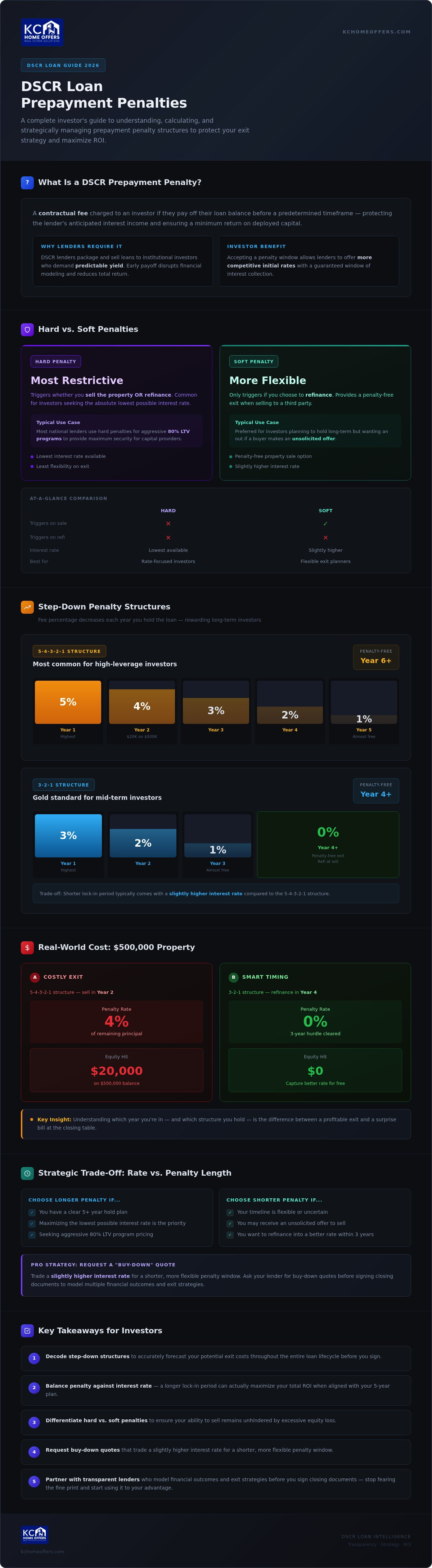
In 2026; high-leverage DSCR products typically come with one of two penalty types. Understanding the specific mechanics of your DSCR loan prepayment penalty is the difference between a profitable exit and a surprise bill at the closing table. You'll usually encounter these two variations:
- Hard Penalty: This is the most restrictive version. It triggers whether you sell the property or simply try to refinance into a better rate. This structure is common for investors seeking the absolute lowest possible interest rate.
- Soft Penalty: This version only triggers if you choose to refinance. It provides a "penalty-free" exit if you decide to sell the asset to a third party. While a soft penalty offers more flexibility; it often comes with a slightly higher interest rate.
Most national lenders currently favor hard penalties for their most aggressive 80% LTV programs. This provides the most security for the capital providers. Investors often find themselves choosing between liquidity and cost. A hard penalty locks you in regardless of your path forward. If a sudden market shift makes selling the right move; you'll pay the fee. In contrast; soft penalties are the preferred choice for those who plan to flip to a long-term hold but want an out if a buyer makes an unsolicited offer. We prioritize transparency here. We'll always show you the math on both options so you can scale your portfolio with confidence.
Common DSCR Prepayment Penalty Structures (5-4-3-2-1 vs. 3-2-1)
The majority of DSCR loans utilize a "step-down" structure. This model is designed to be more palatable for long-term holders by reducing the fee percentage for every year you keep the loan active. Unlike a fixed penalty; which might charge a flat 5% for five consecutive years; the step-down approach acknowledges that your intent to hold the asset increases over time. Understanding these layers is vital because your DSCR loan prepayment penalty directly impacts your net proceeds at the time of sale or refinance.
The "5-4-3-2-1" structure is the most frequent choice for high-leverage investors. In this scenario; you'd pay a 5% fee in the first year; 4% in the second; and so on until the fee disappears in year six. Conversely; the "3-2-1" structure has become the gold standard for mid-term investors. It offers a shorter lock-in period; typically in exchange for a slightly higher interest rate. While fixed penalties like "5% for 5 years" still exist; they're generally reserved for the most aggressive pricing tiers where the lender needs maximum yield protection.
Calculating the Real-World Cost
Calculating the real-world cost of a DSCR loan prepayment penalty requires looking at your principal balance. Let's look at how these numbers play out on a $500,000 property. If you choose a 5-4-3-2-1 structure and decide to sell in year two; your penalty is 4% of the remaining principal. On a $500,000 balance; that's a $20,000 hit to your equity. In Scenario B; refinancing that same property in year four with a 3-2-1 structure means you've already cleared the three-year hurdle. Your penalty is non-existent; allowing you to capture a better rate for free. You can model these exit scenarios with us before signing to ensure the math aligns with your portfolio goals.
Prepayment Windows and Expiration
The moment your penalty period expires; you enter the "Open" period. This is the sweet spot for investors looking to harvest equity or pivot to a lower rate. In 2026; we see a growing trend of investors prioritizing no-penalty windows after year three. This provides the flexibility to respond to market shifts without losing six figures in fees. Always verify these terms in your "Prepayment Rider." This specific document overrides the general language in the note. The prepayment penalty rules outlined by federal regulators ensure that these terms must be clearly disclosed to you upfront. Don't gloss over this rider; it dictates your freedom to move your capital as you see fit.
The Strategic Trade-off: Interest Rate vs. Penalty Length
The relationship between your interest rate and your DSCR loan prepayment penalty is fundamentally inverse. Lenders price risk and yield based on time. When you commit to a longer penalty period; you're providing the lender with a guaranteed window of interest income. In exchange; they are typically willing to offer a lower interest rate. This isn't just a fee; it's a financial instrument you can use to "buy" a better cap rate through reduced financing costs. Understanding the prepayment penalty structure is the first step in deciding if the immediate cash flow gains outweigh the loss of future flexibility.
Determining if a 0.25% rate reduction justifies a 5-year lock-in requires a cold look at the math. On a $500,000 loan; that quarter-point reduction saves you roughly $1,250 annually. Over five years; that's $6,250 in total savings. However; a 5% penalty in the first year would cost you $25,000. If there's even a 20% chance you'll need to sell or refinance early; the higher rate might actually be the cheaper option. We help our partners model these numbers upfront so there are no surprises when market conditions shift.
Exit Strategy Alignment
Your choice must align with your 2026-2030 portfolio goals. For a Buy-and-Hold strategy; a five-year penalty is rarely a hurdle. You intend to cash flow the property for a decade; so the lower rate simply compounds your ROI over time. Conversely; if you're executing a BRRRR strategy; a 1-year or 0-year penalty is essential. The "Refinance" step of BRRRR requires you to exit the initial loan quickly to capture the forced equity. Paying a heavy DSCR loan prepayment penalty would cannibalize your profits before you even get to the next deal.
Impact on the Debt Service Coverage Ratio
A lower interest rate doesn't just save money; it helps you qualify. Since the DSCR is calculated by dividing net operating income by the debt service; any reduction in your monthly payment improves the ratio. Using a longer penalty to secure a lower rate can be the difference between a "1.10" ratio that fails and a "1.25" ratio that gets funded. For more on these calculations; check out our guide on DSCR Loan: Financing Rental Properties Based on Income. Balancing your immediate cash flow requirements with your need for future exit flexibility is the hallmark of a seasoned investor.
How to Negotiate or Avoid the DSCR Prepayment Penalty
Investors often assume loan terms are set in stone. They aren't. While secondary market demands make some form of yield protection necessary; you have leverage. Start by asking for a "buy-down" quote. This is a direct trade where you accept a slightly higher interest rate in exchange for a shorter penalty window. It's a pragmatic way to buy flexibility if you expect to sell within 24 months. If the math shows your projected profit on a sale outweighs the extra interest expense; the buy-down is a winning move.
Next; push for a "soft" penalty. As we established earlier; a soft penalty only triggers on a refinance; leaving your exit through a sale untouched. You should also scrutinize the math behind the fee. A "declining balance" structure is far more predictable than "yield maintenance" clauses; which can fluctuate based on market treasury yields. Finally; check for standard exceptions. Most professional contracts include waivers for natural disasters or condemnation; ensuring you aren't penalized for events outside your control. Reviewing the "Prepayment Clause" for these specific carve-outs is a standard practice for seasoned pros.
The Cost of a 'No-Penalty' DSCR Loan
Eliminating the DSCR loan prepayment penalty entirely is possible; but it comes with a price. Typically; a 0-year penalty requires a rate premium. You might also choose to pay "points" upfront to buy out the penalty period. This is often a wise move for high-velocity investors who want to keep their options open. Even with a no-penalty agreement; be prepared for a 1-year "lock-out" period. Most institutional lenders won't allow a payoff within the first 12 months simply to cover their administrative and origination costs. If you plan to hold for less than a year; a fix and flip loan is likely a better fit than a DSCR product.
Refinancing Within the Same Lender
Your current lender is often your best ally for negotiation. If you have a growing portfolio; use that scale as leverage. Lenders value "retention." They'd often rather waive a portion of the prepayment premium to keep your business than lose the entire loan to a competitor. In 2026; many national firms offer "retention waivers" where they reduce the penalty if you refinance into another one of their products. This keeps your capital working while lowering your friction costs. It's about building a partnership; not just a transaction. Ready to see how these numbers impact your next deal? Get a transparent DSCR loan quote today and model your exit strategy with us.
Transparency and Speed: The KC Home Offers Advantage
Transparency is the bedrock of any successful real estate partnership. We understand that investors need more than just a capital source; they need a strategic ally who clarifies the fine print before the closing date. Many lenders bury the specifics of a DSCR loan prepayment penalty in the back of a dense document. We take the opposite approach. We help you model your exit strategies in real time, comparing different penalty durations against your projected interest savings. This ensures your capital isn't trapped when a high-value exit opportunity arises in the fast-paced 2026 market.
In a competitive landscape, momentum is everything. Our streamlined underwriting process prioritizes speed without sacrificing the thoroughness your portfolio requires. Whether you're looking for a long-term hold or a bridge solution for a short-term flip, our products are customized to match your specific timeline. We provide the clarity you need to move with confidence. By explaining the math upfront, we remove the friction that often stalls ambitious scaling plans.
Investor-First Financing Solutions
Our approach removes the friction of traditional banking. We don't require W2s or personal income verification. Instead, we focus entirely on the property's ability to generate revenue. This allows you to scale your portfolio across state lines using our national coverage. For a deeper look at the specific criteria we use, explore our guide on What is a DSCR Loan?. We prioritize the performance of the asset, giving you the freedom to grow without the constraints of personal debt-to-income ratios.
Ready to Scale Your Portfolio?
Choosing the right financing partner means finding a "straight shooter" who values your time. At KC Home Offers LLC, we don't hide fees or surprise you with complex yield maintenance calculations at the last minute. You deserve a custom quote that lays out every transparent penalty option available for your deal. Our goal is to help you build a resilient rental portfolio that maximizes ROI while maintaining the flexibility to pivot when the market demands it. It's time to work with a lender who understands the practical realities of property deals and market dynamics. Get a transparent DSCR loan quote from KC Home Offers LLC today and secure the capital you need to dominate your market.
Strategic Scaling with Confidence
Mastering the DSCR loan prepayment penalty transforms a perceived obstacle into a powerful financing tool. By aligning your exit strategy with the right fee structure; you protect your equity while securing the lowest possible cost of capital. Whether you choose a step-down model for a long-term hold or a shorter window for a BRRRR project; the math must always serve your bottom line. We provide specialized capital for active investors who need fast approvals and transparent; no-fluff loan terms. Our team specializes in non-QM and investor-focused capital; focusing on property performance rather than personal income verification. You don't have to navigate complex private finance alone. We're here to act as your strategic ally; providing the expert guidance necessary to dominate the 2026 market.
Secure Your Next Rental with a Transparent DSCR Loan from KC Home Offers
Let's build your portfolio together.
Frequently Asked Questions
Can I pay off a DSCR loan early without a penalty?
Yes, you can secure a no-penalty loan, but it usually requires paying a higher interest rate or upfront points to buy out the penalty period. Most lenders also enforce a 12 month lock-out period to cover their initial administrative costs. If you need a zero penalty exit within the first year, a fix and flip loan is often a more suitable financial product than a long term DSCR loan.
Is the prepayment penalty tax-deductible for rental property owners?
The IRS generally allows you to deduct prepayment penalties as a business expense for investment properties. Since these fees are considered a cost of doing business or a form of interest, they can often be written off in the year they are paid. You should always consult with a qualified tax professional to confirm how this deduction applies to your specific portfolio and 2026 tax filings.
What is the difference between yield maintenance and a step-down penalty?
Yield maintenance is a complex formula that ensures the lender receives the same return they would have earned if you made all scheduled payments. It fluctuates based on current treasury yields. A step-down penalty is a fixed percentage that decreases every year, such as a 5-4-3-2-1 structure. Step-down penalties are much easier for investors to model when calculating their potential DSCR loan prepayment penalty during an exit.
Can I negotiate a 5-4-3-2-1 penalty down to a 3-2-1?
You can often negotiate the length of the penalty by accepting a slightly higher interest rate. Lenders view the penalty as a trade-off for yield security. If you have a strong track record or a high-performing property, you have more leverage to request a shorter 3-2-1 window. This flexibility allows you to align the loan terms with your specific five year investment plan and portfolio goals.
Does the prepayment penalty apply if the property is destroyed by a fire?
Most professional DSCR loan agreements include exceptions for involuntary payoffs caused by natural disasters or condemnation. If insurance proceeds are used to pay off the balance after a total loss, the lender usually waives the fee. You must verify this in the Prepayment Rider of your specific contract. Standard investor-focused capital providers include these protections to ensure you aren't penalized for events outside your control.
What happens to the penalty if I sell the property to another investor?
If you have a hard penalty, the fee triggers regardless of whether you sell or refinance the asset. If you have a soft penalty, you can sell the property to another investor without paying the fee, as it only applies to refinancing. Understanding this distinction is vital for investors who might want to capitalize on a market upswing by selling their property before the penalty window expires.
How do I find the prepayment penalty details in my loan documents?
You'll find these specifics in a document called the Prepayment Rider or within the Promissory Note itself. This section clearly outlines the DSCR loan prepayment penalty structure, the duration of the lock-in period, and any specific exceptions. We prioritize transparency, so we always highlight these terms upfront. Reviewing these documents with your legal counsel ensures you understand your exit costs before you sign at the closing table.
Is it better to have a higher interest rate or a longer prepayment penalty?
It depends on your intended hold time. If you plan to keep the property for ten years, a longer penalty is a smart trade for a lower interest rate that compounds your ROI. However, if you intend to sell or refinance within three years, paying a slightly higher rate is better than losing six figures in equity to a penalty. We help you model these scenarios to ensure your financing matches your strategy.
Frequently asked
Ready to Scale Your Portfolio?
Choosing the right financing partner means finding a "straight shooter" who values your time. We don't hide fees or surprise you with complex yield maintenance calculations at the last minute. You deserve a custom quote that lays out every transparent penalty option available for your deal. Our goal is to help you build a resilient rental portfolio that maximizes ROI while maintaining the flexibility to pivot when the market demands it. It's time to work with a lender who understands the practical realities of property deals and market dynamics. Get a transparent DSCR loan quote from KC Home Offers today and secure the capital you need to dominate your market. Mastering the DSCR loan prepayment penalty transforms a perceived obstacle into a powerful financing tool. By aligning your exit strategy with the right fee structure; you protect your equity while securing the lowest possible cost of capital. Whether you choose a step-down model for a long-term hold or a shorter window for a BRRRR project; the math must always serve your bottom line. We provide specialized capital for active investors who need fast approvals and transparent; no-fluff loan terms. Our team specializes in non-QM and investor-focused capital; focusing on property performance rather than personal income verification. You don't have to navigate complex private finance alone. We're here to act as your strategic ally; providing the expert guidance necessary to dominate the 2026 market. Secure Your Next Rental with a Transparent DSCR Loan from KC Home Offers Let's build your portfolio together.
Can I pay off a DSCR loan early without a penalty?
Yes, you can secure a no-penalty loan, but it usually requires paying a higher interest rate or upfront points to buy out the penalty period. Most lenders also enforce a 12 month lock-out period to cover their initial administrative costs. If you need a zero penalty exit within the first year, a fix and flip loan is often a more suitable financial product than a long term DSCR loan.
Is the prepayment penalty tax-deductible for rental property owners?
The IRS generally allows you to deduct prepayment penalties as a business expense for investment properties. Since these fees are considered a cost of doing business or a form of interest, they can often be written off in the year they are paid. You should always consult with a qualified tax professional to confirm how this deduction applies to your specific portfolio and 2026 tax filings.
What is the difference between yield maintenance and a step-down penalty?
Yield maintenance is a complex formula that ensures the lender receives the same return they would have earned if you made all scheduled payments. It fluctuates based on current treasury yields. A step-down penalty is a fixed percentage that decreases every year, such as a 5-4-3-2-1 structure. Step-down penalties are much easier for investors to model when calculating their potential DSCR loan prepayment penalty during an exit.
Can I negotiate a 5-4-3-2-1 penalty down to a 3-2-1?
You can often negotiate the length of the penalty by accepting a slightly higher interest rate. Lenders view the penalty as a trade-off for yield security. If you have a strong track record or a high-performing property, you have more leverage to request a shorter 3-2-1 window. This flexibility allows you to align the loan terms with your specific five year investment plan and portfolio goals.
Does the prepayment penalty apply if the property is destroyed by a fire?
Most professional DSCR loan agreements include exceptions for involuntary payoffs caused by natural disasters or condemnation. If insurance proceeds are used to pay off the balance after a total loss, the lender usually waives the fee. You must verify this in the Prepayment Rider of your specific contract. Standard investor-focused capital providers include these protections to ensure you aren't penalized for events outside your control.
What happens to the penalty if I sell the property to another investor?
If you have a hard penalty, the fee triggers regardless of whether you sell or refinance the asset. If you have a soft penalty, you can sell the property to another investor without paying the fee, as it only applies to refinancing. Understanding this distinction is vital for investors who might want to capitalize on a market upswing by selling their property before the penalty window expires.
How do I find the prepayment penalty details in my loan documents?
You'll find these specifics in a document called the Prepayment Rider or within the Promissory Note itself. This section clearly outlines the DSCR loan prepayment penalty structure, the duration of the lock-in period, and any specific exceptions. We prioritize transparency, so we always highlight these terms upfront. Reviewing these documents with your legal counsel ensures you understand your exit costs before you sign at the closing table.
Is it better to have a higher interest rate or a longer prepayment penalty?
It depends on your intended hold time. If you plan to keep the property for ten years, a longer penalty is a smart trade for a lower interest rate that compounds your ROI. However, if you intend to sell or refinance within three years, paying a slightly higher rate is better than losing six figures in equity to a penalty. We help you model these scenarios to ensure your financing matches your strategy.
Need financing on a deal like this?
DSCR, fix & flip and new construction loans, underwritten on the deal rather than your tax returns. Soft credit pull only.
Apply in 5 minutes