Guides › Private lending
DSCR Cash-Out Refinance: The 2026 Strategy for Scaling Investment Portfolios

Unlock lazy equity with a DSCR cash-out refinance. Bypass personal DTI hurdles, tap tax-free capital, and strategically scale your rental portfolio in 2026.
Your rental property’s equity is a stagnant asset until you decide to move it. In a market where speed defines the winner, sitting on "lazy equity" is the fastest way to stall your growth. You’ve likely hit the wall with traditional banks that obsess over your personal debt-to-income ratio. It’s frustrating to have a high-performing asset but be told you don’t qualify for more capital simply because of what’s on your personal tax returns. You need a way to keep your momentum without the friction of conventional underwriting.
This guide explains how a DSCR cash-out refinance allows you to bypass personal income hurdles and unlock tax-free liquidity based solely on your property’s performance. You’ll learn why this non-QM strategy is the superior choice for investors who value efficiency over red tape. We’ll explore the mechanics of leveraging property cash flow to fund your next acquisition and how to maintain a healthy portfolio balance while you scale. It’s time to stop letting "lazy equity" sit idle and start using your existing assets to fuel your future deals.
Key Takeaways
- Understand how to bypass personal debt-to-income limits by qualifying for capital based on property performance rather than tax returns.
- Discover why a DSCR cash-out refinance provides a tax-free capital injection that allows you to reinvest equity without selling your assets.
- Master the debt service coverage ratio formula to see if your property meets the 1.0 to 1.2 coverage required for maximum liquidity.
- Compare the benefits of immediate lump-sum funding against traditional lines of credit to decide which tool better serves your 2026 goals.
- Identify essential eligibility requirements, including credit score benchmarks and documentation needs, to ensure a streamlined approval process.
Table of Contents
- What is a DSCR Cash-Out Refinance and How Does it Build Wealth?
- The Mechanics of DSCR: Calculating Your Cash-Out Potential
- DSCR Cash-Out vs. Investment Property Line of Credit: Which is Better?
- Eligibility Checklist: Preparing for a DSCR Cash-Out Refinance
- Scaling Your Portfolio with KC Home Offers
What is a DSCR Cash-Out Refinance and How Does it Build Wealth?
A DSCR cash-out refinance is a non-QM (non-qualified mortgage) loan that allows real estate investors to access the equity in their rental properties without verifying personal income. Unlike traditional loans that rely on your W2 or tax returns, this product focuses on the property's ability to generate revenue. If the rental income covers the mortgage and expenses, the property qualifies. This shift in underwriting transforms your real estate from a static asset into a liquid source of capital.
Extracting equity through a refinance is a strategic wealth-building move because the proceeds are generally tax-free. When you sell a property to access cash, you're often hit with capital gains taxes and depreciation recapture. A refinance is a debt obligation, not income, meaning you can pull out six figures of liquidity and put the entire amount toward your next deal. It's the primary engine for the "Refinance" and "Repeat" stages of the BRRRR strategy, allowing you to recycle the same capital across multiple properties.
The Core Difference: Property Income vs. Personal DTI
Conventional lenders use a debt-to-income (DTI) ratio to measure your personal ability to pay back a loan. For seasoned investors, this creates a "ceiling" where even a profitable portfolio can make you look "unqualified" due to high total debt. A DSCR lender ignores your personal DTI. Instead, they calculate the debt service coverage ratio (DSCR) of the specific asset. This moves the liability away from your personal life and places the focus on the asset's performance. It's a cleaner, faster way to scale because your personal debt limits won't stop you from acquiring your tenth or twentieth property.
Why 2026 Investors Prefer Asset-Based Liquidity
Speed is the most valuable currency in the 2026 real estate market. Traditional banking processes are often too slow to keep up with competitive bidding wars or off-market opportunities. By using a DSCR cash-out refinance, you maintain full control of your original asset while gaining the liquidity needed for a down payment on a new acquisition. Many investors refer to untapped equity as "lazy equity" because it isn't working for you. Moving that capital into a new cash-flowing property compounds your returns and accelerates your portfolio's growth without the friction of selling and buying in a high-cost environment.
The Mechanics of DSCR: Calculating Your Cash-Out Potential
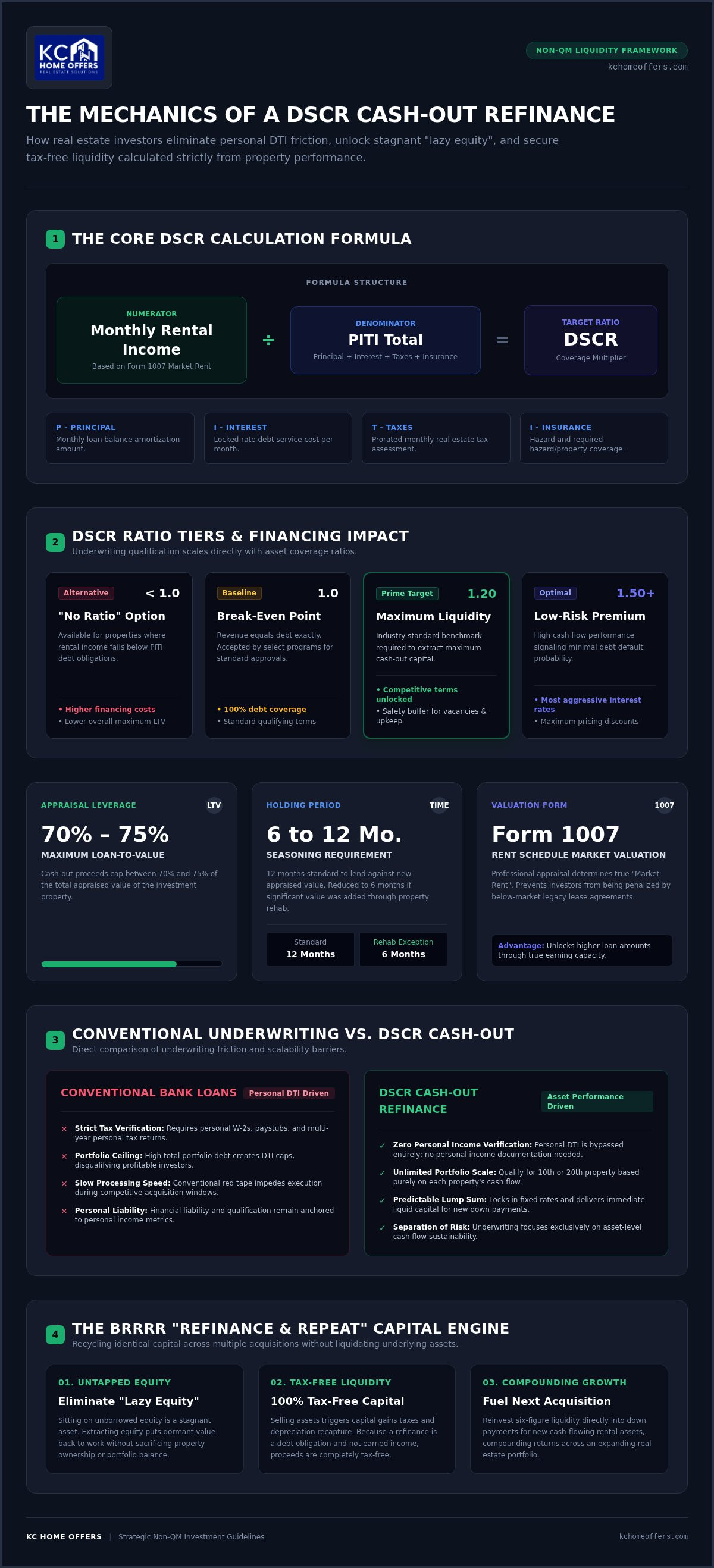
The DSCR cash-out refinance process relies on a straightforward calculation: your Monthly Rental Income divided by your PITI (Principal, Interest, Taxes, and Insurance). This ratio serves as the primary indicator of a property's ability to self-fund its own debt. Lenders look for a "magic number" to approve the loan. While some programs accept a 1.0 ratio, meaning the property breaks even, most competitive cash-out terms require a 1.2 coverage. This provides a safety net for maintenance and vacancies.
In 2026, appraisals do more than just value the bricks and mortar. Lenders use a Rent Schedule (Form 1007) to determine the "Market Rent." If your current tenant is on a legacy lease below market rates, a professional appraiser's assessment of current market potential can often help you qualify for a larger loan amount. This allows you to leverage the true earning power of the asset rather than being penalized for an outdated rental agreement.
Maximum LTV and Seasoning Requirements
LTV limits for a DSCR cash-out refinance typically cap at 70% to 75% of the appraised value. You also need to account for seasoning. Most lenders require you to own the property for at least 12 months before they will lend against the new appraised value rather than your original purchase price. If you’ve added significant value through a rehab, some lenders offer exceptions at the six-month mark. Understanding these timelines is critical for planning your next acquisition. You don't want your capital locked in a property longer than necessary.
DSCR Ratio Tiers and Interest Rate Impact
Your interest rate is directly tied to the strength of your ratio. A property with a 1.5 DSCR signals lower risk and secures more aggressive terms than one sitting at 1.1. When comparing cash-out refinances to lines of credit, remember that the refinance locks in your rate and provides a predictable lump sum. If your property doesn't quite meet the 1.0 mark, some "No Ratio" options exist, though they carry higher costs and lower LTVs. Always factor in HOA fees and property management expenses in your internal math. If you're ready to see how your specific assets stack up, our team at KC Home Offers can help you run the numbers on your current portfolio.
DSCR Cash-Out vs. Investment Property Line of Credit: Which is Better?
Choosing the right liquidity tool is a tactical decision that impacts your portfolio's long-term health. Many investors weigh a DSCR cash-out refinance against an investment property line of credit (LOC). While both tap into equity, they serve different masters. A line of credit offers a revolving door of capital, but it’s becoming increasingly scarce for non-owner-occupied properties. Most traditional banks have pulled back on rental HELOCs, making them a rare product in the current market.
A DSCR cash-out refinance provides a lump sum of capital at a fixed interest rate. This is the primary differentiator. In a shifting economy, variable rates on a line of credit can erode your margins overnight. By refinancing, you trade "lazy equity" for a predictable, long-term debt structure. This allows you to plan your next acquisition with total clarity on your monthly obligations. It also removes the personal income hurdles that often disqualify professional investors from revolving lines.
When to Choose an Investment Property Line of Credit
A line of credit is ideal if you need a revolving reserve for minor rehabs or emergency maintenance. It gives you the flexibility to draw only what you need and pay interest only on that amount during the draw period. However, the barrier to entry is high. Lenders typically demand impeccable personal credit and high W2 income to offset the risk of a non-owner-occupied line. For the investor who has already transitioned out of a traditional job, this requirement often makes the product inaccessible.
Why the DSCR Cash-Out Refinance Wins for Scaling
If your goal is aggressive growth, the lump sum from a refinance is far more effective. It puts a significant down payment in your hand immediately. While institutional cash-out refinance underwriting guidelines often place strict caps on the number of financed properties you can own, DSCR lenders don't. They care about the property's performance, not your personal loan count.
This asset-based approach allows for higher loan amounts and faster closing times. It’s a cleaner way to manage a portfolio. You get fixed-rate stability, which protects your cash flow against future interest rate hikes. When you're building a legacy, predictability beats the flexibility of a revolving line. You can secure the capital you need today without worrying about what the prime rate will do tomorrow.
Eligibility Checklist: Preparing for a DSCR Cash-Out Refinance
Qualifying for a DSCR cash-out refinance is significantly less invasive than a traditional mortgage, but it still requires a disciplined approach to documentation. Lenders in 2026 prioritize the asset's performance, yet they need to see that the borrower is a reliable steward of that asset. To secure the most competitive terms, you should aim for a credit score of at least 660 to 680. While lower scores are sometimes accepted, they often come with reduced LTV limits or higher costs that can eat into your liquidity.
Your property’s paperwork must be airtight. Lenders will require a clean Rent Roll and fully executed lease agreements for every unit. This proves the income used in your DSCR calculation is verifiable and stable. Most programs are designed for single-family homes, 2-4 unit properties, and small multi-family buildings. Additionally, you must show liquid reserves. Typically, lenders want to see three to six months of PITI (Principal, Interest, Taxes, and Insurance) in a bank account to ensure you can handle temporary vacancies without defaulting.
The Appraisal Process for Cash-Out Deals
The appraisal is the most critical hurdle in the refinance process. For a DSCR loan, the appraiser doesn't just look at comparable sales; they also complete a 1007 Rent Schedule. This document confirms the market rental rates for your specific area. If your property is in top-tier condition, it supports a higher valuation and ensures you hit your target LTV. Small upgrades like fresh paint, modern fixtures, or improved curb appeal can have a disproportionate impact on the final appraisal value, allowing you to pull more cash out of the deal.
Timeline and Closing Expectations
Speed is a hallmark of asset-based lending. You can typically expect a DSCR cash-out refinance to close within 21 to 30 days. This is roughly half the time of a conventional bank loan. However, bottlenecks can still occur. Common delays include title clouds from previous owners, slow insurance binder deliveries, or appraiser backlogs in hot markets. Staying ahead of these requirements ensures your capital is ready when you find your next deal. See our DSCR Loan Guide for a deeper dive into the scaling process. If you want to see how quickly you can unlock your equity, apply with KC Home Offers today for a transparent review of your portfolio.
Scaling Your Portfolio with KC Home Offers
KC Home Offers isn't just a lender; we act as a strategic ally for investors who have outgrown the limitations of traditional banking. We understand the friction points of scaling a portfolio because we operate within the same market realities you do. Whether you need the rapid execution of Hard Money Loans to secure a distressed property or a long-term DSCR cash-out refinance to stabilize your equity, we provide the specialized capital required for growth. We pride ourselves on being straight shooters. You won't deal with last-minute term changes or hidden fees that jeopardize your margins.
Our process is designed to support the full investor lifecycle. Many of our clients utilize a Fix and Flip Loan to acquire and renovate an asset, then seamlessly transition into a DSCR cash-out refinance once the property is stabilized and rented. This streamlined approach removes the stress of sourcing new lenders mid-project and ensures your capital stays in motion. By keeping your financing under one roof, you maintain the momentum needed to move from one closing to the next without missing a beat.
A Partnership Built on Momentum
In the 2026 market, a deal delayed is a deal lost. Our fast approval process gives you the confidence to make competitive offers in any national market. We don't just look at spreadsheets; we evaluate the actual potential of your deal. This allows us to create customized loan structures that traditional institutions simply cannot match. We treat your success as a reflection of our own, providing the professional oversight and speed necessary to outpace the competition while maintaining high-integrity standards.
Take the Next Step Toward Liquidity
Preparing for a 2026 equity harvest shouldn't be a guessing game. You can get a quote from our team without a hard credit pull, allowing you to assess your options without impacting your credit score. We will help you evaluate your current Rent Roll and property performance to maximize your liquidity and ensure your assets are working as hard as possible. Contact Ashley and the team at KC Home Offers today to unlock your property's potential and start your next phase of scaling.
Unlocking Your Property Potential for 2026
Scaling a real estate portfolio requires a shift from personal liability to asset-based performance. By utilizing a DSCR cash-out refinance, you stop letting "lazy equity" sit idle and start putting your capital to work where it belongs: in your next acquisition. You now understand how to bypass personal debt-to-income limits and why fixed-rate stability is the superior choice for long-term portfolio health compared to revolving lines of credit. Speed and transparency are the foundations of any successful scaling strategy in this competitive market.
KC Home Offers provides the specialized capital and professional authority you need to stay ahead. We focus on transparent, asset-based lending with fast approvals for ambitious investors. There's no W2 or personal income verification required, allowing you to move with the same momentum as the most seasoned pros. It's time to leverage your property's cash flow and build your legacy with a strategic ally by your side who values results as much as you do.
Get a Custom DSCR Quote from KC Home Offers and take the first step toward your next deal today. Your portfolio's growth shouldn't be limited by outdated banking rules.
Frequently Asked Questions
Can I get a DSCR cash-out refinance on a vacant property?
Yes, you can obtain a DSCR cash-out refinance on a vacant property, though it often requires a higher level of scrutiny. Lenders typically use the appraiser’s 1007 Rent Schedule to estimate market rent for the vacancy. This is a common strategy for investors finishing a renovation who want to pull capital before placing a tenant. However, having a signed lease usually secures better terms and higher loan-to-value limits.
How much equity do I need to pull cash out of my rental?
You generally need at least 25% to 30% equity in your property to qualify for a cash-out transaction. Most 2026 programs cap the loan-to-value ratio at 70% or 75%. For example, if your property appraises for $200,000, you can typically borrow up to $150,000. This total amount must cover your existing mortgage, closing costs, and the actual cash you wish to receive at the closing table.
Are DSCR loan interest rates higher than traditional mortgages?
Interest rates for a DSCR cash-out refinance are typically higher than those for traditional residential mortgages. This reflects the increased risk of non-QM lending and the convenience of bypassing personal income verification. While traditional loans focus on your W2, these loans prioritize property performance. Investors often accept the higher rate in exchange for the ability to scale their portfolios quickly without hitting personal debt-to-income ceilings.
What is the minimum credit score for a DSCR cash-out refinance?
Most lenders require a minimum credit score between 660 and 680 for a DSCR cash-out refinance. A higher score often unlocks more aggressive interest rates and higher LTV limits. If your score sits below 660, you might still find funding, but expect to leave more equity in the deal. Maintaining a clean credit profile ensures you can move quickly when a new acquisition opportunity arises in a competitive market.
Is there a limit to how many DSCR loans I can have?
Unlike conventional financing which often caps you at ten properties, there is generally no hard limit on the number of DSCR loans you can hold. Because these are asset-based loans, each property is evaluated on its own merits. As long as every asset in your portfolio maintains a healthy debt service coverage ratio, you can continue to scale. This flexibility makes it the preferred tool for professional investors building large portfolios.
Can I use a DSCR cash-out refinance for a short-term rental (Airbnb)?
Yes, you can use this strategy for short-term rentals like Airbnb or VRBO. Lenders will look at the property’s historical income or use specialized data sources to verify market rent for the area. Some programs require at least twelve months of short-term rental history to prove performance. It’s an excellent way to tap into the high equity growth often seen in vacation markets to fund your next purchase.
What is a seasoning requirement for a cash-out refi?
Seasoning refers to the length of time you have owned the property before you can refinance based on its new appraised value. Most lenders require twelve months of ownership for a cash-out deal. If you try to refinance earlier, the loan amount is typically limited to your original purchase price plus documented renovation costs. Some specialized programs offer exceptions at six months if you’ve completed significant value-add improvements.
Can I use the cash from a DSCR refinance for any purpose?
You can use the proceeds from a DSCR refinance for almost any business-related purpose. Most investors use the tax-free capital as a down payment for their next rental property or to fund a new fix-and-flip project. Other common uses include property renovations, paying off high-interest private debt, or building a liquid cash reserve. This liquidity is what allows your portfolio to grow exponentially rather than waiting years to save for a down payment.
Frequently asked
Can I get a DSCR cash-out refinance on a vacant property?
Yes, you can obtain a DSCR cash-out refinance on a vacant property, though it often requires a higher level of scrutiny. Lenders typically use the appraiser’s 1007 Rent Schedule to estimate market rent for the vacancy. This is a common strategy for investors finishing a renovation who want to pull capital before placing a tenant. However, having a signed lease usually secures better terms and higher loan-to-value limits.
How much equity do I need to pull cash out of my rental?
You generally need at least 25% to 30% equity in your property to qualify for a cash-out transaction. Most 2026 programs cap the loan-to-value ratio at 70% or 75%. For example, if your property appraises for $200,000, you can typically borrow up to $150,000. This total amount must cover your existing mortgage, closing costs, and the actual cash you wish to receive at the closing table.
Are DSCR loan interest rates higher than traditional mortgages?
Interest rates for a DSCR cash-out refinance are typically higher than those for traditional residential mortgages. This reflects the increased risk of non-QM lending and the convenience of bypassing personal income verification. While traditional loans focus on your W2, these loans prioritize property performance. Investors often accept the higher rate in exchange for the ability to scale their portfolios quickly without hitting personal debt-to-income ceilings.
What is the minimum credit score for a DSCR cash-out refinance?
Most lenders require a minimum credit score between 660 and 680 for a DSCR cash-out refinance. A higher score often unlocks more aggressive interest rates and higher LTV limits. If your score sits below 660, you might still find funding, but expect to leave more equity in the deal. Maintaining a clean credit profile ensures you can move quickly when a new acquisition opportunity arises in a competitive market.
Is there a limit to how many DSCR loans I can have?
Unlike conventional financing which often caps you at ten properties, there is generally no hard limit on the number of DSCR loans you can hold. Because these are asset-based loans, each property is evaluated on its own merits. As long as every asset in your portfolio maintains a healthy debt service coverage ratio, you can continue to scale. This flexibility makes it the preferred tool for professional investors building large portfolios.
Can I use a DSCR cash-out refinance for a short-term rental (Airbnb)?
Yes, you can use this strategy for short-term rentals like Airbnb or VRBO. Lenders will look at the property’s historical income or use specialized data sources to verify market rent for the area. Some programs require at least twelve months of short-term rental history to prove performance. It’s an excellent way to tap into the high equity growth often seen in vacation markets to fund your next purchase.
What is a seasoning requirement for a cash-out refi?
Seasoning refers to the length of time you have owned the property before you can refinance based on its new appraised value. Most lenders require twelve months of ownership for a cash-out deal. If you try to refinance earlier, the loan amount is typically limited to your original purchase price plus documented renovation costs. Some specialized programs offer exceptions at six months if you’ve completed significant value-add improvements.
Can I use the cash from a DSCR refinance for any purpose?
You can use the proceeds from a DSCR refinance for almost any business-related purpose. Most investors use the tax-free capital as a down payment for their next rental property or to fund a new fix-and-flip project. Other common uses include property renovations, paying off high-interest private debt, or building a liquid cash reserve. This liquidity is what allows your portfolio to grow exponentially rather than waiting years to save for a down payment.
Need financing on a deal like this?
DSCR, fix & flip and new construction loans, underwritten on the deal rather than your tax returns. Soft credit pull only.
Apply in 5 minutes