Guides › Private lending
Rent to Own Homes: A Guide for Real Estate Investors

Learn how rent to own homes work for real estate investors. Compare lease options, analyze contracts, mitigate risks, and evaluate smart financing options.
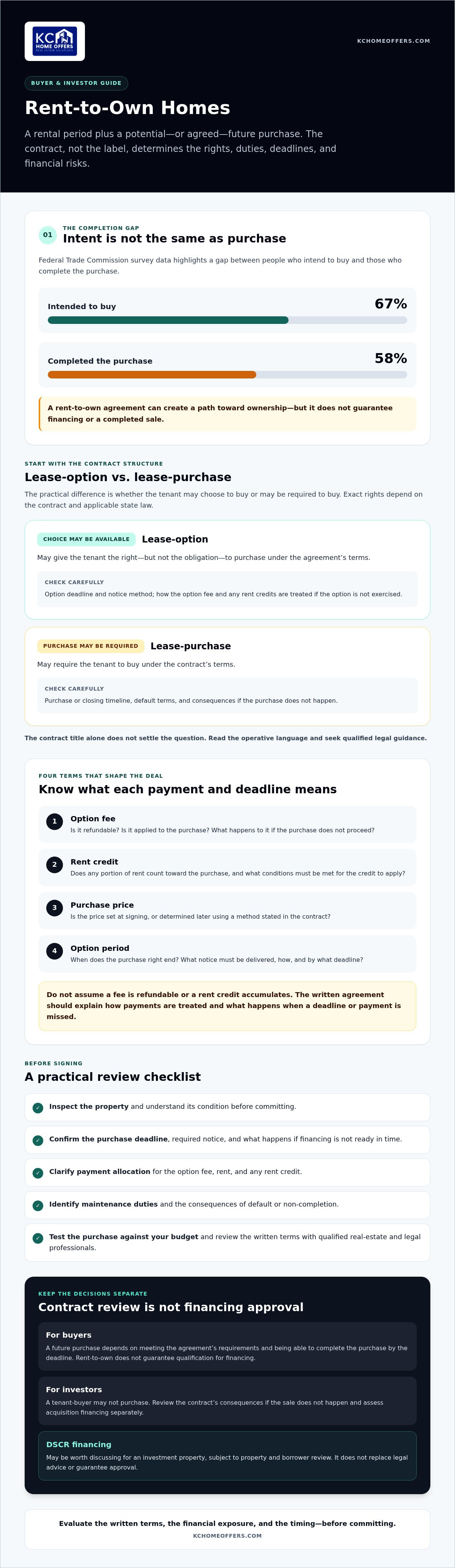
Federal Trade Commission survey data indicates that 58% of people who enter rent-to-own agreements complete the purchase, despite 67% intending to buy. That gap is a reminder that Rent to own homes aren’t just a flexible path to ownership. They’re a contract strategy with financial and timing risks.
If you’re weighing a deal, ask what happens to the option fee, whether rent credits count toward the purchase, and what happens if financing isn’t ready by the deadline. The answers depend on the agreement, especially whether it’s a lease-option, which gives the tenant a choice to buy, or a lease-purchase, which may require a purchase.
This guide compares those structures, outlines how buyers and investors can assess the economics and risks, and identifies contract questions to raise with qualified real-estate and legal professionals. Financing deserves a separate review: an investor financing conversation, such as one about DSCR financing, depends on property and borrower review. It doesn’t replace legal advice or guarantee approval.
Key Takeaways
- Rent to own homes can offer a path toward a future purchase, but the contract, not the label, sets the parties’ rights and responsibilities.
- Compare flexibility, purchase obligations, and financial exposure before choosing rent-to-own over renting or buying outright.
- Before signing, inspect the property and check the purchase deadline, payment allocation, maintenance duties, and consequences of default.
- Test whether the proposed purchase fits your budget and ask qualified real-estate and legal professionals to review the terms.
- Assess acquisition financing separately from the contract. DSCR financing may be worth discussing for an investment property, subject to property and borrower review.
Table of Contents
- Rent to Own Homes: What the Arrangement Means for Buyers and Investors
- How Rent-to-Own Homes Work: Lease-Option and Lease-Purchase Explained
- Rent-to-Own Homes vs. Renting or Buying: Weigh the Trade-Offs
- How to Evaluate a Rent-to-Own Home Before Signing
- Financing an Investment Property: Next Steps After Reviewing Rent-to-Own
Rent to Own Homes: What the Arrangement Means for Buyers and Investors
Rent-to-own pairs a rental period with a potential or agreed future purchase. The key distinction is whether the occupant has a choice or a contractual duty to buy. Under a lease-option, the tenant generally has the right, but not the obligation, to purchase under the agreement’s terms. Under a lease-purchase, the contract may require the tenant to buy. Exact rights depend on the contract language and applicable state law.
That distinction shapes the deal: who can end the arrangement, when a purchase must happen, and what may be at stake if it doesn’t. The neutral overview of Rent-to-own provides background on the general transaction structure, but it can’t determine how a specific contract will be interpreted.
Who considers rent-to-own, and what are they trying to solve?
A prospective buyer may want time to prepare for ownership, assess whether the property suits their needs, or work toward meeting future purchase conditions. The arrangement can provide a defined period to consider buying, but it doesn’t guarantee the buyer will qualify for financing or complete the purchase by the deadline.
An investor may consider a tenant-buyer arrangement as one property strategy: rent the property while setting out a potential future sale. The occupant may not purchase, so the investor needs to understand the contract’s consequences if the sale doesn’t happen. Rent to own homes should be evaluated as contracts with specific rights and risks, not as automatic sales or guaranteed ownership.
Which terms shape the agreement from the start?
Review these four terms early. Together, they determine how the arrangement works financially and over time:
- Option fee: Any upfront payment connected to the right to buy, including whether it is refundable or applied to the purchase.
- Rent credit: Whether any portion of rent is credited toward the purchase, and what conditions must be met for that credit to apply.
- Purchase price: Whether the price is set at signing or determined later using a method described in the contract.
- Option period: The timeframe for exercising a purchase option, including the required notice and deadline.
Don’t rely on verbal explanations or assume a payment will count toward the purchase. The written agreement should state how each amount is treated, what actions each party must take, and what happens if a deadline is missed or a payment isn’t made. Terms may be interpreted differently depending on state law and individual circumstances. Before signing or offering an agreement, have a qualified real-estate attorney review the contract and explain the relevant requirements.
How Rent-to-Own Homes Work: Lease-Option and Lease-Purchase Explained
The practical difference is straightforward: a lease-option may give the tenant a right to buy without requiring a purchase, while a lease-purchase may create an obligation to buy, subject to the contract and applicable law. The title alone doesn’t settle the question. Read the operative language and ask a qualified attorney how it applies in the relevant jurisdiction.
| Contract feature | Lease-option | Lease-purchase |
|---|---|---|
| Purchase right or duty | May give the tenant the right to buy, without requiring them to do so. | May require the tenant to buy under the contract’s terms. |
| Option period | May set a deadline for exercising the purchase right, including notice requirements. | May set a required purchase or closing timeline. |
| What to check | How to exercise the option and how payments are treated if it isn’t exercised. | Default, closing, and non-completion provisions, including the consequences of failing to purchase. |
What does a lease-option typically allow?
A lease-option may let the tenant choose to buy at a price or under a pricing method stated in the agreement. The option period defines how long that right remains available. To exercise it, the tenant may need to provide notice in a particular way and meet stated conditions by the deadline. Identify each required step, delivery method, and date in writing, since missing a requirement can affect the purchase right.
The agreement should also explain the option fee, monthly rent, and whether any rent credit applies. Don’t assume the fee is refundable or credited toward the purchase, or that rent credits accumulate automatically. The contract controls how these payments are handled. For a broader discussion of potential trade-offs, Forbes’ overview of rent-to-own arrangements offers additional context.
How can a lease-purchase agreement differ?
A lease-purchase may go beyond granting a choice: its wording may commit the tenant to buy. That can change the exposure for both parties if financing, property condition, or another closing issue disrupts the plan. Review what counts as default, what must happen before closing, and what remedies or consequences apply if the transaction doesn’t close. Don’t assume a tenant can simply decline to purchase as they might under an option.
Rent to own homes can involve different rights depending on the agreement and state law. Both parties should get qualified legal review before signing. Investors should also assess acquisition financing separately from the contract. KC Home Offers LLC provides investor-focused DSCR loan financing, subject to property and borrower review.
Rent-to-Own Homes vs. Renting or Buying: Weigh the Trade-Offs
Rent-to-own can combine a rental period with a possible future purchase, but it doesn’t automatically build ownership or guarantee a sale. Whether payments create a purchase credit, and what happens if the buyer doesn’t proceed, depends on the written agreement. Forbes explains how rent-to-own homes work; use that overview as context, then assess the actual contract.
| Path | Flexibility and timing | Financial exposure and control |
|---|---|---|
| Rent | Typically offers a defined rental term without a purchase commitment. | Payments generally cover occupancy; the renter doesn’t gain ownership through rent alone. Property decisions remain with the owner, subject to the lease and applicable law. |
| Rent-to-own | May provide time to decide or meet purchase conditions, but deadlines and rights depend on the agreement. | Option fees or rent credits may be at risk if requirements aren’t met. Purchase rights, maintenance duties, and payment treatment are contract-specific. |
| Buy | Purchase happens upfront, subject to the transaction and financing process. | The buyer takes on ownership and its associated costs and control, as set by the sale documents and applicable law. |
When might rent-to-own fit a buyer’s situation?
Extra time may help someone who wants to live in a property before deciding or needs time to prepare for a purchase. It won’t ensure future loan qualification. Before committing, compare the full housing budget with likely purchase costs, check whether the timeline is realistic, and confirm you can meet the agreement’s conditions. Renting may be simpler if flexibility matters most; buying may suit someone ready to proceed now.
What risks should investors and tenant-buyers compare?
Inspect the property and clarify who handles repairs, maintenance, and other costs. Confirm in writing how rent, any credits, and fees are treated, and what happens after missed payments, a missed deadline, or a failed closing. A tenant-buyer could lose contractual benefits if requirements aren’t met, depending on the agreement and law. Investors should model vacancy, carrying costs, and resale assumptions if the tenant doesn’t buy.
Bottom line: Rent to own homes may offer a bridge between renting and purchasing, but they also add contract-specific obligations. Compare the trade-offs with a straightforward lease or purchase, and have qualified professionals review the terms before either party commits.
How to Evaluate a Rent-to-Own Home Before Signing
Use a due-diligence process before either party commits. A property that looks workable on paper can still create exposure if its condition, contract terms, or future financing plan hasn’t been checked. Evaluate Rent to own homes from both sides of the transaction, and make responsibilities and assumptions explicit.
- 1. Inspect the property. Arrange an appropriate professional inspection and clarify the condition of major systems and components. Ask qualified professionals how to verify ownership, title matters, and any relevant property disclosures.
- 2. Read the contract closely. Confirm the purchase price or pricing method, option period, exercise-notice process, and closing requirements. Identify how rent, any rent credit, and upfront fees are allocated, then check what happens after missed payments, an unmet condition, or a missed deadline.
- 3. Assign responsibilities. Make sure the agreement clearly addresses taxes, insurance, repairs, and routine maintenance. Don’t rely on assumptions about which party pays or handles a task.
- 4. Test affordability and get advice. Build a budget for rent, savings, repairs, and possible future financing. Ask a lender about relevant qualification requirements, but don’t treat that conversation as a promise of approval. Have a qualified real-estate attorney review the agreement and advise you on requirements that may apply in the property’s state.
Which contract terms deserve careful review?
Focus on how the purchase price is set and whether it can change, when the purchase right begins and ends, how notice must be delivered, and what must happen before closing. Get the treatment of rent credits and upfront fees in writing, including conditions that could affect them. Review default and non-completion provisions, too. Since contract interpretation and applicable requirements can vary, ask qualified counsel to assess the specific agreement rather than relying on a general description.
How can the parties test whether the plan is financially workable?
For a tenant-buyer, compare current housing costs with the savings needed for a future purchase, likely repairs, and other expenses. Consider what happens if financing isn’t available by the contract deadline. For an investor, estimate realistic property income against expenses, repairs, carrying costs, and the possibility that the tenant doesn’t buy. Avoid relying on a best-case resale assumption.
Separate contract review from acquisition financing. Investors considering DSCR financing can explore DSCR loan financing as a possible financing conversation, subject to property and borrower review. It doesn’t replace legal review or guarantee loan approval.
Financing an Investment Property: Next Steps After Reviewing Rent-to-Own
A rent-to-own agreement and the financing used to acquire an investment property are separate decisions. The contract sets the parties’ rights and deadlines; a lender evaluates a financing request under its own requirements. Don’t assume signing an agreement means financing will be available later. Match the potential loan timeline and projected property performance to the contract’s purchase or closing dates.
For a wider overview of investor financing considerations, see this investment property loan guide. One category to explore is DSCR financing. At a high level, DSCR lending evaluates property income alongside lender requirements, but the review and terms depend on the lender, property, and borrower. Learn more in this DSCR loan investor guide.
What should an investor ask before pursuing financing?
Ask the lender what property, borrower, income, and documentation factors it reviews, and confirm current product availability and terms directly. Then compare the lender’s process and financing assumptions with the agreement’s timeline. If projected income or expenses change, check whether the property still fits the investment plan. Treat a financing discussion as a planning step, not confirmation of approval.
- What property and borrower information is needed for review?
- Which income and expense assumptions matter to the lender?
- Can the financing timeline align with the agreement’s purchase and closing deadlines?
- Does projected property performance still support the investment if costs, occupancy, or timing differ from expectations?
When should a buyer or investor seek professional help?
Bring in the right professionals before committing. A qualified real-estate attorney can review contract language and help identify state-specific requirements. A qualified tax professional can discuss potential tax implications for the parties’ circumstances. Contact a lender early to understand possible financing options and the information needed for a review, without treating preliminary guidance as loan approval.
For investors considering rent to own homes, keep the contract, financing, and property analysis aligned, but evaluate each on its own merits. KC Home Offers LLC provides investor-focused financing, including DSCR loans, subject to property and borrower review. If you’re assessing financing for an investment property, discuss your financing questions with the team before making a commitment.
Make Your Next Investment Decision With Clarity
Rent to own homes can create a path toward a future purchase, but the agreement’s structure determines whether buying is optional or required. Before committing, scrutinize deadlines, payment treatment, property condition, maintenance responsibilities, and what happens if the transaction doesn’t close. Assess financing separately, since a rent-to-own contract doesn’t guarantee that a future loan will be available.
For investors, test the deal’s assumptions against realistic property income, expenses, and timing. Get qualified legal and tax guidance on the contract and your circumstances, and speak with a lender early about financing requirements without assuming approval.
KC Home Offers LLC provides investor-focused DSCR, fix-and-flip, and new-construction loans. Its approach is transparent and tailored to real-estate investors, with financing subject to property and borrower review. Explore investor financing options with KC Home Offers LLC as you evaluate the right funding path for your investment.
Frequently Asked Questions
Is rent-to-own the same as a lease-option?
Not necessarily. A lease-option commonly gives the tenant a right to buy under stated terms, while a lease-purchase may create a stronger obligation to complete the purchase. The precise effect depends on the contract language and applicable state law. Don’t rely on the agreement’s title alone to understand your rights. Have a qualified real-estate attorney review the document and explain the obligations before either party signs.
Can you lose money in a rent-to-own agreement?
Yes, depending on the written terms and what happens if the tenant doesn’t exercise an option or complete the purchase. An upfront fee or rent credits may be treated differently from one agreement to another. Don’t assume payments are refundable or will count toward the purchase price. Confirm in writing how each payment is handled, what conditions apply, and what happens if a deadline or other contract requirement isn’t met.
How much is a rent-to-own option fee?
There’s no single amount that applies to every agreement. The contract should state the fee, its purpose, when it’s due, and whether it may be credited toward the purchase or forfeited if the tenant doesn’t buy. Don’t rely on verbal descriptions of how the payment works. Ask a qualified attorney to explain the consequences and confirm the written terms match your understanding before you pay or accept the fee.
What happens if a rent-to-own buyer cannot get financing?
The outcome depends on the agreement, its deadlines, and applicable law. The tenant may lose the opportunity to purchase and could lose payments or credits if the contract provides for that result. Before signing, ask a lender about qualification requirements and possible financing options, without assuming approval is assured. Have qualified counsel explain what happens if financing isn’t available or the buyer can’t close by the stated deadline.
Can a rent-to-own purchase price change during the agreement?
It depends on how the contract establishes the purchase price. Some agreements state a price in advance, while others may set out a method for determining it later. Don’t rely on verbal explanations or assumptions about future pricing. Confirm the price or formula, the dates that apply, and how any disagreement will be handled. Ask a qualified attorney to review the language before signing so both parties understand the terms.
Is rent-to-own a good strategy for real-estate investors?
It can be worth evaluating, but suitability depends on the property, contract structure, tenant-buyer circumstances, and financial assumptions. Rent to own homes don’t guarantee a completed sale or profitable outcome. Investors should model realistic income and expenses, clarify maintenance and default responsibilities, and assess financing needs separately from the contract. Legal and tax professionals can help evaluate obligations and potential implications based on the agreement and each party’s circumstances.
Frequently asked
Who considers rent-to-own, and what are they trying to solve?
A prospective buyer may want time to prepare for ownership, assess whether the property suits their needs, or work toward meeting future purchase conditions. The arrangement can provide a defined period to consider buying, but it doesn’t guarantee the buyer will qualify for financing or complete the purchase by the deadline. An investor may consider a tenant-buyer arrangement as one property strategy: rent the property while setting out a potential future sale. The occupant may not purchase, so the investor needs to understand the contract’s consequences if the sale doesn’t happen. Rent to own homes should be evaluated as contracts with specific rights and risks, not as automatic sales or guaranteed ownership.
Which terms shape the agreement from the start?
Review these four terms early. Together, they determine how the arrangement works financially and over time: Don’t rely on verbal explanations or assume a payment will count toward the purchase. The written agreement should state how each amount is treated, what actions each party must take, and what happens if a deadline is missed or a payment isn’t made. Terms may be interpreted differently depending on state law and individual circumstances. Before signing or offering an agreement, have a qualified real-estate attorney review the contract and explain the relevant requirements. The practical difference is straightforward: a lease-option may give the tenant a right to buy without requiring a purchase, while a lease-purchase may create an obligation to buy, subject to the contract and applicable law. The title alone doesn’t settle the question. Read the operative language and ask a qualified attorney how it applies in the relevant jurisdiction.
What does a lease-option typically allow?
A lease-option may let the tenant choose to buy at a price or under a pricing method stated in the agreement. The option period defines how long that right remains available. To exercise it, the tenant may need to provide notice in a particular way and meet stated conditions by the deadline. Identify each required step, delivery method, and date in writing, since missing a requirement can affect the purchase right. The agreement should also explain the option fee, monthly rent, and whether any rent credit applies. Don’t assume the fee is refundable or credited toward the purchase, or that rent credits accumulate automatically. The contract controls how these payments are handled. For a broader discussion of potential trade-offs, Forbes’ overview of rent-to-own arrangements offers additional context.
How can a lease-purchase agreement differ?
A lease-purchase may go beyond granting a choice: its wording may commit the tenant to buy. That can change the exposure for both parties if financing, property condition, or another closing issue disrupts the plan. Review what counts as default, what must happen before closing, and what remedies or consequences apply if the transaction doesn’t close. Don’t assume a tenant can simply decline to purchase as they might under an option. Rent to own homes can involve different rights depending on the agreement and state law. Both parties should get qualified legal review before signing. Investors should also assess acquisition financing separately from the contract. KC Home Offers LLC provides investor-focused DSCR loan financing, subject to property and borrower review. Rent-to-own can combine a rental period with a possible future purchase, but it doesn’t automatically build ownership or guarantee a sale. Whether payments create a purchase credit, and what happens if the buyer doesn’t proceed, depends on the written agreement. Forbes explains how rent-to-own homes work; use that overview as context, then assess the actual contract.
When might rent-to-own fit a buyer’s situation?
Extra time may help someone who wants to live in a property before deciding or needs time to prepare for a purchase. It won’t ensure future loan qualification. Before committing, compare the full housing budget with likely purchase costs, check whether the timeline is realistic, and confirm you can meet the agreement’s conditions. Renting may be simpler if flexibility matters most; buying may suit someone ready to proceed now.
What risks should investors and tenant-buyers compare?
Inspect the property and clarify who handles repairs, maintenance, and other costs. Confirm in writing how rent, any credits, and fees are treated, and what happens after missed payments, a missed deadline, or a failed closing. A tenant-buyer could lose contractual benefits if requirements aren’t met, depending on the agreement and law. Investors should model vacancy, carrying costs, and resale assumptions if the tenant doesn’t buy. Bottom line: Rent to own homes may offer a bridge between renting and purchasing, but they also add contract-specific obligations. Compare the trade-offs with a straightforward lease or purchase, and have qualified professionals review the terms before either party commits. Use a due-diligence process before either party commits. A property that looks workable on paper can still create exposure if its condition, contract terms, or future financing plan hasn’t been checked. Evaluate Rent to own homes from both sides of the transaction, and make responsibilities and assumptions explicit.
Which contract terms deserve careful review?
Focus on how the purchase price is set and whether it can change, when the purchase right begins and ends, how notice must be delivered, and what must happen before closing. Get the treatment of rent credits and upfront fees in writing, including conditions that could affect them. Review default and non-completion provisions, too. Since contract interpretation and applicable requirements can vary, ask qualified counsel to assess the specific agreement rather than relying on a general description.
How can the parties test whether the plan is financially workable?
For a tenant-buyer, compare current housing costs with the savings needed for a future purchase, likely repairs, and other expenses. Consider what happens if financing isn’t available by the contract deadline. For an investor, estimate realistic property income against expenses, repairs, carrying costs, and the possibility that the tenant doesn’t buy. Avoid relying on a best-case resale assumption. Separate contract review from acquisition financing. Investors considering DSCR financing can explore DSCR loan financing as a possible financing conversation, subject to property and borrower review. It doesn’t replace legal review or guarantee loan approval. A rent-to-own agreement and the financing used to acquire an investment property are separate decisions. The contract sets the parties’ rights and deadlines; a lender evaluates a financing request under its own requirements. Don’t assume signing an agreement means financing will be available later. Match the potential loan timeline and projected property performance to the contract’s purchase or closing dates. For a wider overview of investor financing considerations, see this investment property loan guide. One category to explore is DSCR financing. At a high level, DSCR lending evaluates property income alongside lender requirements, but the review and terms depend on the lender, property, and borrower. Learn more in this DSCR loan investor guide.
What should an investor ask before pursuing financing?
Ask the lender what property, borrower, income, and documentation factors it reviews, and confirm current product availability and terms directly. Then compare the lender’s process and financing assumptions with the agreement’s timeline. If projected income or expenses change, check whether the property still fits the investment plan. Treat a financing discussion as a planning step, not confirmation of approval.
When should a buyer or investor seek professional help?
Bring in the right professionals before committing. A qualified real-estate attorney can review contract language and help identify state-specific requirements. A qualified tax professional can discuss potential tax implications for the parties’ circumstances. Contact a lender early to understand possible financing options and the information needed for a review, without treating preliminary guidance as loan approval. For investors considering Rent to own homes, keep the contract, financing, and property analysis aligned, but evaluate each on its own merits. KC Home Offers provides investor-focused financing, including DSCR loans, subject to property and borrower review. If you’re assessing financing for an investment property, discuss your financing questions with the team before making a commitment. Rent to own homes can create a path toward a future purchase, but the agreement’s structure determines whether buying is optional or required. Before committing, scrutinize deadlines, payment treatment, property condition, maintenance responsibilities, and what happens if the transaction doesn’t close. Assess financing separately, since a rent-to-own contract doesn’t guarantee that a future loan will be available. For investors, test the deal’s assumptions against realistic property income, expenses, and timing. Get qualified legal and tax guidance on the contract and your circumstances, and speak with a lender early about financing requirements without assuming approval. KC Home Offers LLC provides investor-focused DSCR, fix-and-flip, and new-construction loans. Its approach is transparent and tailored to real-estate investors, with financing subject to property and borrower review. Explore investor financing options with KC Home Offers LLC as you evaluate the right funding path for your investment.
Is rent-to-own the same as a lease-option?
Not necessarily. A lease-option commonly gives the tenant a right to buy under stated terms, while a lease-purchase may create a stronger obligation to complete the purchase. The precise effect depends on the contract language and applicable state law. Don’t rely on the agreement’s title alone to understand your rights. Have a qualified real-estate attorney review the document and explain the obligations before either party signs.
Can you lose money in a rent-to-own agreement?
Yes, depending on the written terms and what happens if the tenant doesn’t exercise an option or complete the purchase. An upfront fee or rent credits may be treated differently from one agreement to another. Don’t assume payments are refundable or will count toward the purchase price. Confirm in writing how each payment is handled, what conditions apply, and what happens if a deadline or other contract requirement isn’t met.
How much is a rent-to-own option fee?
There’s no single amount that applies to every agreement. The contract should state the fee, its purpose, when it’s due, and whether it may be credited toward the purchase or forfeited if the tenant doesn’t buy. Don’t rely on verbal descriptions of how the payment works. Ask a qualified attorney to explain the consequences and confirm the written terms match your understanding before you pay or accept the fee.
What happens if a rent-to-own buyer cannot get financing?
The outcome depends on the agreement, its deadlines, and applicable law. The tenant may lose the opportunity to purchase and could lose payments or credits if the contract provides for that result. Before signing, ask a lender about qualification requirements and possible financing options, without assuming approval is assured. Have qualified counsel explain what happens if financing isn’t available or the buyer can’t close by the stated deadline.
Can a rent-to-own purchase price change during the agreement?
It depends on how the contract establishes the purchase price. Some agreements state a price in advance, while others may set out a method for determining it later. Don’t rely on verbal explanations or assumptions about future pricing. Confirm the price or formula, the dates that apply, and how any disagreement will be handled. Ask a qualified attorney to review the language before signing so both parties understand the terms.
Is rent-to-own a good strategy for real-estate investors?
It can be worth evaluating, but suitability depends on the property, contract structure, tenant-buyer circumstances, and financial assumptions. Rent to own homes don’t guarantee a completed sale or profitable outcome. Investors should model realistic income and expenses, clarify maintenance and default responsibilities, and assess financing needs separately from the contract. Legal and tax professionals can help evaluate obligations and potential implications based on the agreement and each party’s circumstances.
Need financing on a deal like this?
DSCR, fix & flip and new construction loans, underwritten on the deal rather than your tax returns. Soft credit pull only.
Apply in 5 minutes