Guides › Private lending
Portfolio Loans for Investment Properties: Pros, Cons and Requirements

Understand how a portfolio loan for investment properties works. Compare pros, cons, collateral terms, and DSCR options to find the right financing structure.
What if financing that simplifies a growing rental portfolio also makes it harder to refinance or sell one property? A portfolio loan for investment properties can group multiple assets under one borrowing arrangement, but the term can describe different structures. One loan may use several properties as collateral, while “portfolio loan” can also refer to financing a lender keeps on its own books. That distinction matters: fewer separate loans may simplify administration, but shared collateral can limit flexibility.
It’s reasonable to want financing that supports growth without tying up every asset in the same way. This article explains how portfolio structures work, how they compare with property-by-property financing, and what to review when weighing underwriting, collateral, and flexibility. KC Home Offers LLC connects investors with lending partners for DSCR rental financing, a property-level option to compare. Loan decisions and terms are subject to the lending partner’s approval. By the end, you’ll have practical criteria for assessing a structure against your investment strategy, rather than assuming every portfolio loan works alike.
Key Takeaways
- A portfolio loan for investment properties can be structured in different ways. Confirm which properties and collateral the arrangement covers.
- Separate property-level financing keeps each asset’s borrowing distinct. Compare that flexibility with the administrative simplicity you want.
- Review property performance, borrower profile, and collateral as separate underwriting considerations. Lender criteria vary.
- Before applying, define your investment goals and compare written terms, repayment structure, collateral scope, and extension provisions.
- KC Home Offers connects investors with lending partners for business-purpose financing, including DSCR loans for long-term rentals. Approval and terms are subject to the lending partner.
Table of Contents
- What Is a Portfolio Loan for Investment Properties?
- How Portfolio Loans Assess Properties, Cash Flow, and Borrowers
- Portfolio Loan vs. Separate Property Loans: Which Structure Fits?
- How to Evaluate a Portfolio Loan Before Applying
- Explore Investment Property Financing That Matches Your Strategy
What Is a Portfolio Loan for Investment Properties?
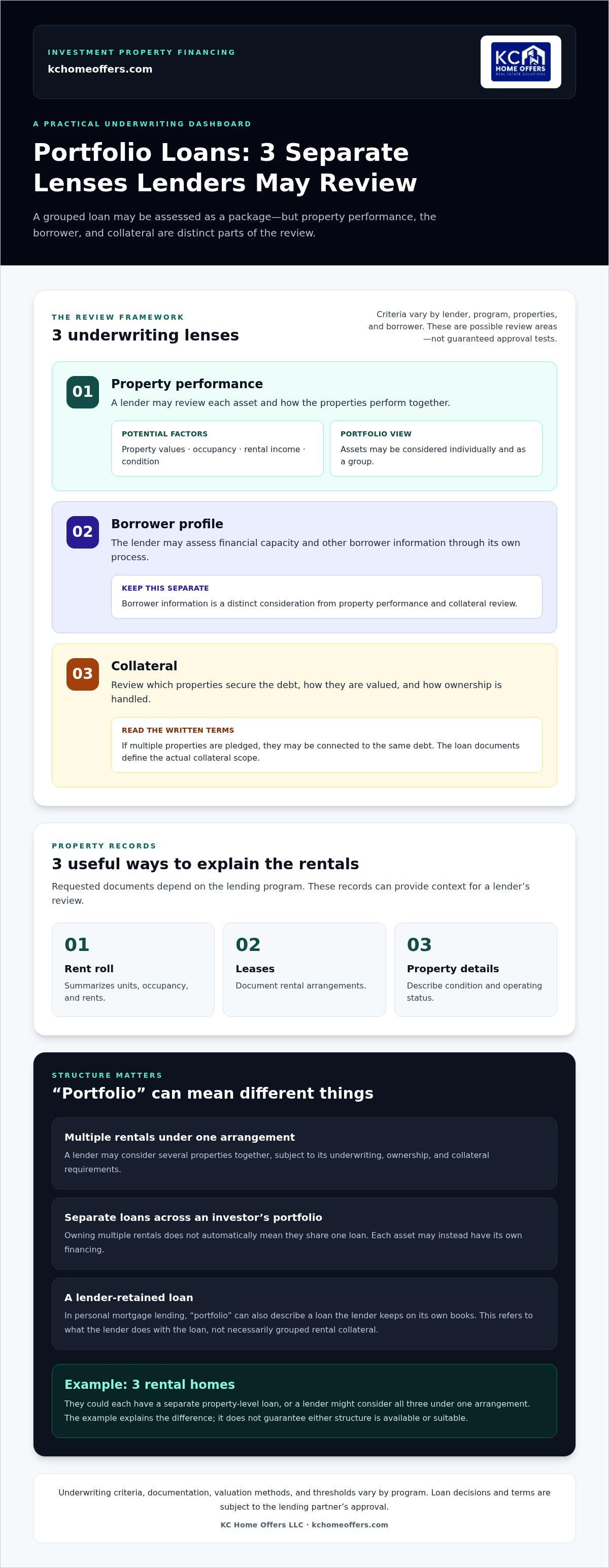
A portfolio loan for investment properties is a financing arrangement that may cover multiple rental assets under one loan structure. The lender evaluates the properties and proposed borrowing as a package, according to its underwriting and collateral rules. The key distinction is that “portfolio” can describe properties financed together, not simply an investor who owns several rentals.
In plain language: an investor portfolio loan may put multiple investment properties under one financing arrangement, but owning several properties doesn’t determine the loan structure. The loan documents specify which assets support the debt, who must own them, and how the arrangement works. Eligible property types and structures vary by program, so the label alone doesn’t tell you what’s included.
How portfolio financing groups rental properties
A lender may review several properties together, considering the proposed collateral as a group rather than treating every asset as a completely separate transaction. Those properties might share a financing arrangement without being identical in location, condition, or rental profile. Eligibility depends on the lender’s criteria and the specific structure.
Ownership and collateral deserve close attention. The loan requirements may address how the properties are held and which assets secure the borrowing. If more than one property is pledged, those assets may be connected to the same debt. Read the written terms to understand the actual scope, rather than relying on the phrase “portfolio loan.” For foundational context on mortgage financing, see Understanding Mortgage Loans.
Portfolio loan versus a portfolio of separate loans
Owning a portfolio of rentals doesn’t automatically mean you have one portfolio loan. “Property portfolio” describes an investor’s collection of assets. “Loan structure” describes how those assets are financed. An investor can own several rentals and finance each with its own loan, or pursue a structure that groups multiple properties if the program allows it.
For example, imagine an investor owns three rental homes. Each could have its own loan, with financing tied to that individual property. Alternatively, a lender might consider all three under one arrangement, with collateral and ownership handled according to its requirements. This example illustrates the difference, not a promise that either structure will suit every situation.
This distinction also helps separate investor financing from a personal mortgage portfolio loan. In personal mortgage lending, “portfolio” can describe a loan the lender keeps on its own books instead of selling it into the secondary market. That use of the term concerns what the lender does with the loan. Investor-focused portfolio financing, by contrast, often refers to how multiple rental properties are grouped for borrowing. The meanings can overlap, but they aren’t interchangeable.
Before comparing options, identify whether you’re discussing a lender-retained loan, a multi-property financing arrangement, or several separate loans held by one investor. Clarifying the structure makes it easier to discuss collateral, ownership, and underwriting accurately.
How Portfolio Loans Assess Properties, Cash Flow, and Borrowers
A lender evaluating a portfolio loan for investment properties may look at the assets as a group, but underwriting isn’t based on one universal checklist. Portfolio underwriting criteria differ by lender, loan program, and the properties and borrower involved. A factor that matters to one program may be handled differently by another, so treat common review areas as possibilities, not guaranteed approval tests.
It helps to separate the review into three parts: how each property performs, the borrower’s financial profile, and the collateral securing the debt. A package can look strong in one area and raise questions in another. Knowing what falls into each category helps you organize the deal and identify points that need clarification.
What lenders may review across a rental portfolio
Depending on the program, a lender may consider property values, occupancy, rental income, and condition. Across multiple rentals, the review may look at each asset individually as well as how the properties work together. Documentation, valuation methods, and thresholds vary by loan program; no single item guarantees approval.
A clear set of property records can help explain the portfolio. A rent roll summarizes units, occupancy, and rents; leases document rental arrangements; and property details describe condition and operating status. These materials give a lender context for its review, while the exact documents requested depend on the program.
The borrower profile is a separate consideration. A lender may assess financial capacity and other borrower information under its own process, while collateral review focuses on which properties secure the financing and how they’re valued. The Consumer Financial Protection Bureau’s overview of loan options provides general context on comparing financing choices, though an investor loan’s specific underwriting is set by its lending program.
How DSCR relates to portfolio financing
Debt-service coverage ratio, or DSCR, compares a property’s rental income with its debt obligations. It helps frame whether rental cash flow supports the debt being considered. Some DSCR programs assess a property’s income against its payment obligations; criteria and calculations vary by lender. Research cited in this article reports that DSCR requirements often fall between 1.0 and 1.25, but that range isn’t a universal rule for every loan or portfolio.
A DSCR loan is a rental-financing option, not automatically a portfolio loan. It may finance a single property based on its rental performance, while a portfolio structure may group multiple properties in one arrangement. The loan name alone doesn’t tell you how many assets are included or what collateral is pledged. KC Home Offers connects investors with lending partners for DSCR financing, subject to the lending partner’s approval. If you’re weighing rental financing structures, you can discuss your investment financing scenario with KC Home Offers.
Portfolio Loan vs. Separate Property Loans: Which Structure Fits?
The choice isn’t simply between one payment and several. A portfolio loan for investment properties may centralize financing, but the loan documents determine which assets are connected and what happens if you refinance, sell, or change plans for one of them. Separate loans keep each property’s financing distinct, though they can mean managing multiple accounts and repayment schedules.
Use this comparison as a starting point, not a prediction of cost or qualification. Actual terms depend on the lender and deal.
| Consideration | Portfolio structure | Separate property loans |
|---|---|---|
| Structure | One arrangement may cover several properties. | Each property has its own loan arrangement. |
| Administration | A single payment may simplify payment tracking, depending on the terms. | Payments and loan records are managed separately. |
| Collateral | Multiple properties may secure the same borrowing, connecting the assets. | Collateral is generally tied to the loan for each property, subject to the documents. |
| Future flexibility | A sale or refinance involving one asset may affect the broader arrangement. | A change to one property’s financing may be handled separately, subject to its loan terms. |
When combining properties may suit an investor
Centralized financing may appeal to an investor coordinating several eligible rentals in one transaction or planning around the portfolio’s overall performance. A single payment could make administration more straightforward, while portfolio-level planning may help align financing with a broader investment strategy. These potential advantages depend on the lender’s rules and the final structure. If properties secure the same debt, the arrangement can also link their financial outcomes.
When separate loans may offer a better fit
Separate financing may suit an investor who wants each property’s borrowing to remain distinct or who acquires assets at different times. It can also align with different plans, such as holding one rental while preparing another for sale or refinancing. But separate loans don’t automatically mean lower risk or greater flexibility. Each loan has its own terms, and those terms govern available options.
Consider a simple example: an investor already owns one stabilized rental and is evaluating another that needs a different investment approach. Financing them separately may keep the plans distinct. If the investor is coordinating several rentals under one strategy, a combined structure could be worth comparing. Neither scenario makes one option universally preferable.
Before deciding, consider how you expect to manage payments, whether you may sell or refinance an individual property, and how comfortable you are with assets being connected through shared collateral. Then compare the written terms, not just the number of loans or payments. The right fit depends on lender terms and your priorities, including how you weigh centralized administration against property-level separation.
How to Evaluate a Portfolio Loan Before Applying
Start with the investment plan, not the loan label. Before evaluating a portfolio loan for investment properties, define what you want the financing to accomplish and identify which properties belong in the discussion. A clear snapshot makes it easier to compare structures and spot gaps between your plans and the proposed obligations.
Compare the complete structure and its obligations, not just the number of payments. One payment may simplify tracking, but it doesn’t show which assets secure the loan or what happens if your plans change. Use this checklist to prepare:
- Set your goals. Clarify whether you’re acquiring rentals, refinancing existing debt, holding properties long term, or preparing assets for sale.
- Identify the properties. List every property you’re considering and mark whether you plan to acquire, retain, refinance, or sell it.
- Build a property snapshot. Record each address, use, occupancy, current rent, and existing financing. Keep verified figures separate from estimates, projections, and planned renovation details.
- Compare the written terms. Review the loan term, repayment schedule, collateral scope, recourse, and any release provisions that apply.
- Map possible changes. Understand how selling or refinancing one property could affect the overall loan and the remaining assets.
Build a clear snapshot of the properties
Keep the inventory consistent across the portfolio. For each property, note its current use and occupancy, rent being collected, current financing, and any change you expect to make. Label figures as verified or projected so assumptions aren’t mistaken for current performance. If a property is vacant or undergoing planned work, state that clearly rather than folding it into a rent estimate.
Then connect the inventory to your plan. Identify which assets are part of the proposed financing and which are outside it. This clarifies the scope of the request and gives you a practical way to compare a combined arrangement with property-level financing.
Compare terms and questions in writing
Put the proposed terms side by side, including repayment timing and any provisions that govern collateral changes. Where applicable, review recourse and release language carefully. A release provision may describe conditions for removing a property from pledged collateral; the actual effect depends on the written agreement. Use the documents, not a verbal summary, to understand the obligation.
Clarify how selling or refinancing one property would affect the loan, what conditions apply to releasing collateral, and whether repayment terms change under that scenario. Record the answers alongside the written offer. The loan documents govern final terms, collateral obligations, and approval, so resolve differences between a summary and the agreement before proceeding.
For investors comparing business-purpose financing routes, KC Home Offers connects investors with lending partners. Share your goals and property snapshot to discuss your investment financing scenario. Any loan decision and terms are subject to the lending partner’s approval.
Explore Investment Property Financing That Matches Your Strategy
The right financing structure depends on what you plan to do with each property and on the lender’s requirements. Before choosing a portfolio loan for investment properties, clarify whether you’re coordinating several rentals under one borrowing arrangement or financing assets individually. Then compare the written terms, collateral obligations, and repayment structure against your investment plan. A consolidated structure isn’t automatically simpler overall, and separate loans aren’t automatically more flexible.
Compare property-level financing with a portfolio approach
For a long-term rental, a DSCR loan may offer a property-level financing route that considers rental cash flow. It’s distinct from a portfolio structure: using DSCR financing doesn’t, by itself, mean multiple properties are grouped under one loan. Compare how each option handles the property, its intended use, and your plans. The lending partner’s requirements and the specific deal determine available structures and approval.
KC Home Offers connects investors with lending partners for business-purpose financing, including DSCR loans for long-term rentals. Founder Ashley Abbott brings an investor’s perspective to conversations about financing scenarios. KC Home Offers does not lend directly, and loan decisions and terms are subject to the lending partner’s review and approval.
Take the next step with a clear deal overview
Before discussing financing, assemble a concise snapshot of the opportunity. Include the property details, intended use, purchase status, and financing goals. If you’re considering more than one property, distinguish which assets you want to acquire, retain, refinance, or sell. Note what’s current and verified separately from projections or planned work. This gives the financing discussion a practical starting point without assuming one structure fits every deal.
It can also help to state your priorities plainly. You may value keeping each property’s financing distinct, coordinating multiple rentals under one plan, or matching long-term rental income with property-level financing. Those priorities can guide the comparison, while the lender’s written requirements and final loan documents determine the available terms and obligations.
KC Home Offers can help investors explore business-purpose financing through its lending partners. If you’re weighing a portfolio approach against property-level options, bring your property details and goals to a conversation about your financing scenario. Focus on how the available structure fits your plan and the lender’s review.
Make Your Next Financing Move With a Clear Plan
Your financing strategy should support the role each property plays in your investment plan, not simply reduce the number of payments you manage. A portfolio loan for investment properties may suit a coordinated approach, while property-level financing may better match an asset with its own timeline or goals. Revisit the choice as your portfolio changes, especially before adding a property or changing how you plan to use one.
KC Home Offers connects investors with lending partners for business-purpose financing, including DSCR loans for long-term rentals. The company doesn’t lend directly, and financing decisions and terms are subject to the lending partner’s review and approval. Bring your property details, intended use, and financing priorities to the conversation so you can focus on what matters for your next move.
Discuss your investment property financing options and take a considered next step toward a structure that fits your strategy.
Frequently Asked Questions
Can one portfolio loan cover multiple rental properties?
Yes, some programs are designed to finance multiple rental properties under one arrangement, but the eligible number and types depend on the lender and program. A set of separate loans across several properties is a different structure. Before evaluating an offer, map each property to its proposed loan and collateral. This makes it easier to see whether the arrangement truly consolidates financing or covers multiple individual loans under a broader financing plan.
Are portfolio loans the same as DSCR loans?
No. “Portfolio loan” describes a financing structure that may group properties, while DSCR describes an approach to evaluating rental income relative to debt obligations. A loan can use DSCR analysis to assess one rental without covering multiple properties. For example, a lender could evaluate one rental’s income and debt under a DSCR program while financing it separately. The lender’s program documents determine the actual structure and qualification criteria.
Do portfolio loans require all properties to be in the same state?
Not universally. Geographic eligibility depends on the lender and program, so don’t assume properties in different states will qualify together or that all properties must be in one state. During a financing review, provide the location and ownership details for each asset, including properties held in different entities if applicable. This gives the lender a clearer basis for assessing eligibility and identifying property-specific conditions that may affect the proposed structure.
Can I sell one property covered by a portfolio loan?
Possibly, but the loan documents control what’s allowed and whether the lender’s consent or a collateral release is required. Selling one property could affect the loan balance or the remaining collateral, depending on the agreement. Before closing, identify the clauses that address property sales, release conditions, and repayment. If you later decide to sell, use the signed agreement to understand the applicable process rather than assuming the property can be removed independently.
Is a portfolio loan better than separate loans for rentals?
Neither structure is automatically better. A combined arrangement may centralize financing, while separate loans keep each property’s debt distinct. Compare the actual offers for repayment terms, collateral connections, administration, and what happens if you sell or refinance an asset. For example, an investor planning to sell one rental soon may weigh shared collateral differently from someone holding every property long term. Don’t assume consolidation guarantees lower costs or easier approval.
Can a new investor qualify for a portfolio loan?
A new investor may qualify under some programs, but experience requirements vary, so there’s no universal yes or no. A lender may consider the properties, rental performance or projections, borrower profile, and transaction details. A first-time investor with a clearly documented rental plan presents a different application from one with uncertain property information, but neither example determines the outcome. The lending partner sets the requirements and decides whether to approve each application.
Frequently asked
Can one portfolio loan cover multiple rental properties?
Yes, some programs are designed to finance multiple rental properties under one arrangement, but the eligible number and types depend on the lender and program. A set of separate loans across several properties is a different structure. Before evaluating an offer, map each property to its proposed loan and collateral. This makes it easier to see whether the arrangement truly consolidates financing or covers multiple individual loans under a broader financing plan.
Are portfolio loans the same as DSCR loans?
No. “Portfolio loan” describes a financing structure that may group properties, while DSCR describes an approach to evaluating rental income relative to debt obligations. A loan can use DSCR analysis to assess one rental without covering multiple properties. For example, a lender could evaluate one rental’s income and debt under a DSCR program while financing it separately. The lender’s program documents determine the actual structure and qualification criteria.
Do portfolio loans require all properties to be in the same state?
Not universally. Geographic eligibility depends on the lender and program, so don’t assume properties in different states will qualify together or that all properties must be in one state. During a financing review, provide the location and ownership details for each asset, including properties held in different entities if applicable. This gives the lender a clearer basis for assessing eligibility and identifying property-specific conditions that may affect the proposed structure.
Can I sell one property covered by a portfolio loan?
Possibly, but the loan documents control what’s allowed and whether the lender’s consent or a collateral release is required. Selling one property could affect the loan balance or the remaining collateral, depending on the agreement. Before closing, identify the clauses that address property sales, release conditions, and repayment. If you later decide to sell, use the signed agreement to understand the applicable process rather than assuming the property can be removed independently.
Is a portfolio loan better than separate loans for rentals?
Neither structure is automatically better. A combined arrangement may centralize financing, while separate loans keep each property’s debt distinct. Compare the actual offers for repayment terms, collateral connections, administration, and what happens if you sell or refinance an asset. For example, an investor planning to sell one rental soon may weigh shared collateral differently from someone holding every property long term. Don’t assume consolidation guarantees lower costs or easier approval.
Can a new investor qualify for a portfolio loan?
A new investor may qualify under some programs, but experience requirements vary, so there’s no universal yes or no. A lender may consider the properties, rental performance or projections, borrower profile, and transaction details. A first-time investor with a clearly documented rental plan presents a different application from one with uncertain property information, but neither example determines the outcome. The lending partner sets the requirements and decides whether to approve each application.
Need financing on a deal like this?
DSCR, fix & flip and new construction loans, underwritten on the deal rather than your tax returns. Soft credit pull only.
Apply in 5 minutes