Guides › Private lending
Is Flipping Homes Lucrative in 2026? How to Judge the Real Profit

Is flipping homes lucrative in 2026? Learn how to calculate real net profit beyond gross spread, evaluate financing costs, and avoid common renovation traps.
What if a home that appears to offer a healthy profit leaves you with far less after the work is done? Asking “is flipping homes lucrative” is only useful if you look beyond the projected resale price. The headline spread can shrink quickly once renovation overruns, loan interest, holding costs, and selling expenses enter the calculation.
It’s easy to focus first on the purchase price and after-repair value. But a promising estimate isn’t the same as take-home profit. A delayed sale or a larger-than-expected repair bill can change the deal. When margins are tight, disciplined numbers matter more than optimism.
This article shows you how to assess a flip using realistic assumptions, a renovation contingency, financing costs, and a practical timeline. You’ll learn to distinguish gross spread from net profit, test how delays or resale changes affect your margin, and decide when to proceed, renegotiate, or walk away. We’ll also explain how a fix-and-flip loan can fit into the project budget and exit plan, without letting financing make a weak deal look stronger than it is.
Key Takeaways
- Whether flipping homes is lucrative depends on what remains after the full project costs, not just the gap between purchase price and projected resale value.
- Build a more defensible after-repair value by comparing renovated properties and accounting for differences in condition, features, and location.
- Test a deal against base, downside, and delayed-project scenarios to see how changing assumptions affect its potential return.
- Set clear go, renegotiate, or walk-away criteria based on verified property, renovation, schedule, and expense assumptions.
- Understand how a fix-and-flip loan can affect the project budget, timeline, and capital committed without treating financing as proof of profitability.
Table of Contents
- Is Flipping Homes Lucrative? Start With Net Profit, Not the Headline Spread
- How to Calculate a Flip's Potential Profit Before You Buy
- Does Flipping Still Make Money? Stress-Test the Risks Behind the Numbers
- How to Decide Whether a Home-Flip Deal Is Worth Pursuing
- Where Fix-and-Flip Financing Fits Into a Profitable Project
Is Flipping Homes Lucrative? Start With Net Profit, Not the Headline Spread
Yes, flipping a home can be profitable, but the result depends on the purchase, renovation, resale, and how well the project is managed. A projected resale price is only one input. To assess whether flipping homes is lucrative for a specific deal, calculate what could remain after all project costs, then test how that figure changes if your assumptions miss the mark.
The gross spread is the projected resale value, often called the after-repair value (ARV), minus the purchase price and renovation budget. It’s a quick screening figure, not take-home profit. For a general overview of what it means to flip a property, see Wikipedia. For the investment decision, the key is tracing every dollar in and out of the project.
What counts as profit on a house flip?
Resale proceeds are revenue. The amount left after expenses is profit. Start with the gross spread, then account for costs such as:
- Acquisition: Purchase price and buying-related closing expenses.
- Renovation: Labor, materials, permits, and scope additions.
- Financing and holding: Loan interest and fees, taxes, insurance, utilities, and other costs while you own the property.
- Disposition: Selling-related costs, including applicable closing expenses.
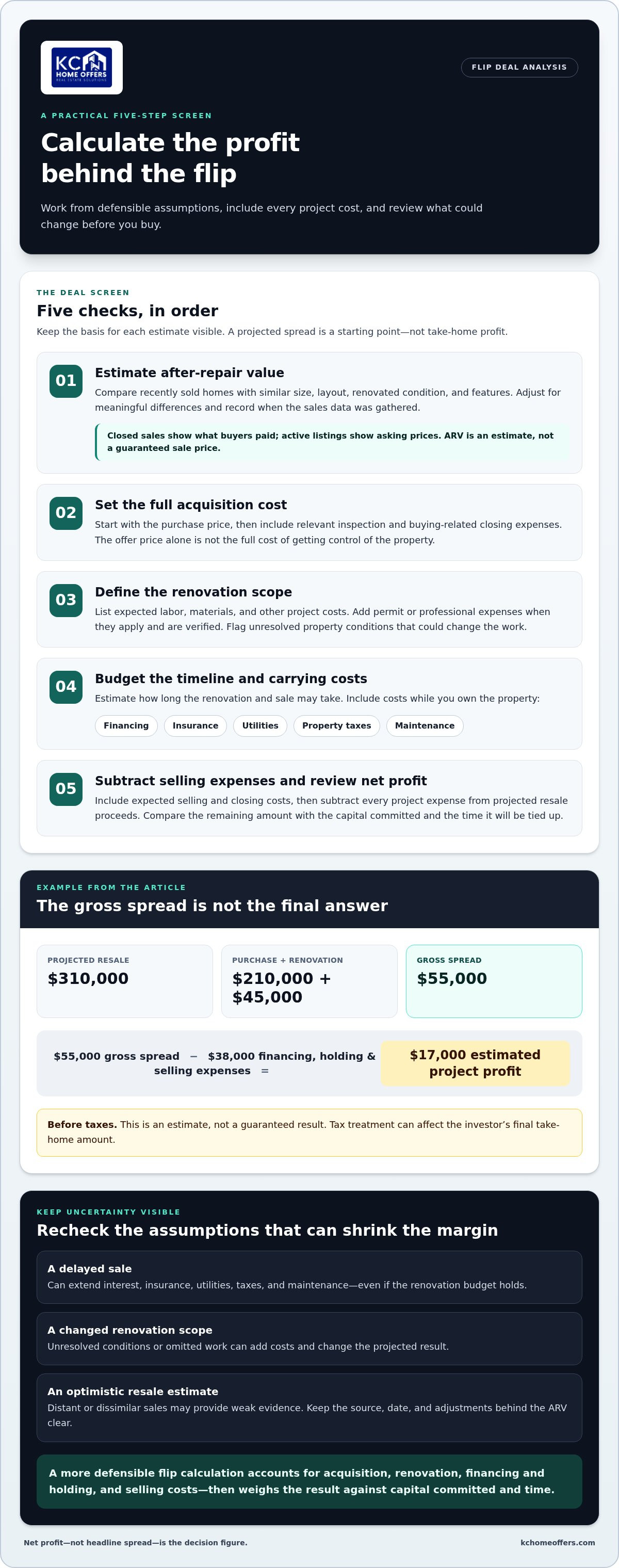
For example, suppose a hypothetical property has a projected resale value of $310,000, a purchase price of $210,000, and a renovation budget of $45,000. The gross spread is $55,000. If financing, holding, and selling expenses total $38,000, estimated project profit falls to $17,000 before taxes. That’s still an estimate, not a guaranteed result. Tax treatment can affect the investor’s final take-home amount, so consider it separately when evaluating personal returns.
Net flip profit is the resale proceeds minus the purchase price, renovation costs, financing and holding expenses, and selling costs, with taxes considered when estimating the investor’s final take-home return.
Profit in dollars doesn’t tell the whole story. Compare the expected return with the capital committed, including cash needed for acquisition, renovation, and reserves, and with the time that capital will be tied up. A smaller profit that takes less time and capital may compare differently with a larger projected profit that carries more exposure.
Why a projected spread can give a misleading answer
An incomplete renovation scope can leave out necessary work, while an optimistic ARV can overstate likely resale proceeds. Either can make a thin deal appear strong. Build estimates from defensible inputs and account for costs that accrue while the property is being renovated and sold. The spread is a starting point for analysis, not proof that the flip is lucrative.
How to Calculate a Flip's Potential Profit Before You Buy
Screen the deal in order and keep each assumption visible. This makes it easier to spot which number is driving the result and where uncertainty could erase the margin.
- Estimate the after-repair value (ARV). Compare the property with recently sold homes that are similar in size, layout, condition after renovation, and features. Adjust your estimate for meaningful differences, and record when the sales data was gathered.
- Set the acquisition cost. Include the purchase price and relevant inspection and closing expenses. Don’t treat the offer price as the full cost of getting control of the property.
- Define the renovation scope. List expected labor, materials, and other project costs. Include permit or professional expenses only when they apply and are verified for the project. Note unresolved conditions that could change the scope.
- Build the timeline and carrying budget. Estimate the time needed to complete the work and sell. Account for financing, insurance, utilities, property taxes, and maintenance during ownership.
- Subtract resale expenses and review net profit. Include expected selling and closing costs, then subtract every project expense from the projected resale proceeds. Review the remaining amount against the capital committed and the time it will be tied up.
Estimate after-repair value with relevant comparable sales
Prioritize closed sales over active asking prices: a listing shows what a seller hopes to receive, not what a buyer has paid. A distant sale or a home with a different layout, condition, or feature set may also provide weak evidence. ARV is an estimate based on comparable properties, not a guaranteed sale price. Note the date and source of your market data, explain your adjustments, and keep uncertainty visible rather than treating the estimate as exact.
Build a full project budget and timeline
For each cost, record the estimate, its basis, and whether it is confirmed or uncertain. Then model a base case alongside a slower schedule and a possible scope change. For example, a delayed sale can extend interest, insurance, utilities, taxes, and maintenance costs even if the renovation budget holds. Your financing structure should fit the project’s timeline and exit assumptions, not just its purchase price. For a separate overview of the terminology and legal issues, consult Cornell Law School’s legal definition of property flipping.
This step-by-step review helps answer whether flipping homes is lucrative for a specific property, rather than for an imagined best-case version of it. Once the deal’s economics are clear, you can review fix-and-flip financing options as one possible capital route and compare how financing costs fit your budget and schedule.
Does Flipping Still Make Money? Stress-Test the Risks Behind the Numbers
Flips can make money, but no projected return is assured. A deal that works on paper may lose margin if repairs expand, the resale price softens, or the property takes longer to sell. The useful question isn’t whether a flip could be profitable. It’s whether the numbers remain workable when reasonable assumptions change.
Separate risks you can investigate and manage from those you can’t fully control. You can inspect the property, define the renovation scope, review comparable sales, and build a realistic schedule. You can’t guarantee what buyers will pay or prevent every delay. Strong underwriting accounts for both.
Which assumptions can erase an apparent profit?
Hidden damage may surface after work begins, and contractor scheduling or material changes can extend the project or increase its cost. An incomplete inspection can leave costly unknowns outside the original scope. On resale, weaker buyer demand or a lower offer than your ARV estimate reduces proceeds. Each issue matters on its own; several together can quickly compress a thin margin.
Time has a cost, too. A longer renovation or slower sale can add financing expense and property carrying costs such as insurance, utilities, taxes, and maintenance. Check which costs continue for each additional period you own the property rather than assuming the original schedule will hold.
How to compare a base case with a downside case
Start with your planned assumptions, then change one input at a time. This shows what the deal is most sensitive to before you combine risks. Use your own estimates and mark uncertain inputs clearly. Don’t treat the most optimistic outcome as the expected one.
- Planned: Use your supported resale estimate, defined renovation scope, expected schedule, and complete expense list. Record the projected net result.
- Delayed: Keep the other inputs unchanged, extend the timeline, and add the financing and holding expenses that follow from the delay.
- Cost overrun: Keep the planned resale and schedule, but increase the renovation allowance to reflect a plausible scope change or newly discovered work.
- Combined downside: After testing each change separately, combine a lower resale outcome, higher renovation costs, and a longer hold to see whether the deal still meets your minimum return.
A lower resale estimate can reduce proceeds while leaving most project costs in place. Test it separately, then alongside overruns and delays. If a modest change turns the projected profit into a loss, the deal has little room for error. If the downside case remains financially viable, you have a clearer basis for deciding whether the risk fits your strategy.
How to Decide Whether a Home-Flip Deal Is Worth Pursuing
A promising property isn’t automatically a sound investment. Decide before committing what evidence you need, what return makes the project worthwhile, and which changes would cause you to renegotiate or walk away. That keeps the decision tied to the deal’s economics, not the excitement of finding a property.
A practical pre-purchase flip checklist
Before making a decision, review the assumptions behind the projected net result. Use this checklist to identify gaps:
- Resale: Is the ARV supported by comparable renovated sales, with differences in condition, layout, size, and features accounted for?
- Property and scope: Have you assessed the property’s condition and defined the renovation work, including known unknowns that could affect cost or timing?
- Schedule: Does the timeline allow for the work, possible delays, and time to sell, with carrying costs included?
- Expenses: Have you included acquisition, renovation, financing, insurance, utilities, taxes, maintenance, and resale costs where applicable?
- Capital and funding: Do you understand how much capital will be committed, the funding structure, repayment expectations, and how costs change if the project runs longer?
Set your decision thresholds before negotiating or committing. Compare the expected return with the capital tied up, the time involved, and the execution demands. If the plan only works under best-case assumptions, it may not meet your criteria.
Go, renegotiate, or walk away
Go when the ARV is defensible, the renovation scope and schedule are grounded in evidence, expenses are accounted for, and the downside still fits your risk tolerance. Renegotiate when the property may work but the current price or terms leave too little room for uncertainty. Recalculate after any change; don’t rely on the original margin.
Walk away when the resale estimate or renovation budget lacks support, key condition questions remain unresolved, or financing and timing undermine the planned exit. A lower purchase price can improve the numbers, but it can’t fix an unworkable scope or an unreliable resale assumption. A property can be attractive and still fail as an investment.
So, is flipping homes lucrative? For any specific deal, the answer depends on verified inputs and whether the return justifies the capital, time, and execution risk. For financing context, review the fix-and-flip funding guide and consider how funding terms fit the project budget and exit plan. Once you’ve established the deal’s economics, review fix-and-flip financing as a possible capital option.
Where Fix-and-Flip Financing Fits Into a Profitable Project
Financing is part of the deal math, not a step to consider after the purchase decision. The structure you use can affect project expenses, how much of your own capital is committed, and how long the project can remain viable. A fix-and-flip loan is one financing category investors may consider, but it doesn’t guarantee approval or make an unprofitable deal work.
Match project funding to the renovation and exit plan
Review the purchase, renovation stages, expected holding period, and resale strategy as one plan. Then account for financing costs and repayment expectations alongside renovation, holding, and selling expenses. A project that takes longer than planned may require more time and capital than the initial budget allows, so test how the funding structure aligns with your timeline and exit assumptions.
No single loan structure suits every investor or property. The right analysis depends on the deal’s cost, scope, schedule, and the investor’s capital plan. For more context on asset-based lending, see this hard money loan guide. Compare financing terms as part of your overall underwriting, not as a substitute for it.
Organize the deal before exploring financing
Before evaluating project funding, bring together the inputs that support your decision:
- A defensible after-repair value based on relevant comparable sales.
- A defined renovation scope, with uncertain items identified.
- A realistic project and resale timeline, including a delay scenario.
- A complete expense estimate covering acquisition, renovation, financing, holding, and disposition.
- Your expected net result, downside case, and the amount of capital tied up over the project.
These figures help you assess whether financing fits the project, rather than letting available capital drive the purchase decision. If the numbers only work under optimistic assumptions, revisit the deal before moving forward. That discipline is central to determining whether flipping homes is lucrative for a specific investment.
KC Home Offers LLC provides investors nationwide with fix-and-flip financing, alongside DSCR loans, new construction loans, and other real estate investment offerings. Once your project budget and exit plan are clear, you can explore investor financing options as a possible next step. Compare the financing structure with your timeline, costs, and capital needs before deciding whether it fits.
Make Your Next Flip Decision With Confidence
So, is flipping homes lucrative? It can be, when the deal’s net-profit estimate holds up after renovation, financing, holding, and resale costs, and still makes sense under less favorable scenarios. A defensible resale estimate, a defined scope, and a realistic timeline give you a stronger basis for deciding whether to proceed, renegotiate, or walk away.
Financing belongs in that analysis from the start. Match the funding structure to the project budget, timeline, and exit plan rather than treating it as a separate decision. KC Home Offers LLC provides investor-focused fix-and-flip loans, along with DSCR and new construction financing options, with a focus on transparent terms and flexible financing.
Once your deal assumptions are organized, explore investor financing options with KC Home Offers LLC as a next step. A disciplined review won’t remove every risk, but it can help you move forward with clearer numbers and greater confidence.
Frequently Asked Questions
Is flipping homes still lucrative in 2026?
Yes, flipping can still be lucrative in 2026, but profit depends on the specific property, purchase price, renovation, financing, timeline, and resale. A projected spread isn’t a reliable measure of what you’ll take home. Calculate net profit after project expenses, then test whether the deal still works if repairs cost more or the sale takes longer than planned. If the downside erases your margin, reconsider the price or walk away.
How much profit can you make flipping a house?
There’s no dependable profit amount for every flip. Whether flipping homes is lucrative comes down to what remains after you subtract acquisition, renovation, financing, holding, and resale expenses from sale proceeds. For example, a large gap between purchase price and projected resale value may shrink once loan interest, insurance, taxes, utilities, and selling costs are included. Estimate the deal’s net result using its own verified inputs, not a promised or assumed return.
What costs should you include when calculating a home-flip profit?
Include the purchase price and acquisition expenses, inspection costs, renovation labor and materials, and any relevant permit or professional costs. Add financing charges, insurance, property taxes, utilities, maintenance, and other holding expenses for the full ownership period. Then account for selling and closing costs. Consider taxes separately when assessing your final take-home return. If the schedule slips, update time-based costs rather than relying on the original estimate.
Can you flip a house without using your own cash?
Possibly, but don’t assume a flip can be completed with no personal capital. Investor financing, including fix-and-flip loans, may fund a project, while the structure, terms, and eligibility depend on the financing arrangement. You may still need funds for expenses, reserves, or costs outside the financing plan. KC Home Offers LLC provides investor-focused fix-and-flip financing. Evaluate the funding option against the project budget, timeline, and exit strategy.
What happens if renovation costs exceed the budget?
An overrun reduces projected profit and may require additional capital or changes to the project plan. First, identify what caused the increase and whether the work is necessary to complete the renovation or support the resale plan. Update the budget, schedule, financing costs, and downside scenario. If the revised numbers no longer meet your return threshold, reassess the scope or exit plan instead of assuming the original profit estimate still holds.
Is flipping homes riskier than buying a rental property?
They involve different risks, so one isn’t automatically riskier for every investor. A flip concentrates exposure in renovation execution, holding time, financing, and resale price. A rental investment adds ongoing considerations such as vacancy, maintenance, operating costs, and rental income. Compare the capital required, time horizon, cash-flow expectations, and risks you can manage for each specific property. Your experience, financing, and investment goals also affect which strategy fits.
Frequently asked
What counts as profit on a house flip?
Resale proceeds are revenue. The amount left after expenses is profit. Start with the gross spread, then account for costs such as: For example, suppose a hypothetical property has a projected resale value of $310,000, a purchase price of $210,000, and a renovation budget of $45,000. The gross spread is $55,000. If financing, holding, and selling expenses total $38,000, estimated project profit falls to $17,000 before taxes. That’s still an estimate, not a guaranteed result. Tax treatment can affect the investor’s final take-home amount, so consider it separately when evaluating personal returns. Net flip profit is the resale proceeds minus the purchase price, renovation costs, financing and holding expenses, and selling costs, with taxes considered when estimating the investor’s final take-home return. Profit in dollars doesn’t tell the whole story. Compare the expected return with the capital committed, including cash needed for acquisition, renovation, and reserves, and with the time that capital will be tied up. A smaller profit that takes less time and capital may compare differently with a larger projected profit that carries more exposure.
Which assumptions can erase an apparent profit?
Hidden damage may surface after work begins, and contractor scheduling or material changes can extend the project or increase its cost. An incomplete inspection can leave costly unknowns outside the original scope. On resale, weaker buyer demand or a lower offer than your ARV estimate reduces proceeds. Each issue matters on its own; several together can quickly compress a thin margin. Time has a cost, too. A longer renovation or slower sale can add financing expense and property carrying costs such as insurance, utilities, taxes, and maintenance. Check which costs continue for each additional period you own the property rather than assuming the original schedule will hold.
Is flipping homes still lucrative in 2026?
Yes, flipping can still be lucrative in 2026, but profit depends on the specific property, purchase price, renovation, financing, timeline, and resale. A projected spread isn’t a reliable measure of what you’ll take home. Calculate net profit after project expenses, then test whether the deal still works if repairs cost more or the sale takes longer than planned. If the downside erases your margin, reconsider the price or walk away.
How much profit can you make flipping a house?
There’s no dependable profit amount for every flip. Whether flipping homes is lucrative comes down to what remains after you subtract acquisition, renovation, financing, holding, and resale expenses from sale proceeds. For example, a large gap between purchase price and projected resale value may shrink once loan interest, insurance, taxes, utilities, and selling costs are included. Estimate the deal’s net result using its own verified inputs, not a promised or assumed return.
What costs should you include when calculating a home-flip profit?
Include the purchase price and acquisition expenses, inspection costs, renovation labor and materials, and any relevant permit or professional costs. Add financing charges, insurance, property taxes, utilities, maintenance, and other holding expenses for the full ownership period. Then account for selling and closing costs. Consider taxes separately when assessing your final take-home return. If the schedule slips, update time-based costs rather than relying on the original estimate.
Can you flip a house without using your own cash?
Possibly, but don’t assume a flip can be completed with no personal capital. Investor financing, including fix-and-flip loans, may fund a project, while the structure, terms, and eligibility depend on the financing arrangement. You may still need funds for expenses, reserves, or costs outside the financing plan. KC Home Offers provides investor-focused fix-and-flip financing. Evaluate the funding option against the project budget, timeline, and exit strategy.
What happens if renovation costs exceed the budget?
An overrun reduces projected profit and may require additional capital or changes to the project plan. First, identify what caused the increase and whether the work is necessary to complete the renovation or support the resale plan. Update the budget, schedule, financing costs, and downside scenario. If the revised numbers no longer meet your return threshold, reassess the scope or exit plan instead of assuming the original profit estimate still holds.
Is flipping homes riskier than buying a rental property?
They involve different risks, so one isn’t automatically riskier for every investor. A flip concentrates exposure in renovation execution, holding time, financing, and resale price. A rental investment adds ongoing considerations such as vacancy, maintenance, operating costs, and rental income. Compare the capital required, time horizon, cash-flow expectations, and risks you can manage for each specific property. Your experience, financing, and investment goals also affect which strategy fits.
Need financing on a deal like this?
DSCR, fix & flip and new construction loans, underwritten on the deal rather than your tax returns. Soft credit pull only.
Apply in 5 minutes