Guides › Private lending
How to Avoid Foreclosure by Selling Your House: Options and Timeline

If you need to avoid foreclosure sell house options can help. Compare mortgage payoff amounts, foreclosure timelines, and direct cash sale solutions today.
Can selling your house help you avoid foreclosure, or could a rushed sale leave you with a remaining balance? If you're weighing whether to avoid foreclosure sell house, first compare the timing, mortgage payoff, and lender requirements with the proceeds a sale may realistically generate.
A notice from your servicer can make every day feel urgent, but the type of notice and the date on it matter. Ask the servicer what stage the process has reached, whether a foreclosure sale is scheduled, and what payoff amount and other charges must be addressed. A sale doesn't automatically stop foreclosure. The transaction must meet applicable deadlines and lender requirements.
This guide explains how selling may fit alongside options such as a loan modification, forbearance, or repayment plan. You'll learn which time-sensitive facts to confirm, how to compare estimated net proceeds with your obligations, and what to consider when weighing a direct cash sale against other paths. KC Home Offers LLC buys homes directly for its own account, so you can compare a potential offer with your payoff figures without treating speed as a guarantee or assuming the numbers will work before they're clear.
Key Takeaways
- Foreclosure notices mark different stages, and timelines and protections depend on your state, loan, and circumstances.
- Gather your current payoff statement, ownership records, known liens, and sale deadlines before estimating what a sale could leave you.
- Compare selling with reinstatement, a repayment plan, forbearance, or loan modification. Each option depends on your situation and lender review.
- To avoid foreclosure sell house only after weighing realistic sale proceeds and timing against the obligations that must be addressed.
- A direct cash offer from KC Home Offers can be evaluated against your payoff figures and timeline. The company buys homes for its own account.
Table of Contents
- How foreclosure works and where selling your house may fit
- Before selling to avoid foreclosure, understand the payoff and timeline
- Selling versus lender workout options: compare what each can do
- Foreclosure sale checklist: What to do now
- A direct cash sale with KC Home Offers LLC: evaluate the next step
How foreclosure works and where selling your house may fit
Foreclosure is the process a mortgage lender may use to take and sell a home after the borrower falls behind on the loan. Missed payments can lead to lender or servicer contact, but falling behind isn’t the same as a completed foreclosure. Formal steps, notices, and opportunities to respond depend on the state, loan, and circumstances. For a neutral overview of the foreclosure process, including judicial and non-judicial approaches, see Wikipedia.
A sale may help address the mortgage debt, but it doesn’t automatically pause or cancel foreclosure proceedings. The practical question behind “avoid foreclosure sell house” is whether the sale can be completed in time and meet the lender’s requirements.
What changes after missed mortgage payments?
Your servicer may contact you about missed payments and possible next steps. There isn’t one timeline that applies to every loan and state. Federal rules generally require servicers to wait until a borrower is more than 120 days delinquent before starting foreclosure, but that doesn’t tell you the exact status or deadline for your case.
Open every notice and contact your mortgage servicer to confirm the account status, any scheduled sale date, and deadlines that apply. Ask for an accurate payoff amount and keep a record of the information you receive. Foreclosure procedures and notice periods vary by state, so use the dates in your own notices and confirm how they apply to your loan.
When can selling a house help avoid foreclosure?
Selling may be an option when the transaction can meet the relevant deadlines and the proceeds, together with any other funds or arrangements, satisfy the obligations required to complete the sale. Confirm the timing and requirements with your servicer. A signed purchase agreement or accepted offer is not the same as a completed sale, and neither alone guarantees that foreclosure proceedings will stop.
Compare the expected sale proceeds with the mortgage payoff, other liens, and sale expenses. If the proceeds won’t cover the debt, ask the servicer whether a short sale can be considered. A short sale generally requires lender approval, and its effect on any remaining balance depends on the agreement and circumstances. Don’t assume that selling resolves every obligation until the terms and figures are clear.
Before selling to avoid foreclosure, understand the payoff and timeline
Before weighing whether to avoid foreclosure sell house, build a clear picture of what’s owed, who owns the property, and how much time remains. A home’s estimated market value is only a starting point. It doesn’t show what you may receive after paying off the mortgage, addressing other liens, and accounting for transaction expenses.
Gather the documents and details that can change the calculation:
- Current payoff statement: Request an updated amount from the servicer. The current payoff may differ from the balance on an older statement.
- Loan status and deadlines: Confirm the account’s current status, any scheduled foreclosure sale, and dates that apply to your situation.
- Ownership records: Identify all owners whose participation may be needed to transfer the property.
- Known liens: Include other recorded claims against the property in your estimates.
- Likely transaction expenses: Account for costs that may apply to the specific sale rather than assuming a standard amount.
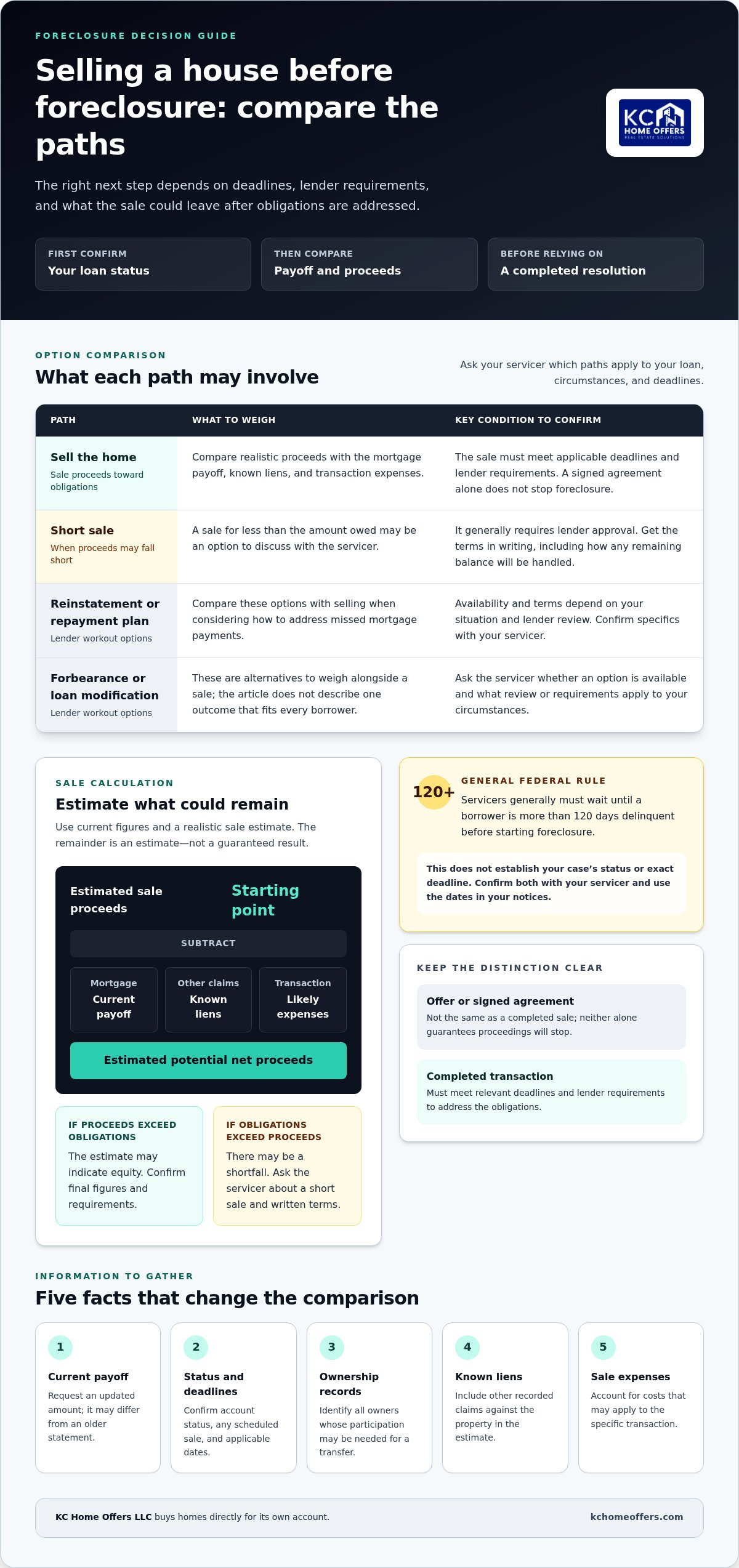
Use a realistic sale estimate and subtract the payoff, known liens, and expected expenses. The remainder is an estimate of potential net proceeds, not a guaranteed result. If the estimate is positive, that may indicate equity. If the obligations exceed the likely proceeds, there may be a shortfall. Final figures depend on the property, loan, and transaction details.
How to estimate whether sale proceeds could cover what you owe
Compare a supportable estimate of what the home could sell for with the current payoff statement, not an old loan balance. Then account for known liens and expenses tied to the transaction. For example, a price that appears higher than the mortgage balance may still leave less than expected after other obligations are included. Keep the estimate grounded in the property’s condition and the time available to sell.
What if the sale price may not cover the mortgage?
If expected proceeds fall short, a short sale may be an option to discuss with the servicer. It generally involves selling for less than the amount owed and may require lender approval. Don’t assume a remaining balance is automatically forgiven. Get the lender’s terms in writing, including how any shortfall will be handled, before relying on the proposed resolution. The HUD-approved housing counseling resource from USAGov can help you find guidance as you assess options.
A signed purchase contract alone doesn’t confirm that the sale has closed or that the lender’s requirements have been met. Keep checking the transaction timeline against applicable deadlines. To compare a direct cash offer with your estimated payoff and obligations, review the option of selling directly to a home buyer.
Selling versus lender workout options: compare what each can do
A sale is one possible path, but it isn’t the only way to address missed mortgage payments. Compare the options against your goal, the home’s estimated net proceeds, your ability to afford future payments, and the time available. Eligibility and outcomes depend on your loan, circumstances, and servicer review.
| Option | What it may do | Key constraint |
|---|---|---|
| Sell the home | Use sale proceeds toward the mortgage payoff and other obligations. | The sale must meet applicable deadlines and lender requirements. If proceeds are short, lender approval for a short sale may be needed. |
| Reinstatement | Bring the loan current by paying overdue amounts and other amounts required by the servicer. | You need to confirm the reinstatement amount, deadline, and whether this option fits your situation. |
| Repayment plan | Spread missed payments over an agreed period while resuming regular payments. | The added amount must be affordable, and the servicer must agree to the plan. |
| Forbearance | Temporarily reduce or pause payments under an arrangement. | Payments may still need to be addressed later. Clarify the terms and what happens when the arrangement ends. |
| Loan modification | Change loan terms, potentially including the interest rate or length, to make payments more manageable. | It requires servicer review, and approval and terms depend on eligibility. |
Which mortgage-servicer options might be available?
Ask your servicer which options it will review and what each requires. Reinstatement means bringing overdue amounts current; a repayment plan schedules how to catch up; forbearance offers temporary payment relief; and a modification changes loan terms. These are distinct paths, not automatic entitlements. Record the requested documents, submission method, response deadlines, and any payment terms in writing.
When might selling be more practical than keeping the home?
If future payments and ongoing ownership costs aren’t sustainable, selling may be worth comparing with a workout option. A traditional listing may expose the home to a broader pool of buyers, but timing, expenses, and final proceeds can vary. A direct cash sale is another route to evaluate; KC Home Offers buys houses for its own account. Compare any offer with the current payoff, liens, expenses, and foreclosure deadlines. A contract alone doesn’t establish that the sale has closed or satisfy lender requirements.
For more on comparing a cash offer with other sale considerations, see Sell My House Fast: The 2026 Guide to Cash Offers and Quick Closings. Bankruptcy may affect foreclosure proceedings, including through an automatic stay, but its impact depends on the circumstances. Speak with a qualified bankruptcy attorney before relying on it as a solution. There’s no universal best path. Choose based on verified terms, realistic numbers, and the time you actually have.
Foreclosure sale checklist: What to do now
Use this checklist to turn a stressful situation into a sequence of decisions. The aim isn’t to rush into a sale. It’s to establish your actual deadline, understand the numbers, and compare a sale with any options your servicer may offer.
- 1. Open every notice. Note the sender, date, action described, and any response or sale deadline. Keep the complete notice, including attachments.
- 2. Contact your mortgage servicer. Ask for the current loan status, the amount needed to bring the account current or pay it off, and any scheduled foreclosure sale date. Confirm which requirements apply if you sell.
- 3. Gather key records. Collect your latest mortgage statement, payoff request details, foreclosure notices, ownership information, and available records of other liens or claims against the property.
- 4. Assess the property and sale expectations. Make a practical note of its condition and any known repairs. Compare a realistic sale estimate with the payoff, liens, and likely transaction expenses rather than relying on an optimistic price alone.
- 5. Record each conversation and deadline. Write down the date, servicer contact, information received, documents requested, and your next step. If a sale or other resolution needs lender approval, keep the requirements and approved terms in writing.
Keep the timeline visible. An offer or signed contract isn’t proof that a sale has closed, and it doesn’t by itself confirm that foreclosure activity will stop. Ask the servicer how a proposed transaction affects the account and what must be completed by each deadline. Homeowners trying to avoid foreclosure sell a home only after checking that the proposed path fits the applicable dates, payoff, and lender requirements.
Documents and details to gather before discussing a sale
Along with notices and mortgage records, list all owners and any known liens. Keep a simple call log with dates, contact names or departments, answers, and follow-up items. This makes it easier to spot missing information and explain your situation consistently when comparing a possible sale with a lender workout option.
Questions to resolve before choosing a route
Ask the servicer what the current status is, what amount is required, and which deadlines matter. Then compare a proposed offer with the current payoff, known obligations, and likely transaction expenses. Clarify whether the sale needs lender approval, such as for a short sale, and get any conditions in writing. For guidance on rights, bankruptcy, or state-specific procedure, consider a qualified housing counselor or attorney. USAGov provides information on avoiding foreclosure.
Once you have those figures and dates, KC Home Offers LLC can be one direct-buy option to evaluate against them. Discuss a potential direct cash sale as part of your comparison.
A direct cash sale with KC Home Offers LLC: evaluate the next step
A direct cash sale is one route to compare, not an automatic foreclosure solution. KC Home Offers LLC buys homes directly for its own account. It doesn’t list or represent homes for sellers. Consider a potential offer alongside your current mortgage payoff, known liens, other obligations, and the time available to complete a transaction.
If you’re weighing whether to avoid foreclosure by selling your house, focus on the full terms, not just the offer amount. A sale may help resolve the mortgage obligation if it closes in time and meets applicable lender requirements. An offer or signed agreement alone doesn’t stop foreclosure proceedings or guarantee that the debt will be paid in full.
How to assess a direct cash offer in a foreclosure situation
Compare the offer with your current payoff figures. Account for known property obligations and transaction expenses, then estimate the net proceeds. You can also compare this with a traditional listing, recognizing that timing, costs, and final proceeds may differ. Neither route guarantees a particular price or closing date.
Check the proposed transaction timeline against deadlines verified with your servicer and, where relevant, a qualified legal professional. Ask the servicer what must happen for the sale to meet its requirements. If expected proceeds won’t cover the debt, clarify whether lender approval for a short sale is needed, and get any approved conditions in writing before treating the offer as a resolution.
Decide on a next step with the facts in hand
You can pursue a servicer workout option, consider selling, or evaluate both in parallel while confirming deadlines and eligibility. The right comparison depends on whether keeping the home is financially workable, what the lender will consider, and whether a sale can be completed in time. Don’t base the decision on a promised outcome or assumed timeline.
For more detail on the sale process, read Sell My House Fast: The Expert Guide to Quick Cash Sales. Confirm the lender’s requirements and deadlines, then explore whether a direct cash-sale option fits your circumstances. Explore a direct cash-sale option with KC Home Offers LLC.
Make your next move with clear numbers and deadlines
An avoid foreclosure sell house decision should start with verified facts, not a rushed promise. Confirm your loan status, payoff amount, and deadlines with the servicer. Then compare selling with available workout options, weighing realistic net proceeds against liens, expenses, and any lender conditions.
A direct sale may be worth considering, but an offer alone doesn’t stop foreclosure or guarantee that the mortgage debt will be resolved. KC Home Offers LLC buys homes directly for its own account. Founder Ashley Abbott is a real estate investor and direct home buyer, and a potential offer can be assessed alongside your payoff figures and timeline.
First, clarify the lender’s requirements. Then explore whether a cash-sale option fits your circumstances. Explore a direct cash-sale option with KC Home Offers LLC.
You don’t have to make the decision based on guesswork. Take the next step with the dates, documents, and numbers in front of you, and choose the path that best aligns with your situation.
Frequently Asked Questions
Can I sell my house to avoid foreclosure?
Yes, selling may help address the mortgage debt if the sale is completed in time and meets applicable lender requirements. Contact your servicer to confirm the account status, deadlines, and payoff amount, then compare those figures with realistic sale proceeds and other obligations. An offer or signed agreement alone doesn’t stop foreclosure. Whether selling can help you avoid foreclosure depends on your loan, state procedure, and transaction details.
How late in the foreclosure process can I sell my house?
The deadline depends on state procedure, your loan, and the specific stage of the process. In some situations, a homeowner may sell before the foreclosure sale is completed, but an approaching sale date can sharply limit the time available. Ask your servicer to confirm the current status and deadlines, and get legal guidance if you’re unsure how local rules apply. Don’t assume an accepted offer postpones a scheduled sale.
What happens if my house sells for less than my mortgage payoff?
If expected proceeds won’t cover the payoff and other obligations, you may need the servicer’s approval for a short sale. Don’t assume the remaining balance will be forgiven just because the property sells. Before proceeding, request the lender’s decision and any conditions in writing, including how a shortfall will be handled. The outcome can depend on your loan, the agreement, and applicable rules, so review the terms carefully.
Can a cash buyer stop foreclosure?
No, a cash buyer can’t independently stop foreclosure proceedings. A direct offer is only one part of a possible sale, and the transaction must meet relevant deadlines and lender requirements. KC Home Offers LLC buys homes directly for its own account, but an offer or signed agreement isn’t a guarantee that foreclosure will pause or that the mortgage debt will be resolved. Confirm the status and requirements with your servicer before relying on a sale.
Should I contact my mortgage servicer before selling?
Yes. Contact the servicer early to confirm your loan status, current payoff, any scheduled sale date, and what requirements apply to a sale. Ask whether lender approval is needed if proceeds may fall short, and record document requests, response deadlines, and any conditions. These facts help you compare a potential offer with the amount owed and available workout options. Keep copies of notices and written communications with your records.
Can bankruptcy prevent foreclosure if I am trying to sell?
Bankruptcy may affect foreclosure proceedings, and filing can trigger an automatic stay in some circumstances. It isn’t a guaranteed or permanent solution, and the impact on a planned sale depends on the case and applicable law. Before filing or relying on bankruptcy to create time for a sale, speak with a qualified bankruptcy attorney. Also confirm how any court process interacts with lender requirements and the transaction timeline.
Frequently asked
What changes after missed mortgage payments?
Your servicer may contact you about missed payments and possible next steps. There isn’t one timeline that applies to every loan and state. Federal rules generally require servicers to wait until a borrower is more than 120 days delinquent before starting foreclosure, but that doesn’t tell you the exact status or deadline for your case. Open every notice and contact your mortgage servicer to confirm the account status, any scheduled sale date, and deadlines that apply. Ask for an accurate payoff amount and keep a record of the information you receive. Foreclosure procedures and notice periods vary by state, so use the dates in your own notices and confirm how they apply to your loan.
When can selling a house help avoid foreclosure?
Selling may be an option when the transaction can meet the relevant deadlines and the proceeds, together with any other funds or arrangements, satisfy the obligations required to complete the sale. Confirm the timing and requirements with your servicer. A signed purchase agreement or accepted offer is not the same as a completed sale, and neither alone guarantees that foreclosure proceedings will stop. Compare the expected sale proceeds with the mortgage payoff, other liens, and sale expenses. If the proceeds won’t cover the debt, ask the servicer whether a short sale can be considered. A short sale generally requires lender approval, and its effect on any remaining balance depends on the agreement and circumstances. Don’t assume that selling resolves every obligation until the terms and figures are clear. Before weighing whether to avoid foreclosure sell house, build a clear picture of what’s owed, who owns the property, and how much time remains. A home’s estimated market value is only a starting point. It doesn’t show what you may receive after paying off the mortgage, addressing other liens, and accounting for transaction expenses. Gather the documents and details that can change the calculation: Use a realistic sale estimate and subtract the payoff, known liens, and expected expenses. The remainder is an estimate of potential net proceeds, not a guaranteed result. If the estimate is positive, that may indicate equity. If the obligations exceed the likely proceeds, there may be a shortfall. Final figures depend on the property, loan, and transaction details.
What if the sale price may not cover the mortgage?
If expected proceeds fall short, a short sale may be an option to discuss with the servicer. It generally involves selling for less than the amount owed and may require lender approval. Don’t assume a remaining balance is automatically forgiven. Get the lender’s terms in writing, including how any shortfall will be handled, before relying on the proposed resolution. The HUD-approved housing counseling resource from USAGov can help you find guidance as you assess options. A signed purchase contract alone doesn’t confirm that the sale has closed or that the lender’s requirements have been met. Keep checking the transaction timeline against applicable deadlines. To compare a direct cash offer with your estimated payoff and obligations, review the option of selling directly to a home buyer. A sale is one possible path, but it isn’t the only way to address missed mortgage payments. Compare the options against your goal, the home’s estimated net proceeds, your ability to afford future payments, and the time available. Eligibility and outcomes depend on your loan, circumstances, and servicer review.
Which mortgage-servicer options might be available?
Ask your servicer which options it will review and what each requires. Reinstatement means bringing overdue amounts current; a repayment plan schedules how to catch up; forbearance offers temporary payment relief; and a modification changes loan terms. These are distinct paths, not automatic entitlements. Record the requested documents, submission method, response deadlines, and any payment terms in writing.
When might selling be more practical than keeping the home?
If future payments and ongoing ownership costs aren’t sustainable, selling may be worth comparing with a workout option. A traditional listing may expose the home to a broader pool of buyers, but timing, expenses, and final proceeds can vary. A direct cash sale is another route to evaluate; KC Home Offers buys houses for its own account. Compare any offer with the current payoff, liens, expenses, and foreclosure deadlines. A contract alone doesn’t establish that the sale has closed or satisfy lender requirements. For more on comparing a cash offer with other sale considerations, see Sell My House Fast: The 2026 Guide to Cash Offers and Quick Closings. Bankruptcy may affect foreclosure proceedings, including through an automatic stay, but its impact depends on the circumstances. Speak with a qualified bankruptcy attorney before relying on it as a solution. There’s no universal best path. Choose based on verified terms, realistic numbers, and the time you actually have. Use this checklist to turn a stressful situation into a sequence of decisions. The aim isn’t to rush into a sale. It’s to establish your actual deadline, understand the numbers, and compare a sale with any options your servicer may offer. Keep the timeline visible. An offer or signed contract isn’t proof that a sale has closed, and it doesn’t by itself confirm that foreclosure activity will stop. Ask the servicer how a proposed transaction affects the account and what must be completed by each deadline. Homeowners trying to avoid foreclosure sell a home only after checking that the proposed path fits the applicable dates, payoff, and lender requirements.
Can I sell my house to avoid foreclosure?
Yes, selling may help address the mortgage debt if the sale is completed in time and meets applicable lender requirements. Contact your servicer to confirm the account status, deadlines, and payoff amount, then compare those figures with realistic sale proceeds and other obligations. An offer or signed agreement alone doesn’t stop foreclosure. Whether selling can help you avoid foreclosure depends on your loan, state procedure, and transaction details.
How late in the foreclosure process can I sell my house?
The deadline depends on state procedure, your loan, and the specific stage of the process. In some situations, a homeowner may sell before the foreclosure sale is completed, but an approaching sale date can sharply limit the time available. Ask your servicer to confirm the current status and deadlines, and get legal guidance if you’re unsure how local rules apply. Don’t assume an accepted offer postpones a scheduled sale.
What happens if my house sells for less than my mortgage payoff?
If expected proceeds won’t cover the payoff and other obligations, you may need the servicer’s approval for a short sale. Don’t assume the remaining balance will be forgiven just because the property sells. Before proceeding, request the lender’s decision and any conditions in writing, including how a shortfall will be handled. The outcome can depend on your loan, the agreement, and applicable rules, so review the terms carefully.
Can a cash buyer stop foreclosure?
No, a cash buyer can’t independently stop foreclosure proceedings. A direct offer is only one part of a possible sale, and the transaction must meet relevant deadlines and lender requirements. KC Home Offers LLC buys homes directly for its own account, but an offer or signed agreement isn’t a guarantee that foreclosure will pause or that the mortgage debt will be resolved. Confirm the status and requirements with your servicer before relying on a sale.
Should I contact my mortgage servicer before selling?
Yes. Contact the servicer early to confirm your loan status, current payoff, any scheduled sale date, and what requirements apply to a sale. Ask whether lender approval is needed if proceeds may fall short, and record document requests, response deadlines, and any conditions. These facts help you compare a potential offer with the amount owed and available workout options. Keep copies of notices and written communications with your records.
Can bankruptcy prevent foreclosure if I am trying to sell?
Bankruptcy may affect foreclosure proceedings, and filing can trigger an automatic stay in some circumstances. It isn’t a guaranteed or permanent solution, and the impact on a planned sale depends on the case and applicable law. Before filing or relying on bankruptcy to create time for a sale, speak with a qualified bankruptcy attorney. Also confirm how any court process interacts with lender requirements and the transaction timeline.
Need financing on a deal like this?
DSCR, fix & flip and new construction loans, underwritten on the deal rather than your tax returns. Soft credit pull only.
Apply in 5 minutes