Guides › Private lending
Hard Money Loans: Fast Financing for Real Estate Investors

Explore how a hard money loan works for real estate investors. Compare rates, risks, and exit strategies to secure fast financing without costly surprises.
The fastest financing can become the most expensive mistake if the deal can’t repay it on time. A Hard money loan may help an investor move quickly when a property needs work or a time-sensitive purchase can’t wait for conventional underwriting. Approval often centers on the property and project, not just the borrower’s credit or income, and the property is at risk if the loan isn’t repaid.
That speed can be appealing when a promising opportunity might otherwise pass by. But short terms and higher borrowing costs can squeeze returns. A delayed sale or refinance can also put the payoff plan at risk.
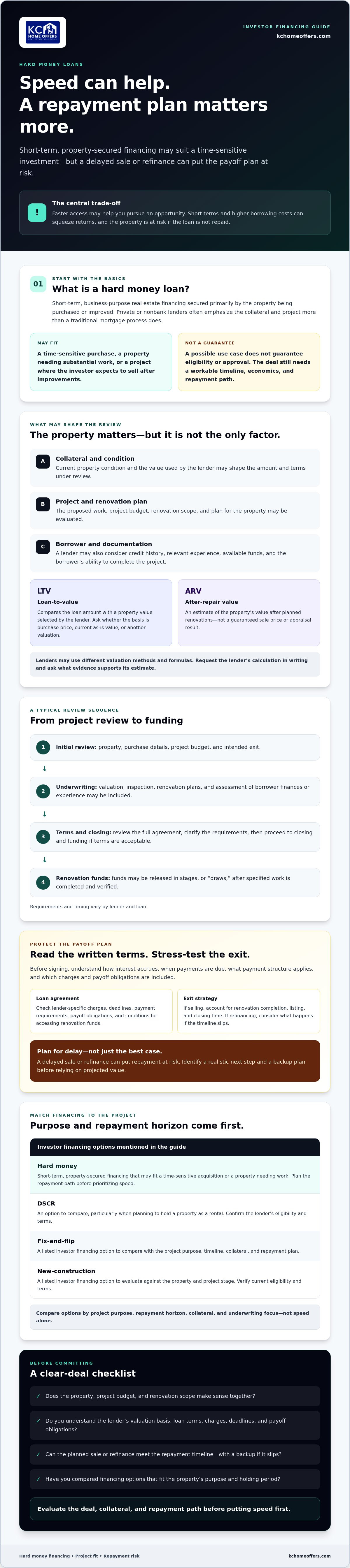
This guide explains how hard money financing is structured, what lenders may evaluate, and how to assess the property, borrowing costs, and exit strategy before applying. You’ll also compare hard money with other investor financing options, including DSCR, fix-and-flip, and new-construction loans, to match financing to the property and project stage. The goal is straightforward: evaluate the deal, collateral, and repayment path before putting speed first.
Key Takeaways
- A Hard money loan may suit a time-sensitive investment, but evaluate the property, project economics, and repayment plan before prioritizing speed.
- Understand how collateral, property condition, renovation scope, and projected value may factor into a lender’s review.
- Compare financing options by project purpose, repayment horizon, collateral, and underwriting focus, especially if you plan to hold the property as a rental.
- Review the written loan agreement for lender-specific charges, deadlines, and payoff obligations. Then assess whether your exit strategy can meet them.
- KC Home Offers LLC lists DSCR, fix-and-flip, and new-construction loans. Confirm current eligibility and terms to determine whether an option fits your project.
Table of Contents
- What Is a Hard Money Loan, and When Do Investors Use One?
- How Hard Money Loan Underwriting, Collateral, and Repayment Work
- Hard Money Loan vs. Other Investor Financing: Match the Loan to the Deal
- How to Evaluate Hard Money Loan Costs, Lenders, and Exit Risk
- Choose Your Next Investor Financing Step With a Clear Project Plan
What Is a Hard Money Loan, and When Do Investors Use One?
A Hard money loan is short-term, business-purpose real estate financing secured primarily by the property being purchased or improved. It’s commonly provided by private or nonbank lenders, whose underwriting often emphasizes the collateral and project more than a traditional mortgage process does. That focus may make this type of loan relevant to certain investment deals, but it doesn’t guarantee approval or remove the need for a workable repayment plan. For more background on the term and its history, see this overview of the Hard money loan.
What does asset-based lending mean for a real estate investor?
Asset-based lending means the lender assesses the property as a key source of security. Its current condition and estimated value may shape the review, along with the proposed renovation scope and the investor’s plan for the property. A lender may also consider credit history, relevant experience, available funds, and the borrower’s ability to complete the project. The property matters, but it isn’t the only factor.
Two terms can help make lender discussions clearer:
- Loan-to-value (LTV) compares the loan amount with the value used by the lender.
- After-repair value (ARV) is the estimated property value after planned renovations are complete.
Lenders may use different valuation methods or formulas to determine how much they’ll finance. Ask which value they’ll use, how they assess the property’s condition and renovation plans, and what documentation supports their estimate.
Which projects may fit a hard money loan?
Potential uses include a time-sensitive acquisition, a property requiring substantial work, or a project where the investor expects to sell after improvements. These are possible use cases, not promises of eligibility. The deal still needs to make sense after accounting for the work, timeline, financing terms, and risks that could delay completion or sale.
Bridge financing is temporary funding that connects one stage of a project to a defined next step. For example, an investor might use short-term financing to acquire and renovate a property, then plan to sell or refinance after improvements. That next step should be realistic, with a backup plan if the timeline slips.
By contrast, a rental-property strategy focused on long-term ownership may call for financing designed around rental income and a longer holding period. Match the loan to the project’s purpose and repayment horizon, and verify eligibility and terms with the lender before committing.
How Hard Money Loan Underwriting, Collateral, and Repayment Work
Expect a sequence of reviews, not a single approval decision. A lender may first review the property, purchase details, project budget, and intended exit. Underwriting can then include a valuation, inspection, review of renovation plans, and assessment of the borrower’s finances or experience. If the terms are acceptable, the parties proceed to closing and funding. For renovation projects, funds may be released in stages, or “draws,” after specified work is completed and verified. Requirements and timing vary by lender and loan.
Before signing, read the proposed terms as a complete package. Clarify how interest accrues, when payments are due, whether the loan requires interest-only or other scheduled payments, and what charges apply. Confirm any conditions for accessing renovation funds. The how hard money loans work overview from Corporate Finance Institute also explains how collateral valuation relates to loan sizing.
How do LTV and ARV affect the loan decision?
Loan-to-value (LTV) compares the proposed loan amount with a property value selected by the lender. Ask whether the calculation uses the purchase price, current as-is value, or another valuation basis. After-repair value (ARV) is an estimate of what the property could be worth after planned improvements. It’s a projection, not a guaranteed sale price or appraisal result.
A lender may consider the property’s current condition, renovation scope, and projected value together. There’s no single LTV formula or limit that applies to every loan. Request the lender’s calculation in writing and check what evidence supports its valuation.
What should the repayment plan include?
Build the payoff strategy before relying on the projected value. If you plan to sell, account for renovation completion, listing, and closing time. If you expect to refinance, confirm that the property and your projected finances could meet the new lender’s requirements. Neither route is automatic.
Stress-test the plan for contractor delays, unexpected repairs, higher carrying costs, and a slower sale or weaker market. Then check the agreement for the maturity date, payment schedule, extension provisions, default terms, and any remedies the lender may pursue if you miss an obligation. Consequences depend on the contract and applicable requirements, so get clear answers before closing.
If your project may suit a different structure, compare DSCR, fix-and-flip, and new-construction loan options and verify current eligibility and terms.
Hard Money Loan vs. Other Investor Financing: Match the Loan to the Deal
The right financing depends on what the property needs now and how you plan to repay. A short-term acquisition or renovation can call for a different structure than a stabilized rental or a ground-up build. Compare options by project purpose, collateral, repayment horizon, and underwriting emphasis, then verify the lender’s actual terms. A useful rule: choose financing around the project and repayment plan, not speed alone.
| Financing type | Potential project fit | Collateral and underwriting emphasis | Repayment horizon |
|---|---|---|---|
| Hard money | Time-sensitive acquisition or renovation | Property value and condition, with borrower qualifications also relevant | Typically short-term; confirm the maturity and payoff terms |
| DSCR financing | Rental property, particularly when evaluating income from the asset | Property collateral and projected or documented rental income; lender criteria vary | Designed around the lender’s offered terms and the rental plan |
| Fix-and-flip financing | Acquisition and improvement ahead of resale | Project scope, property, and proposed exit; verify the specific product’s criteria | Aligned to the renovation and sale plan, subject to the agreement |
| New-construction financing | Building a property from the ground up | Land, construction plans, budget, and project review may matter | Confirm funding stages, term, and payoff requirements with the lender |
| Conventional financing | Eligible property purchases or longer-term ownership | Typically involves borrower-focused qualification and property review | Often structured for longer-term repayment; terms depend on the loan |
When might hard money fit better than DSCR financing?
Hard money may be worth investigating when a property is in transition, such as before renovation or stabilization, and the plan is to sell or refinance after a defined project milestone. DSCR financing focuses more directly on whether a rental property’s income supports its debt obligations. Once repairs are complete and the property is ready to rent, the financing question may shift from funding the transition to qualifying for a long-term rental strategy. For a hard money loan vs. DSCR loan comparison, weigh the project stage, income readiness, and payoff route, not just the application process.
How do conventional, bridge, and project loans differ?
Conventional financing generally relies more on borrower qualification and is often considered for a longer holding period. A bridge loan is temporary financing intended to connect one stage of a transaction to another, but lenders may define and structure bridge products differently. Fix-and-flip and new-construction loans are project-oriented categories, with terms that should match the work being financed. These are examples of asset-based real estate loans, but a focus on collateral alone doesn’t determine eligibility or suitability.
KC Home Offers LLC lists DSCR, fix-and-flip, and new-construction financing. Check current product eligibility and terms to see whether one aligns with your project and repayment plan.
How to Evaluate Hard Money Loan Costs, Lenders, and Exit Risk
Speed only helps if the deal can carry the financing and repay it as planned. Before committing to a Hard money loan, work through the numbers, written terms, and exit assumptions in order. Use project estimates and lender disclosures rather than relying on a headline rate or optimistic resale projection.
- 1. Test the deal economics. Estimate acquisition, renovation, holding, and selling costs, then compare the total with conservative sale proceeds or the funds available through a potential refinance. Include a contingency for overruns.
- 2. Review the full financing cost. Identify how interest accrues and when it’s due. Check the agreement and disclosures for lender-specific origination, valuation, legal, servicing, draw, extension, and payoff charges. Confirm which charges apply and when they’re payable. Don’t assume one charge is included in another.
- 3. Read the obligations and deadlines. Locate the maturity date, payment schedule, extension conditions, default provisions, and any requirements tied to funding or renovation draws. Ask the lender to explain unclear language in writing.
- 4. Stress-test the exit. Rework the plan for construction delays, higher project costs, a slower sale, reduced proceeds, or a refinance that takes longer or isn’t approved. Confirm the project can withstand those scenarios before relying on the expected outcome.
- 5. Get independent review. Have a qualified legal and financial professional review the specific agreement and its implications for your project before signing.
What should investors inspect in a hard money loan agreement?
Pay close attention to the maturity date and what happens if the balance isn’t repaid by then. Verify the payment schedule, all charges, extension provisions, and default terms. For renovation funding, confirm draw requirements, eligible work, required records, inspection procedures, and how long a draw review may take. These details are specific to the lender and loan, so use the written agreement as the source of truth.
How can you test whether the exit plan is realistic?
Map the steps that must happen before payoff: finish the work, obtain any required inspections, list and sell the property, or meet a new lender’s conditions for refinancing. Build realistic timing into each milestone, then test the plan against weaker proceeds and delays. If refinancing is the exit, don’t treat approval as certain. Compare verified timelines and terms for fast approval investment property loan options, including DSCR, fix-and-flip, and new-construction financing, and confirm current eligibility before proceeding.
Choose Your Next Investor Financing Step With a Clear Project Plan
A sound financing decision starts with the project, not the product name. Define what you’re buying or building, assess the property and work required, review the proposed loan terms, and confirm how you’ll repay. A Hard money loan may suit a short-term project, but it isn’t the only investor financing path. For more context, use this hard money loans and asset-based lending guide alongside a comparison of options aligned with your project stage.
Which financing information should investors prepare?
Bring a clear project outline to any lender conversation. Organize the details so you can discuss the property, scope, timeline, and planned payoff without relying on rough assumptions.
- Property: Share the address and available information about current condition, value, and intended use.
- Project: Describe the acquisition, renovation, or construction work, with a supported budget and relevant plans or bids where available.
- Timeline: Identify major milestones, expected completion, and any dependencies that could affect progress.
- Repayment: Explain whether you expect to sell, refinance, or use another payoff route. If rental income is part of the plan, prepare your assumptions and supporting information.
Gathering these details can make comparisons more useful, but it doesn’t determine approval. Eligibility, underwriting criteria, timelines, and final terms depend on lender review and the specific loan.
When should you explore another investor loan option?
If the property is intended for long-term rental and the key question is whether its income can support financing, investigate DSCR financing and confirm how the lender evaluates rental income. A property that needs renovation before it can be rented may require a different approach during the transitional phase.
For a resale-focused renovation, consider whether fix-and-flip financing aligns with the work and planned sale. For a ground-up build, consider new-construction financing only if its terms and requirements match the project. KC Home Offers LLC lists DSCR, fix-and-flip, and new-construction loan products, but doesn’t list hard money loans by name. These are options to assess, not guarantees of eligibility or availability.
Review KC Home Offers LLC’s investor financing options and discuss which category may fit your property, project stage, and repayment plan. Verify current terms and eligibility before making a commitment.
Make Your Next Financing Decision With Confidence
A hard money loan can help address a time-sensitive investment, but speed alone doesn’t make it the right fit. Evaluate the collateral, project costs, written loan obligations, and repayment route together. Then compare financing based on the property’s stage and your plan, whether you intend to renovate for resale, build, or hold a rental.
KC Home Offers LLC lists DSCR, fix-and-flip, and new-construction financing for investors. The company emphasizes transparent terms and investor-focused solutions, but eligibility, availability, and specific terms should be confirmed for your project. Hard money loans aren’t listed as a KC Home Offers LLC offering, so explore the confirmed categories if your needs extend beyond hard money.
Prepare your property details, scope, timeline, and exit assumptions before weighing your options. A clear project plan makes it easier to ask focused questions and compare financing on more than speed alone. Explore KC Home Offers LLC's investor financing options and identify which category may align with your next deal. With the right fit and a realistic payoff plan, you can move forward with greater clarity.
Frequently Asked Questions
What is a hard money loan?
A Hard money loan is short-term financing secured by real estate and commonly provided by a private or nonbank lender. For an investor, the property and project may play a central role in underwriting, but that doesn’t mean credit, experience, or other qualifications are irrelevant. Before proceeding, review the lender’s criteria, repayment terms, charges, and collateral risks. Loan structures can vary, so rely on the written agreement, not the label alone.
How does a hard money loan work?
The borrower presents a property, project details, and proposed repayment plan for the lender to review. If approved, the agreement describes how funds are provided, what payments are due, when the balance matures, and whether renovation funds require draws or inspections. Repayment may come from a planned property sale or refinance. Underwriting steps, funding timelines, and contract provisions differ, so confirm the details with the lender before closing.
Are hard money loans easier to qualify for than conventional loans?
They may assess the property and project differently from conventional financing, but approval isn’t automatic, and a lender may still consider the borrower’s finances. Requirements can vary for credit, experience, documentation, collateral, and repayment plans. Compare the full qualification criteria rather than assuming an asset-based review means fewer hurdles. Before making an offer, ask the lender what it requires for your specific property, project purpose, and intended use.
How much can you borrow with a hard money loan?
The amount depends on the lender’s valuation method, the property’s condition, the project plan, and the borrower’s qualifications. A lender may consider current value or projected after-repair value, then apply its own limits and conditions. Don’t assume a standard advance amount or rely on an online estimate to set your budget. Ask for the lender’s written calculation and verify which costs, improvements, and project phases it includes.
How fast can a hard money loan close?
There’s no single closing timeline for every deal. Timing may depend on property review, title work, documentation, underwriting, valuation, and the lender’s funding process. Renovation draws may involve separate requirements and steps. Ask which milestones remain, what documents are needed, and how funding is handled after closing. Treat any quoted timeline as specific to that lender and transaction, not as a guaranteed closing date.
Can you refinance a hard money loan?
Refinancing may be a possible payoff route, but it isn’t guaranteed. You’ll need to qualify for replacement financing when you apply, and the property, rental income, value, market conditions, and new lender’s criteria may affect the decision. Build an alternative plan in case refinancing is delayed or unavailable. Before relying on a future refinance, check the existing loan’s maturity date, extension provisions, payment obligations, and payoff terms.
Frequently asked
What does asset-based lending mean for a real estate investor?
Asset-based lending means the lender assesses the property as a key source of security. Its current condition and estimated value may shape the review, along with the proposed renovation scope and the investor’s plan for the property. A lender may also consider credit history, relevant experience, available funds, and the borrower’s ability to complete the project. The property matters, but it isn’t the only factor. Two terms can help make lender discussions clearer: Lenders may use different valuation methods or formulas to determine how much they’ll finance. Ask which value they’ll use, how they assess the property’s condition and renovation plans, and what documentation supports their estimate.
Which projects may fit a hard money loan?
Potential uses include a time-sensitive acquisition, a property requiring substantial work, or a project where the investor expects to sell after improvements. These are possible use cases, not promises of eligibility. The deal still needs to make sense after accounting for the work, timeline, financing terms, and risks that could delay completion or sale. Bridge financing is temporary funding that connects one stage of a project to a defined next step. For example, an investor might use short-term financing to acquire and renovate a property, then plan to sell or refinance after improvements. That next step should be realistic, with a backup plan if the timeline slips. By contrast, a rental-property strategy focused on long-term ownership may call for financing designed around rental income and a longer holding period. Match the loan to the project’s purpose and repayment horizon, and verify eligibility and terms with the lender before committing. Expect a sequence of reviews, not a single approval decision. A lender may first review the property, purchase details, project budget, and intended exit. Underwriting can then include a valuation, inspection, review of renovation plans, and assessment of the borrower’s finances or experience. If the terms are acceptable, the parties proceed to closing and funding. For renovation projects, funds may be released in stages, or “draws,” after specified work is completed and verified. Requirements and timing vary by lender and loan. Before signing, read the proposed terms as a complete package. Clarify how interest accrues, when payments are due, whether the loan requires interest-only or other scheduled payments, and what charges apply. Confirm any conditions for accessing renovation funds. The how hard money loans work overview from Corporate Finance Institute also explains how collateral valuation relates to loan sizing.
How do LTV and ARV affect the loan decision?
Loan-to-value (LTV) compares the proposed loan amount with a property value selected by the lender. Ask whether the calculation uses the purchase price, current as-is value, or another valuation basis. After-repair value (ARV) is an estimate of what the property could be worth after planned improvements. It’s a projection, not a guaranteed sale price or appraisal result. A lender may consider the property’s current condition, renovation scope, and projected value together. There’s no single LTV formula or limit that applies to every loan. Request the lender’s calculation in writing and check what evidence supports its valuation.
What should the repayment plan include?
Build the payoff strategy before relying on the projected value. If you plan to sell, account for renovation completion, listing, and closing time. If you expect to refinance, confirm that the property and your projected finances could meet the new lender’s requirements. Neither route is automatic. Stress-test the plan for contractor delays, unexpected repairs, higher carrying costs, and a slower sale or weaker market. Then check the agreement for the maturity date, payment schedule, extension provisions, default terms, and any remedies the lender may pursue if you miss an obligation. Consequences depend on the contract and applicable requirements, so get clear answers before closing. If your project may suit a different structure, compare DSCR, fix-and-flip, and new-construction loan options and verify current eligibility and terms. The right financing depends on what the property needs now and how you plan to repay. A short-term acquisition or renovation can call for a different structure than a stabilized rental or a ground-up build. Compare options by project purpose, collateral, repayment horizon, and underwriting emphasis, then verify the lender’s actual terms. A useful rule: choose financing around the project and repayment plan, not speed alone.
When might hard money fit better than DSCR financing?
Hard money may be worth investigating when a property is in transition, such as before renovation or stabilization, and the plan is to sell or refinance after a defined project milestone. DSCR financing focuses more directly on whether a rental property’s income supports its debt obligations. Once repairs are complete and the property is ready to rent, the financing question may shift from funding the transition to qualifying for a long-term rental strategy. For a hard money loan vs. DSCR loan comparison, weigh the project stage, income readiness, and payoff route, not just the application process.
How do conventional, bridge, and project loans differ?
Conventional financing generally relies more on borrower qualification and is often considered for a longer holding period. A bridge loan is temporary financing intended to connect one stage of a transaction to another, but lenders may define and structure bridge products differently. Fix-and-flip and new-construction loans are project-oriented categories, with terms that should match the work being financed. These are examples of asset-based real estate loans, but a focus on collateral alone doesn’t determine eligibility or suitability. KC Home Offers LLC lists DSCR, fix-and-flip, and new-construction financing. Check current product eligibility and terms to see whether one aligns with your project and repayment plan. Speed only helps if the deal can carry the financing and repay it as planned. Before committing to a Hard money loan, work through the numbers, written terms, and exit assumptions in order. Use project estimates and lender disclosures rather than relying on a headline rate or optimistic resale projection.
What should investors inspect in a hard money loan agreement?
Pay close attention to the maturity date and what happens if the balance isn’t repaid by then. Verify the payment schedule, all charges, extension provisions, and default terms. For renovation funding, confirm draw requirements, eligible work, required records, inspection procedures, and how long a draw review may take. These details are specific to the lender and loan, so use the written agreement as the source of truth.
How can you test whether the exit plan is realistic?
Map the steps that must happen before payoff: finish the work, obtain any required inspections, list and sell the property, or meet a new lender’s conditions for refinancing. Build realistic timing into each milestone, then test the plan against weaker proceeds and delays. If refinancing is the exit, don’t treat approval as certain. Compare verified timelines and terms for fast approval investment property loan options, including DSCR, fix-and-flip, and new-construction financing, and confirm current eligibility before proceeding. A sound financing decision starts with the project, not the product name. Define what you’re buying or building, assess the property and work required, review the proposed loan terms, and confirm how you’ll repay. A Hard money loan may suit a short-term project, but it isn’t the only investor financing path. For more context, use this hard money loans and asset-based lending guide alongside a comparison of options aligned with your project stage.
Which financing information should investors prepare?
Bring a clear project outline to any lender conversation. Organize the details so you can discuss the property, scope, timeline, and planned payoff without relying on rough assumptions. Gathering these details can make comparisons more useful, but it doesn’t determine approval. Eligibility, underwriting criteria, timelines, and final terms depend on lender review and the specific loan.
When should you explore another investor loan option?
If the property is intended for long-term rental and the key question is whether its income can support financing, investigate DSCR financing and confirm how the lender evaluates rental income. A property that needs renovation before it can be rented may require a different approach during the transitional phase. For a resale-focused renovation, consider whether fix-and-flip financing aligns with the work and planned sale. For a ground-up build, consider new-construction financing only if its terms and requirements match the project. KC Home Offers LLC lists DSCR, fix-and-flip, and new-construction loan products, but doesn’t list hard money loans by name. These are options to assess, not guarantees of eligibility or availability. Review KC Home Offers LLC’s investor financing options and discuss which category may fit your property, project stage, and repayment plan. Verify current terms and eligibility before making a commitment. A Hard money loan can help address a time-sensitive investment, but speed alone doesn’t make it the right fit. Evaluate the collateral, project costs, written loan obligations, and repayment route together. Then compare financing based on the property’s stage and your plan, whether you intend to renovate for resale, build, or hold a rental. KC Home Offers lists DSCR, fix-and-flip, and new-construction financing for investors. The company emphasizes transparent terms and investor-focused solutions, but eligibility, availability, and specific terms should be confirmed for your project. Hard money loans aren’t listed as a KC Home Offers offering, so explore the confirmed categories if your needs extend beyond hard money. Prepare your property details, scope, timeline, and exit assumptions before weighing your options. A clear project plan makes it easier to ask focused questions and compare financing on more than speed alone. Explore KC Home Offers' investor financing options and identify which category may align with your next deal. With the right fit and a realistic payoff plan, you can move forward with greater clarity.
What is a hard money loan?
A Hard money loan is short-term financing secured by real estate and commonly provided by a private or nonbank lender. For an investor, the property and project may play a central role in underwriting, but that doesn’t mean credit, experience, or other qualifications are irrelevant. Before proceeding, review the lender’s criteria, repayment terms, charges, and collateral risks. Loan structures can vary, so rely on the written agreement, not the label alone.
How does a hard money loan work?
The borrower presents a property, project details, and proposed repayment plan for the lender to review. If approved, the agreement describes how funds are provided, what payments are due, when the balance matures, and whether renovation funds require draws or inspections. Repayment may come from a planned property sale or refinance. Underwriting steps, funding timelines, and contract provisions differ, so confirm the details with the lender before closing.
Are hard money loans easier to qualify for than conventional loans?
They may assess the property and project differently from conventional financing, but approval isn’t automatic, and a lender may still consider the borrower’s finances. Requirements can vary for credit, experience, documentation, collateral, and repayment plans. Compare the full qualification criteria rather than assuming an asset-based review means fewer hurdles. Before making an offer, ask the lender what it requires for your specific property, project purpose, and intended use.
How much can you borrow with a hard money loan?
The amount depends on the lender’s valuation method, the property’s condition, the project plan, and the borrower’s qualifications. A lender may consider current value or projected after-repair value, then apply its own limits and conditions. Don’t assume a standard advance amount or rely on an online estimate to set your budget. Ask for the lender’s written calculation and verify which costs, improvements, and project phases it includes.
How fast can a hard money loan close?
There’s no single closing timeline for every deal. Timing may depend on property review, title work, documentation, underwriting, valuation, and the lender’s funding process. Renovation draws may involve separate requirements and steps. Ask which milestones remain, what documents are needed, and how funding is handled after closing. Treat any quoted timeline as specific to that lender and transaction, not as a guaranteed closing date.
Can you refinance a hard money loan?
Refinancing may be a possible payoff route, but it isn’t guaranteed. You’ll need to qualify for replacement financing when you apply, and the property, rental income, value, market conditions, and new lender’s criteria may affect the decision. Build an alternative plan in case refinancing is delayed or unavailable. Before relying on a future refinance, check the existing loan’s maturity date, extension provisions, payment obligations, and payoff terms.
Need financing on a deal like this?
DSCR, fix & flip and new construction loans, underwritten on the deal rather than your tax returns. Soft credit pull only.
Apply in 5 minutes