Guides › Private lending
Hard Money Loan vs DSCR Loan: Which Investor Financing Wins in 2026?

Unsure about a hard money loan vs DSCR loan? Learn which financing tool is best for your 2026 investment strategy and scale your portfolio without a W2.
Relying on a traditional bank to fund your 2026 acquisition strategy is a guaranteed way to watch your competitors outpace you. Whether you are currently deciding between a hard money loan vs DSCR loan or just looking for faster capital, you know the frustration of waiting weeks for a loan committee. These outdated hurdles often stop ambitious investors from seizing high-margin opportunities simply because they lack a traditional W2 job or cannot meet high down payment requirements.
The decision isn't just about comparing interest rates; it's about matching your financing tool to your specific exit strategy. You need a partner who understands that speed is a competitive advantage and that property cash flow often matters more than personal income. Choosing the wrong leverage can stall your momentum, while the right choice provides the fuel to expand your holdings rapidly and efficiently.
This guide clarifies the critical differences between these two financing engines so you can choose the right leverage to scale your real estate portfolio. We'll explore how to secure funding for new acquisitions, maximize leverage without personal income verification, and master the transition from short-term bridge debt into permanent, income-producing assets. By the end, you'll have a clear roadmap for utilizing private capital to drive your growth.
Key Takeaways
- Understand that hard money serves as a short-term tactical tool for property acquisition, whereas DSCR loans provide a long-term foundation for holding cash-flowing rentals.
- Learn why evaluating a hard money loan vs DSCR loan is less about choosing one over the other and more about using them sequentially to maximize investment velocity.
- Discover how to qualify for financing based on property potential or rental income without the need for traditional W2 documentation or personal income verification.
- Master the strategy of using high-leverage bridge debt for the acquisition phase before stabilizing your asset with a fully amortized 30-year DSCR loan.
- Identify the specific timelines and requirements needed to scale your portfolio past traditional bank limits and secure funding for distressed properties.
Table of Contents
- Hard Money vs. DSCR: Understanding the Core Differences
- The Hard Money Advantage: Speed and Leverage for Acquisition
- DSCR Loans: The Gold Standard for Long-Term Rental Growth
- Side-by-Side Comparison: Rates, Terms, and Requirements
- Strategic Financing: When to Use Hard Money vs. DSCR
Hard Money vs. DSCR: Understanding the Core Differences
Traditional lenders often view real estate investors as high-risk entities. Between strict debt-to-income ratios and endless documentation requests, the conventional mortgage path usually ends in a bottleneck. In 2026, the shift toward non-QM (Qualified Mortgage) loans has accelerated because these products prioritize the asset's performance over the borrower's personal tax returns. Understanding the nuance of a hard money loan vs DSCR loan is the first step in moving from a single property owner to a scaled portfolio manager.
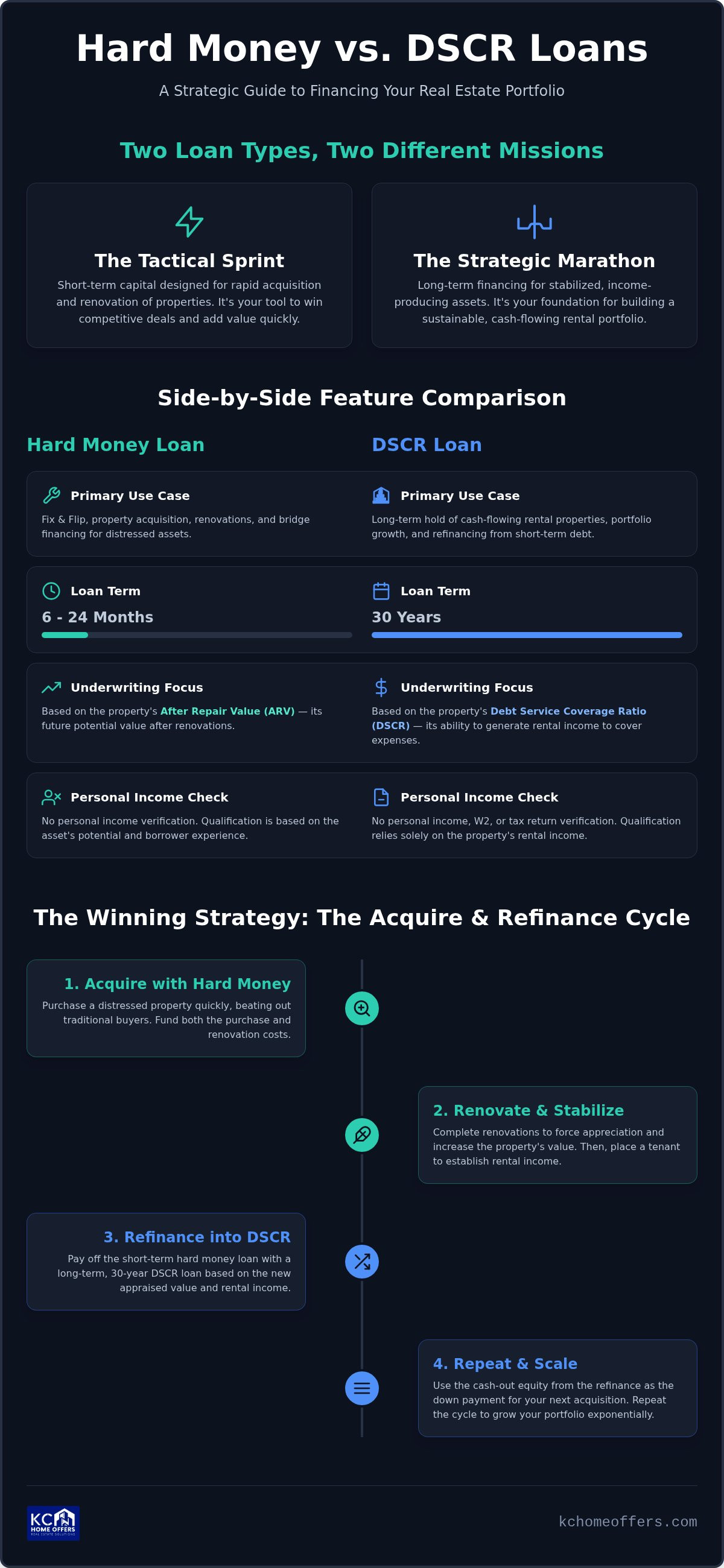
The primary differentiator between these two lies in the timeline and the underwriting focus. Hard money is your tactical sprint; it's designed to get you into a deal fast. DSCR is your strategic marathon; it's designed to keep you in the deal profitably. While traditional banks fail because they can't see past a W2, private capital thrives by analyzing either the property's potential or its current rental yield. This flexibility allows you to bypass the "10-loan limit" that restricts many investors using conventional financing.
What is a Hard Money Loan?
A hard money loan acts as short-term bridge financing, typically spanning 6 to 24 months. Unlike traditional loans that look at a property's current "as-is" condition, hard money lenders focus on the After Repair Value (ARV). This allows you to purchase distressed properties that aren't currently habitable. Speed is the main advantage here. You can often secure funding in days rather than months, which is essential for winning competitive bids. These loans are typically interest-only, which keeps your monthly carrying costs lower during the renovation phase.
What is a DSCR Loan?
A DSCR (Debt Service Coverage Ratio) loan is a long-term financing solution, often structured as a 30-year fixed mortgage or an Adjustable Rate Mortgage (ARM). It's the gold standard for stabilized rental properties. Qualification is straightforward: the property's gross monthly rent must cover the monthly mortgage, taxes, insurance, and association dues (PITIA). Because the loan is based on the property's income, there's no personal income, DTI, or employment verification required. This makes it an ideal tool for investors who don't have traditional W2 income but possess cash-flowing assets. It provides the stability needed to build generational wealth without the constant pressure of a looming balloon payment.
The Hard Money Advantage: Speed and Leverage for Acquisition
Hard money is the fuel for the acquisition phase of your investment cycle. While the debate of hard money loan vs DSCR loan often centers on interest rates, savvy investors prioritize deal access above all else. If you can't close, the rate doesn't matter. Hard money provides a "cash-like" offer that allows you to close in as little as 7 to 14 days. In a competitive 2026 market, this speed beats out buyers relying on traditional financing every time. It's about winning the deal first and worrying about long-term debt later.
Traditional lenders require properties to be "habitable" to qualify for funding. This means no missing flooring, no leaking roofs, and no stripped copper. Hard money lenders operate differently by focusing on the After Repair Value (ARV). They fund the purchase and often a significant portion of the renovation costs for distressed assets. This is the core engine behind the Fix & Flip model. You leverage the future value of the home rather than its current, broken state. This access to capital allows you to take on projects that would be impossible with bank financing.
When Hard Money is the Only Choice
Some deals simply won't wait for a 30-day appraisal or a deep dive into your tax returns. Auctions, pre-foreclosures, and major structural overhauls require immediate liquidity. If you're wondering how do hard money loans work in these high-pressure scenarios, it comes down to asset-based underwriting. The lender cares more about the equity and the specific deal than your personal debt-to-income ratio. This makes it the only viable path for properties that need to be "rescued" before they can be rented.
Hard Money Requirements and Terms
Expect to bring some "skin in the game" when using this type of leverage. Down payments typically range from 10% to 20% of the total project cost, and lenders charge origination fees, often called "points," at closing. While these costs are higher than long-term debt, they're the price of speed and flexibility. When comparing a hard money loan vs DSCR loan, remember that hard money is a temporary bridge. Your exit strategy is the most important requirement. You must have a clear plan to either sell the asset for a profit or refinance it into a permanent loan. If you're ready to secure your next acquisition, you can explore our fix and flip options to see how we can accelerate your next deal.
DSCR Loans: The Gold Standard for Long-Term Rental Growth
Scaling a rental portfolio requires a shift from acquisition speed to operational stability. While hard money provides the initial spark for a deal, DSCR loans serve as the foundation for long-term wealth. Many investors hit a "ceiling" with traditional banks after their fourth or tenth property because of strict debt-to-income (DTI) limits. DSCR financing bypasses these hurdles entirely. Because these are business-purpose loans, they don't appear on your personal credit report in the same way, allowing you to scale an unlimited rental portfolio as long as the assets themselves are profitable.
In 2026, locking in long-term rates is a vital strategy to protect against market volatility. For self-employed investors or those with complex tax returns, the "No Income Verification" aspect is a game-changer. You don't need to provide years of tax documents or prove a steady W2 salary. The lender's primary concern is whether the property can pay for itself. When weighing a hard money loan vs DSCR loan, remember that the latter is designed to be your permanent debt solution, offering 30-year fixed terms that provide predictable cash flow for decades.
Calculating the Ratio: What Lenders Look For
The Debt Service Coverage Ratio is a financial metric used by lenders to determine if a property's rental income is sufficient to cover its total debt obligations. To find this number, you divide the gross monthly rent by the full PITIA payment (Principal, Interest, Taxes, Insurance, and any HOA dues). Lenders typically look for a magic ratio between 1.0x and 1.25x. A ratio of 1.0x means the property breaks even, while 1.25x indicates the property generates 25% more income than its debt costs. Achieving a higher ratio often unlocks more favorable interest rates and higher Loan-to-Value (LTV) options, as it represents a lower risk to the lender.
The 'Rent-Ready' Requirement
Unlike hard money, which thrives on distressed assets, a DSCR loan requires the property to be in "rent-ready" condition at the time of funding. The property must be habitable and capable of generating immediate income. During the appraisal process, the lender will request a 1007 Rent Schedule. This document confirms the fair market rent for the area, ensuring the projected income is realistic and supported by local data. If you are moving a property from a renovation phase into a holding phase, check our DSCR loan for rental property guide for a full requirement checklist to ensure your asset meets the necessary standards for long-term financing.
Side-by-Side Comparison: Rates, Terms, and Requirements
Choosing between a hard money loan vs DSCR loan requires a cold look at your balance sheet and your project calendar. Speed is the primary differentiator. A hard money loan can move from application to funding in 7 to 10 days; a DSCR loan typically requires 21 to 30 days because of the more rigorous appraisal and title requirements associated with long-term debt. Payment structures also diverge sharply. Hard money is almost exclusively interest-only; this maximizes your cash flow during a renovation. DSCR loans are usually fully amortized over 30 years, though some 40-year options exist. You are trading higher short-term costs for the security of a fixed rate that won't change for three decades.
Your capital requirement depends on how the lender views the asset. For a hard money acquisition, you'll likely need 10% to 15% of the total project cost. This includes the purchase price and the renovation budget, often referred to as Loan to Cost (LTC). Conversely, a DSCR loan is based on the appraised value, or Loan to Value (LTV). You should expect to bring 20% to 25% of that value as a down payment. This higher equity requirement reflects the lender's need for a safety buffer on a long-term commitment. If you need to move quickly on a distressed asset, you can apply for investor financing today to secure your leverage.
The Investor Decision Matrix
The choice often boils down to three simple questions. First, is the property currently generating rent? If the answer is no, a DSCR lender won't fund it; you need hard money to bridge the gap until it's "rent-ready." Second, is the goal a quick flip or a long-term hold? Flips require the flexibility of short-term debt, while holds require the stability of amortized payments. Finally, do you need funding in under 10 days? If you're competing against cash buyers at an auction or a pre-foreclosure sale, hard money is your only viable path. Matching the tool to the timeline is how successful investors maintain their momentum.
Prepayment Penalties and Exit Fees
The "exit cost" is a vital factor in the hard money loan vs DSCR loan debate. Hard money lenders prioritize capital velocity. They want you to finish your project and pay them back so they can re-deploy that capital. Consequently, these loans often have no prepayment penalties. You pay for the months you use and nothing more. DSCR lenders, however, are looking for predictable yield over a long horizon. They often utilize a step-down penalty structure, such as 5-4-3-2-1. This means if you refinance or sell in year one, you pay a 5% penalty; in year two, it drops to 4%, and so on. Understanding these fees is essential if you plan to sell the property within a few years rather than holding it for the full term.
Strategic Financing: When to Use Hard Money vs. DSCR
Successful 2026 investors don't view the hard money loan vs DSCR loan choice as a binary decision. Instead, they treat these products as sequential steps in a broader wealth-building cycle. The most effective strategy for building a portfolio is the BRRRR method: Buy, Rehab, Rent, Refinance, Repeat. This involves using a hard money loan to secure a distressed asset and fund the renovations, then transitioning into a DSCR loan once the property is stabilized and cash-flowing. This sequence allows you to maximize your leverage while minimizing the amount of personal capital tied up in any single deal.
Another advanced tactic is the "Delayed Financing" strategy. In highly competitive markets, you might use cash or a high-leverage hard money loan to close in days, beating out traditional buyers who are stuck in underwriting. Once you have control of the asset, you immediately apply for a DSCR loan to recoup your initial capital. This approach combines the aggressive speed of private bridge debt with the long-term safety of institutional-grade rental financing. Working with a lender like KC Home Offers LLC, who understands both sides of this coin, ensures that your transition from acquisition to permanent debt is seamless and efficient.
The Refinance Bridge: Moving from Hard Money to DSCR
Timing is everything when moving from a bridge loan to permanent debt. You shouldn't wait until the final inspection is signed off to start your next application. We recommend initiating the DSCR process as your rehab enters its final 30 days. This proactive approach minimizes the time you're paying higher interest rates on your bridge debt. You should also account for seasoning requirements. While some lenders allow for immediate refinancing based on the purchase price, most require a 6-month seasoning period to use the new, higher appraised value for your loan-to-value calculation. For detailed advice on managing your renovation budget during this phase, check out our guide on fix and flip funding.
Building a Long-Term Relationship with Your Lender
The most successful investors in 2026 prioritize "one-stop-shop" lending. When your lender understands both your acquisition strategy and your long-term goals, they can move with much greater speed. Consistent deal flow with KC Home Offers LLC often leads to streamlined paperwork and more favorable terms over time. It removes the friction of re-explaining your business model for every new deal. If you're looking to scale your portfolio with a strategic ally who understands the nuances of the hard money loan vs DSCR loan transition, it's time to take action. Apply for a DSCR or Hard Money loan today to get your next deal funded.
Master Your 2026 Financing Strategy
Success in the current real estate market requires more than just finding the right property; it requires the right capital structure. Deciding between a hard money loan vs DSCR loan isn't about finding a superior product, but about matching the specific tool to your current project phase. Use hard money to win competitive bids and transform distressed assets. Transition into DSCR financing to lock in long-term stability and protect your cash flow without the burden of traditional W2 requirements.
By mastering this transition, you remove the friction that stalls most portfolios. You don't have to wait for slow bank approvals or worry about personal income verification when you have a partner that understands the speed of the investor market. KC Home Offers LLC provides the specialized expertise needed to navigate both acquisition and long-term holding with transparency and efficiency. This strategic approach ensures your capital remains fluid and your growth remains consistent.
Ready to move your next deal forward? Scale Your Portfolio with KC Home Offers LLC today. Our team delivers fast, transparent approvals and investor-focused terms for 2026 without requiring personal income verification. Your growth is our priority, and we're here to provide the leverage you need to win.
Frequently Asked Questions
Can I use a DSCR loan for a property that needs major repairs?
No, you typically cannot use a DSCR loan for distressed properties requiring significant structural or cosmetic work. These loans require the asset to be "rent-ready" and habitable at the time of funding. Lenders need to see immediate rental income potential to calculate the coverage ratio. For properties needing major repairs, a fix-and-flip loan is the appropriate tool. You can transition to long-term financing once the renovation is complete and a tenant is in place.
What is the minimum credit score for a hard money loan vs. a DSCR loan?
DSCR loans typically require a minimum credit score between 620 and 680 to qualify for the most competitive terms. Hard money loans are much more flexible because they are asset-based. While some hard money lenders still perform a credit check, they prioritize the property's equity and your experience over a specific score. This makes hard money a viable path for investors with lower scores who have a strong deal and a solid plan for renovation.
Do I need a W2 job to qualify for either of these loans?
You don't need a W2 job to qualify for either financing option. Hard money lenders focus on the asset's value and your specific exit strategy. DSCR loans specifically use the property's rental income to qualify the deal rather than your personal salary or employment history. This "no income verification" approach is why these products are the gold standard for self-employed real estate investors looking to scale their portfolios quickly without traditional documentation hurdles.
How fast can a hard money loan close compared to a DSCR loan?
Hard money loans can close in as little as 7 to 14 days because the underwriting process is streamlined and focused primarily on the property asset. DSCR loans usually take 21 to 35 days to reach the finish line. This longer timeline is due to the requirement for a full appraisal, a 1007 rent schedule, and more extensive title work. Speed is the primary advantage of choosing a hard money loan vs DSCR loan during a competitive acquisition phase.
Is hard money always more expensive than a DSCR loan?
Hard money usually carries higher interest rates and origination points because it represents higher risk and shorter terms for the lender. However, it's often "cheaper" when you consider opportunity cost. If the speed of hard money allows you to secure a deeply discounted distressed property that a DSCR lender wouldn't touch, the profit margin on the deal often far outweighs the higher cost of capital. It's a tactical tool for acquisition, not long-term holding.
Can I hold a DSCR loan in an LLC?
Yes, holding a DSCR loan in an LLC is standard practice and often encouraged by private lenders. Closing in a business entity provides a layer of liability protection and aligns with the business-purpose nature of these non-QM loan products. Many lenders actually require the loan to be in an LLC name to ensure it remains a commercial transaction. This structure also makes it easier to manage multiple properties as you scale your rental portfolio nationally.
What happens if I can't refinance my hard money loan into a DSCR loan?
If you can't refinance, you must pivot to your secondary exit strategy, which usually involves selling the property to pay off the debt. Hard money loans include balloon payments, so you need a clear path to satisfy the balance before the term ends. If the property doesn't meet the "rent-ready" standards for a DSCR loan, you might need to complete more renovations or adjust your asking rent to meet the required debt service coverage ratio.
Are there prepayment penalties on hard money loans?
Most hard money loans don't have prepayment penalties because the lender's goal is capital velocity. They want you to finish the project and pay them back quickly so they can re-deploy those funds into the next deal. This flexibility allows you to exit the loan as soon as your rehab is complete. In contrast, DSCR loans often include step-down penalties, like a 5-4-3-2-1 structure, to ensure the lender receives a predictable yield over a longer horizon.
Frequently asked
What is a Hard Money Loan?
A hard money loan acts as short-term bridge financing, typically spanning 6 to 24 months. Unlike traditional loans that look at a property's current "as-is" condition, hard money lenders focus on the After Repair Value (ARV). This allows you to purchase distressed properties that aren't currently habitable. Speed is the main advantage here. You can often secure funding in days rather than months, which is essential for winning competitive bids. These loans are typically interest-only, which keeps your monthly carrying costs lower during the renovation phase.
What is a DSCR Loan?
A DSCR (Debt Service Coverage Ratio) loan is a long-term financing solution, often structured as a 30-year fixed mortgage or an Adjustable Rate Mortgage (ARM). It's the gold standard for stabilized rental properties. Qualification is straightforward: the property's gross monthly rent must cover the monthly mortgage, taxes, insurance, and association dues (PITIA). Because the loan is based on the property's income, there's no personal income, DTI, or employment verification required. This makes it an ideal tool for investors who don't have traditional W2 income but possess cash-flowing assets. It provides the stability needed to build generational wealth without the constant pressure of a looming balloon payment. Hard money is the fuel for the acquisition phase of your investment cycle. While the debate of hard money loan vs DSCR loan often centers on interest rates, savvy investors prioritize deal access above all else. If you can't close, the rate doesn't matter. Hard money provides a "cash-like" offer that allows you to close in as little as 7 to 14 days. In a competitive 2026 market, this speed beats out buyers relying on traditional financing every time. It's about winning the deal first and worrying about long-term debt later. Traditional lenders require properties to be "habitable" to qualify for funding. This means no missing flooring, no leaking roofs, and no stripped copper. Hard money lenders operate differently by focusing on the After Repair Value (ARV). They fund the purchase and often a significant portion of the renovation costs for distressed assets. This is the core engine behind the Fix & Flip model. You leverage the future value of the home rather than its current, broken state. This access to capital allows you to take on projects that would be impossible with bank financing.
Can I use a DSCR loan for a property that needs major repairs?
No, you typically cannot use a DSCR loan for distressed properties requiring significant structural or cosmetic work. These loans require the asset to be "rent-ready" and habitable at the time of funding. Lenders need to see immediate rental income potential to calculate the coverage ratio. For properties needing major repairs, a fix-and-flip loan is the appropriate tool. You can transition to long-term financing once the renovation is complete and a tenant is in place.
What is the minimum credit score for a hard money loan vs. a DSCR loan?
DSCR loans typically require a minimum credit score between 620 and 680 to qualify for the most competitive terms. Hard money loans are much more flexible because they are asset-based. While some hard money lenders still perform a credit check, they prioritize the property's equity and your experience over a specific score. This makes hard money a viable path for investors with lower scores who have a strong deal and a solid plan for renovation.
Do I need a W2 job to qualify for either of these loans?
You don't need a W2 job to qualify for either financing option. Hard money lenders focus on the asset's value and your specific exit strategy. DSCR loans specifically use the property's rental income to qualify the deal rather than your personal salary or employment history. This "no income verification" approach is why these products are the gold standard for self-employed real estate investors looking to scale their portfolios quickly without traditional documentation hurdles.
How fast can a hard money loan close compared to a DSCR loan?
Hard money loans can close in as little as 7 to 14 days because the underwriting process is streamlined and focused primarily on the property asset. DSCR loans usually take 21 to 35 days to reach the finish line. This longer timeline is due to the requirement for a full appraisal, a 1007 rent schedule, and more extensive title work. Speed is the primary advantage of choosing a hard money loan vs DSCR loan during a competitive acquisition phase.
Is hard money always more expensive than a DSCR loan?
Hard money usually carries higher interest rates and origination points because it represents higher risk and shorter terms for the lender. However, it's often "cheaper" when you consider opportunity cost. If the speed of hard money allows you to secure a deeply discounted distressed property that a DSCR lender wouldn't touch, the profit margin on the deal often far outweighs the higher cost of capital. It's a tactical tool for acquisition, not long-term holding.
Can I hold a DSCR loan in an LLC?
Yes, holding a DSCR loan in an LLC is standard practice and often encouraged by private lenders. Closing in a business entity provides a layer of liability protection and aligns with the business-purpose nature of these non-QM loan products. Many lenders actually require the loan to be in an LLC name to ensure it remains a commercial transaction. This structure also makes it easier to manage multiple properties as you scale your rental portfolio nationally.
What happens if I can't refinance my hard money loan into a DSCR loan?
If you can't refinance, you must pivot to your secondary exit strategy, which usually involves selling the property to pay off the debt. Hard money loans include balloon payments, so you need a clear path to satisfy the balance before the term ends. If the property doesn't meet the "rent-ready" standards for a DSCR loan, you might need to complete more renovations or adjust your asking rent to meet the required debt service coverage ratio.
Are there prepayment penalties on hard money loans?
Most hard money loans don't have prepayment penalties because the lender's goal is capital velocity. They want you to finish the project and pay them back quickly so they can re-deploy those funds into the next deal. This flexibility allows you to exit the loan as soon as your rehab is complete. In contrast, DSCR loans often include step-down penalties, like a 5-4-3-2-1 structure, to ensure the lender receives a predictable yield over a longer horizon.
Need financing on a deal like this?
DSCR, fix & flip and new construction loans, underwritten on the deal rather than your tax returns. Soft credit pull only.
Apply in 5 minutes