Guides › Private lending
DSCR Loans With No Personal Income Verification: Who Qualifies

Explore how a DSCR loan no personal income verification works for rental investors. Learn underwriting standards, property cash flow needs, and how to qualify.
Could a DSCR loan no personal income verification still involve a close review of your application? Yes. This financing approach can reduce reliance on personal tax returns or pay stubs, but qualification is not automatic, and the lending partner may review more than the property alone.
If you’re self-employed, have complex tax returns, or want to understand what documentation a rental-property loan may require, that distinction matters. A lending partner may focus on the property’s rental income while also reviewing borrower and property details as part of underwriting. Requirements vary by partner and loan program.
This guide explains how rental cash flow relates to DSCR qualification, what information may still be reviewed, and how to prepare a focused application. It also covers how to assess whether a property’s income may support financing. KC Home Offers connects real estate investors with lending partners for DSCR rental loans. Any loan is subject to the lending partner’s approval.
Key Takeaways
- A DSCR loan no personal income verification can shift attention toward rental-property performance, but underwriting still applies.
- Assess a property’s income potential alongside its details to understand how it may support financing.
- Organize property, rental, transaction, and ownership information. Document requests vary by lending partner.
- Use a preparation sequence to identify information that may be relevant before submitting an application.
- KC Home Offers connects investors with lending partners for DSCR loans, and the lending partner makes the approval decision.
Table of Contents
- What Does a DSCR Loan With No Personal Income Verification Mean?
- How DSCR Underwriting Can Work Without Relying on Personal Income
- Personal-Income Documentation vs. Other DSCR Loan Qualification Factors
- A Practical Checklist for Preparing a DSCR Loan Application
- How KC Home Offers Connects Investors With DSCR Lending Partners
What Does a DSCR Loan With No Personal Income Verification Mean?
A debt service coverage ratio (DSCR) loan is business-purpose financing evaluated in relation to a rental property’s income and debt obligations. Instead of making the borrower’s personal earnings the main measure of repayment capacity, the lending partner considers whether the property’s income can support its financing obligations. A DSCR loan no personal income verification approach may place less emphasis on personal income documents, but it does not remove the application review.
In short, “no personal income verification” refers to how income is documented, not to an absence of qualification checks. A program may not require personal tax returns or pay stubs to verify earnings, while still assessing the property, transaction, and other borrower information. The scope depends on the lending partner and the specific loan program.
This distinction can matter to investors whose tax returns do not neatly reflect their available cash flow or whose earnings come from multiple sources. It also sets a realistic expectation: rental income is important, but it may not be the only factor considered. Property type, ownership structure, and transaction details may also enter the review, depending on the application.
How a property’s cash flow enters the DSCR discussion
DSCR compares qualifying property income with the debt service used in the calculation. In plain language, it helps show how much rental income is available relative to the property’s financing obligations. A ratio above 1 indicates that the income used in the calculation exceeds those obligations; a ratio below 1 indicates that it falls short. The Debt Service Coverage Ratio (DSCR) is also used in other financial contexts, and calculation details can vary.
For a rental application, the lending partner determines which income figures and debt obligations count. For example, it may assess documented rent or another qualifying rent figure alongside its defined debt-service calculation. Do not assume every lending partner uses the same inputs or requires the same ratio. A property’s apparent cash flow is a starting point for evaluation, not an approval decision on its own.
What “no personal income verification” does not promise
The phrase does not guarantee approval, eliminate underwriting, or mean the lending partner will disregard the borrower. Even when personal earnings are not verified through tax returns or pay stubs, the partner may review other information relevant to the borrower, property, ownership, or transaction. Documents and criteria differ by program.
Think of it as a shift in emphasis, not a waiver of review. The property’s income potential may be central, while other details help the lending partner evaluate the proposed financing as a whole. Requirements can vary with the property, transaction, and loan program, so one program’s process should not be treated as a universal DSCR rule.
How DSCR Underwriting Can Work Without Relying on Personal Income
When personal income documentation is less central, the lending partner still needs a basis for assessing the rental-property transaction. The process generally starts with details about the property and its rent, then moves through the partner’s calculation and review criteria before an application decision. The exact sequence and information considered vary by loan program and transaction.
DSCR describes how property income may cover debt obligations, not whether a loan is approved. A rent projection that looks strong does not settle the application. The lending partner evaluates the information using its own underwriting approach.
How rental income and debt obligations inform the review
The lending partner may compare qualifying rental income with the proposed debt payments to calculate the property’s DSCR. The general concept is straightforward, but the inputs are not universal. For an overview of the ratio and how it may inform financing decisions, see Understanding DSCR for Investors.
Rent information can differ in strength and context. An existing lease shows what a tenant is contractually expected to pay, while an estimate for a vacant property reflects projected rent rather than current lease income. A lending partner may treat those sources differently or apply its own standards to determine which rent qualifies. It may also define debt service and relevant expenses according to its program. Do not assume a particular rent figure or calculation method will apply across lending partners.
Why property and borrower factors may still matter
Property cash flow is one part of the picture. Depending on the program and transaction, the lending partner may also consider the property’s value and condition, the requested loan relative to that value, borrower credit, available liquidity, or reserves. These factors can shape how the partner views the transaction even when personal earnings are not the central qualification measure.
Other details may matter too. Sponsor experience, ownership structure, and property condition can be relevant review areas, but their role is not identical across programs. For example, a recently acquired rental and a property with an established lease history may present different information for review. That does not determine how either application will be decided; it shows why the facts of the transaction matter.
A practical way to think about the process is as a sequence:
- Describe the asset: Identify the property and provide the details requested for its evaluation.
- Document rent context: Distinguish current lease information from estimates or projections.
- Outline the transaction: Present the proposed financing and ownership details clearly.
- Complete partner review: The lending partner evaluates the submitted information under its program criteria and makes the application decision.
For investors exploring a DSCR loan no personal income approach, organizing property and rent details is a useful starting point. Keep expectations grounded in the partner’s full review. KC Home Offers connects investors with lending partners for business-purpose DSCR rental loans. Explore DSCR rental financing connections. Any loan is subject to the lending partner’s approval.
Personal-Income Documentation vs. Other DSCR Loan Qualification Factors
A DSCR review can place less weight on personal earnings than some other financing approaches, but that does not mean every part of the application receives less scrutiny. Separate the information into categories: personal-income documents, property income, property details, and other possible review areas. This makes it easier to see what a “no personal income verification” program may change and what it may leave in place.
| Review category | What it may involve | Why it matters |
|---|---|---|
| Personal-income documentation | Tax returns, pay stubs, employment details, or other income records, depending on the program | Personal earnings may be less central to repayment analysis, but document rules vary by lending partner. |
| Property income | Lease information or other evidence used to assess qualifying rental income | It helps the lending partner evaluate the property’s income relative to its debt obligations. |
| Property details | Property type, value, condition, and transaction information | These details help establish what asset is being financed and how the transaction is structured. |
| Other possible review areas | Credit, liquidity, reserves, leverage, and ownership structure | These may inform the partner’s assessment of the borrower and the overall application. |
Which financial details may be less central?
In some DSCR programs, the property’s qualifying income is a primary repayment measure, so a borrower’s personal income may receive less emphasis. That does not establish a universal document exemption. One lending partner may not rely on personal tax returns or pay stubs for a particular program, while another may request personal or employment information as part of its process. Requirements depend on the program and application.
For someone considering a DSCR loan no personal income option, the practical question is not simply whether personal income is reviewed. It is how the specific program treats that documentation and what other parts of the application need to support the proposed financing.
Which qualification questions can remain?
A strong rent picture can support the property-income analysis, but it may not resolve questions about credit, available liquidity, reserves, leverage, or ownership structure. Property eligibility and rent evidence are also distinct from personal earnings: the lending partner may assess whether the asset fits its program and how the rental income is substantiated.
Keep these categories separate as you assess a deal. For example, a property could appear to generate enough income for its proposed debt while still raising a question about leverage, condition, or the borrower’s available reserves. That is not a prediction about approval; it shows why one favorable factor does not necessarily answer every underwriting question.
Finally, income verification and recourse are separate loan features. Recourse concerns whether the borrower may have personal liability under the loan terms; it does not determine whether personal income documents are required. A DSCR program’s income-documentation approach should not be taken as proof of its recourse structure. Review each aspect independently, since the lending partner sets the applicable requirements and terms.
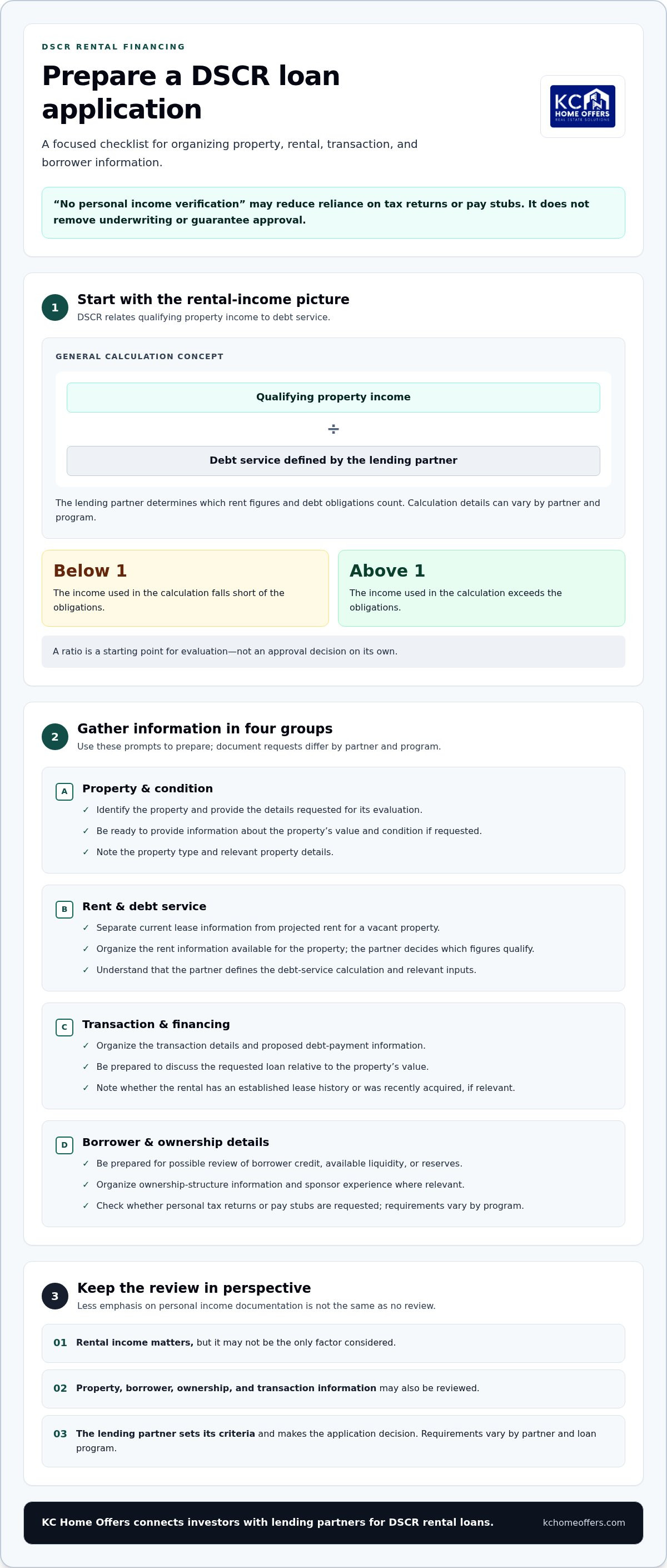
A Practical Checklist for Preparing a DSCR Loan Application
A focused application presents the property and transaction clearly and can reduce avoidable follow-up about basic details. Use this sequence to organize your information. The items below are examples, not universal document requirements; the lending partner and program determine what applies.
- Identify the property and its status. Gather the property address, type, current occupancy, and available information about its condition and value. Note whether it is vacant, tenant-occupied, or being acquired. These details give the lending partner a clear starting point for reviewing the asset and transaction.
- Separate established rent from estimates. Collect available lease information and records that support current rental income. If the property is vacant or you are using a rent projection, label the figure as an estimate rather than presenting it as rent already being collected. This distinction keeps the application accurate and gives the partner context for its review.
- Outline the proposed financing and obligations. Organize current transaction details, such as the purchase or refinance context, requested financing information, and known property-related debt obligations. Keep figures tied to the current deal, and flag anything that is still an estimate or subject to change. Clear inputs make it easier to understand how the transaction is presented.
- Prepare borrower and ownership information. Gather relevant details about the borrower and any ownership entity involved. Credit, liquidity, and reserves may be part of a lending partner’s review, so keep related information organized if available. Examples might include entity records or account information, but documents requested vary by program.
- Clarify the income-documentation approach. Identify which personal-income documents the specific program uses, if any, before assembling personal financial records. Tax returns, pay stubs, and employment details are not automatically waived across all DSCR programs. Understanding the program’s documentation scope helps you prepare without treating “no personal income verification” as a blanket rule.
Before submitting information, review the package for consistency. Check that the property status matches the rent evidence, projected figures are clearly labeled, and the borrower or ownership entity is described consistently throughout. If something is incomplete, identify it rather than filling the gap with an unsupported assumption.
This preparation can help investors evaluate whether a DSCR loan no personal income program may fit the transaction, but it cannot establish eligibility on its own. Requirements vary by lending partner, property, and loan program, and the lending partner makes the application decision.
KC Home Offers connects real estate investors with lending partners for business-purpose DSCR rental loans. Explore DSCR loan options.
How KC Home Offers Connects Investors With DSCR Lending Partners
KC Home Offers connects real estate investors with lending partners for business-purpose DSCR rental loans. The company helps investors explore a financing path for a rental-property transaction, while the lending partner evaluates the application and decides whether to approve it.
That distinction matters if you’re considering a DSCR loan no personal income program. A connection to a lending partner does not establish that personal-income documents will be waived or that a property and borrower meet the partner’s criteria. Program requirements, documentation requests, and review steps depend on the lending partner and transaction.
What investors can expect from a lending-partner connection
A useful starting point is a clear picture of the investment property and your financing goal. Note whether you’re evaluating a purchase or an existing rental, what rent information is available, and what stage the transaction has reached. These details help frame the financing discussion. They do not replace the partner’s underwriting or guarantee a particular program, rate, term, or result.
Investors can also use the DSCR rental-property loan guide to review broader considerations for this type of financing. As you evaluate the fit, keep the roles clear: KC Home Offers connects investors with lending partners, while the partner sets its program criteria, requests applicable documents, and makes the lending decision.
Before discussing the transaction, organize a few key points:
- Property: Identify the rental property and its current status.
- Rent: Distinguish lease information from projected or estimated rent.
- Financing goal: Describe the transaction you’re considering and the financing you’re seeking.
- Ownership: Note the borrower or ownership entity involved, if applicable.
These details create a focused starting point without assuming every lending partner uses the same application requirements. The partner may request additional information based on its program and the transaction. Keep estimates clearly labeled, and describe the property and deal as they stand rather than presenting assumptions as established facts.
Choose a clear next step for the property
Consider what you need to determine next: whether the property’s rental profile may support the financing you’re exploring, what information may be needed for the review, or how the proposed transaction fits your investment plan. Sharing the property context and financing goal can make the discussion more specific. Approval, rates, terms, and timing are not guaranteed; all financing remains subject to lending-partner review and approval.
To discuss DSCR financing for your investment property, share your rental-property financing goals with KC Home Offers.
Turn Your Rental-Property Plan Into a Clear Next Step
Use your financing review to test the deal against your investment plan. Consider how the property’s income, expected obligations, and ownership structure fit your goals, then identify what information would help clarify the next decision. A DSCR loan no personal income option may suit some rental transactions, but the specific program and lending partner’s review will shape the path forward.
KC Home Offers connects real estate investors with lending partners for business-purpose DSCR loans. The connection is a starting point, not a lending decision; financing remains subject to the lending partner’s approval. Bring your property details and transaction context into the conversation so you can focus on the questions that matter for your investment.
Explore a financing path for your rental property, and take your next step with a clearer view of the opportunity.
Frequently Asked Questions
Can I get a DSCR loan if I have no personal income?
Possibly, if the rental property and the rest of the application meet the lending partner’s criteria. A DSCR program may assess the property’s income rather than require personal earnings to be the main repayment measure. Having no personal income does not establish eligibility, though. For a DSCR loan no personal income application, the partner may still consider factors such as credit, property fit, and transaction details. The lending partner makes the approval decision.
Does a DSCR loan require tax returns or pay stubs?
Not necessarily, but document requirements depend on the lending partner and loan program. Some DSCR programs may place less emphasis on personal tax returns or pay stubs, while others may request personal or employment information as part of their review. The program determines which personal-income documents apply. Also prepare for separate property and transaction documentation, which is not the same as proof of personal earnings.
What happens if the rental income does not cover the proposed debt payment?
The property may not meet that lending partner’s DSCR criteria, which could affect the application decision. The partner may assess the rent figure and debt calculation using its own program rules, so distinguish documented rent from an estimate and use current proposed payment information. If the gap remains, revisit the deal assumptions or financing plan before proceeding. A shortfall does not automatically determine the outcome across every program.
Can a first-time real estate investor apply for a DSCR loan?
Yes, a first-time investor may apply, but applying does not guarantee qualification. The lending partner may give attention to the borrower’s credit, available funds, property details, and ownership plan. Prepare a clear account of who will own the property and how it will be operated as a rental. Experience is one possible review area; the partner’s program criteria and the full transaction determine the decision.
Can a DSCR loan use projected rent for a property that is not yet leased?
Possibly. A lending partner may consider a rent estimate for a vacant property, but its program determines whether and how projected rent can be used. Keep projections clearly labeled and separate them from signed lease income or rent already being collected. For example, if renovations are still underway, explain the property’s current status rather than presenting a future rent figure as established income. The partner decides what evidence it will accept.
Does no personal income verification mean a DSCR loan is non-recourse?
No. Income-documentation rules and recourse terms are separate loan features. “No personal income verification” describes how a program may handle income documents; it does not establish whether a borrower has personal liability under the loan terms. Review the financing documents to understand recourse separately from qualification and documentation. The lending partner determines the applicable terms, and approval remains subject to its review.
Frequently asked
Which financial details may be less central?
In some DSCR programs, the property’s qualifying income is a primary repayment measure, so a borrower’s personal income may receive less emphasis. That does not establish a universal document exemption. One lending partner may not rely on personal tax returns or pay stubs for a particular program, while another may request personal or employment information as part of its process. Requirements depend on the program and application. For someone considering a DSCR loan no personal income option, the practical question is not simply whether personal income is reviewed. It is how the specific program treats that documentation and what other parts of the application need to support the proposed financing.
Which qualification questions can remain?
A strong rent picture can support the property-income analysis, but it may not resolve questions about credit, available liquidity, reserves, leverage, or ownership structure. Property eligibility and rent evidence are also distinct from personal earnings: the lending partner may assess whether the asset fits its program and how the rental income is substantiated. Keep these categories separate as you assess a deal. For example, a property could appear to generate enough income for its proposed debt while still raising a question about leverage, condition, or the borrower’s available reserves. That is not a prediction about approval; it shows why one favorable factor does not necessarily answer every underwriting question. Finally, income verification and recourse are separate loan features. Recourse concerns whether the borrower may have personal liability under the loan terms; it does not determine whether personal income documents are required. A DSCR program’s income-documentation approach should not be taken as proof of its recourse structure. Review each aspect independently, since the lending partner sets the applicable requirements and terms. A focused application presents the property and transaction clearly and can reduce avoidable follow-up about basic details. Use this sequence to organize your information. The items below are examples, not universal document requirements; the lending partner and program determine what applies. Before submitting information, review the package for consistency. Check that the property status matches the rent evidence, projected figures are clearly labeled, and the borrower or ownership entity is described consistently throughout. If something is incomplete, identify it rather than filling the gap with an unsupported assumption. This preparation can help investors evaluate whether a DSCR loan no personal income program may fit the transaction, but it cannot establish eligibility on its own. Requirements vary by lending partner, property, and loan program, and the lending partner makes the application decision. KC Home Offers connects real estate investors with lending partners for business-purpose DSCR rental loans. Explore DSCR loan options. Any loan is subject to the lending partner’s approval. KC Home Offers connects real estate investors with lending partners for business-purpose DSCR rental loans. The company helps investors explore a financing path for a rental-property transaction, while the lending partner evaluates the application and decides whether to approve it. That distinction matters if you’re considering a DSCR loan no personal income program. A connection to a lending partner does not establish that personal-income documents will be waived or that a property and borrower meet the partner’s criteria. Program requirements, documentation requests, and review steps depend on the lending partner and transaction.
Can I get a DSCR loan if I have no personal income?
Possibly, if the rental property and the rest of the application meet the lending partner’s criteria. A DSCR program may assess the property’s income rather than require personal earnings to be the main repayment measure. Having no personal income does not establish eligibility, though. For a DSCR loan no personal income application, the partner may still consider factors such as credit, property fit, and transaction details. The lending partner makes the approval decision.
Does a DSCR loan require tax returns or pay stubs?
Not necessarily, but document requirements depend on the lending partner and loan program. Some DSCR programs may place less emphasis on personal tax returns or pay stubs, while others may request personal or employment information as part of their review. The program determines which personal-income documents apply. Also prepare for separate property and transaction documentation, which is not the same as proof of personal earnings.
What happens if the rental income does not cover the proposed debt payment?
The property may not meet that lending partner’s DSCR criteria, which could affect the application decision. The partner may assess the rent figure and debt calculation using its own program rules, so distinguish documented rent from an estimate and use current proposed payment information. If the gap remains, revisit the deal assumptions or financing plan before proceeding. A shortfall does not automatically determine the outcome across every program.
Can a first-time real estate investor apply for a DSCR loan?
Yes, a first-time investor may apply, but applying does not guarantee qualification. The lending partner may give attention to the borrower’s credit, available funds, property details, and ownership plan. Prepare a clear account of who will own the property and how it will be operated as a rental. Experience is one possible review area; the partner’s program criteria and the full transaction determine the decision.
Can a DSCR loan use projected rent for a property that is not yet leased?
Possibly. A lending partner may consider a rent estimate for a vacant property, but its program determines whether and how projected rent can be used. Keep projections clearly labeled and separate them from signed lease income or rent already being collected. For example, if renovations are still underway, explain the property’s current status rather than presenting a future rent figure as established income. The partner decides what evidence it will accept.
Does no personal income verification mean a DSCR loan is non-recourse?
No. Income-documentation rules and recourse terms are separate loan features. “No personal income verification” describes how a program may handle income documents; it does not establish whether a borrower has personal liability under the loan terms. Review the financing documents to understand recourse separately from qualification and documentation. The lending partner determines the applicable terms, and approval remains subject to its review.
Need financing on a deal like this?
DSCR, fix & flip and new construction loans, underwritten on the deal rather than your tax returns. Soft credit pull only.
Apply in 5 minutes