Guides › Private lending
DSCR Loans for Rental Property: How They Work and How to Qualify

Learn how a DSCR loan for rental property works, how lenders assess income and debt service, and how to qualify before pursuing investment property financing.
What if the rent that looks strong on a listing still falls short under a lender’s numbers? A DSCR loan for rental property is assessed against the property’s income and debt obligations, so the headline rent alone doesn’t show whether a deal may qualify. Lenders commonly compare qualifying rental income with monthly debt service, which may include principal, interest, taxes, insurance, and HOA dues.
Before committing time or money to financing, estimate coverage using realistic rent and the property’s full expected payment. Then separate documented income from projections and identify which costs affect your overall cash flow. Lending partners may define income and debt service differently, and financing is subject to the lending partner’s approval.
This guide explains how to calculate debt-service coverage, which property and loan details can affect a review, and what information to organize for a financing discussion. KC Home Offers connects real estate investors with lending partners for DSCR rental financing. Use the steps below to assess a property’s income before pursuing a loan, while keeping in mind that underwriting requirements vary.
Key Takeaways
- A DSCR loan for rental property focuses on qualifying property income and debt obligations, so a realistic rent estimate is central to your financing assessment.
- Estimate coverage by dividing qualifying property income by qualifying debt service. Lending partners may define both figures differently.
- Compare financing paths by the property’s stage, repayment horizon, income analysis, and your investment objective.
- Organize property details, expected rent, lease information, and financing purpose before a review. The lending partner determines which documents are required.
- KC Home Offers connects investors with DSCR lending partners. It is not the direct lender, and financing is subject to the lending partner’s approval.
Table of Contents
- Is a DSCR Loan for Rental Property the Right Financing Fit?
- How to Calculate DSCR for a Rental Property Without Overstating Income
- DSCR Loan or Another Rental-Property Financing Path?
- What Information Should You Prepare Before a DSCR Loan Review?
- How KC Home Offers Connects Investors With DSCR Lending Partners
Is a DSCR Loan for Rental Property the Right Financing Fit?
A DSCR loan for rental property is business-purpose financing for an investment property. The debt-service coverage ratio, or DSCR, compares income accepted by the lender with the debt service included in its analysis. Lending partners may define both figures differently, so the ratio is a starting point for review, not a universal qualification formula.
Investors consider this structure when they want to assess a rental purchase or refinance through the property’s cash flow. That makes rental income especially relevant, but it doesn’t mean a lender will never review the borrower’s personal finances. Underwriting can also consider borrower and property details, and the lending partner sets its own requirements. Start by testing the deal with realistic rent and expected financing obligations instead of relying on optimistic projections.
What does a DSCR loan evaluate on a rental property?
DSCR helps show whether qualifying rental income can cover the debt service counted by the lender. Learn more about the general concept in this overview of the Debt Service Coverage Ratio (DSCR). For a property review, distinguish documented rent, such as income supported by current leases, from estimated rent for a vacant or newly acquired unit. A lender may not accept every rent figure at face value.
The lending partner’s approach also determines which debt payments and property expenses enter the calculation. Taxes, insurance, and association dues may be treated differently across underwriting programs. Use a preliminary estimate to identify questions and pressure points, not as a prediction of the final calculation.
When might this financing structure suit an investor?
This approach may be worth exploring when you want to compare a property’s income with its expected financing obligations. For a purchase, consider whether projected rent supports the proposed debt under the lender’s standards. For a refinance, review current lease income, existing debt, and the purpose of the new financing.
DSCR financing is not an automatic fit in either case. A property with uncertain rent, substantial expenses, or debt obligations that outweigh qualifying income may call for a different financing plan. Match the financing discussion to the property’s stage and cash flow, then account for the lending partner’s underwriting requirements before treating an estimate as a decision.
How to Calculate DSCR for a Rental Property Without Overstating Income
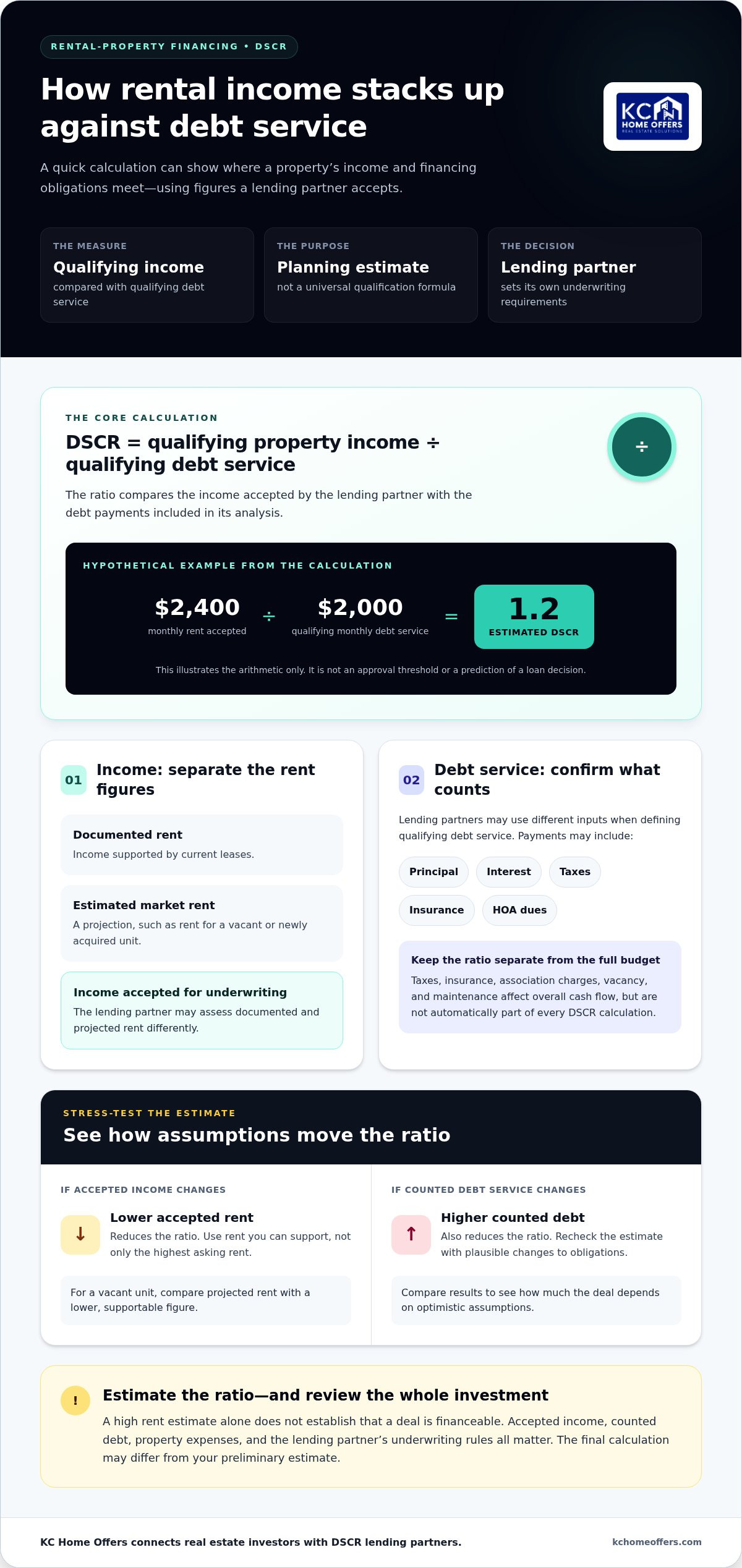
A useful starting point is: DSCR = qualifying property income ÷ qualifying debt service. The result compares income the lender accepts with the debt payments it includes. Treat it as a planning tool, not a universal underwriting formula. Lending partners may use different income and payment inputs, so your estimate may not match their final calculation.
Hypothetical example: Suppose a property has $2,400 in monthly rent accepted for underwriting and $2,000 in qualifying monthly debt service. The estimated DSCR is 1.2 ($2,400 ÷ $2,000). If the lender accepts less rent or counts higher debt service, the ratio falls. This example shows the arithmetic only. It does not indicate an approval threshold or predict a loan decision.
Which rent and debt figures belong in the calculation?
Separate three rent figures before estimating coverage: actual income supported by current leases, an estimate based on market rent, and the amount the lending partner accepts for underwriting. They are not necessarily interchangeable. For example, projected rent for a vacant unit may be assessed differently from rent documented by an active lease.
Debt service can also vary by underwriting method. A lending partner may define which payment components to include, so don’t assume your estimate uses exactly the same inputs. Taxes, insurance, association charges, vacancy, and maintenance still matter to your investment’s cash flow, but they are not automatically part of every DSCR calculation. Keep the lender’s ratio separate from your broader operating budget.
How should investors stress-test a DSCR estimate?
Start with rent you can support, not simply the highest asking rent you find. Recalculate with a more conservative rent assumption and with any plausible change to the debt obligations. Lower accepted income reduces the ratio; higher counted debt service does the same. Comparing the results can show how much the deal depends on optimistic assumptions.
For a vacant unit, for instance, compare the estimated rent with a lower, supportable figure rather than treating the full projection as certain. Then consider whether taxes, insurance, association charges, or likely upkeep leave the investment’s overall cash flow workable, even if those costs are not part of the lender’s ratio. A high rent estimate alone doesn’t establish that a deal is financeable. Accepted income, counted debt, and underwriting rules all matter.
For broader context, read this DSCR investor guide. Investors organizing a property’s rent and debt assumptions can also explore a DSCR financing discussion through KC Home Offers, which connects investors with lending partners. KC Home Offers is not the direct lender, and financing is subject to the lending partner’s approval.
DSCR Loan or Another Rental-Property Financing Path?
The right financing path depends on the property’s stage and your plan for it. A DSCR loan for rental property centers the review on qualifying rental income and debt service, while conventional investment-property financing may weigh borrower finances alongside property details. Bridge financing serves a different purpose, often addressing a project or transition before a property is ready for a longer-term rental hold. These are broad distinctions, not fixed rules. Underwriting depends on the lending partner and transaction.
| Financing path | Property stage | Repayment horizon | Income analysis | Investor objective |
|---|---|---|---|---|
| DSCR financing | Rental property being purchased or refinanced | Considered for an ongoing rental hold | Focuses on qualifying property income relative to qualifying debt service; lender methods vary | Assess financing in relation to the rental’s cash flow |
| Conventional investment-property financing | Investment property purchase or refinance | Based on the loan structure offered | May consider borrower finances as well as property information | Finance an investment property through a conventional lending approach |
| Bridge financing | Property in transition or an earlier project stage | Shorter-term financing approach | May emphasize the asset and transaction; requirements depend on the lending partner | Address a project-stage or timing need before a longer-term plan |
When does DSCR financing fit a rental-property hold?
It may suit an investor evaluating a property intended to generate rental income over time, provided the rent assumptions and expected debt obligations make sense together. A purchase calls for estimating income and costs for a property you’re acquiring. A refinance involves reviewing existing debt and current or supportable rental income in light of the proposed transaction. Neither scenario guarantees that the property or borrower will meet a lending partner’s criteria.
How do the options differ?
DSCR analysis puts property income in the foreground, but it doesn’t automatically remove borrower-level review. A lending partner may still assess borrower information and other aspects of the transaction. Conventional investment-property financing can also consider borrower and property factors, though its documentation and underwriting approach may differ.
Bridge financing addresses a different point in the investment timeline than a stabilized rental hold. If the property needs a short-term, asset-based financing approach, this hard money loan guide explains that financing context. Compare options by the property’s current stage, how long you need financing, what income evidence is available, and your investment objective. The specific lending partner’s requirements also factor into the decision.
What Information Should You Prepare Before a DSCR Loan Review?
A clear deal snapshot helps a lending partner understand the property, its rental income, and the purpose of the financing. Before discussing a DSCR loan for rental property, organize what you know and separate confirmed facts from estimates. The lending partner decides which documents are required, how the information is underwritten, and whether additional items are needed.
Use this sequence to prepare:
- Identify the property. Record its address, occupancy status, and any property records you have available. Note whether the transaction involves a purchase or refinance.
- Summarize rental income. Gather current leases if the property is occupied. For a vacant or not-yet-leased property, record projected rent and the information supporting that estimate. Label projections clearly so they aren’t confused with rent already being collected.
- List property costs separately. Note known taxes, insurance, association obligations, and other expenses. Keeping these distinct from rent helps you discuss both the lender’s coverage calculation and your broader cash-flow assumptions.
- Clarify the financing purpose. State whether you’re seeking financing for a purchase or refinance and summarize the transaction details relevant to that purpose.
- Outline ownership and intended use. Describe the current or planned ownership structure and confirm that the property is intended for investment use. Organize any borrower or entity information already available, without assuming every lending partner requests the same records.
- Share relevant timing and financing details. Note transaction timing and the financing you’re seeking. Treat these as deal facts, not as a promise about a lending partner’s deadlines, terms, or decision.
Separate preparation from underwriting
Your role is to provide an accurate picture of the property and transaction. The lending partner determines which income it will accept, which debt or expense components it will include, what borrower or entity documentation it needs, and whether further information is required. Those details vary by partner and loan scenario, so an investor-prepared summary is a starting point, not a substitute for underwriting.
Organized property information supports a clear review, but it doesn’t guarantee approval. Keep leases, rent assumptions, costs, and transaction details current as the deal develops. KC Home Offers connects investors with lending partners for business-purpose DSCR financing. You can use this DSCR loan discussion to frame your property details and financing needs. KC Home Offers is not the direct lender, and financing is subject to the lending partner’s approval.
How KC Home Offers Connects Investors With DSCR Lending Partners
KC Home Offers connects real estate investors with lending partners for business-purpose DSCR financing. The goal is to bring the rental-property deal and financing questions into focus, then connect the investor with a lending partner for its review. KC Home Offers is not the direct lender. A financing discussion is a starting point, not an approval or commitment to lend.
What to expect when discussing a DSCR rental-property deal
Start with the property, rent assumptions, and investment objective. A purchase discussion may focus on the property you plan to acquire and its expected rental income. A refinance conversation may center on the existing property, current rent, debt obligations, and the purpose of the new financing. Supportable details keep the discussion grounded in the actual transaction.
The lending partner determines which financing options may fit and what documents or additional information it needs. Requirements can differ by partner and deal. The lender reviews the transaction and makes its own underwriting decision. Discussing a DSCR loan for rental property doesn’t guarantee approval, a particular rate or term, or a specific timeline.
Take the next step with your rental-property financing plan
Before discussing financing, bring together your rent assumptions, expected or current debt obligations, and purchase or refinance goal. Distinguish documented lease income from projections, and describe the property’s occupancy and intended investment use. If an estimate is preliminary, label it clearly. This context helps identify the questions that need a lending-partner review.
KC Home Offers connects investors with lending partners for DSCR rental financing, while the partner handles underwriting and determines whether to approve the request. To discuss your rental-property financing plan, discuss rental-property financing with KC Home Offers. Financing is subject to the lending partner’s review and approval, with no guaranteed outcome.
Move Forward With a Clear Rental-Financing Plan
A sound financing review starts with the property’s real income, not an optimistic rent projection. Estimate DSCR using supportable rent and the debt obligations the lending partner may count, then compare that picture with your purchase or refinance objective. A DSCR loan for rental property focuses on property-level cash flow, but underwriting methods and documentation requirements vary, and borrower information may also be reviewed.
Organize the property details, current leases or rent assumptions, known expenses, ownership information, and transaction purpose before discussing financing. That preparation helps frame the deal clearly, but it doesn’t guarantee approval or a specific outcome.
KC Home Offers connects real estate investors with lending partners for business-purpose DSCR rental-property loans. KC Home Offers is not the direct lender, and any financing is subject to the lending partner’s review and approval. Discuss your rental-property financing plan with KC Home Offers and take a practical next step with your deal details in hand.
Frequently Asked Questions
How do you calculate DSCR for a rental property?
Calculate DSCR by dividing qualifying property income by qualifying debt service. For example, if a lender accepts $2,400 in monthly rent and counts $2,000 in monthly debt service, the estimated ratio is 1.2. This is a planning example, not a lender decision. A DSCR loan for rental property may use different income and payment inputs depending on the lending partner’s underwriting approach.
What DSCR do lenders require for a rental property?
Requirements vary by lending partner and transaction. Many lenders commonly look for a DSCR in the range of 1.0x to 1.25x, but that isn’t a universal qualification threshold. A higher ratio may strengthen the property’s coverage profile, while other factors can also affect the review. The lending partner’s definitions of qualifying income and debt service determine how the ratio is calculated.
Can I get a DSCR loan if the property is vacant?
A vacant property may still be considered, but the lending partner determines whether projected rent can be used and what support it requires. Market-rent estimates aren’t automatically treated the same as rent documented by an active lease. Prepare the available rental information and clearly label projections. The partner’s underwriting approach and the transaction details determine how vacancy affects the review.
Do DSCR loans require personal income verification?
DSCR financing primarily evaluates property income relative to debt service, so personal income may not be the central qualification measure. That doesn’t mean personal finances or borrower details will never be reviewed. Requirements depend on the lending partner and transaction, and the partner may request borrower or entity information as part of underwriting. Documentation requirements vary by loan scenario.
Can you use a DSCR loan to refinance a rental property?
Yes, DSCR financing may be considered for a rental-property refinance. The review can involve the property’s current or qualifying rental income, existing debt, and the purpose of the new financing. A refinance differs from a purchase, so organize current leases, property costs, and transaction details. The lending partner determines its underwriting requirements and whether the transaction meets them.
Can an LLC borrow through a DSCR loan?
An LLC may be able to borrow through a DSCR loan, depending on the lending partner’s program and the transaction. The partner determines how it reviews the ownership structure and which entity or borrower documents it requires. Prepare a clear summary of who owns the property and its intended use. LLC applications and documentation can vary by lending partner.
Are DSCR loans only for long-term rental properties?
Not necessarily, but the property’s rental strategy and income documentation matter. Some lending partners may consider different rental models, while others may apply specific rules to the income they accept. Short-term rental projections, for example, shouldn’t be assumed to qualify like established lease income. Describe the intended use and available rental records so the lending partner can assess the scenario under its own guidelines.
Frequently asked
What does a DSCR loan evaluate on a rental property?
DSCR helps show whether qualifying rental income can cover the debt service counted by the lender. Learn more about the general concept in this overview of the Debt Service Coverage Ratio (DSCR). For a property review, distinguish documented rent, such as income supported by current leases, from estimated rent for a vacant or newly acquired unit. A lender may not accept every rent figure at face value. The lending partner’s approach also determines which debt payments and property expenses enter the calculation. Taxes, insurance, and association dues may be treated differently across underwriting programs. Use a preliminary estimate to identify questions and pressure points, not as a prediction of the final calculation.
When might this financing structure suit an investor?
This approach may be worth exploring when you want to compare a property’s income with its expected financing obligations. For a purchase, consider whether projected rent supports the proposed debt under the lender’s standards. For a refinance, review current lease income, existing debt, and the purpose of the new financing. DSCR financing is not an automatic fit in either case. A property with uncertain rent, substantial expenses, or debt obligations that outweigh qualifying income may call for a different financing plan. Match the financing discussion to the property’s stage and cash flow, then account for the lending partner’s underwriting requirements before treating an estimate as a decision. A useful starting point is: DSCR = qualifying property income ÷ qualifying debt service. The result compares income the lender accepts with the debt payments it includes. Treat it as a planning tool, not a universal underwriting formula. Lending partners may use different income and payment inputs, so your estimate may not match their final calculation. Hypothetical example: Suppose a property has $2,400 in monthly rent accepted for underwriting and $2,000 in qualifying monthly debt service. The estimated DSCR is 1.2 ($2,400 ÷ $2,000). If the lender accepts less rent or counts higher debt service, the ratio falls. This example shows the arithmetic only. It does not indicate an approval threshold or predict a loan decision.
Which rent and debt figures belong in the calculation?
Separate three rent figures before estimating coverage: actual income supported by current leases, an estimate based on market rent, and the amount the lending partner accepts for underwriting. They are not necessarily interchangeable. For example, projected rent for a vacant unit may be assessed differently from rent documented by an active lease. Debt service can also vary by underwriting method. A lending partner may define which payment components to include, so don’t assume your estimate uses exactly the same inputs. Taxes, insurance, association charges, vacancy, and maintenance still matter to your investment’s cash flow, but they are not automatically part of every DSCR calculation. Keep the lender’s ratio separate from your broader operating budget.
How should investors stress-test a DSCR estimate?
Start with rent you can support, not simply the highest asking rent you find. Recalculate with a more conservative rent assumption and with any plausible change to the debt obligations. Lower accepted income reduces the ratio; higher counted debt service does the same. Comparing the results can show how much the deal depends on optimistic assumptions. For a vacant unit, for instance, compare the estimated rent with a lower, supportable figure rather than treating the full projection as certain. Then consider whether taxes, insurance, association charges, or likely upkeep leave the investment’s overall cash flow workable, even if those costs are not part of the lender’s ratio. A high rent estimate alone doesn’t establish that a deal is financeable. Accepted income, counted debt, and underwriting rules all matter. For broader context, read this DSCR investor guide. Investors organizing a property’s rent and debt assumptions can also explore a DSCR financing discussion through KC Home Offers, which connects investors with lending partners. KC Home Offers is not the direct lender, and financing is subject to the lending partner’s approval. The right financing path depends on the property’s stage and your plan for it. A DSCR loan for rental property centers the review on qualifying rental income and debt service, while conventional investment-property financing may weigh borrower finances alongside property details. Bridge financing serves a different purpose, often addressing a project or transition before a property is ready for a longer-term rental hold. These are broad distinctions, not fixed rules. Underwriting depends on the lending partner and transaction.
When does DSCR financing fit a rental-property hold?
It may suit an investor evaluating a property intended to generate rental income over time, provided the rent assumptions and expected debt obligations make sense together. A purchase calls for estimating income and costs for a property you’re acquiring. A refinance involves reviewing existing debt and current or supportable rental income in light of the proposed transaction. Neither scenario guarantees that the property or borrower will meet a lending partner’s criteria.
How do the options differ?
DSCR analysis puts property income in the foreground, but it doesn’t automatically remove borrower-level review. A lending partner may still assess borrower information and other aspects of the transaction. Conventional investment-property financing can also consider borrower and property factors, though its documentation and underwriting approach may differ. Bridge financing addresses a different point in the investment timeline than a stabilized rental hold. If the property needs a short-term, asset-based financing approach, this hard money loan guide explains that financing context. Compare options by the property’s current stage, how long you need financing, what income evidence is available, and your investment objective. The specific lending partner’s requirements also factor into the decision. A clear deal snapshot helps a lending partner understand the property, its rental income, and the purpose of the financing. Before discussing a DSCR loan for rental property, organize what you know and separate confirmed facts from estimates. The lending partner decides which documents are required, how the information is underwritten, and whether additional items are needed. Use this sequence to prepare:
How do you calculate DSCR for a rental property?
Calculate DSCR by dividing qualifying property income by qualifying debt service. For example, if a lender accepts $2,400 in monthly rent and counts $2,000 in monthly debt service, the estimated ratio is 1.2. This is a planning example, not a lender decision. A DSCR loan for rental property may use different income and payment inputs depending on the lending partner’s underwriting approach.
What DSCR do lenders require for a rental property?
Requirements vary by lending partner and transaction. Many lenders commonly look for a DSCR in the range of 1.0x to 1.25x, but that isn’t a universal qualification threshold. A higher ratio may strengthen the property’s coverage profile, while other factors can also affect the review. The lending partner’s definitions of qualifying income and debt service determine how the ratio is calculated.
Can I get a DSCR loan if the property is vacant?
A vacant property may still be considered, but the lending partner determines whether projected rent can be used and what support it requires. Market-rent estimates aren’t automatically treated the same as rent documented by an active lease. Prepare the available rental information and clearly label projections. The partner’s underwriting approach and the transaction details determine how vacancy affects the review.
Do DSCR loans require personal income verification?
DSCR financing primarily evaluates property income relative to debt service, so personal income may not be the central qualification measure. That doesn’t mean personal finances or borrower details will never be reviewed. Requirements depend on the lending partner and transaction, and the partner may request borrower or entity information as part of underwriting. Documentation requirements vary by loan scenario.
Can you use a DSCR loan to refinance a rental property?
Yes, DSCR financing may be considered for a rental-property refinance. The review can involve the property’s current or qualifying rental income, existing debt, and the purpose of the new financing. A refinance differs from a purchase, so organize current leases, property costs, and transaction details. The lending partner determines its underwriting requirements and whether the transaction meets them.
Can an LLC borrow through a DSCR loan?
An LLC may be able to borrow through a DSCR loan, depending on the lending partner’s program and the transaction. The partner determines how it reviews the ownership structure and which entity or borrower documents it requires. Prepare a clear summary of who owns the property and its intended use. LLC applications and documentation can vary by lending partner.
Are DSCR loans only for long-term rental properties?
Not necessarily, but the property’s rental strategy and income documentation matter. Some lending partners may consider different rental models, while others may apply specific rules to the income they accept. Short-term rental projections, for example, shouldn’t be assumed to qualify like established lease income. Describe the intended use and available rental records so the lending partner can assess the scenario under its own guidelines.
Need financing on a deal like this?
DSCR, fix & flip and new construction loans, underwritten on the deal rather than your tax returns. Soft credit pull only.
Apply in 5 minutes