Guides › Private lending
Construction Loan Cost Overruns: Causes, Prevention, and Solutions

Prevent construction loan cost overruns before they impact feasibility. Learn causes, cost tracking strategies, and actionable solutions for your project.
A construction project can stay on schedule and still lose financial footing when labor, materials, site work, or permitting cost more than planned. Construction loan cost overruns rarely come from one line item alone. Delays and change orders can compound the pressure, disrupt draw timing, and squeeze cash flow just when decisions matter most.
If you’re concerned that an overrun could weaken your project’s feasibility or financing, a realistic budget and active cost tracking can help you spot drift early. You also need a clear plan for responding when the numbers change.
This guide explains how to identify common causes, build a more resilient budget, and document decisions as costs shift. You’ll learn how to weigh contingency funds, scope adjustments, and funding options while keeping draw assumptions and the project timeline in view. For investors planning a ground-up project, align financing discussions with the current scope, budget, and schedule from the outset.
Key Takeaways
- Set a clear project scope and build a budget that separates construction costs, soft costs, financing assumptions, and selected upgrades.
- Track committed costs, invoices, payments, and remaining work to spot construction loan cost overruns before they threaten project feasibility.
- Keep draw timing in perspective: a draw schedule tracks disbursements, but it doesn’t prevent costs from rising.
- If costs exceed the budget, prepare an updated cost-to-complete estimate before weighing contingency use, scope changes, schedule adjustments, or additional financing.
- Keep estimates, contracts, invoices, change orders, and draw history together so decisions are documented and based on current project information.
Table of Contents
- What Causes Construction Loan Cost Overruns, and Why They Matter
- How to Prevent Construction Loan Cost Overruns Before Work Begins
- How to Catch Construction Budget Drift Through Draws and Change Orders
- What to Do When Construction Costs Exceed the Loan Budget
- A Practical Construction Cost Overrun Action Plan for Investors
What Causes Construction Loan Cost Overruns, and Why They Matter
A construction loan cost overrun happens when a project’s actual or forecast costs exceed the budget approved for the work. The Cost overrun reference describes overruns as costs beyond an original estimate, which can result from inaccurate assumptions or unforeseen conditions. For an investor, the first step is to determine whether the issue is a higher total cost or a different kind of project variance.
A timing issue means spending is happening earlier or later than forecast, but the expected total cost may be unchanged. A scope change adds, removes, or alters work, potentially affecting both budget and schedule. A funding shortfall means available funds won’t cover upcoming obligations. It may result from an overrun, but it can also come from draw timing or a mismatch between payment dates and loan disbursements. The distinction matters because each issue calls for a different response.
Which project costs most often exceed the original estimate?
Costs can rise when material prices change, skilled labor is harder to schedule, or site conditions differ from initial assumptions. Underestimated quantities, such as too little concrete or wiring in the takeoff, can also push costs above the estimate. Design revisions, permit-related changes, and coordination gaps between trades may add work or require rework. Exposure depends on the project’s scope, site, contracts, and timing, so estimates should reflect the specific job rather than broad assumptions.
How can a budget overrun affect construction loan performance?
When spending rises, the approved loan amount may no longer match the funds needed to finish. The resulting gap between available financing and cost to complete may require you to bring in additional capital, reduce scope, or consider other options. The loan amount doesn’t automatically increase to cover higher costs.
Cash flow can tighten before the final budget picture is clear. If invoices remain unpaid or work slows while you address funding, project milestones may shift. A delayed milestone can complicate draw planning because construction funds are commonly released in stages under the loan’s process. Draws, changes, and extensions are governed by the applicable loan terms. Keep current cost forecasts aligned with completed work, invoices due, and the schedule ahead. Early visibility gives you more time to make deliberate decisions and assess the effect on projected returns.
How to Prevent Construction Loan Cost Overruns Before Work Begins
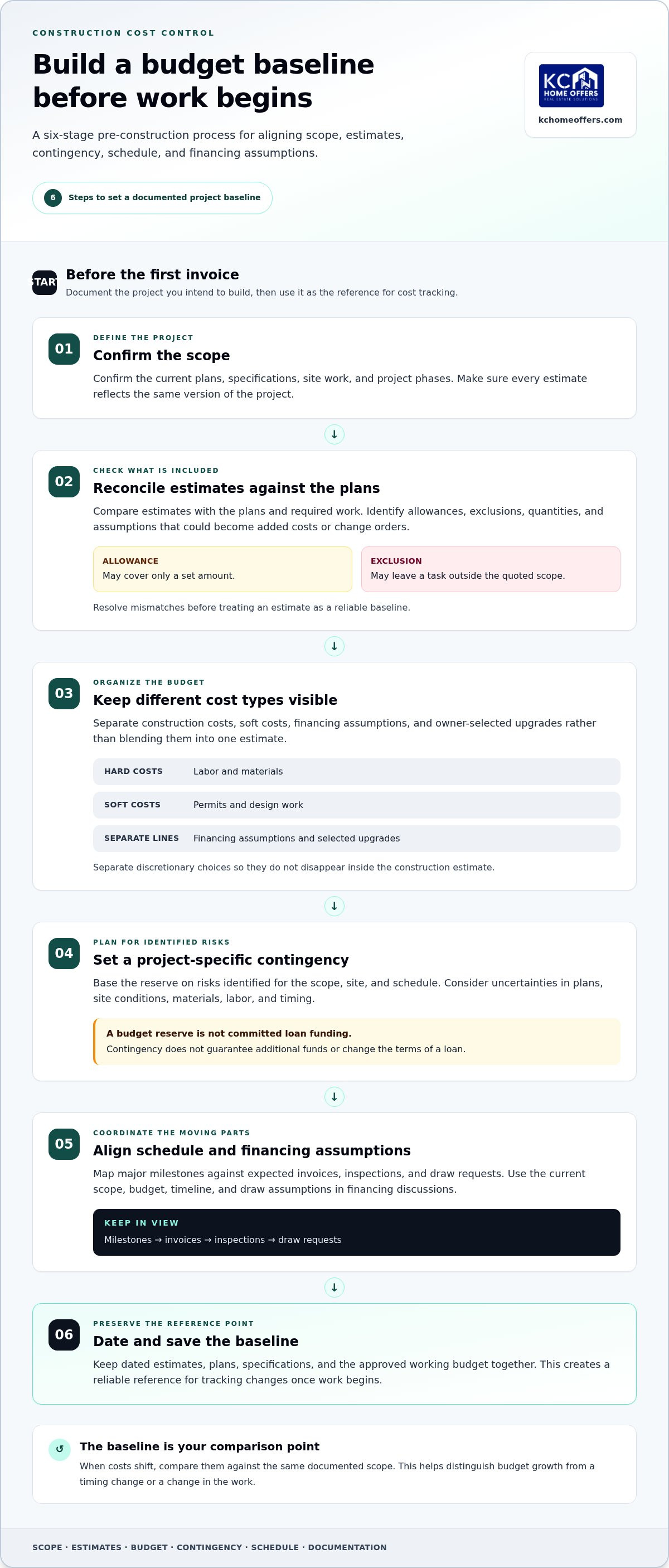
Strong cost control starts before the first invoice. Build a documented baseline around the project you intend to construct, then align the schedule and financing assumptions with that plan. Use this pre-construction checklist to expose gaps early:
- 1. Define the scope. Confirm the current plans, specifications, site work, and project phases. Make sure every estimate reflects the same version of the project.
- 2. Reconcile estimates. Compare estimates against the plans and required work. Identify allowances, exclusions, quantities, and assumptions that could turn into added costs or change orders.
- 3. Organize the budget. Separate hard costs, such as labor and materials, from soft costs, such as permits and design work. List financing assumptions and owner-selected upgrades separately so discretionary choices don’t disappear inside the construction estimate.
- 4. Set a project-specific contingency. Base the reserve on risks identified for the scope, site, and schedule. Treat it as a planning reserve, not automatic lender funding.
- 5. Coordinate schedule and financing. Map major milestones against expected invoices, inspections, and draw requests. Use current scope, budget, timeline, and draw assumptions in financing discussions.
- 6. Date and preserve the baseline. Keep dated estimates, plans, specifications, and the approved working budget. This gives you a reliable reference for tracking changes once work begins.
Build a budget that reflects the actual project scope
A low estimate isn’t useful if it leaves out necessary work. Check whether site preparation, utility connections, finish selections, and each construction phase are included. Read the assumptions closely: an allowance may cover only a set amount, while an exclusion may leave a task outside the quoted scope. Record these details and resolve mismatches before treating an estimate as a reliable baseline. Then you can compare later costs against the same scope and distinguish budget growth from ordinary changes in timing.
Plan contingency, schedule, and financing assumptions together
Risk varies by project, so there’s no single contingency amount that fits every build. Consider uncertainties in the plans, site, materials, labor, and schedule, then document how you would evaluate the reserve if a cost changes. A project contingency is a reserve in your budget, not committed loan proceeds. It doesn’t guarantee additional funds or change the terms of a loan.
Before work starts, understand how planned milestones connect to invoices, inspections, and draw requests. For a closer look at financing considerations for ground-up projects, review the new construction financing guide. Financing is one part of the plan; a current scope, realistic budget, and coordinated cash-flow assumptions remain essential.
How to Catch Construction Budget Drift Through Draws and Change Orders
A draw schedule shows when loan funds are requested and disbursed. It doesn’t control project costs or guarantee that the remaining budget will cover upcoming work. To catch construction loan cost overruns early, compare the original budget with current commitments, invoices, payments, and a realistic forecast of unfinished work.
Use a consistent budget-to-actual tracker. The categories below are related, but they aren’t interchangeable totals:
| Category | What to record |
|---|---|
| Budget | Original approved amount for each cost item |
| Committed | Contracted costs and approved change orders |
| Paid | Invoices paid, matched to draw and payment records |
| Forecast | Expected total cost, including remaining work and pending changes |
| Variance | Forecast compared with budget, with the reason for the difference |
What should a monthly budget-to-actual review include?
Reconcile invoices and draw records against the latest cost forecast. Check that paid amounts match invoices and disbursements, then add contracted costs not yet invoiced and pending changes that may not appear in payments. For each variance, record its cause, the next action, and whether the schedule or cash flow needs attention.
Past spending shows what’s behind you; the forecast-to-complete shows whether the funds still cover the work ahead. A project can appear on budget based on payments to date even when substantial commitments or unfinished work remain. For a closer look at disbursement stages, see the construction loan draw schedule guide.
How do change orders affect loan draws and completion dates?
A change order can add cost, alter work sequencing, require new documentation, or push back completion. Track proposed changes separately from authorized ones. Record the scope, estimated or final cost, approval status, and schedule impact for each. Don’t treat an unpriced proposal as a confirmed commitment, but include its potential cost in the forecast when assessing exposure.
Before incorporating a change into the working budget, document the decision and update the cost-to-complete estimate. A change may also affect draw planning, depending on the loan’s documentation and approval process. Keep the current scope, budget, timeline, and draw assumptions aligned as the project evolves. For investors assessing ground-up project financing, explore new construction financing as part of a broader cost-control plan.
What to Do When Construction Costs Exceed the Loan Budget
Don’t make a funding decision based on the original estimate alone. Prepare a revised cost-to-complete forecast using current invoices, unpaid commitments, project input, and a line-by-line estimate of the work still required. Compare that figure with available loan proceeds and any contingency you can actually access. This establishes the size and timing of the shortfall and gives you a sound basis for deciding what to change.
Then compare the available responses separately. Each can affect project value, cash flow, and completion differently:
- Use contingency: Apply the reserve to eligible project needs if it’s available and appropriate. A contingency is a budget provision, not automatic loan funding.
- Reduce or defer scope: Remove or postpone selected work, weighing the effect on market appeal, functionality, and expected returns.
- Adjust the schedule: Re-sequence work or revise timing where practical. Delays may ease immediate cash pressure, but they can also affect completion and carrying costs.
- Seek additional financing: Consider whether more capital could address the gap, recognizing that added debt can increase financial exposure and isn’t guaranteed.
Which project adjustments can close a shortfall?
Protect essential work first. Prioritize safety, code-related items, weather protection, and tasks needed to complete and secure the property. Then review upgrades that could be deferred without undermining the project’s core function or value. For each possible adjustment, record the cost reduction, schedule effect, and expected project impact. Document scope changes in writing and obtain any required approvals before treating them as final or updating the working budget.
Construction loan cost overruns can’t be solved by cutting indiscriminately. Removing a finish upgrade may have a different effect from postponing a system essential to occupancy or operation. Make the trade-off explicit, then update the forecast and completion plan.
When should an investor discuss financing changes?
Address a likely funding gap as soon as the updated forecast identifies one, rather than waiting until an invoice is due or work stops. Prepare the revised budget, remaining-work estimate, current schedule, supporting invoices, and a concise explanation of what changed and which adjustments you’ve considered. Review the loan agreement and its draw or change-order process. Additional funding, amended terms, or an extension require review; none is automatic, and processes vary by agreement.
Once you’ve clarified the project’s revised needs, explore construction financing options as part of a broader plan to keep scope, cash flow, and completion expectations aligned.
A Practical Construction Cost Overrun Action Plan for Investors
Managing construction loan cost overruns takes a repeatable process, not a one-time budget check. Set a clear baseline before work begins, review actual and forecast costs regularly, and document decisions as soon as a variance appears. Keep estimates, contracts, invoices, change orders, and draw history together so every updated forecast has a reliable paper trail.
A repeatable checklist for keeping project costs visible
- Before work: Finalize the scope and plans, record budget assumptions, identify project-specific contingency, and map expected milestones to draw expectations.
- During work: At set intervals, update committed costs, invoices, payments, the construction schedule, and the forecast-to-complete. Include approved changes and flag proposals that could affect the budget.
- When a variance appears: Record its cause and likely effect, compare practical responses, and document the selected next steps, approvals, and revised assumptions.
Consistency matters. A recurring review can reveal a mismatch between remaining work and available funds while there’s still time to make an informed decision. Keep dated versions of the budget and forecast to see what changed, when it changed, and how the project plan responded.
How to align financing with the construction plan
Financing should fit the project’s scope, timeline, milestones, and capital strategy. Draw timing affects when loan funds may become available, while payment dates and work sequencing shape when cash is needed. Compare these moving parts before construction starts, then revisit the assumptions if the schedule, scope, or cost-to-complete changes. A loan is one part of the project plan, not a replacement for cost controls or a reserve for every unexpected expense.
KC Home Offers LLC provides new construction loans for investors planning ground-up projects. This differs from a fix-and-flip loan, which supports renovation-oriented investment projects. In either case, financing discussions are most useful when they reflect current project information, including scope, budget, timeline, and draw assumptions. Approval and terms depend on the financing process and project, so don’t build a cost-control plan around assumed funding.
With an organized budget and current project records, you can make financing decisions from a clearer picture of the work ahead and the capital required. Explore construction financing with KC Home Offers LLC as you plan funding for a ground-up investment project.
Keep Your Project Feasible From Budget to Completion
Construction loan cost overruns are easier to manage when you treat the budget as a working tool, not a one-time estimate. Start with a clear scope and documented baseline, then compare commitments, invoices, draw activity, and the forecast for remaining work. When costs shift, establish the size of the gap before choosing between contingency, scope changes, schedule adjustments, or additional financing.
Document decisions and connect financing assumptions to the project’s current scope, milestones, and capital needs. That discipline helps you respond early and make choices with project feasibility and returns in view.
KC Home Offers LLC provides new construction loans for real estate investors, with transparent communication and investor-focused financing. If you’re planning a ground-up project, explore construction financing options with KC Home Offers LLC as part of your project plan. A realistic budget and a clear process for handling changes can help you move forward with greater control and confidence.
Frequently Asked Questions
What causes cost overruns in construction projects?
Cost overruns happen when actual or forecast project costs exceed the approved budget. Common causes include material price changes, limited labor availability, unexpected site conditions, and underestimated quantities. Design revisions, permit-related changes, or coordination gaps between trades can also add work, cost, or time. Risks vary by project, so base your estimate on its specific scope, site, contracts, and schedule rather than relying on a generic allowance.
How much contingency should I include in a construction loan budget?
Set contingency according to your project’s risks rather than applying one percentage to every build. Consider uncertainties in the plans, site conditions, materials, labor, and timeline, then document how you’ll use the reserve. Keep it distinct from approved loan proceeds: a budgeted contingency is a planning reserve, not guaranteed lender funding. Review the applicable loan terms to understand how contingencies and budget changes are handled.
Can a construction loan cover cost overruns?
Not automatically. Construction loan funds are generally tied to an approved budget and loan agreement, so an overrun doesn’t by itself increase the amount available. Whether a lender can approve a budget change or additional funding depends on the loan and its review process. Before relying on the loan to cover higher costs, prepare an updated cost-to-complete estimate and understand how the agreement handles changes, draws, and additional capital.
What happens if construction costs exceed the approved loan amount?
You may need to cover the gap with available capital, reduce or defer scope, adjust the schedule, or pursue additional financing. Start by comparing remaining loan proceeds with a current estimate of the cost to finish, including unpaid commitments and upcoming work. Unpaid invoices or delayed work can create cash-flow and schedule pressure. Additional funding, amended terms, or an extension requires review and isn’t automatic.
How do change orders affect construction loan draws?
A change order can add cost, affect work sequencing, and shift the completion timeline, changing when funds are needed. Keep proposals separate from priced and authorized changes, and record each change’s scope, cost impact, approval status, and schedule effect. A draw schedule tracks disbursements; it doesn’t prevent budget increases. Documentation and approval steps vary by loan agreement, so account for the applicable process in your project planning.
Can I change the scope of a project after construction loan approval?
Scope changes may be possible, but their impact depends on the loan agreement and applicable approval process. A change can affect the budget, draw assumptions, work sequence, or completion date. Before treating it as final, document what’s changing, the expected cost and schedule impact, and the revised project plan. Obtain any required approvals before proceeding, then update your budget and cost-to-complete forecast to reflect the decision.
How can I track construction costs against my loan budget?
Use a project cost tracker that compares the original budget with committed costs, invoices, paid amounts, forecast costs, and variance by category. Reconcile invoices and draw records regularly, and include approved changes plus pending items that could affect remaining work. Review the forecast-to-complete, not just spending to date, to see whether available funds still match the work ahead. Keep estimates, contracts, invoices, change orders, and draw history together.
Frequently asked
Which project costs most often exceed the original estimate?
Costs can rise when material prices change, skilled labor is harder to schedule, or site conditions differ from initial assumptions. Underestimated quantities, such as too little concrete or wiring in the takeoff, can also push costs above the estimate. Design revisions, permit-related changes, and coordination gaps between trades may add work or require rework. Exposure depends on the project’s scope, site, contracts, and timing, so estimates should reflect the specific job rather than broad assumptions.
How can a budget overrun affect construction loan performance?
When spending rises, the approved loan amount may no longer match the funds needed to finish. The resulting gap between available financing and cost to complete may require you to bring in additional capital, reduce scope, or consider other options. The loan amount doesn’t automatically increase to cover higher costs. Cash flow can tighten before the final budget picture is clear. If invoices remain unpaid or work slows while you address funding, project milestones may shift. A delayed milestone can complicate draw planning because construction funds are commonly released in stages under the loan’s process. Draws, changes, and extensions are governed by the applicable loan terms. Keep current cost forecasts aligned with completed work, invoices due, and the schedule ahead. Early visibility gives you more time to make deliberate decisions and assess the effect on projected returns. Strong cost control starts before the first invoice. Build a documented baseline around the project you intend to construct, then align the schedule and financing assumptions with that plan. Use this pre-construction checklist to expose gaps early:
What should a monthly budget-to-actual review include?
Reconcile invoices and draw records against the latest cost forecast. Check that paid amounts match invoices and disbursements, then add contracted costs not yet invoiced and pending changes that may not appear in payments. For each variance, record its cause, the next action, and whether the schedule or cash flow needs attention. Past spending shows what’s behind you; the forecast-to-complete shows whether the funds still cover the work ahead. A project can appear on budget based on payments to date even when substantial commitments or unfinished work remain. For a closer look at disbursement stages, see the construction loan draw schedule guide.
How do change orders affect loan draws and completion dates?
A change order can add cost, alter work sequencing, require new documentation, or push back completion. Track proposed changes separately from authorized ones. Record the scope, estimated or final cost, approval status, and schedule impact for each. Don’t treat an unpriced proposal as a confirmed commitment, but include its potential cost in the forecast when assessing exposure. Before incorporating a change into the working budget, document the decision and update the cost-to-complete estimate. A change may also affect draw planning, depending on the loan’s documentation and approval process. Keep the current scope, budget, timeline, and draw assumptions aligned as the project evolves. For investors assessing ground-up project financing, explore new construction financing as part of a broader cost-control plan. Don’t make a funding decision based on the original estimate alone. Prepare a revised cost-to-complete forecast using current invoices, unpaid commitments, project input, and a line-by-line estimate of the work still required. Compare that figure with available loan proceeds and any contingency you can actually access. This establishes the size and timing of the shortfall and gives you a sound basis for deciding what to change. Then compare the available responses separately. Each can affect project value, cash flow, and completion differently:
Which project adjustments can close a shortfall?
Protect essential work first. Prioritize safety, code-related items, weather protection, and tasks needed to complete and secure the property. Then review upgrades that could be deferred without undermining the project’s core function or value. For each possible adjustment, record the cost reduction, schedule effect, and expected project impact. Document scope changes in writing and obtain any required approvals before treating them as final or updating the working budget. Construction loan cost overruns can’t be solved by cutting indiscriminately. Removing a finish upgrade may have a different effect from postponing a system essential to occupancy or operation. Make the trade-off explicit, then update the forecast and completion plan.
When should an investor discuss financing changes?
Address a likely funding gap as soon as the updated forecast identifies one, rather than waiting until an invoice is due or work stops. Prepare the revised budget, remaining-work estimate, current schedule, supporting invoices, and a concise explanation of what changed and which adjustments you’ve considered. Review the loan agreement and its draw or change-order process. Additional funding, amended terms, or an extension require review; none is automatic, and processes vary by agreement. Once you’ve clarified the project’s revised needs, explore construction financing options as part of a broader plan to keep scope, cash flow, and completion expectations aligned. Managing construction loan cost overruns takes a repeatable process, not a one-time budget check. Set a clear baseline before work begins, review actual and forecast costs regularly, and document decisions as soon as a variance appears. Keep estimates, contracts, invoices, change orders, and draw history together so every updated forecast has a reliable paper trail.
What causes cost overruns in construction projects?
Cost overruns happen when actual or forecast project costs exceed the approved budget. Common causes include material price changes, limited labor availability, unexpected site conditions, and underestimated quantities. Design revisions, permit-related changes, or coordination gaps between trades can also add work, cost, or time. Risks vary by project, so base your estimate on its specific scope, site, contracts, and schedule rather than relying on a generic allowance.
How much contingency should I include in a construction loan budget?
Set contingency according to your project’s risks rather than applying one percentage to every build. Consider uncertainties in the plans, site conditions, materials, labor, and timeline, then document how you’ll use the reserve. Keep it distinct from approved loan proceeds: a budgeted contingency is a planning reserve, not guaranteed lender funding. Review the applicable loan terms to understand how contingencies and budget changes are handled.
Can a construction loan cover cost overruns?
Not automatically. Construction loan funds are generally tied to an approved budget and loan agreement, so an overrun doesn’t by itself increase the amount available. Whether a lender can approve a budget change or additional funding depends on the loan and its review process. Before relying on the loan to cover higher costs, prepare an updated cost-to-complete estimate and understand how the agreement handles changes, draws, and additional capital.
What happens if construction costs exceed the approved loan amount?
You may need to cover the gap with available capital, reduce or defer scope, adjust the schedule, or pursue additional financing. Start by comparing remaining loan proceeds with a current estimate of the cost to finish, including unpaid commitments and upcoming work. Unpaid invoices or delayed work can create cash-flow and schedule pressure. Additional funding, amended terms, or an extension requires review and isn’t automatic.
How do change orders affect construction loan draws?
A change order can add cost, affect work sequencing, and shift the completion timeline, changing when funds are needed. Keep proposals separate from priced and authorized changes, and record each change’s scope, cost impact, approval status, and schedule effect. A draw schedule tracks disbursements; it doesn’t prevent budget increases. Documentation and approval steps vary by loan agreement, so account for the applicable process in your project planning.
Can I change the scope of a project after construction loan approval?
Scope changes may be possible, but their impact depends on the loan agreement and applicable approval process. A change can affect the budget, draw assumptions, work sequence, or completion date. Before treating it as final, document what’s changing, the expected cost and schedule impact, and the revised project plan. Obtain any required approvals before proceeding, then update your budget and cost-to-complete forecast to reflect the decision.
How can I track construction costs against my loan budget?
Use a project cost tracker that compares the original budget with committed costs, invoices, paid amounts, forecast costs, and variance by category. Reconcile invoices and draw records regularly, and include approved changes plus pending items that could affect remaining work. Review the forecast-to-complete, not just spending to date, to see whether available funds still match the work ahead. Keep estimates, contracts, invoices, change orders, and draw history together.
Need financing on a deal like this?
DSCR, fix & flip and new construction loans, underwritten on the deal rather than your tax returns. Soft credit pull only.
Apply in 5 minutes